Electricity & Magnetism

    Static, Currents, Circuits
Magnetic Fields & Electro Magnets
Motors & Generators by_ JESLIN
              JOHN
Atoms…
 Have  neutrons, protons, and
  electrons.
 Protons are positively charged
 Electrons are negatively charged
Electrons…
 Are  located on the outer edges of
  atoms…they can be moved.
 A concentration of electrons in an
  atom creates a net negative
  charge.
 If electrons are stripped away, the
  atom becomes positively charged.
The world is filled with electrical
           charges:
                          +
       + +       -
-        -     + -   +
     +
     -     +       + -
               -
            +      +
       -     -         -
What is this electrical potential
              called?
 Static   Electricity


             -
       -  -
     -   -               +   ++
       - -                   ++
Static Electricity
 The  build up of an electric charge
  on the surface of an object.
 The charge builds up but does not
  flow.
 Static electricity is potential
  energy. It does not move. It is
  stored.
Static Discharge…
 Occurs  when there is a loss of
 static electricity due to three
 possible things:
   Friction - rubbing
   Conduction – direct contact
   Induction – through an electrical
    field (not direct contact)
Electricity that moves…
 Current: The flow of electrons
  from one place to another.
 Measured in amperes (amps)
 Kinetic energy
How can we control currents?
 With circuits.
 Circuit: is a path for the flow of
  electrons. We use wires.
There are 2 types of currents:
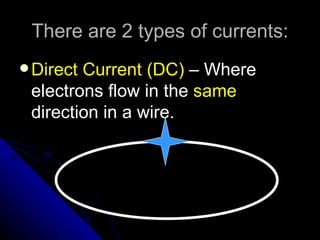
 DirectCurrent (DC) – Where
 electrons flow in the same
 direction in a wire.
There are 2 types of currents:
 AlternatingCurrent (AC) –
 electrons flow in different
 directions in a wire
There are 2 types of circuits:
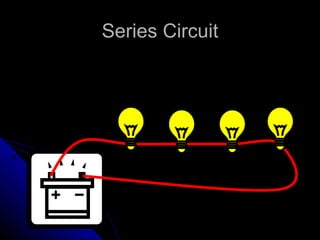
 Series Circuit: the components
 are lined up along one path. If
 the circuit is broken, all
 components turn off.
Series Circuit
There are 2 types of circuits:
 Parallel Circuit – there are several
 branching paths to the
 components. If the circuit is
 broken at any one branch, only
 the components on that branch
 will turn off.
Parallel Circuit
Conductors vs. Insulators
 Conductors – material through
 which electric current flows easily.

 Insulators
           – materials through
 which electric current cannot
 move.
Examples
 Conductors:    Insulators:
  Metal           Styrofoam
  Water           Rubber
                   Plastic
                   Paper
What is Resistance?
 The  opposition to the flow of an
  electric current, producing heat.
 The greater the resistance, the
  less current gets through.
 Good conductors have low
  resistance.
 Measured in ohms.
What Influences Resistance?
 Material of wire – aluminum and
  copper have low resistance
 Thickness – the thicker the wire the
  lower the resistance
 Length – shorter wire has lower
  resistance
 Temperature – lower temperature has
  lower resistance
What is Voltage?
 The  measure of energy given to
  the charge flowing in a circuit.
 The greater the voltage, the
  greater the force or “pressure”
  that drives the charge through the
  circuit.
Difference b/t Volts and Amps
 Example   – you could say that…
  Amps  measure how much water
   comes out of a hose.
  Volts measure how hard the water
   comes out of a hose.
Ohm’s Law


 Resistance   = Voltage / Current

     Ohms     = Volts / Amps
What is an electromagnet?
 Electromagnet – a magnet made
 from a current bearing coil of wire
 wrapped around an iron or steel
 core.
What is a generator?
 Generator   – a machine that
  changes mechanical energy to
  electrical energy
 Usually use moving magnets to
  create currents in coils of wire.
What is a motor?
 Motor – a device that changes
 electrical energy to mechanical
 energy that can do work.
That’s It !!!!

Electricity 2

  • 1.
    Electricity & Magnetism Static, Currents, Circuits Magnetic Fields & Electro Magnets Motors & Generators by_ JESLIN JOHN
  • 2.
    Atoms…  Have neutrons, protons, and electrons.  Protons are positively charged  Electrons are negatively charged
  • 3.
    Electrons…  Are located on the outer edges of atoms…they can be moved.  A concentration of electrons in an atom creates a net negative charge.  If electrons are stripped away, the atom becomes positively charged.
  • 4.
    The world isfilled with electrical charges: + + + - - - + - + + - + + - - + + - - -
  • 5.
    What is thiselectrical potential called?  Static Electricity - - - - - + ++ - - ++
  • 6.
    Static Electricity  The build up of an electric charge on the surface of an object.  The charge builds up but does not flow.  Static electricity is potential energy. It does not move. It is stored.
  • 7.
    Static Discharge…  Occurs when there is a loss of static electricity due to three possible things: Friction - rubbing Conduction – direct contact Induction – through an electrical field (not direct contact)
  • 8.
    Electricity that moves… Current: The flow of electrons from one place to another.  Measured in amperes (amps)  Kinetic energy
  • 9.
    How can wecontrol currents?  With circuits.  Circuit: is a path for the flow of electrons. We use wires.
  • 10.
    There are 2types of currents:  DirectCurrent (DC) – Where electrons flow in the same direction in a wire.
  • 11.
    There are 2types of currents:  AlternatingCurrent (AC) – electrons flow in different directions in a wire
  • 12.
    There are 2types of circuits:  Series Circuit: the components are lined up along one path. If the circuit is broken, all components turn off.
  • 13.
  • 14.
    There are 2types of circuits:  Parallel Circuit – there are several branching paths to the components. If the circuit is broken at any one branch, only the components on that branch will turn off.
  • 15.
  • 16.
    Conductors vs. Insulators Conductors – material through which electric current flows easily.  Insulators – materials through which electric current cannot move.
  • 17.
    Examples  Conductors:  Insulators:  Metal  Styrofoam  Water  Rubber  Plastic  Paper
  • 18.
    What is Resistance? The opposition to the flow of an electric current, producing heat.  The greater the resistance, the less current gets through.  Good conductors have low resistance.  Measured in ohms.
  • 19.
    What Influences Resistance? Material of wire – aluminum and copper have low resistance  Thickness – the thicker the wire the lower the resistance  Length – shorter wire has lower resistance  Temperature – lower temperature has lower resistance
  • 20.
    What is Voltage? The measure of energy given to the charge flowing in a circuit.  The greater the voltage, the greater the force or “pressure” that drives the charge through the circuit.
  • 21.
    Difference b/t Voltsand Amps  Example – you could say that…  Amps measure how much water comes out of a hose.  Volts measure how hard the water comes out of a hose.
  • 22.
    Ohm’s Law  Resistance = Voltage / Current  Ohms = Volts / Amps
  • 23.
    What is anelectromagnet?  Electromagnet – a magnet made from a current bearing coil of wire wrapped around an iron or steel core.
  • 24.
    What is agenerator?  Generator – a machine that changes mechanical energy to electrical energy  Usually use moving magnets to create currents in coils of wire.
  • 25.
    What is amotor?  Motor – a device that changes electrical energy to mechanical energy that can do work.
  • 26.