
EEP316 Laboratory
Differential Phase shift Keying- carrier
acquisition and Bit Error Rate
20/3/13
Indra Bhushan 2010EE50548
Umang Gupta 2010EE50564
Vivek Mangal 2010EE50566
DPSK- carrier acquisition and BER
Aim:
1. Reception and demodulation of DPSK signal.
2. Carrier and bit clock recovery
3. BER measurement
Theory:
PSK is a method of digital modulation. There are various ways in which phase shift
keying can be done. One is CPSK, i.e. coherent phase shift keying (Normal M-PSK) in
which one the data is encoded in phase changes. Hence while demodulation one needs
the original reference signal. However, a better way would be to encode the data in
change of phase rather than encoding in phases. This is done by differential phase shift
keying (DPSK). However, the BER in DPSK is double of CPSK, for which Energy of signal
has to be increased by small amount. The main advantage of DPSK is that it could be
demodulated using local carrier wave and hence save on transmission/synchronisation
of reference wave.
Observations:
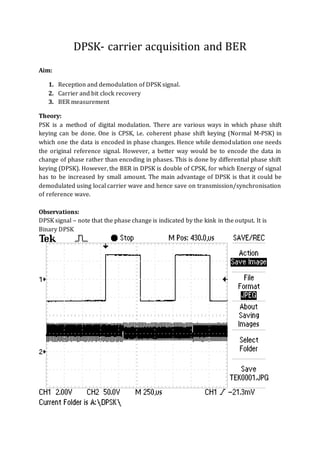
DPSK signal – note that the phase change is indicated by the kink in the output. It is
Binary DPSK
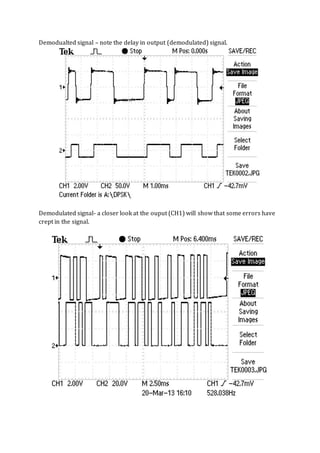
Demodualted signal – note the delay in output (demodulated) signal.
Demodulated signal- a closer look at the ouput (CH1) will show that some errors have
crept in the signal.
The amount of error is more in DPSK. This could be corrected by increasing SNR of the
input. A plot of SNR vs BER can be drawn for DPSK.
BER measurements:
The BER measurements were to be done by synchronising the output with the input (as
there is some delay in output), taking XOR and counting the ones.
However, synchronisation could not be achieved and hence BER could not be
calculated.`

EEL316: Dpsk - BER & carrier acquisition

  • 1.
    EEP316 Laboratory Differential Phaseshift Keying- carrier acquisition and Bit Error Rate 20/3/13 Indra Bhushan 2010EE50548 Umang Gupta 2010EE50564 Vivek Mangal 2010EE50566
  • 2.
    DPSK- carrier acquisitionand BER Aim: 1. Reception and demodulation of DPSK signal. 2. Carrier and bit clock recovery 3. BER measurement Theory: PSK is a method of digital modulation. There are various ways in which phase shift keying can be done. One is CPSK, i.e. coherent phase shift keying (Normal M-PSK) in which one the data is encoded in phase changes. Hence while demodulation one needs the original reference signal. However, a better way would be to encode the data in change of phase rather than encoding in phases. This is done by differential phase shift keying (DPSK). However, the BER in DPSK is double of CPSK, for which Energy of signal has to be increased by small amount. The main advantage of DPSK is that it could be demodulated using local carrier wave and hence save on transmission/synchronisation of reference wave. Observations: DPSK signal – note that the phase change is indicated by the kink in the output. It is Binary DPSK
  • 3.
    Demodualted signal –note the delay in output (demodulated) signal. Demodulated signal- a closer look at the ouput (CH1) will show that some errors have crept in the signal.
  • 4.
    The amount oferror is more in DPSK. This could be corrected by increasing SNR of the input. A plot of SNR vs BER can be drawn for DPSK. BER measurements: The BER measurements were to be done by synchronising the output with the input (as there is some delay in output), taking XOR and counting the ones. However, synchronisation could not be achieved and hence BER could not be calculated.`