AMPLITUDE SHIFT KEYING
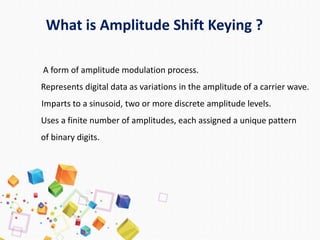
A form of amplitude modulation process.
Represents digital data as variations in the amplitude of a carrier wave.
Imparts to a sinusoid, two or more discrete amplitude levels.
Uses a finite number of amplitudes, each assigned a unique pattern
of binary digits.
What is Amplitude Shift Keying ?
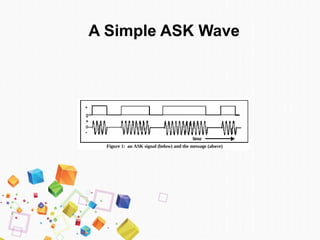
A Simple ASK Wave
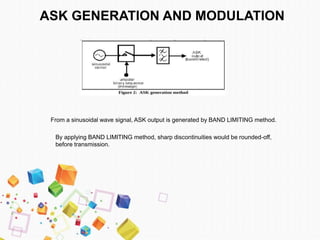
ASK GENERATION AND MODULATION
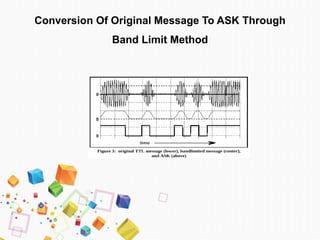
From a sinusoidal wave signal, ASK output is generated by BAND LIMITING method.
By applying BAND LIMITING method, sharp discontinuities would be rounded-off,
before transmission.
Conversion Of Original Message To ASK Through
Band Limit Method
Amplitude Shift Keying is of Two types-
1. Binary ASK
2. Multilevel ASK
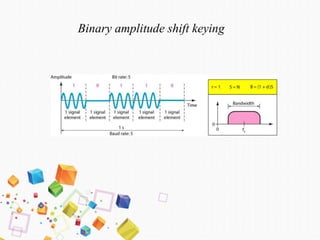
Binary ASK is implemented using only 2 levels.
It is known as ON-OFF keying.
Multilevel ASK is implemented with more than two level.
Different Amplitude used are – 4,8,16…
Different Bits used are- 2,3,4…
TYPES OF AMPLITUDE SHIFT KEYING
Binary amplitude shift keying
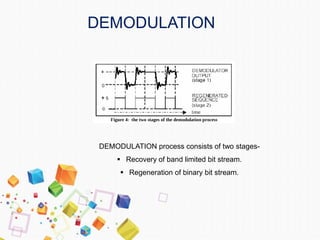
DEMODULATION process consists of two stages-
 Recovery of band limited bit stream.
 Regeneration of binary bit stream.
DEMODULATION
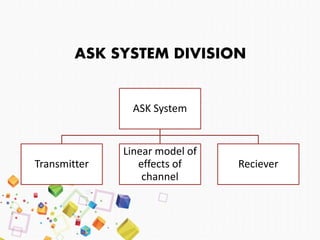
ASK SYSTEM DIVISION
ASK System
Transmitter
Linear model of
effects of
channel
Reciever
IN OUR DAILY USE
 Commonly used to transmit digital data
over optical fibre.
 Transmit Morse code.
For example, in LED transmitter.
Frequency Division
Multiplexing
FDM
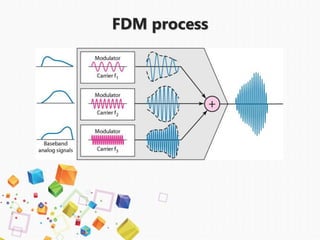
 Sharing is done by assigning each user a specific
frequency (Carrier Frequency)
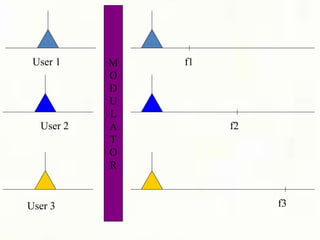
 Modulation equipment is used to move each
signal to the required frequency band.
 Multiplexing equipment is needed to combine
the modulated signal
FDM
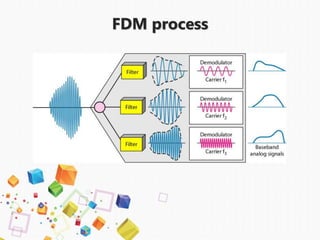
 Separation of spectrum into smaller frequency
bands
 Channel gets band of the spectrum for the whole
time
User 1
User 2
User 3
M
O
D
U
L
A
T
O
R
f1
f2
f3
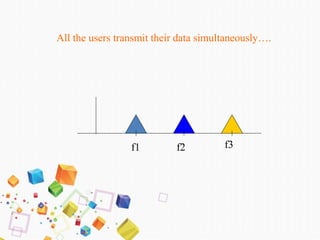
All the users transmit their data simultaneously….
f1 f2 f3
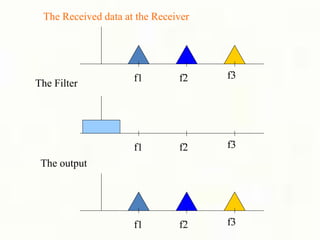
The Received data at the Receiver
f1 f2 f3
f1 f2 f3
The Filter
The output
f1 f2 f3
FDM process
FDM process
Advantages
no dynamic coordination
needed
works also for analog signals
Twisted Pair Cable
Department of CE/IT
Introduction
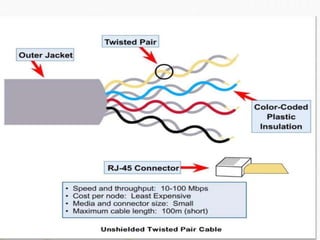
• Twisted pair is the simples, oldest and low priced cable
medium.
• It is made up of two insulated copper wires, typically, twisted
around each other in a continuous spiral.
• The purpose of twisting the wires is to reduce electrical
interference (or noise) from similar pairs close by.
Unshielded Twisted Pair (UTP) Cable
– Shielded Twisted Pair (STP) Cable
Department of CE/IT
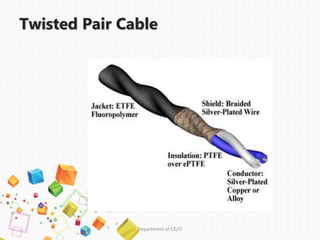
Twisted Pair Cable
Department of CE/IT
Unshielded Twisted Pair (UTP) Cable
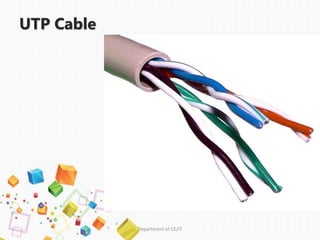
• Unshielded Twisted Pair (UTP) is the most common type of twisted
pair cable used in telecommunication networks.
• The reason for placing twist in the pair of wires is to minimize the
vulnerability of the twisted pair cable to external electrical noise.
• Its frequency range is suitable for data transmission as well as voice
transmission (100 Hz-5 MHz).
•
Department of CE/IT
Department of CE/IT
UTP Cable
Department of CE/IT
Advantages
• The advantages of UTP are its low cost,
• It is easy to installation procedure.
• It is basically used in LAN implementations.
Department of CE/IT
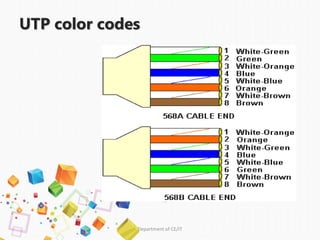
UTP color codes
Department of CE/IT
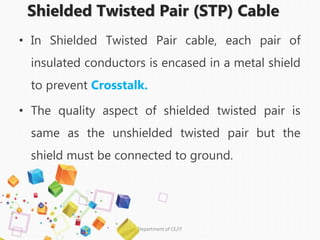
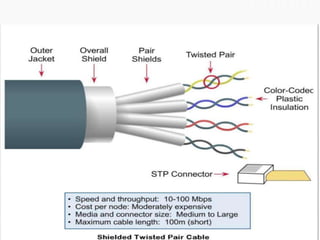
Shielded Twisted Pair (STP) Cable
• In Shielded Twisted Pair cable, each pair of
insulated conductors is encased in a metal shield
to prevent Crosstalk.
• The quality aspect of shielded twisted pair is
same as the unshielded twisted pair but the
shield must be connected to ground.
Department of CE/IT
Department of CE/IT
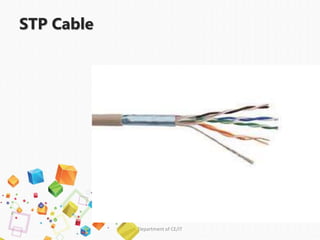
STP Cable
Department of CE/IT
Uses
• STP cables use same connectors as UTP, and are
more expensive than UTP cable.
• It is used for both analog and digital
transmission.
• It is said to be a “balanced transmission medium
Department of CE/IT

Fdm ask and twested pair

  • 1.
  • 2.
    A form ofamplitude modulation process. Represents digital data as variations in the amplitude of a carrier wave. Imparts to a sinusoid, two or more discrete amplitude levels. Uses a finite number of amplitudes, each assigned a unique pattern of binary digits. What is Amplitude Shift Keying ?
  • 3.
  • 4.
    ASK GENERATION ANDMODULATION From a sinusoidal wave signal, ASK output is generated by BAND LIMITING method. By applying BAND LIMITING method, sharp discontinuities would be rounded-off, before transmission.
  • 5.
    Conversion Of OriginalMessage To ASK Through Band Limit Method
  • 6.
    Amplitude Shift Keyingis of Two types- 1. Binary ASK 2. Multilevel ASK Binary ASK is implemented using only 2 levels. It is known as ON-OFF keying. Multilevel ASK is implemented with more than two level. Different Amplitude used are – 4,8,16… Different Bits used are- 2,3,4… TYPES OF AMPLITUDE SHIFT KEYING
  • 7.
  • 8.
    DEMODULATION process consistsof two stages-  Recovery of band limited bit stream.  Regeneration of binary bit stream. DEMODULATION
  • 9.
    ASK SYSTEM DIVISION ASKSystem Transmitter Linear model of effects of channel Reciever
  • 10.
    IN OUR DAILYUSE  Commonly used to transmit digital data over optical fibre.  Transmit Morse code. For example, in LED transmitter.
  • 11.
  • 12.
    FDM  Sharing isdone by assigning each user a specific frequency (Carrier Frequency)  Modulation equipment is used to move each signal to the required frequency band.  Multiplexing equipment is needed to combine the modulated signal
  • 13.
    FDM  Separation ofspectrum into smaller frequency bands  Channel gets band of the spectrum for the whole time
  • 14.
    User 1 User 2 User3 M O D U L A T O R f1 f2 f3
  • 15.
    All the userstransmit their data simultaneously…. f1 f2 f3
  • 16.
    The Received dataat the Receiver f1 f2 f3 f1 f2 f3 The Filter The output f1 f2 f3
  • 17.
  • 18.
  • 19.
  • 20.
  • 21.
    Introduction • Twisted pairis the simples, oldest and low priced cable medium. • It is made up of two insulated copper wires, typically, twisted around each other in a continuous spiral. • The purpose of twisting the wires is to reduce electrical interference (or noise) from similar pairs close by. Unshielded Twisted Pair (UTP) Cable – Shielded Twisted Pair (STP) Cable Department of CE/IT
  • 22.
  • 23.
    Unshielded Twisted Pair(UTP) Cable • Unshielded Twisted Pair (UTP) is the most common type of twisted pair cable used in telecommunication networks. • The reason for placing twist in the pair of wires is to minimize the vulnerability of the twisted pair cable to external electrical noise. • Its frequency range is suitable for data transmission as well as voice transmission (100 Hz-5 MHz). • Department of CE/IT
  • 24.
  • 25.
  • 26.
    Advantages • The advantagesof UTP are its low cost, • It is easy to installation procedure. • It is basically used in LAN implementations. Department of CE/IT
  • 27.
  • 28.
    Shielded Twisted Pair(STP) Cable • In Shielded Twisted Pair cable, each pair of insulated conductors is encased in a metal shield to prevent Crosstalk. • The quality aspect of shielded twisted pair is same as the unshielded twisted pair but the shield must be connected to ground. Department of CE/IT
  • 29.
  • 30.
  • 31.
    Uses • STP cablesuse same connectors as UTP, and are more expensive than UTP cable. • It is used for both analog and digital transmission. • It is said to be a “balanced transmission medium Department of CE/IT