EEP316 Laboratory
Pseudo Random Bit Sequence Generation
(PRBS)
27/2/13
Indra Bhushan 2010EE50548
Umang Gupta 2010EE50564
Vivek Mangal 2010EE50566
PRBS- Pseudo Random Bit Sequence Genration
Aim:
1. To generate PRBS
2. Time domain viewing
3. Synchronisation and alignment with sliding window correlator
Theory:
We optimise SNR in analog signal transmission whereas in Digital signal transmission
we talk about optimising bit error rate (BER). PRBS is used to test the system, we supply
a random signal and this signal though random, could be exactly aligned at the receiver
side by simply synchronising the clock and the start-of-the-sequence trigger, which can
be done easily. To generate the same PRBS sequence generator have to be same
circuitry and share a common bit clock. This is also done by using sliding window co-
relator.
Also bit clock synchronisation is done so as to recover the bit clock at the receiver side.
It gets delayed and hence needs to be synchronised. However, in lab we accomplish by
using stolen carrier signal.
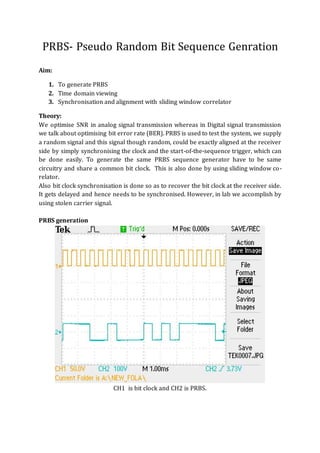
PRBS generation
CH1 is bit clock and CH2 is PRBS.
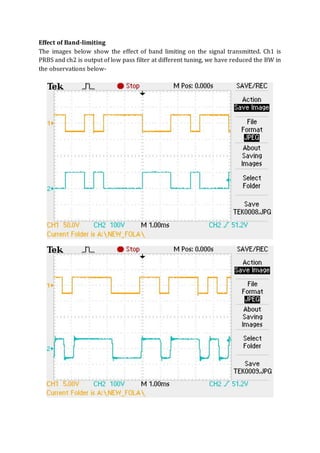
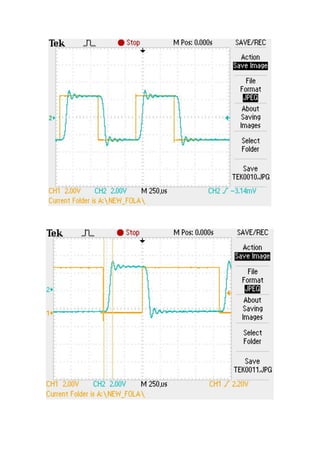
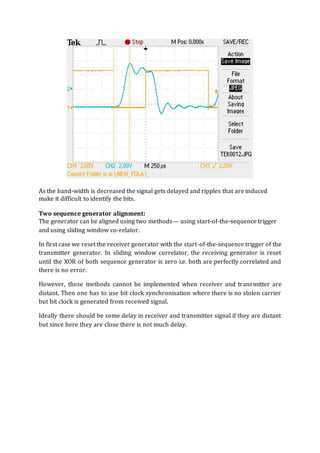
Effect of Band-limiting
The images below show the effect of band limiting on the signal transmitted. Ch1 is
PRBS and ch2 is output of low pass filter at different tuning, we have reduced the BW in
the observations below-
As the band-width is decreased the signal gets delayed and ripples that are induced
make it difficult to identify the bits.
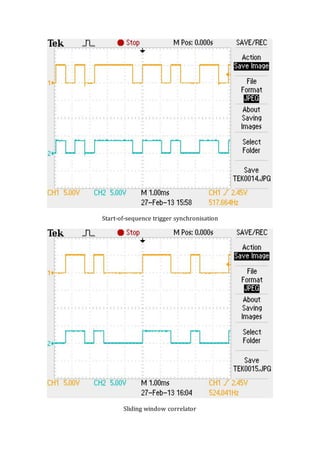
Two sequence generator alignment:
The generator can be aligned using two methods--- using start-of-the-sequence trigger
and using sliding window co-relator.
In first case we reset the receiver generator with the start-of-the-sequence trigger of the
transmitter generator. In sliding window correlator, the receiving generator is reset
until the XOR of both sequence generator is zero i.e. both are perfectly correlated and
there is no error.
However, these methods cannot be implemented when receiver and transmitter are
distant. Then one has to use bit clock synchronisation where there is no stolen carrier
but bit clock is generated from received signal.
Ideally there should be some delay in receiver and transmitter signal if they are distant
but since here they are close there is not much delay.
Start-of-sequence trigger synchronisation
Sliding window correlator

EEL316: Pseudo Random Bit Generation

  • 1.
    EEP316 Laboratory Pseudo RandomBit Sequence Generation (PRBS) 27/2/13 Indra Bhushan 2010EE50548 Umang Gupta 2010EE50564 Vivek Mangal 2010EE50566
  • 2.
    PRBS- Pseudo RandomBit Sequence Genration Aim: 1. To generate PRBS 2. Time domain viewing 3. Synchronisation and alignment with sliding window correlator Theory: We optimise SNR in analog signal transmission whereas in Digital signal transmission we talk about optimising bit error rate (BER). PRBS is used to test the system, we supply a random signal and this signal though random, could be exactly aligned at the receiver side by simply synchronising the clock and the start-of-the-sequence trigger, which can be done easily. To generate the same PRBS sequence generator have to be same circuitry and share a common bit clock. This is also done by using sliding window co- relator. Also bit clock synchronisation is done so as to recover the bit clock at the receiver side. It gets delayed and hence needs to be synchronised. However, in lab we accomplish by using stolen carrier signal. PRBS generation CH1 is bit clock and CH2 is PRBS.
  • 3.
    Effect of Band-limiting Theimages below show the effect of band limiting on the signal transmitted. Ch1 is PRBS and ch2 is output of low pass filter at different tuning, we have reduced the BW in the observations below-
  • 5.
    As the band-widthis decreased the signal gets delayed and ripples that are induced make it difficult to identify the bits. Two sequence generator alignment: The generator can be aligned using two methods--- using start-of-the-sequence trigger and using sliding window co-relator. In first case we reset the receiver generator with the start-of-the-sequence trigger of the transmitter generator. In sliding window correlator, the receiving generator is reset until the XOR of both sequence generator is zero i.e. both are perfectly correlated and there is no error. However, these methods cannot be implemented when receiver and transmitter are distant. Then one has to use bit clock synchronisation where there is no stolen carrier but bit clock is generated from received signal. Ideally there should be some delay in receiver and transmitter signal if they are distant but since here they are close there is not much delay.
  • 6.