Phase-shift keying (PSK) is a digital modulation technique in which the phase of carrier signal is changed by
varying the sine and cosine inputs at a particular time.
It enables data to be carried on a radio communications signal in more efficient way compared to Frequency
Shift Keying (FSK).
There are different forms of PSK - BPSK, QPSK, MPSK etc.
8 PSK is a form of multiple level PSK or MPSK. In 8 PSK, there are 8 different phase changes defined, each
phase change represents the transmission of 3 bits. The phase changes are -112.5, -157.5, -67.5, -22.5, 112.5,
157.5, 67.5 and 22.5 degrees.
Introduction
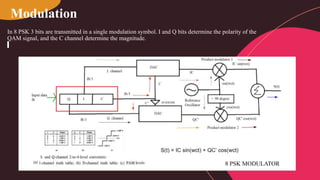
In 8 PSK 3 bits are transmitted in a single modulation symbol. I and Q bits determine the polarity of the
QAM signal, and the C channel determine the magnitude.
Modulation
8 PSK MODULATOR
●
●
●
●
●
●
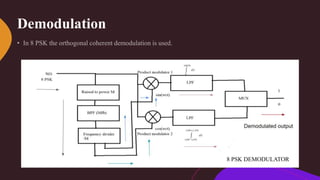
Demodulation
8 PSK DEMODULATOR
Constellation Diagram
Phasor Diagram and Truth
Table
Phasor Diagram
Truth Table
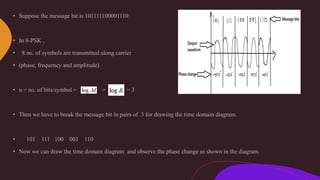
Time domain diagram
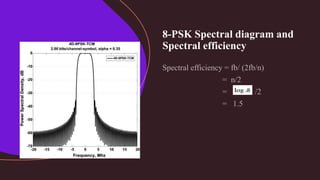
Power spectral density is the measure of signal’s power content versus
frequency. The amplitude of PSD is normalized by spectral resolution
employed to digitize signal.
The PSD of 8-PSK signal or any other MPSK using rectangular data
pulses is given by:
For a given symbol rate, the bit rate for 8-PSK is 3/2 times the bit rate
of QPSK and that of 16-PSK is 4/3 times bit rate of 8 PSK. The PSDs
for m-PSK signals are typically compared on the basis of constant bit
rate.
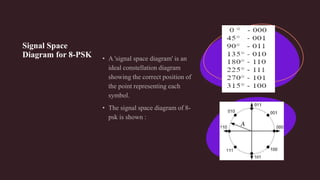
Signal Space
Diagram for 8-PSK
8-PSK Spectral diagram and
Spectral efficiency
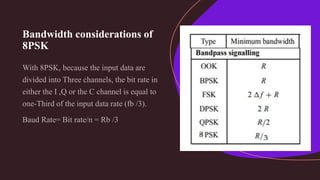
Bandwidth considerations of
8PSK
Applications
One of the application is that it uses the upper sideband signals of the two
first-order sidebands suppressed by the carrier and are then synthesized.
8 PSK modulator is the direct downlink of data from LEO satellites, mainly
earth observation satellites, to the ground station during fly over a satellite.
Another application is that on board a data relay satellite. A possible scenario
for such a GEO communication satellite is to receive data via an inter-
satellite link from a LEO satellite and transmit them from GEO to ground.
Data relay systems provide the capability to transmit very high data volumes
within a short time interval between the generation of the data on the LEO
satellite and their reception on ground.
8PSK transmits more bits per symbol, so it requires higher transmission
power and may have a higher bit-error rate. Designers consider these factors
when planning transmission systems.
Advantages
It carries data over RF signal more efficiently compared to
other modulation types. Hence it is more power efficient
modulation technique compared to ASK and FSK.
8PSK modulation is widely used in wireless transmission.
8PSK is a power efficient system but it has lower bandwidth
efficiency.
8PSK allows information to be transmitted in the radio
communication in a way more efficiently
By using 8PSK modulation, we can also achieve a high data
transmission using this technique and it is also quite less
prone to the error when it is evaluated.
Disadvantages
Since being a multi-level PSK modulation, it is
more sensitive to the phase variation.
8PSK has also a lower bandwidth efficiency
making the detection and recovery algorithms
very complex.
Sometimes 8PSK modulation can generate the
wrong modulation also.
8PSK is a type of non-coherent reference signal.
Conclusion
THANK YOU!

8-PSK(Digital Communication Technique)

  • 2.
    Phase-shift keying (PSK)is a digital modulation technique in which the phase of carrier signal is changed by varying the sine and cosine inputs at a particular time. It enables data to be carried on a radio communications signal in more efficient way compared to Frequency Shift Keying (FSK). There are different forms of PSK - BPSK, QPSK, MPSK etc. 8 PSK is a form of multiple level PSK or MPSK. In 8 PSK, there are 8 different phase changes defined, each phase change represents the transmission of 3 bits. The phase changes are -112.5, -157.5, -67.5, -22.5, 112.5, 157.5, 67.5 and 22.5 degrees. Introduction
  • 3.
    In 8 PSK3 bits are transmitted in a single modulation symbol. I and Q bits determine the polarity of the QAM signal, and the C channel determine the magnitude. Modulation 8 PSK MODULATOR
  • 4.
  • 5.
  • 7.
  • 8.
    Phasor Diagram andTruth Table Phasor Diagram Truth Table
  • 9.
  • 11.
    Power spectral densityis the measure of signal’s power content versus frequency. The amplitude of PSD is normalized by spectral resolution employed to digitize signal. The PSD of 8-PSK signal or any other MPSK using rectangular data pulses is given by: For a given symbol rate, the bit rate for 8-PSK is 3/2 times the bit rate of QPSK and that of 16-PSK is 4/3 times bit rate of 8 PSK. The PSDs for m-PSK signals are typically compared on the basis of constant bit rate.
  • 12.
  • 13.
    8-PSK Spectral diagramand Spectral efficiency
  • 14.
  • 15.
    Applications One of theapplication is that it uses the upper sideband signals of the two first-order sidebands suppressed by the carrier and are then synthesized. 8 PSK modulator is the direct downlink of data from LEO satellites, mainly earth observation satellites, to the ground station during fly over a satellite. Another application is that on board a data relay satellite. A possible scenario for such a GEO communication satellite is to receive data via an inter- satellite link from a LEO satellite and transmit them from GEO to ground. Data relay systems provide the capability to transmit very high data volumes within a short time interval between the generation of the data on the LEO satellite and their reception on ground. 8PSK transmits more bits per symbol, so it requires higher transmission power and may have a higher bit-error rate. Designers consider these factors when planning transmission systems.
  • 16.
    Advantages It carries dataover RF signal more efficiently compared to other modulation types. Hence it is more power efficient modulation technique compared to ASK and FSK. 8PSK modulation is widely used in wireless transmission. 8PSK is a power efficient system but it has lower bandwidth efficiency. 8PSK allows information to be transmitted in the radio communication in a way more efficiently By using 8PSK modulation, we can also achieve a high data transmission using this technique and it is also quite less prone to the error when it is evaluated.
  • 17.
    Disadvantages Since being amulti-level PSK modulation, it is more sensitive to the phase variation. 8PSK has also a lower bandwidth efficiency making the detection and recovery algorithms very complex. Sometimes 8PSK modulation can generate the wrong modulation also. 8PSK is a type of non-coherent reference signal.
  • 18.
  • 19.