EEP316 Laboratory
Amplitude Shift Keying (ASK)
30/1/13
Indra Bhushan 2010EE50548
Umang Gupta 2010EE50564
Vivek Mangal 2010EE50566
Spread Spectrum-DSSS & CDMA
Aim: Demonstration of some principle of direct sequence spread spectrum (DSSS)
system.
Theory:
Spread Spectrum- A modulation technique that spreads a signal’s power over a wide band
of frequencies. The main reasons for this technique is that the signal becomes much less
susceptible to electrical noise and interferes less with other radio-based systems.
A DSSS generator:
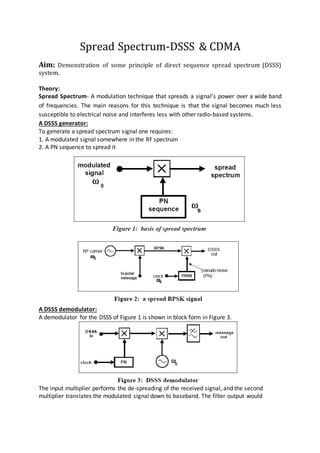
To generate a spread spectrum signal one requires:
1. A modulated signal somewhere in the RF spectrum
2. A PN sequence to spread it
A DSSS demodulator:
A demodulator for the DSSS of Figure 1 is shown in block form in Figure 3.
The input multiplier performs the de-spreading of the received signal, and the second
multiplier translates the modulated signal down to baseband. The filter output would
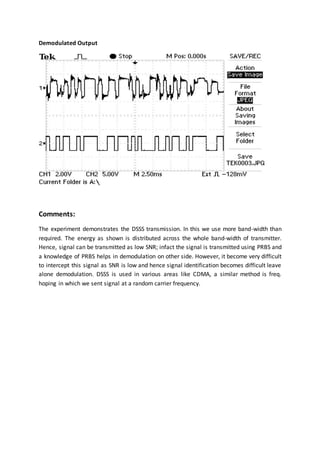
probably require further processing - not shown - to ‘clean up’ the waveform to binary
format.
The PN sequence at the receiver acts as a ‘key’ to the transmission. It must not only have the
same clock and bit pattern; it must be aligned properly with the sequence at the transmitter.
MATLAB code:
% Direct SequenceSpread Spectrum
%%%%%%%%%%%%%%%%%%%%%%%%%%%%%%%%%%%%
clc
clear
% Generating the bit pattern witheach bit 6 sampleslong
b=round(rand(1,20));
pattern=[];
fork=1:20
if b(1,k)==0
sig=zeros(1,6);
else
sig=ones(1,6);
end
pattern=[pattern sig];
end
plot(pattern);
axis([-1130 -.5 1.5]);
title('bfitOriginal Bit Sequence');
% Generating the pseudo randombitpattern forspreading
spread_sig=round(rand(1,120));
figure,plot(spread_sig);
axis([-1130 -.5 1.5]);
title('bfitPseudorandomBitSequence');
% XORing the pattern withthe spread signal
hopped_sig=xor(pattern,spread_sig);
% Modulating thehopped signal
dsss_sig=[];
t=[0:100];
fc=.1
c1=cos(2*pi*fc*t);
c2=cos(2*pi*fc*t+pi);
fork=1:120
if hopped_sig(1,k)==0
dsss_sig=[dsss_sig c1];
else
dsss_sig=[dsss_sig c2];
end
end
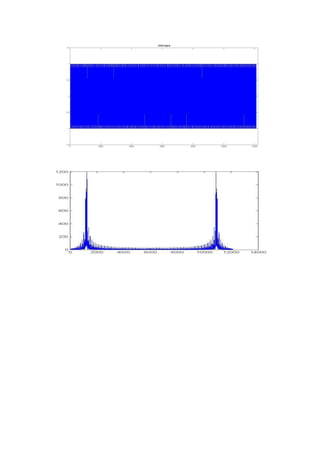
figure,plot([1:12120],dsss_sig);
axis([-112220 -1.5 1.5]);
title('bfitDSSSSignal');
% Plotting the FFT of DSSSsignal
figure,plot([1:12120],abs(fft(dsss_sig)))
OBSERVATIONS:
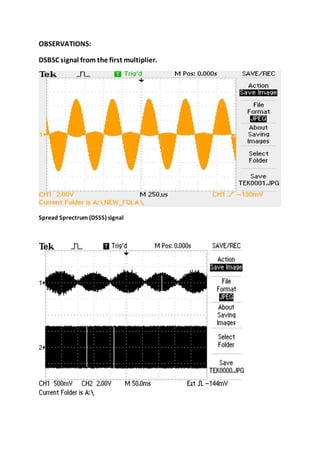
DSBSC signal from the first multiplier.
Spread Sprectrum (DSSS) signal
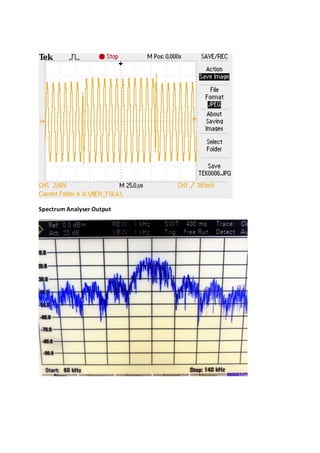
Spectrum Analyser Output
Demodulated Output
Comments:
The experiment demonstrates the DSSS transmission. In this we use more band-width than
required. The energy as shown is distributed across the whole band-width of transmitter.
Hence, signal can be transmitted as low SNR; infact the signal is transmitted using PRBS and
a knowledge of PRBS helps in demodulation on other side. However, it become very difficult
to intercept this signal as SNR is low and hence signal identification becomes difficult leave
alone demodulation. DSSS is used in various areas like CDMA, a similar method is freq.
hoping in which we sent signal at a random carrier frequency.

EEL316: ASK

  • 1.
    EEP316 Laboratory Amplitude ShiftKeying (ASK) 30/1/13 Indra Bhushan 2010EE50548 Umang Gupta 2010EE50564 Vivek Mangal 2010EE50566
  • 2.
    Spread Spectrum-DSSS &CDMA Aim: Demonstration of some principle of direct sequence spread spectrum (DSSS) system. Theory: Spread Spectrum- A modulation technique that spreads a signal’s power over a wide band of frequencies. The main reasons for this technique is that the signal becomes much less susceptible to electrical noise and interferes less with other radio-based systems. A DSSS generator: To generate a spread spectrum signal one requires: 1. A modulated signal somewhere in the RF spectrum 2. A PN sequence to spread it A DSSS demodulator: A demodulator for the DSSS of Figure 1 is shown in block form in Figure 3. The input multiplier performs the de-spreading of the received signal, and the second multiplier translates the modulated signal down to baseband. The filter output would
  • 3.
    probably require furtherprocessing - not shown - to ‘clean up’ the waveform to binary format. The PN sequence at the receiver acts as a ‘key’ to the transmission. It must not only have the same clock and bit pattern; it must be aligned properly with the sequence at the transmitter. MATLAB code: % Direct SequenceSpread Spectrum %%%%%%%%%%%%%%%%%%%%%%%%%%%%%%%%%%%% clc clear % Generating the bit pattern witheach bit 6 sampleslong b=round(rand(1,20)); pattern=[]; fork=1:20 if b(1,k)==0 sig=zeros(1,6); else sig=ones(1,6); end pattern=[pattern sig]; end plot(pattern); axis([-1130 -.5 1.5]); title('bfitOriginal Bit Sequence'); % Generating the pseudo randombitpattern forspreading spread_sig=round(rand(1,120)); figure,plot(spread_sig); axis([-1130 -.5 1.5]); title('bfitPseudorandomBitSequence'); % XORing the pattern withthe spread signal hopped_sig=xor(pattern,spread_sig); % Modulating thehopped signal dsss_sig=[]; t=[0:100]; fc=.1 c1=cos(2*pi*fc*t); c2=cos(2*pi*fc*t+pi); fork=1:120 if hopped_sig(1,k)==0 dsss_sig=[dsss_sig c1]; else dsss_sig=[dsss_sig c2]; end end figure,plot([1:12120],dsss_sig); axis([-112220 -1.5 1.5]); title('bfitDSSSSignal');
  • 4.
    % Plotting theFFT of DSSSsignal figure,plot([1:12120],abs(fft(dsss_sig)))
  • 6.
    OBSERVATIONS: DSBSC signal fromthe first multiplier. Spread Sprectrum (DSSS) signal
  • 7.
  • 8.
    Demodulated Output Comments: The experimentdemonstrates the DSSS transmission. In this we use more band-width than required. The energy as shown is distributed across the whole band-width of transmitter. Hence, signal can be transmitted as low SNR; infact the signal is transmitted using PRBS and a knowledge of PRBS helps in demodulation on other side. However, it become very difficult to intercept this signal as SNR is low and hence signal identification becomes difficult leave alone demodulation. DSSS is used in various areas like CDMA, a similar method is freq. hoping in which we sent signal at a random carrier frequency.