ZigBee Alliance Tutorial September-November 2005 Bob Heile   Chairman, ZigBee Alliance Chair, IEEE 802.15 Copyright © 2005 ZigBee TM  Alliance. All Rights Reserved. Wireless Control That Simply Works
Today’s Wireless Themes Ubiquitous communication with focus on interoperability, plug-and-play, IP, self-organizing networks and low power High quality AV streaming  Bits/Hz/watt  Positioning & Location
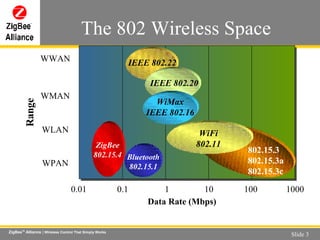
The 802 Wireless Space Data Rate (Mbps) Range ZigBee 802.15.4 802.15.3 802.15.3a 802.15.3c WPAN WLAN WMAN WWAN WiFi 802.11 0.01 0.1 1 10 100 1000 Bluetooth 802.15.1 IEEE 802.22 WiMax IEEE 802.16 IEEE 802.20
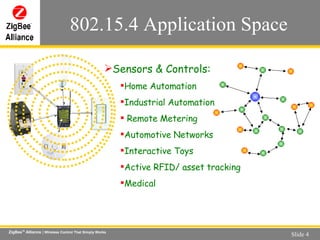
802.15.4 Application Space Sensors & Controls: Home Automation Industrial Automation Remote Metering Automotive Networks Interactive Toys Active RFID/ asset tracking Medical
Large networks (large number of devices and large coverage area) that can form autonomously and that will operate very reliably for years without any operator intervention  Very long battery life (years off of a AA cell), very low infrastructure cost (low device & setup costs) and very low complexity and small size Device data rate and QoS needs are low  Standardized protocols are necessary to allow multiple vendors to interoperate Sensor/Control Network Requirements
What IEEE 802.15.4 Addresses IEEE 802.15.4 MAC and PHY only IEEE 802.15.4 MAC Upper Layer Stack IEEE 802.2 LLC Other LLC IEEE 802.15.4 2400 MHz PHY IEEE 802.15.4 868/915 MHz PHY
So Why ZigBee? Needed an organization with a mission to define  a  complete  open  global standard  for reliable, cost-effective, low-power, wirelessly networked products addressing  monitoring and control Alliance provides upper layer stack and application profiles compliance and certification testing branding Result is a set of recognizable, interoperable solutions
Who is supporting the ZigBee Alliance? Eight promoter companies Chipcon, Ember, Freescale, Honeywell, Mitsubishi, Motorola, Philips and Samsung A rapidly growing list (Now over 175) of industry leaders from 29 countries spanning 6 continents committed to providing ZigBee-compliant products and solutions Companies include chip suppliers, wireless IP providers, OEMs, test equip manufacturers and end users
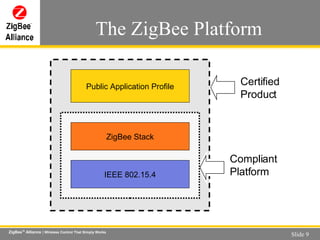
The ZigBee Platform IEEE 802.15.4 Public Application Profile ZigBee Stack Certified Product Compliant Platform
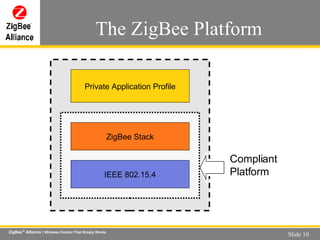
The ZigBee Platform IEEE 802.15.4 Private Application Profile ZigBee Stack Compliant Platform
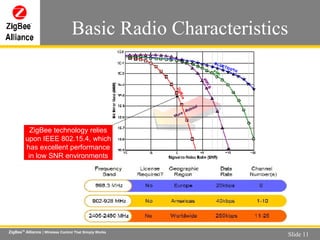
Basic Radio Characteristics ZigBee technology relies upon IEEE 802.15.4, which has excellent performance in low SNR environments
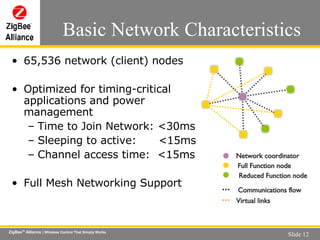
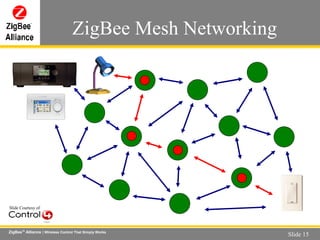
65,536 network (client) nodes Optimized for timing-critical applications and power management Time to Join Network: <30ms Sleeping to active:  <15ms Channel access time:  <15ms Full Mesh Networking Support Basic Network Characteristics Network coordinator Full Function node Reduced Function node Communications flow Virtual links
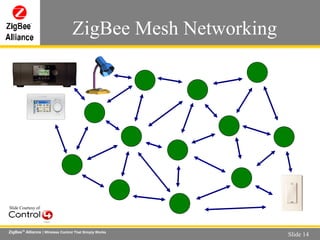
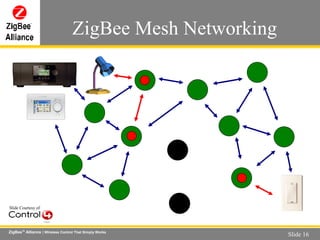
ZigBee Mesh Networking  Slide Courtesy of
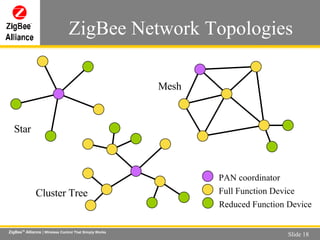
ZigBee Network Topologies PAN coordinator Full Function Device Reduced Function Device Star Mesh Cluster Tree
Cluster Tree Networks Cluster tree networks enable a peer-peer network to be formed with a minimum of routing overhead. DD/CH0 1 0 2 3 4 6 7 8 12 10 11 9 13 14 20 22 5 CH1 CH2 CH3 CH5 CH4 CH6 “ Parent” “ Child” Links indicate familial relationship, not communications capability
Cluster Tree Networks Employ multi-hop routing Can be very large:  255 clusters of 254 nodes each = 64,770 nodes May span physically large areas Suitable for latency-tolerant applications
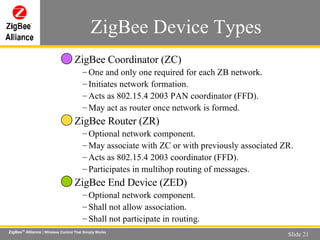
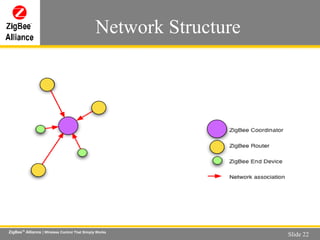
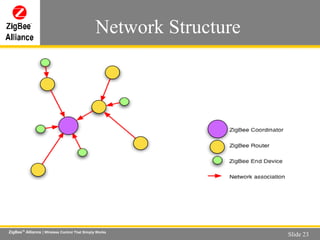
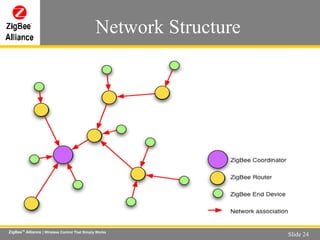
ZigBee Device Types ZigBee Coordinator (ZC) One and only one required for each ZB network. Initiates network formation. Acts as 802.15.4 2003 PAN coordinator (FFD). May act as router once network is formed. ZigBee Router (ZR) Optional network component. May associate with ZC or with previously associated ZR. Acts as 802.15.4 2003 coordinator (FFD). Participates in multihop routing of messages. ZigBee End Device (ZED) Optional network component. Shall not allow association. Shall not participate in routing.
Network Structure
Network Structure
Network Structure
ZigBee Channel Access Options Two channel access mechanisms: Non-beacon network A simple, traditional multiple access system used in simple peer and near-peer networks Standard ALOHA CSMA-CA communications Positive acknowledgement for successfully received packets Beacon-enabled network Superframe structure- network coordinator transmits beacons at predetermined intervals Dedicated bandwidth and low latency Low Power Consumption mode for Coordinator
Other Benefits of Beacon Mode Beacon Mode A very powerful mechanism for controlling power consumption in extended networks like cluster tree or mesh Allows all clients in a local piece of the network the ability to know when to communicate with each other PAN has a coordinator that manages the channel and arranges the calls Significant value will be in system power consumption for networks which are primarily battery powered
ZigBee – Highly Reliable Mesh and tree networking protocol provides redundant paths Automatic retries and acknowledgements Broadcast delivery scheme ensures reliable broadcasts across the network Parents keep track of messages for sleeping children High intrinsic interference tolerance Multiple channels Frequency agility Robust modulation
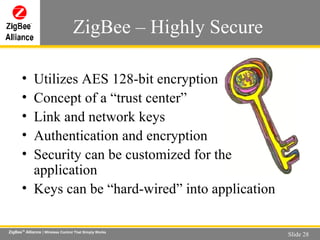
ZigBee – Highly Secure Utilizes AES 128-bit encryption Concept of a “trust center” Link and network keys Authentication and encryption Security can be customized for the application Keys can be “hard-wired” into application
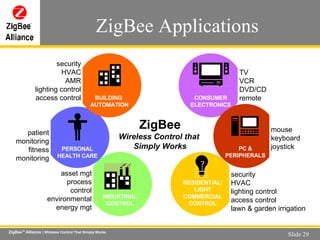
ZigBee Applications ZigBee Wireless Control that  Simply Works RESIDENTIAL/ LIGHT COMMERCIAL CONTROL CONSUMER ELECTRONICS TV VCR DVD/CD remote security HVAC lighting control access control lawn & garden irrigation PC & PERIPHERALS INDUSTRIAL CONTROL asset mgt process control environmental energy mgt PERSONAL HEALTH CARE BUILDING  AUTOMATION security HVAC AMR lighting control access   control mouse keyboard joystick patient monitoring fitness monitoring
ZigBee Home Control
General Commercial Building Automation Quick Payback Leads to Early Adoption Obvious Uses Lighting  HVAC  Alarm Systems Entry Systems Less Obvious Uses Landscaping Leak Detection Pest Monitoring Humidity in Walls
Patient Monitoring May allow more patient freedom Monitors vital statistics and sends via internet Patient can remain in their own home Lowers cost and improves comfort Allows monitoring of elderly family member Sense movement or usage patterns in a home Notify via mobile phone when anomalies occur Can track behavior without visual “spying” Wireless panic buttons for falls or other problems Again lowers cost and improves patient lifestyle Can be used in hospice care Patients are allowed greater movement Reduced staff to patient ratio Light way to bathroom when they get out of bed Reduces patient confusion  graphic graphic
Microprocessor based devices with embedded radios Lighting Ballasts become control and communication nodes Utilizes an open protocol for communication – ZigBee Mesh Network - Scalable, flexible up to 65,000 network nodes 100% digital component based network of devices with the lighting infrastructure providing the DLN backbone Software and UI’s determine the user experience Distributed control of lighting – From personal space to enterprise control Characteristics of a ZigBee Lighting Control System
Reduced cost and complexity of system installation Simplicity of Commissioning Key value drivers of a Wireless Lighting Control system Simplify Lighting Control System design in both new construction and retrofit applications
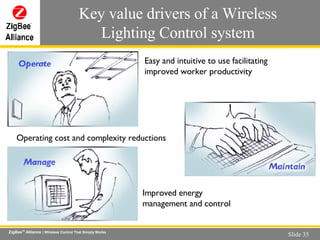
Easy and intuitive to use facilitating improved worker productivity Operating cost and complexity reductions Improved energy management and control   Key value drivers of a Wireless Lighting Control system
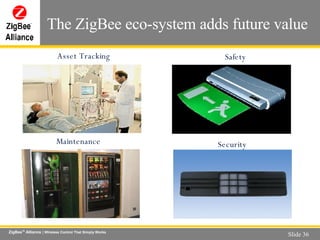
The ZigBee eco-system adds future value Safety Asset Tracking Security Maintenance
Why ZigBee? Reliable and self healing Supports large number of nodes Easy to deploy Very long battery life Secure Low cost Can be used globally
Advantages of  ZigBee over proprietary solutions? Product interoperability Vendor independence Increased product innovation as a result of industry standardization  A common platform is more cost effective than creating a new proprietary solution from scratch every time Companies can focus their energies on finding and serving customers
Benefits of joining the alliance Access to  Specifications Member IP pool Event lists Media and analysts VCs Network with Members  Customers Vendors Partners
Benefits of joining the alliance World class PR Be associated with a hot technology Leverage Alliance event and PR activities Your competitors are here, chance to strengthen your leadership position Get access to marketing ideas, get a sense of the market direction and optimize your product/company plans Equivalent info from other sources would cost many multiples of the annual membership fee Result is you get to market quicker with a better solution
“ Just as the personal computer was a symbol of the '80s, and the symbol of the '90s is the World Wide Web, the next nonlinear shift, is going to be the advent of cheap sensors.” -Paul Saffo  Institute for the Future Parting Thought
Slide  More Information ZigBee Alliance Web Site  http://www.ZigBee.org IEEE 802.15 Web Site http://www.ieee802.org/15 Bob Heile, ZigBee Alliance Chairman,  bheile @ ieee .org

053744r00 Zb Mwg 2005 09 11 Zig Bee Alliance Tutorial

  • 1.
    ZigBee Alliance TutorialSeptember-November 2005 Bob Heile Chairman, ZigBee Alliance Chair, IEEE 802.15 Copyright © 2005 ZigBee TM Alliance. All Rights Reserved. Wireless Control That Simply Works
  • 2.
    Today’s Wireless ThemesUbiquitous communication with focus on interoperability, plug-and-play, IP, self-organizing networks and low power High quality AV streaming Bits/Hz/watt Positioning & Location
  • 3.
    The 802 WirelessSpace Data Rate (Mbps) Range ZigBee 802.15.4 802.15.3 802.15.3a 802.15.3c WPAN WLAN WMAN WWAN WiFi 802.11 0.01 0.1 1 10 100 1000 Bluetooth 802.15.1 IEEE 802.22 WiMax IEEE 802.16 IEEE 802.20
  • 4.
    802.15.4 Application SpaceSensors & Controls: Home Automation Industrial Automation Remote Metering Automotive Networks Interactive Toys Active RFID/ asset tracking Medical
  • 5.
    Large networks (largenumber of devices and large coverage area) that can form autonomously and that will operate very reliably for years without any operator intervention Very long battery life (years off of a AA cell), very low infrastructure cost (low device & setup costs) and very low complexity and small size Device data rate and QoS needs are low Standardized protocols are necessary to allow multiple vendors to interoperate Sensor/Control Network Requirements
  • 6.
    What IEEE 802.15.4Addresses IEEE 802.15.4 MAC and PHY only IEEE 802.15.4 MAC Upper Layer Stack IEEE 802.2 LLC Other LLC IEEE 802.15.4 2400 MHz PHY IEEE 802.15.4 868/915 MHz PHY
  • 7.
    So Why ZigBee?Needed an organization with a mission to define a complete open global standard for reliable, cost-effective, low-power, wirelessly networked products addressing monitoring and control Alliance provides upper layer stack and application profiles compliance and certification testing branding Result is a set of recognizable, interoperable solutions
  • 8.
    Who is supportingthe ZigBee Alliance? Eight promoter companies Chipcon, Ember, Freescale, Honeywell, Mitsubishi, Motorola, Philips and Samsung A rapidly growing list (Now over 175) of industry leaders from 29 countries spanning 6 continents committed to providing ZigBee-compliant products and solutions Companies include chip suppliers, wireless IP providers, OEMs, test equip manufacturers and end users
  • 9.
    The ZigBee PlatformIEEE 802.15.4 Public Application Profile ZigBee Stack Certified Product Compliant Platform
  • 10.
    The ZigBee PlatformIEEE 802.15.4 Private Application Profile ZigBee Stack Compliant Platform
  • 11.
    Basic Radio CharacteristicsZigBee technology relies upon IEEE 802.15.4, which has excellent performance in low SNR environments
  • 12.
    65,536 network (client)nodes Optimized for timing-critical applications and power management Time to Join Network: <30ms Sleeping to active: <15ms Channel access time: <15ms Full Mesh Networking Support Basic Network Characteristics Network coordinator Full Function node Reduced Function node Communications flow Virtual links
  • 13.
    ZigBee Mesh Networking Slide Courtesy of
  • 14.
    ZigBee Mesh Networking Slide Courtesy of
  • 15.
    ZigBee Mesh Networking Slide Courtesy of
  • 16.
    ZigBee Mesh Networking Slide Courtesy of
  • 17.
    ZigBee Mesh Networking Slide Courtesy of
  • 18.
    ZigBee Network TopologiesPAN coordinator Full Function Device Reduced Function Device Star Mesh Cluster Tree
  • 19.
    Cluster Tree NetworksCluster tree networks enable a peer-peer network to be formed with a minimum of routing overhead. DD/CH0 1 0 2 3 4 6 7 8 12 10 11 9 13 14 20 22 5 CH1 CH2 CH3 CH5 CH4 CH6 “ Parent” “ Child” Links indicate familial relationship, not communications capability
  • 20.
    Cluster Tree NetworksEmploy multi-hop routing Can be very large: 255 clusters of 254 nodes each = 64,770 nodes May span physically large areas Suitable for latency-tolerant applications
  • 21.
    ZigBee Device TypesZigBee Coordinator (ZC) One and only one required for each ZB network. Initiates network formation. Acts as 802.15.4 2003 PAN coordinator (FFD). May act as router once network is formed. ZigBee Router (ZR) Optional network component. May associate with ZC or with previously associated ZR. Acts as 802.15.4 2003 coordinator (FFD). Participates in multihop routing of messages. ZigBee End Device (ZED) Optional network component. Shall not allow association. Shall not participate in routing.
  • 22.
  • 23.
  • 24.
  • 25.
    ZigBee Channel AccessOptions Two channel access mechanisms: Non-beacon network A simple, traditional multiple access system used in simple peer and near-peer networks Standard ALOHA CSMA-CA communications Positive acknowledgement for successfully received packets Beacon-enabled network Superframe structure- network coordinator transmits beacons at predetermined intervals Dedicated bandwidth and low latency Low Power Consumption mode for Coordinator
  • 26.
    Other Benefits ofBeacon Mode Beacon Mode A very powerful mechanism for controlling power consumption in extended networks like cluster tree or mesh Allows all clients in a local piece of the network the ability to know when to communicate with each other PAN has a coordinator that manages the channel and arranges the calls Significant value will be in system power consumption for networks which are primarily battery powered
  • 27.
    ZigBee – HighlyReliable Mesh and tree networking protocol provides redundant paths Automatic retries and acknowledgements Broadcast delivery scheme ensures reliable broadcasts across the network Parents keep track of messages for sleeping children High intrinsic interference tolerance Multiple channels Frequency agility Robust modulation
  • 28.
    ZigBee – HighlySecure Utilizes AES 128-bit encryption Concept of a “trust center” Link and network keys Authentication and encryption Security can be customized for the application Keys can be “hard-wired” into application
  • 29.
    ZigBee Applications ZigBeeWireless Control that Simply Works RESIDENTIAL/ LIGHT COMMERCIAL CONTROL CONSUMER ELECTRONICS TV VCR DVD/CD remote security HVAC lighting control access control lawn & garden irrigation PC & PERIPHERALS INDUSTRIAL CONTROL asset mgt process control environmental energy mgt PERSONAL HEALTH CARE BUILDING AUTOMATION security HVAC AMR lighting control access control mouse keyboard joystick patient monitoring fitness monitoring
  • 30.
  • 31.
    General Commercial BuildingAutomation Quick Payback Leads to Early Adoption Obvious Uses Lighting HVAC Alarm Systems Entry Systems Less Obvious Uses Landscaping Leak Detection Pest Monitoring Humidity in Walls
  • 32.
    Patient Monitoring Mayallow more patient freedom Monitors vital statistics and sends via internet Patient can remain in their own home Lowers cost and improves comfort Allows monitoring of elderly family member Sense movement or usage patterns in a home Notify via mobile phone when anomalies occur Can track behavior without visual “spying” Wireless panic buttons for falls or other problems Again lowers cost and improves patient lifestyle Can be used in hospice care Patients are allowed greater movement Reduced staff to patient ratio Light way to bathroom when they get out of bed Reduces patient confusion graphic graphic
  • 33.
    Microprocessor based deviceswith embedded radios Lighting Ballasts become control and communication nodes Utilizes an open protocol for communication – ZigBee Mesh Network - Scalable, flexible up to 65,000 network nodes 100% digital component based network of devices with the lighting infrastructure providing the DLN backbone Software and UI’s determine the user experience Distributed control of lighting – From personal space to enterprise control Characteristics of a ZigBee Lighting Control System
  • 34.
    Reduced cost andcomplexity of system installation Simplicity of Commissioning Key value drivers of a Wireless Lighting Control system Simplify Lighting Control System design in both new construction and retrofit applications
  • 35.
    Easy and intuitiveto use facilitating improved worker productivity Operating cost and complexity reductions Improved energy management and control Key value drivers of a Wireless Lighting Control system
  • 36.
    The ZigBee eco-systemadds future value Safety Asset Tracking Security Maintenance
  • 37.
    Why ZigBee? Reliableand self healing Supports large number of nodes Easy to deploy Very long battery life Secure Low cost Can be used globally
  • 38.
    Advantages of ZigBee over proprietary solutions? Product interoperability Vendor independence Increased product innovation as a result of industry standardization A common platform is more cost effective than creating a new proprietary solution from scratch every time Companies can focus their energies on finding and serving customers
  • 39.
    Benefits of joiningthe alliance Access to Specifications Member IP pool Event lists Media and analysts VCs Network with Members Customers Vendors Partners
  • 40.
    Benefits of joiningthe alliance World class PR Be associated with a hot technology Leverage Alliance event and PR activities Your competitors are here, chance to strengthen your leadership position Get access to marketing ideas, get a sense of the market direction and optimize your product/company plans Equivalent info from other sources would cost many multiples of the annual membership fee Result is you get to market quicker with a better solution
  • 41.
    “ Just asthe personal computer was a symbol of the '80s, and the symbol of the '90s is the World Wide Web, the next nonlinear shift, is going to be the advent of cheap sensors.” -Paul Saffo Institute for the Future Parting Thought
  • 42.
    Slide MoreInformation ZigBee Alliance Web Site http://www.ZigBee.org IEEE 802.15 Web Site http://www.ieee802.org/15 Bob Heile, ZigBee Alliance Chairman, bheile @ ieee .org