EVIDENCE BASED
NURSING PRACTICE
SUBMITTED BY :
NIKITA SHARMA
MSc. Nursing 1st year
ROLL NO. 9
SUBMITTED TO:
Dr. Mrs. Prabhjot Saini
Prof. & Head Med. Surg.
Nsg.
DMCH CON, Ludhiana
INTRODUCTION
• When health care providers know, find, critically appraise and use the best
evidence and patients are confident that their health care providers are
using evidence based care optimal outcomes are achieved for all.
• Research utilization emphasizes the transfer of specific research based
knowledge into practice.
• Sometimes, the terms RESEARH UTILIZATION and EBP are used
interchangeably.
Evidence based practices
RESEARCH UTILIZATION
• It is the process of transferring research knowledge into
practice; thus facilitating an innovative change in practice
protocols.
• Research utilization is the use of findings from a disciplined
study or a set of studies in a practical application.
DEFINITION OF EVIDENCE BASED
PRACTICE
 Evidence-based medicine is the conscientious,
explicit, and judicious use of current best
evidence in making decisions about the care of
individual patients. The practice of evidence-
based medicine means integrating individual
clinical expertise with the best available external
clinical evidence from systematic research.
(Sackett et al., 1996)
CONT…..
• SCOTT and McSHERRY’s:
An ongoing process by which evidence, nursing theory, and the
practitioners clinical expertise are critically evaluated and
considered, in conjunction with patient involvement, to provide
delivery of optimum nursing care for the individual.
GOALS OF EVIDENCE BASED
PRACTICE
 Ensure maximizing health & quality of life from the
client’s perspective.
PURPOSES OF EBP
• To specify the way in which professionals or other decision makers should
make decisions by identifying such evidence that there may be for a
practice, and rating it according to how scientifically sound it may be.
• To eliminate unsound or excessively risky practice in favor of those that
have better outcomes.
• To provide highest quality and most cost-efficient nursing care possible.
• To improve the quality of nursing care.
EXAMPLES
• If a patient is diagnosed with Alzheimer’s disease,
where health care providers plan to give information
about how other family members or informal caregivers
of patients with this disease will cope with the illness,
bases on evidence from well-designed qualitative
and/or descriptive studies?
IMPORTANCE OF EBP
• To provide the most effective care that is available
• To improving patient outcomes.
• to receive the most effective care based on the best available evidence.
• EBP promotes an attitude of inquiry in health professionals and starts us
thinking about: Why am I doing this in this way? Is there evidence that
can guide me to do this in a more effective way?
• EBP also plays a role in ensuring that finite health resources are used
wisely and that relevant evidence is considered when decisions are made
about funding health services.
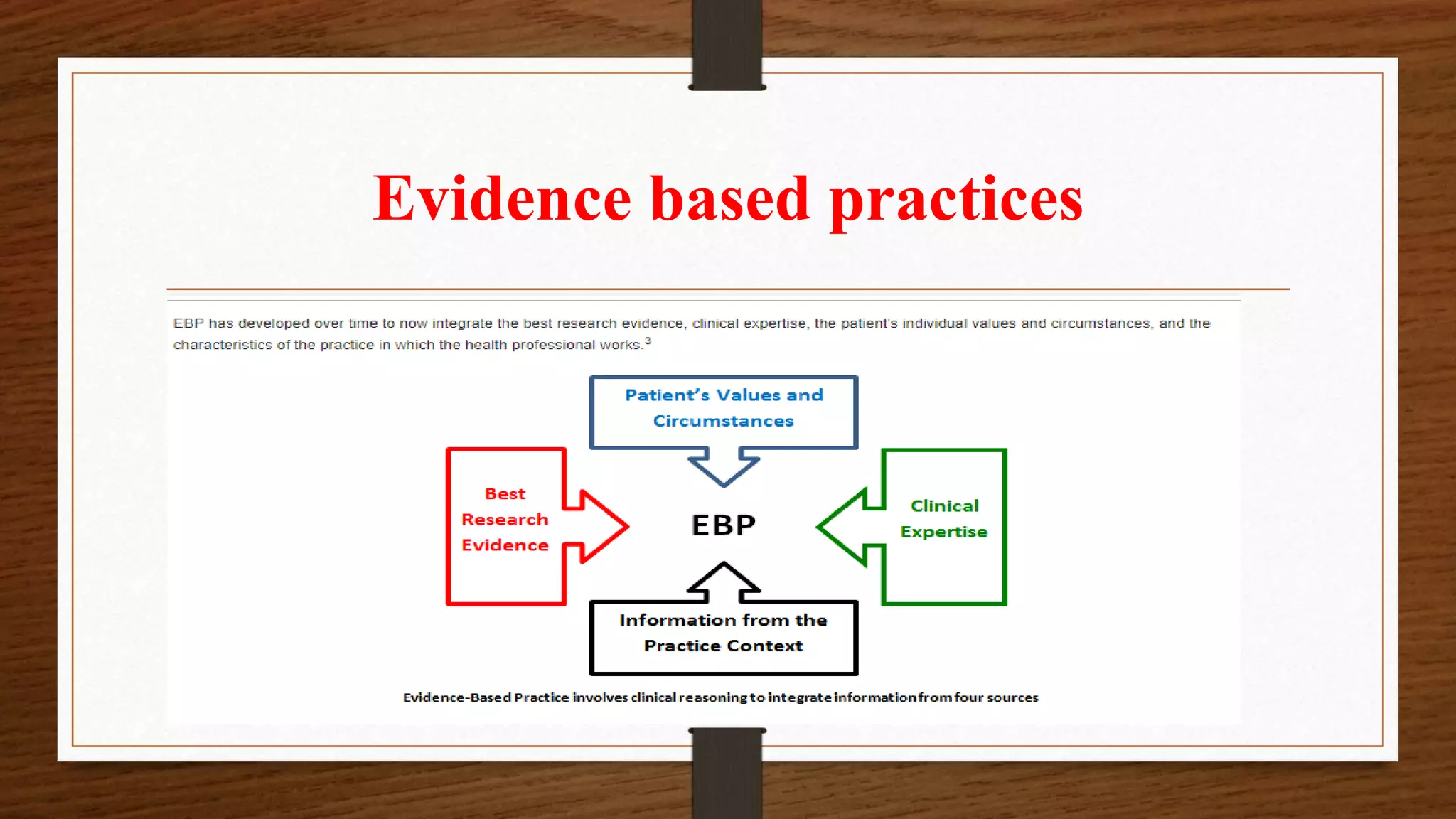
TRAID OF EBP
Key Components of EBP
• Decisions about care are based on:
• A. Research evidence.
• B. Clinical expertise, judicious use.
• C. Patient values and circumstances.
(Institute of Medicine, 2003)
A. Research Evidence
• Randomized controlled trials
• Laboratory experiments
• Clinical trials
• Epidemiological research
• Outcomes research
• Qualitative research
• Expert practice knowledge, inductive reasoning
B. Clinical Expertise
• Knowledge gained from practice over time
• Inductive reasoning
C. Patient Values, Circumstances
• Unique preferences
• Concerns
• Expectations
• Financial resources
• Social supports
EBP Process…
Question
search
AppraiseApply
Evaluate
EBP PROCESS
• Assess practice (formulate question)
• What isn’t working?
• What do you want to know about?
• Decide (evidence review)
• What resources are available and are they any good?
• What has worked in other places?
• How can you change your practice?
Cont.……
• Plan (develop a plan based on findings)
• Make a plan to change care based on relevant, applicable information.
• Let others help.
• Intervene (take action to review process or change)
• Implement revised caregiving protocol in clinical unit.
• Evaluate (care improved or modify and again intervene)
• How well is that working for you?
COMPONENTS OF EVIDENCE BASED
PRACTICE
EVIDENCE
BASED
CLINICAL
DECISION
MAKING
evidence from
research,/theories/
expert panels
evidence from
assessment of
patients history
& physical
exam
&availability of
health care
resources
clinical
expertise
information
about
patient
preferences
& values
STEPS FOR PROCESS OF EVIDENCE
BASED PRACTICES…
Formulating a clear question based on a clinical
problem
Literature review to search best available evidence
Analysis of strengths and weaknesses of evidences
Use of best evidences in clinical evidences
Evaluating the efficacy of empirical evidences
Formulating a clear question based on
clinical problem
sources
Problem based
source
Knowledge
based source
Problem based source
• The health care professionals get an idea about relevant question for EBP
from the clinical or risk assessment data such as:
Data of quality improvement
Risk surveillance
Financial data Recurrent clinical problems
Benchmarking
data
Example
• Increased incidence of pressure sore in critical care units may
be one of the important issues to be considered for EBP.
Knowledge based sources
Scientific
journals
publications
Research
conferences
EBP
guidelines
published by
statutory
bodies
Example
• New evidences on nursing care interventions on prevention of
bed sore, pain management, tube feeding techniques, arterial
and venous line potency, infection control, deep vein
thrombosis prevention ,etc.
PICO model
• P = who is the patient population?
• I = what is the possible intervention or area of interest?
• C = is there a comparison intervention or control group?
• O = what is the desired outcome?
Literature review to search for the best
available evidence
• It must be start with theoretical and clinical articles, which should be
followed by well- known existing EBP guidelines.
• Include high level of evidences such as:
 meta-analysis
RCT’s
• Time management is very crucial for information retrieval, and the current
and fresh information/ evidences are considered more weighted than the
older one.
Analysis of strengths and weaknesses of
evidences
• Evaluating the strengths and weaknesses of that evidence in
terms of validity and generalizability.
• Use of rating systems to determine the quality of the research is
crucial to the development of EBP.
• There are several rating scales proposed to determine the
validity, strengths, and weaknesses of the available evidence.
Use of best evidence in clinical practice
• Implementing useful findings in clinical practice based on valid evidence;
evidence is used alongside clinical expertise and the patient’s perspective
to plan care.
• Once study findings are analyzed for strengths, weaknesses, internal and
external validity, a decision is made about appropriateness of evidence for
the particular question initiated for EBP.
• The final result must be extensively discussed among the users with eisk-
benefit ratio of evidence and extent and level of harms are involved with
particular evidence.
EVIDENCE BASED PRACTICE IN
HEALTH
Evaluating efficacy of empirical evidences
• Through a process of self-reflection, audit, or peer assessment.
• Finally after implementation of the useful findings for the
clinical practices, efficacy and performance is evaluated
through processes of self-reflection, internal or external audit
or peer assessment.
Identify clinical
problem
search for
evidence
Make sense
of evidence
Act on
evidence
Discard poor
evidence, store
good evidence
Update
evidence
Barriers in EBP
TIPS TO PROMOTE USE OF RESEARCH IN
CLINICAL PRACTICE
• Read widely and critically
• Attend professional conference.
• Become involved in a journal club.
• Pursue and participate in EBP projects
CONT….
• Offer financial or research support for utilization
• Reward efforts for using research
• Seek opportunities for institutional RU/EBP projects
CONT….
• Incorporate research findings into curriculum
• Encouraging research and research use
• Place demands on researchers.
EBP

EBP

  • 1.
    EVIDENCE BASED NURSING PRACTICE SUBMITTEDBY : NIKITA SHARMA MSc. Nursing 1st year ROLL NO. 9 SUBMITTED TO: Dr. Mrs. Prabhjot Saini Prof. & Head Med. Surg. Nsg. DMCH CON, Ludhiana
  • 2.
    INTRODUCTION • When healthcare providers know, find, critically appraise and use the best evidence and patients are confident that their health care providers are using evidence based care optimal outcomes are achieved for all. • Research utilization emphasizes the transfer of specific research based knowledge into practice. • Sometimes, the terms RESEARH UTILIZATION and EBP are used interchangeably.
  • 3.
  • 4.
    RESEARCH UTILIZATION • Itis the process of transferring research knowledge into practice; thus facilitating an innovative change in practice protocols. • Research utilization is the use of findings from a disciplined study or a set of studies in a practical application.
  • 5.
    DEFINITION OF EVIDENCEBASED PRACTICE  Evidence-based medicine is the conscientious, explicit, and judicious use of current best evidence in making decisions about the care of individual patients. The practice of evidence- based medicine means integrating individual clinical expertise with the best available external clinical evidence from systematic research. (Sackett et al., 1996)
  • 6.
    CONT….. • SCOTT andMcSHERRY’s: An ongoing process by which evidence, nursing theory, and the practitioners clinical expertise are critically evaluated and considered, in conjunction with patient involvement, to provide delivery of optimum nursing care for the individual.
  • 7.
    GOALS OF EVIDENCEBASED PRACTICE  Ensure maximizing health & quality of life from the client’s perspective.
  • 8.
    PURPOSES OF EBP •To specify the way in which professionals or other decision makers should make decisions by identifying such evidence that there may be for a practice, and rating it according to how scientifically sound it may be. • To eliminate unsound or excessively risky practice in favor of those that have better outcomes. • To provide highest quality and most cost-efficient nursing care possible. • To improve the quality of nursing care.
  • 9.
    EXAMPLES • If apatient is diagnosed with Alzheimer’s disease, where health care providers plan to give information about how other family members or informal caregivers of patients with this disease will cope with the illness, bases on evidence from well-designed qualitative and/or descriptive studies?
  • 10.
    IMPORTANCE OF EBP •To provide the most effective care that is available • To improving patient outcomes. • to receive the most effective care based on the best available evidence. • EBP promotes an attitude of inquiry in health professionals and starts us thinking about: Why am I doing this in this way? Is there evidence that can guide me to do this in a more effective way? • EBP also plays a role in ensuring that finite health resources are used wisely and that relevant evidence is considered when decisions are made about funding health services.
  • 11.
  • 12.
    Key Components ofEBP • Decisions about care are based on: • A. Research evidence. • B. Clinical expertise, judicious use. • C. Patient values and circumstances. (Institute of Medicine, 2003)
  • 13.
    A. Research Evidence •Randomized controlled trials • Laboratory experiments • Clinical trials • Epidemiological research • Outcomes research • Qualitative research • Expert practice knowledge, inductive reasoning
  • 14.
    B. Clinical Expertise •Knowledge gained from practice over time • Inductive reasoning
  • 15.
    C. Patient Values,Circumstances • Unique preferences • Concerns • Expectations • Financial resources • Social supports
  • 16.
  • 17.
    EBP PROCESS • Assesspractice (formulate question) • What isn’t working? • What do you want to know about? • Decide (evidence review) • What resources are available and are they any good? • What has worked in other places? • How can you change your practice?
  • 18.
    Cont.…… • Plan (developa plan based on findings) • Make a plan to change care based on relevant, applicable information. • Let others help. • Intervene (take action to review process or change) • Implement revised caregiving protocol in clinical unit. • Evaluate (care improved or modify and again intervene) • How well is that working for you?
  • 19.
    COMPONENTS OF EVIDENCEBASED PRACTICE EVIDENCE BASED CLINICAL DECISION MAKING evidence from research,/theories/ expert panels evidence from assessment of patients history & physical exam &availability of health care resources clinical expertise information about patient preferences & values
  • 20.
    STEPS FOR PROCESSOF EVIDENCE BASED PRACTICES… Formulating a clear question based on a clinical problem Literature review to search best available evidence Analysis of strengths and weaknesses of evidences Use of best evidences in clinical evidences Evaluating the efficacy of empirical evidences
  • 21.
    Formulating a clearquestion based on clinical problem sources Problem based source Knowledge based source
  • 22.
    Problem based source •The health care professionals get an idea about relevant question for EBP from the clinical or risk assessment data such as: Data of quality improvement Risk surveillance Financial data Recurrent clinical problems Benchmarking data
  • 23.
    Example • Increased incidenceof pressure sore in critical care units may be one of the important issues to be considered for EBP.
  • 24.
  • 25.
    Example • New evidenceson nursing care interventions on prevention of bed sore, pain management, tube feeding techniques, arterial and venous line potency, infection control, deep vein thrombosis prevention ,etc.
  • 26.
    PICO model • P= who is the patient population? • I = what is the possible intervention or area of interest? • C = is there a comparison intervention or control group? • O = what is the desired outcome?
  • 27.
    Literature review tosearch for the best available evidence • It must be start with theoretical and clinical articles, which should be followed by well- known existing EBP guidelines. • Include high level of evidences such as:  meta-analysis RCT’s • Time management is very crucial for information retrieval, and the current and fresh information/ evidences are considered more weighted than the older one.
  • 28.
    Analysis of strengthsand weaknesses of evidences • Evaluating the strengths and weaknesses of that evidence in terms of validity and generalizability. • Use of rating systems to determine the quality of the research is crucial to the development of EBP. • There are several rating scales proposed to determine the validity, strengths, and weaknesses of the available evidence.
  • 29.
    Use of bestevidence in clinical practice • Implementing useful findings in clinical practice based on valid evidence; evidence is used alongside clinical expertise and the patient’s perspective to plan care. • Once study findings are analyzed for strengths, weaknesses, internal and external validity, a decision is made about appropriateness of evidence for the particular question initiated for EBP. • The final result must be extensively discussed among the users with eisk- benefit ratio of evidence and extent and level of harms are involved with particular evidence.
  • 30.
  • 31.
    Evaluating efficacy ofempirical evidences • Through a process of self-reflection, audit, or peer assessment. • Finally after implementation of the useful findings for the clinical practices, efficacy and performance is evaluated through processes of self-reflection, internal or external audit or peer assessment.
  • 32.
    Identify clinical problem search for evidence Makesense of evidence Act on evidence Discard poor evidence, store good evidence Update evidence
  • 33.
  • 34.
    TIPS TO PROMOTEUSE OF RESEARCH IN CLINICAL PRACTICE • Read widely and critically • Attend professional conference. • Become involved in a journal club. • Pursue and participate in EBP projects
  • 35.
    CONT…. • Offer financialor research support for utilization • Reward efforts for using research • Seek opportunities for institutional RU/EBP projects
  • 36.
    CONT…. • Incorporate researchfindings into curriculum • Encouraging research and research use • Place demands on researchers.