EVIDENCE
BASED
NURSING
PRACTICE
PRESENTED BY
SAIMA RASHEED
M.SC. NURSING 1ST
YEAR
INTRODUCTION
Evidence based practice is an approach that
enables clinicians to provide the highest quality of
care in meeting the multiphase needs to their
patients and family.
DEFINITION
• Evidence based practice (EBP) is the process of making clinical
decisions based upon evidence, combined with clinical experience
and patients expectations.
• Evidence-based practice (EBP) is a problem-solving approach to the
delivery of health care that integrates the best evidence from studies
and patient care data with clinician expertise and patient preferences
and values.
(Fineout-overholt E, 2010).
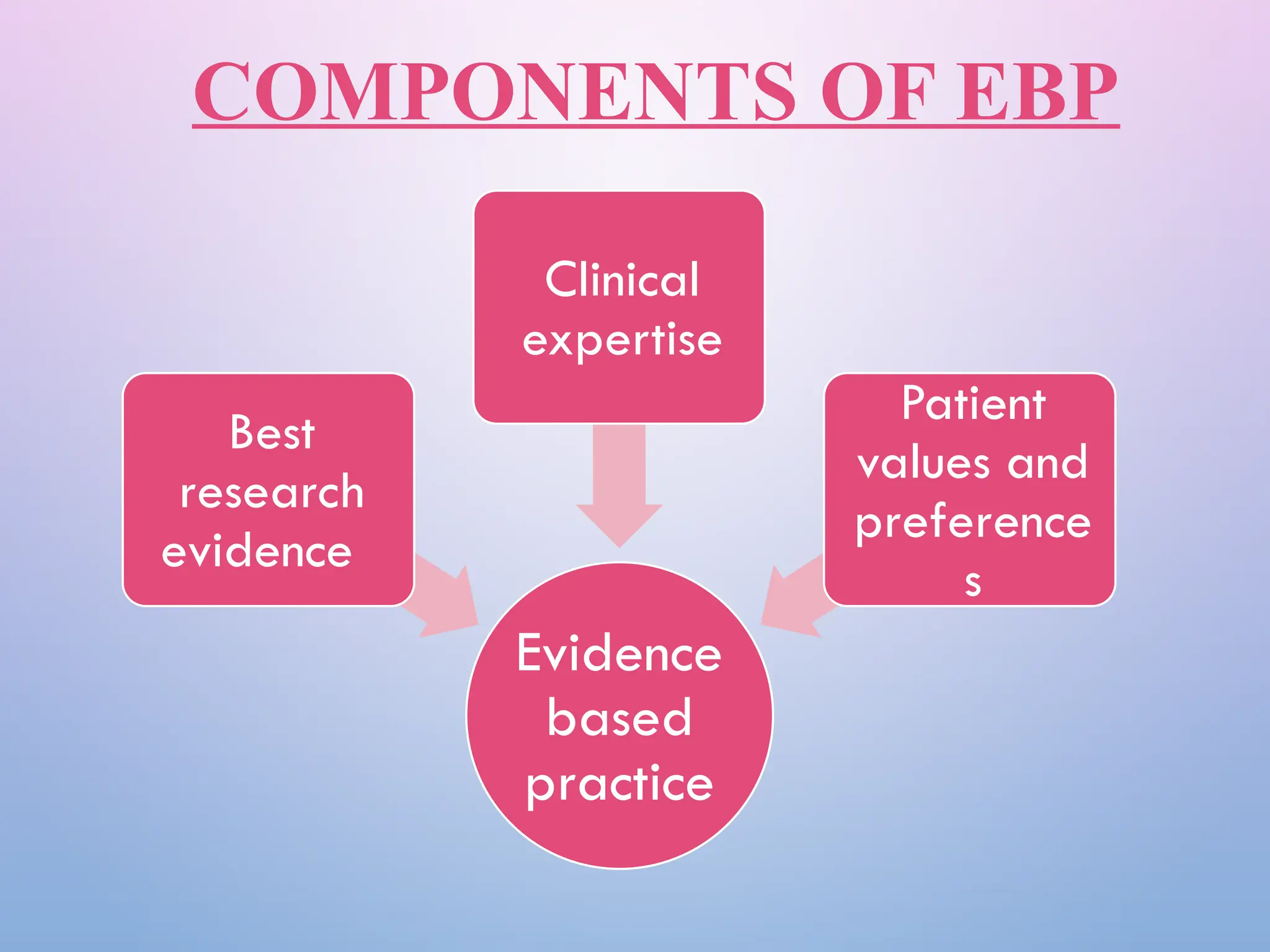
COMPONENTS OF EBP
Evidence
based
practice
Best
research
evidence
Clinical
expertise
Patient
values and
preference
s
AIMS OF EBP
• To provide the high quality and most cost efficient nursing care possible.
• To advance quality of care provided by health worker.
• To increase satisfaction among patients.
• To focus on nursing practice away from habits and tradition to evidence
and research.
• It results in better patient outcomes.
• It contributes to the science of nursing.
• It keeps practice current and relevant.
• It increases confidence in decision making.
OBJECTIVES AND PURPOSES OF
EBP
• Evidence based practice seeks to replace practice as usual with
practice guided by rigorous outcomes oriented research ideally
randomized controlled trials.
• It also seeks to make practice a less subjective enterprise and to
rise it to a higher level of accountability.
• Reduces the variations in nursing care and assist with efficient
and effective decision making.
• Providing practice to the nurse evidence based data to deliver
effective care.
NEED FOR EBP
• For making sure that each client get the best possible services.
• Update knowledge and is essential for lifelong learning.
• Provide clinical judgment.
• Improved care provided and save lives.
• To provide framework for understanding the evidence based
practice process.
STEPS OF EVIDENCE BASED
PRACTICE
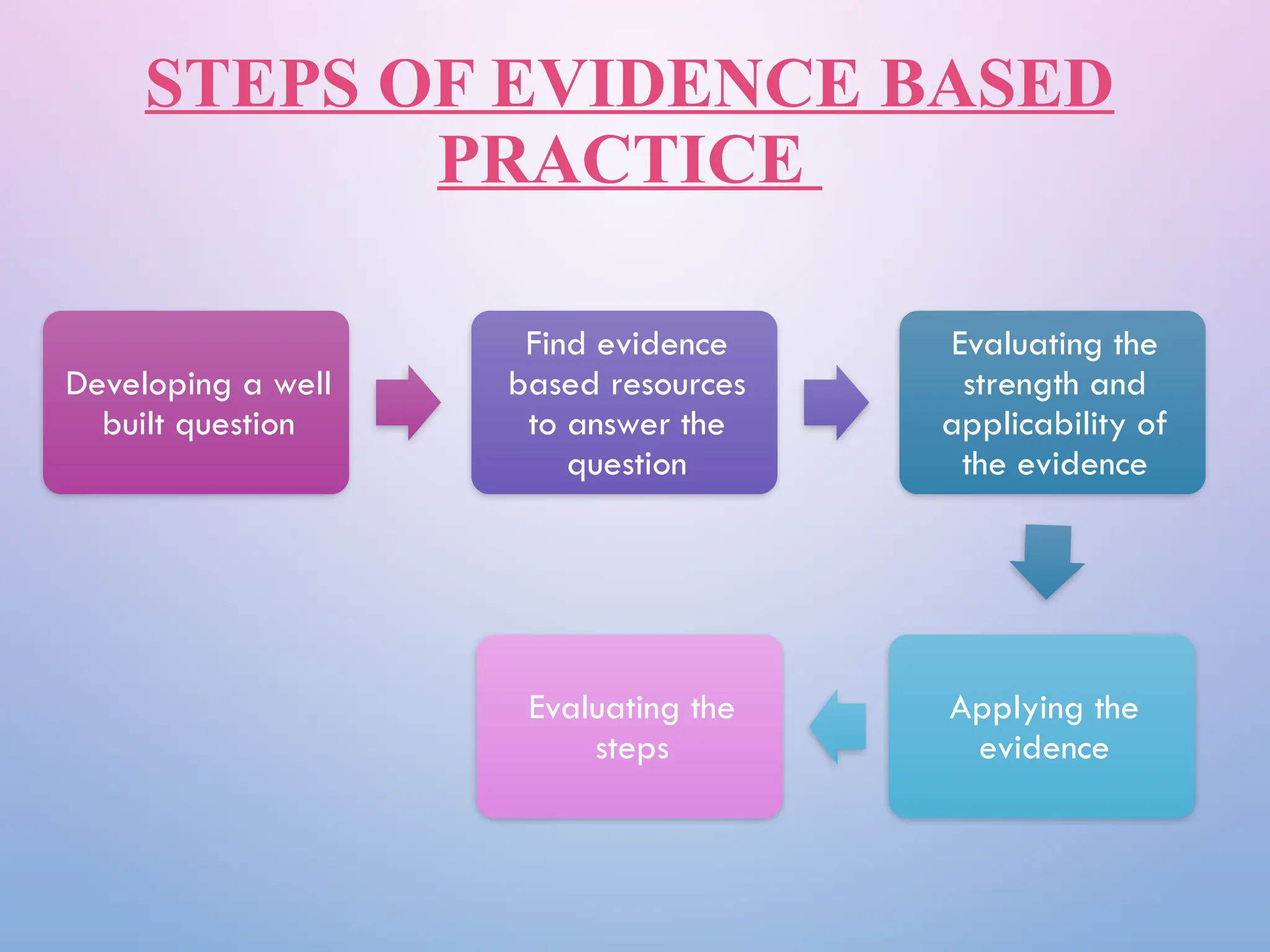
Developing a well
built question
Find evidence
based resources
to answer the
question
Evaluating the
strength and
applicability of
the evidence
Applying the
evidence
Evaluating the
steps
DEVELOPING A QUESTION
• With clinical areas ,there is often a barrage of
details to digest. A well built question includes
the following components
• The patients disorder or disease.
• The intervention or finding under review.
• A comparison between intervention.
FIND EVIDENCE BASED RESOURCES
TO ANSWER THE QUESTION
• Once a clinical practice question has been selected, the
next step is to search and assemble research evidence on the
topic. In doing a literature review as a background for a
new study, the central goal is to discover where the gap are
and how best to advance knowledge.
EBP RESOURCES
• Clinical evidence.
• Dynamed.
• PubMed.
• Cochrane library.
• Reference book entries.
• Textbooks, chapters, appendices.
• Drug monographs, guides to diagnostic tests.
• The library’s bobcat catalog.
• Selected electronic reference tools for background
information in the health science.
EVALUATING THE STRENGTH AND
APPLICABILITY OF THE EVIDENCE
• The assessment of evidence by systematically
reviewing its relevance, validity and results of specific
situations.
• In determining the implementation potential of an
innovation in a particular setting, several issues should
be considered, particularly the transferability of the
innovation, the feasibility of implementing it and its
cost benefit ratio.
• If the implementation assessment suggests that
there might be problems in testing the innovation
in that particular practice setting, then the team can
either identify a new problem and begin the
process anew or consider adopting the plan to
improve the implementation potential.
APPLYING THE EVIDENCE
• If the implementation criteria are met the team can
design and plot the innovation. To reach your
conclusion you may consult questions related to
diagnosis ,therapy, harm and prognosis keep in mind
that you must interpret the information based on a
number of criteria and depending on your skill and
experience ,you may need to confer with a peer
EVALUATING THE STEPS
• The fifth step of the process is outcome evaluation, it
attempts to interpret the results and evaluate the outcomes
of the applied evidence (intervention). Evaluation of the
process and the results may occur through peer assessment,
audit, or even self reflection. Depending on the type of
outcomes achieved, it may be possible to compare the
outcomes of a study with similar outcomes on a local,
regional, national, or international level.
BARRIERS TO EBP
• Lack of value for research in practice .
• Difficulty in bringing change.
• Lack of administrative support.
• Lack of knowledge.
• Lack of time for research.
• Many nurse have not receive any formal instruction in
research and they lack skill to judge the merits of study.
CONT…
• Unavailability of research reports, which are not easily
gathered.
• Complexity of the research regarding evidence based
practice.
• Organization have failed to motivate or rewards.
• There is a shortage of role model nurses who can be
evaluated for their success in using or promoting the
use of research in clinical practice.
ADVANTAGES OF EBP
• Information explores
• Provide better patient outcomes.
• EBP increases the efficiency of nurses.
• Making decision based on knowledge that is backed by
research.
• It keeps nursing practice current to the new trends and
updated the guidelines of care.
CONT…
• It provides variations in practice because it can help
determine high quality cost effective intervention that
actually work.
• It promotes high quality and cost effective intervention
and treatment.
• Using EBP to provide care to patients increases the
nurses confidence.
DISADVANTAGES OF EBP
Disadvantages of evidence-based practice include;
 The shortage of evidence.
 The oversight of common sense.
• The length of time and difficulty of finding valid
credible evidence
CONCLUSION
Health care that is evidence-based and conducted in a caring
context leads to better clinical decisions and patient
outcomes. Gaining knowledge and skills in the EBP process
provides nurses and other clinicians the tools needed to take
ownership of their practices and transform health care.
ASSIGNMENT
Write an assignment on importance of evidence
based practice in nursing education.
evidence based practice ppt.pptxXXXXXXXX

evidence based practice ppt.pptxXXXXXXXX

  • 2.
  • 3.
    INTRODUCTION Evidence based practiceis an approach that enables clinicians to provide the highest quality of care in meeting the multiphase needs to their patients and family.
  • 4.
    DEFINITION • Evidence basedpractice (EBP) is the process of making clinical decisions based upon evidence, combined with clinical experience and patients expectations. • Evidence-based practice (EBP) is a problem-solving approach to the delivery of health care that integrates the best evidence from studies and patient care data with clinician expertise and patient preferences and values. (Fineout-overholt E, 2010).
  • 5.
  • 6.
    AIMS OF EBP •To provide the high quality and most cost efficient nursing care possible. • To advance quality of care provided by health worker. • To increase satisfaction among patients. • To focus on nursing practice away from habits and tradition to evidence and research. • It results in better patient outcomes. • It contributes to the science of nursing. • It keeps practice current and relevant. • It increases confidence in decision making.
  • 7.
    OBJECTIVES AND PURPOSESOF EBP • Evidence based practice seeks to replace practice as usual with practice guided by rigorous outcomes oriented research ideally randomized controlled trials. • It also seeks to make practice a less subjective enterprise and to rise it to a higher level of accountability. • Reduces the variations in nursing care and assist with efficient and effective decision making. • Providing practice to the nurse evidence based data to deliver effective care.
  • 8.
    NEED FOR EBP •For making sure that each client get the best possible services. • Update knowledge and is essential for lifelong learning. • Provide clinical judgment. • Improved care provided and save lives. • To provide framework for understanding the evidence based practice process.
  • 9.
    STEPS OF EVIDENCEBASED PRACTICE Developing a well built question Find evidence based resources to answer the question Evaluating the strength and applicability of the evidence Applying the evidence Evaluating the steps
  • 10.
    DEVELOPING A QUESTION •With clinical areas ,there is often a barrage of details to digest. A well built question includes the following components • The patients disorder or disease. • The intervention or finding under review. • A comparison between intervention.
  • 11.
    FIND EVIDENCE BASEDRESOURCES TO ANSWER THE QUESTION • Once a clinical practice question has been selected, the next step is to search and assemble research evidence on the topic. In doing a literature review as a background for a new study, the central goal is to discover where the gap are and how best to advance knowledge.
  • 12.
    EBP RESOURCES • Clinicalevidence. • Dynamed. • PubMed. • Cochrane library. • Reference book entries. • Textbooks, chapters, appendices. • Drug monographs, guides to diagnostic tests. • The library’s bobcat catalog. • Selected electronic reference tools for background information in the health science.
  • 13.
    EVALUATING THE STRENGTHAND APPLICABILITY OF THE EVIDENCE • The assessment of evidence by systematically reviewing its relevance, validity and results of specific situations. • In determining the implementation potential of an innovation in a particular setting, several issues should be considered, particularly the transferability of the innovation, the feasibility of implementing it and its cost benefit ratio.
  • 14.
    • If theimplementation assessment suggests that there might be problems in testing the innovation in that particular practice setting, then the team can either identify a new problem and begin the process anew or consider adopting the plan to improve the implementation potential.
  • 15.
    APPLYING THE EVIDENCE •If the implementation criteria are met the team can design and plot the innovation. To reach your conclusion you may consult questions related to diagnosis ,therapy, harm and prognosis keep in mind that you must interpret the information based on a number of criteria and depending on your skill and experience ,you may need to confer with a peer
  • 16.
    EVALUATING THE STEPS •The fifth step of the process is outcome evaluation, it attempts to interpret the results and evaluate the outcomes of the applied evidence (intervention). Evaluation of the process and the results may occur through peer assessment, audit, or even self reflection. Depending on the type of outcomes achieved, it may be possible to compare the outcomes of a study with similar outcomes on a local, regional, national, or international level.
  • 17.
    BARRIERS TO EBP •Lack of value for research in practice . • Difficulty in bringing change. • Lack of administrative support. • Lack of knowledge. • Lack of time for research. • Many nurse have not receive any formal instruction in research and they lack skill to judge the merits of study.
  • 18.
    CONT… • Unavailability ofresearch reports, which are not easily gathered. • Complexity of the research regarding evidence based practice. • Organization have failed to motivate or rewards. • There is a shortage of role model nurses who can be evaluated for their success in using or promoting the use of research in clinical practice.
  • 19.
    ADVANTAGES OF EBP •Information explores • Provide better patient outcomes. • EBP increases the efficiency of nurses. • Making decision based on knowledge that is backed by research. • It keeps nursing practice current to the new trends and updated the guidelines of care.
  • 20.
    CONT… • It providesvariations in practice because it can help determine high quality cost effective intervention that actually work. • It promotes high quality and cost effective intervention and treatment. • Using EBP to provide care to patients increases the nurses confidence.
  • 21.
    DISADVANTAGES OF EBP Disadvantagesof evidence-based practice include;  The shortage of evidence.  The oversight of common sense. • The length of time and difficulty of finding valid credible evidence
  • 23.
    CONCLUSION Health care thatis evidence-based and conducted in a caring context leads to better clinical decisions and patient outcomes. Gaining knowledge and skills in the EBP process provides nurses and other clinicians the tools needed to take ownership of their practices and transform health care.
  • 24.
    ASSIGNMENT Write an assignmenton importance of evidence based practice in nursing education.