





“We cannot afford to live with “doing it
my way” as we always doing it mentally.
Avoid basing decisions on untested
but strong past beliefs or evidence can
bring changes, what the winners do
- B. Baruch
PROBLEM SOLVING APPROACH
TOOL
EVIDENCE
BASED
PRACTICE
-Ms. Sucheta Panchal
• Definitions
• Aims
• Purposes
• Research utilization
and EBP
• Historical view
• Types of Evidence
and evidence
hierarchies
• Resources
• Uses
• Barriers and Strategies
• EBP models
• Assumptions of EBP in
nursing
• Process of using
evidence in practice
• EBP in organizational
context
• Limitations
• Role of nurses
CONTENT
• Define evidence based practice
• Describe the aims and purposes of EBP
• Identify the difference between EBP and
research utilization
• Encounter the origin of concept of EBP
• Classify the evidences in hierarchial fashion
• Identify different resources of EBP
• Describe the uses of EBP
OBJECTIVES
• Identify the barriers and the strategies to
overcome
• Enlist the EBP models
• Explain the Assumptions of EBP in
nursing
• Follow the Process of using evidence in
practice
• Determine the Limitations to EBP
• Describe the Role of nurse in EBP
OBJECTIVES
DEFINITIONS
"The integration of the best research
evidence with clinical expertise and patient
values"
Sackett, et al. 2000
EVIDENCE BASED
PRACTICE
"The integration of the best available
research with clinical expertise in the
context of patient characteristics, culture
and preferences."
American Psychological Association
(2006, p. 273)
EVIDENCE BASED
PRACTICE
“A problem-solving approach to clinical decision making
within a health-care organization that integrates the
best available scientific evidence with the best
available experiential evidence. EBP considers
internal and external influences on practice and
encourages critical thinking in the judicious application
of evidence to care of the individual patient, patient
population, or system. EBP uses the latest research
evidence to produce high quality health care. The
challenge for health-care providers is to implement the
best interventions and practices informed by the
evidence.
Newhouse, Dearholt, Poe, Pugh, & White, 2005
EVIDENCE BASED
PRACTICE
EVIDENCE BASED
NURSING
“An integration of the best evidence
available, nursing expertise, and the
values and preferences of the individuals,
families, and communities who are
served.”
EVIDENCE BASED
NURSING
"Evidence-based decision-making is a
continuous interactive process involving
the explicit, conscientious and judicious
consideration of the best available
evidence to provide care."
Position Statement by Canadian Nurses'
Association
EVIDENCE BASED
NURSING
In increasing numbers, nurses as members
of interdisciplinary and transdisciplinary
teams are implementing evidence-based
practice (EBP) changes.
Worral PS, 2009
• To provide the highest quality and most cost-
efficient nursing care possible.
• To advance quality of care provided by nurses.
• To increases satisfaction of patients
• To focus on nursing practice away from habits
and tradition to evidence and research.
AIMS OF EVIDENCE BASED
NURSING PRACTICE
• Replaces practice as usual, with practice
guided by rigorous outcome-oriented
research, ideally randomized controlled trials.
• Makes practice a less subjective enterprise
• Raises the practice to a higher level of
accountability.
• Identifies best practices in nursing and other
disciplines. (Baumann SL, 2010)
PURPOSES OF EVIDENCE
BASED NURSING
PRACTICE
RESEARCH
UTILISATION AND
EVIDENCE BASED
PRACTICE
• Since the introduction of EBP in the 1990s,
questions regarding the relationship
between RU and EBP have been raised.
• The terms are often used interchangeably;
however, they are not synonymous.
RU & EBP
The two major differences
• RU uses only
research evidence
• RU is dependent on
research publication
and availability
• EBP incorporates
non-research
evidence
• EBP includes sources
of data not yet
published and
organizational data
RU & EBP
• EBP incorporates
– Theory
– Clinical decision making
– Clinical judgment
– Knowledge of research techniques
– followed by application of the best, most
effective, and clinically meaningful evidence
(Melnyk & Fineout-Overholt, 2005).
RU & EBP
• Evidence constitutes research findings as well
as other sources of credible information such
as
quality improvement data
operational data
evaluative data
consensus of experts
affirmed clinical experience
patient preference.
RU & EBP
RU uses the same critical review,
recommendation, and implementation process
as EBP
RU & EBP
• In 1972, A. L. Cochrane, a British
epidemiologist, criticized the health profession
for not knowing the outcomes of medical
treatment.
• In the 1980s, the term evidence based medicine
was being used at McMaster University Medical
School in Canada.
HISTORICAL VIEW
• These events led to the establishment, in 1993,
of the Cochrane Collaboration to provide
systematic reviews about the effects of health
care.
• These reviews provide logical reasoning and
sound evidence for providing effective treatment
regimes.
HISTORICAL VIEW
• Relatively new developments include:
– Increasingly sophisticated analytical techniques
– Improved presentation and dissemination of
information
– Growing knowledge of how to implement
findings while effectively considering patient
preferences, costs, and policy issues
– Better understanding of how to measure effect
and use feedback to promote ongoing
improvement.
HISTORICAL VIEW
WAYS OF ACQUIRING
KNOWLEDGE IN NURSING
Traditions
Authority
Borrowing
Trial & Error
Personal Experience
Role Modeling
Intuition
Reasoning
Research
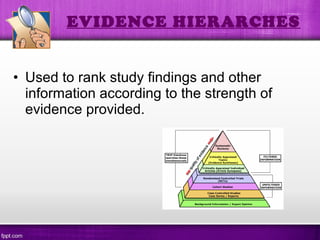
• Used to rank study findings and other
information according to the strength of
evidence provided.
EVIDENCE HIERARCHES
• Best evidence refers generally to findings from
researches that are methodologically
appropriate, rigorous and clinically relevant for
answering pressing questions
• Questions are:
– Efficacy
– safety
– cost effectiveness of nursing interventions
– reliability of nursing assessment measures
– determinants of health and wellbeing.
EVIDENCE HIERARCHES
• Systematic reviews
• Cornerstone of EBP
• Rigorous integration of research evidence from multiple
studies on a topic
• Involve meta-synthesis of qualitative studies or meta-
analysis of quantitative studies
• Sources for systematic reviews are:
– Cochrane Collaboration (www.cochrane.org)
– Cochrane reviews
– Methodological abstracts
– Campbell collaboration (C2- SPECTR, RIPE)
RESOURCES OF EBP
• Clinical practice guidelines
–Evidence-based practice guidelines combine
a synthesis of research evidence with
specific recommendations for clinical
decision making
–Clinical practice guidelines should be
carefully and systematically appraised
RESOURCES OF EBP
• Clinical practice guidelines
–Sources are:
– MEDLINE
– National Guidelines clearinghouse
(www.guidelines.gov)
– RNAO (Registered Nurse Association of Ontario,
Canada- www.rnao.org/best practices.)
– National institute for clinical excellence
(www.nice.org.uk)
– Association of women’s health, obstetric and neonatal
nursing (AWHONN- www.awhonn.org)
RESOURCES OF EBP
• Other pre appraised evidence
–Preprocessed or pre-appraised evidence
is research evidence that has been
carefully selected from primary studies
and evaluated for use by clinicians.
–Sources are:
• Clinical evidence (www.clinicalevidence.com)
• Evidence based nursing
(www.evidencebasednursing.com)
RESOURCES OF EBP
• Journals and professional organizations
are increasingly publishing brief clinical
synopses of research evidence from high
quality studies and systematic reviews.
• e. g. CAT (critically appraised topic)- best
practice recommendations on a topic.
RESOURCES OF EBP
• Nurses (RN, NP)
• Nursing assistants
• Physicians
• Respiratory Therapists
• Physical Therapists
• Pharmacists
• Others
USERS OF EBP
• supports and informs clinical,
administrative, and educational
decision making.
• EBP ensures 3E
–E-efficacy
–E-efficiency
–E-effectiveness
USES OF EBP
• EBP weighs risk, benefit, and cost against a backdrop
of patient preferences.
• This decision making encourages health-care
providers to question practice and determine which
interventions work and which do not.
• EBP ensures that nurses use evidence to promote
optimal outcomes or equivalent care at lower cost or in
less time that health-care providers promote patient
satisfaction and higher health-related quality of life.
USES OF EBP
• Nancy Dickenson hazard states, “nurses have
the capacity to serve as caregivers and change
agents in creating and implementing community
and population-focused health systems”
• Evidence based nursing practice is an attempt to
facilitate the management of the growing
literature and technology accessible to health
care providers that can potentially improve
patient care and their outcomes.
BARRIERS AND STRATEGIES
TO OVERCOME
• There is also a need to overcome the barrier to
encourage the use of research by new
graduates in an attempt to ensure familiarity with
the process.
BARRIERS AND STRATEGIES
TO OVERCOME
• STETLER MODEL: Models that provide a
framework for individual clinicians
• IOWA MODEL: For organizations or team of
clinicians
• ROGER’S MODEL: Diffusion of innovations
theory
EBP MODEL
• Melnyk & Fineout Overholt 2005: Advancing
research and clinical practice through close
collaboration model (ARCC)
• Soukup 2000: Center for advanced nursing
practice model
• Goode & Piedalue, 1999: Evidence based
multidisciplinary practice model
EBP MODEL
• Newhouse et al, 2005: John’s Hopkins
Nursing EBP model
• Logan &Graham, 1998: Ottawa model of
Research use
• Dicenso et al.2005: Framework for adopting
an evidence based innovation
EBP MODEL
• Nursing is both a science and an applied
profession.
• Knowledge is important to professional
practice, and there are limits to knowledge
that must be identified.
• Not all evidence is created equal, and there is
a need to use the best available evidence.
• Evidence-based practice contributes to
improved outcomes (Newhouse).
ASSUMPTIONS OF EBP IN
NURSING
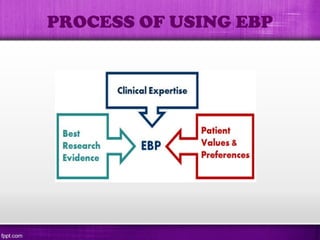
• Nurses have regular opportunity to put
research into practice
• EBP is the integration of clinical expertise,
patient values and the best research
evidence into the decision making process
for the patient care (sackett D, 2002)
PROCESS OF USING EBP
– Clinical expertise
• Clinician’s cumulated experience
• Education and clinical skills
– Patient values
• Patient brings to encounter his or her own personal
preferences and unique concerns, expectations
and values
– Best research evidence
• Found in clinically relevant research that has been
conducted using sound methodology
PROCESS OF USING EBP
• The evidence, by itself, does not make the
decision but it can help to support the patient
care process
• The full integration of these three
components enhances the opportunity of
optimal clinical outcomes and quality of life
PROCESS OF USING EBP
• The practice of EBP is usually triggered by patient
encounters which generate questions about the
effect of therapy, the utility of diagnostic tests, the
prognosis of diseases and/or the etiology of
disorders.
• EBP requires new skills of the clinician including
efficient literature searching and the application of
formal rules of evidence in evaluating the clinical
literature.
1. FRAMING AN ANSWERABLE CLINICAL
QUESTION
– Include PICO (patient intervention comparison
outcome)
– P- Patient disorder or disease
– I- Intervention or finding under review
– C- compare intervention
– O-Outcome
– PICO application is a systematic way to identify
important concepts in a case and formulate a
question for searching
STEPS IN EBP
2. SEARCHING FOR RELEVANT
RESEARCH BASED EVIDENCE
• Consult several type of information
resources such as:
–General information resources ( E-books)
–Filtered resources (Cochrane, natural
standard)
–Unfiltered resources (CINHAL, BIOSIS,
PsycINFO)
STEPS IN EBP
3. CRITICAL APPRAISAL
An appraisal of the evidence involves such
considerations as the validity of study findings,
their clinical importance, the precision of
estimates of effects, associated costs and risks
and utility in a particular clinical situation.
STEPS IN EBP
4. INTEGRATING EVIDENCE WITH OTHER
FACTORS
Integration with clinical expertise, patient
values and best research evidence.
STEPS IN EBP
5. IMPLEMENTING THE EVIDENCE AND
EVALUATING OUTCOMES
–It is to determine whether our action or
decision was useful and achieved the
desired outcome.
–Outcomes will be evaluated on the basis of:
• Transferability
• Feasibility
• Cost/ benefit ratio
STEPS IN EBP
• Selecting a problem for an EBP project
• Addressing practical issues in organizational
EBP efforts
• Finding and appraising evidence clinical practice
guidelines
• Making decisions based on evidence appraisals
• Assessing implementation potential
• Developing evidence based guidelines
• Implementing and evaluating the innovation
EBP IN AN ORGANISATIONAL
CONTEXT
• Resistant to changes in nursing practice.
• Ability to critically appraise research
findings.
• Time, workload pressures, and competing
priorities.
• Lack of continuing education programs.
• Fear of "stepping on one's toes"
• Poor administrative support.
LIMITATIONS
• Read widely and critically:
– Professionally accountable nurses keep abreast of
important developments and real journals relating
to their specialty, including research report in
them.
• Attend professional gathering:
– Conferences, workshops, CNEs include
presentation of studies that have clinical
relevance. Attendees get opportunities to meet
researches and to explore practice implications.
NURSE’S ROLE IN EBP
• Learn to expect evidence that a
procedure is effective:
– Standardization of any procedure is based on
the effectiveness of its outcome. Nurses need
to develop expectations that the made
decision is based on sound evidence based
rationales.
• Involve in journal club:
– Many organizations employ nurses sponsor
journal clubs that review research articles that
have potential relevance to practice.
NURSE’S ROLE IN EBP
• Pursue and participate in research
utilization/ evidence based practice
projects:
– Nurses need to develop more positive attitude
towards research and better research skills.
NURSE’S ROLE IN EBP
 
“EBP is not cook-book practice-
evidence needs extrapolation to
the patient’s unique biology and
values
EBP is not cost-cutting practice-
when efficacy for the patient is
paramount, costs may rise, not
SUMMARY
BIBLIOGRAPHY
• Ciliska, D. (2005). Educating for evidence-based practice. Journal of
Professional Nursing. Dec., 21(6), 345.
• Gambrill, E. (2003). Evidence-based practice: Implications for
knowledge development and use in social work. In A. Rosen & E.
Proctor (Eds.), Developing practice guidelines for social work
intervention (pp. 37-58). New York: Columbia University Press.
• Gibbs, L. (2003). Evidence-based practice for the helping
professions. New York: Wadsworth.
• Nancy Dickenson-Hazard (2004) Global Health Issues and
Challenges Journal of Nursing Scholarship 36 (1) , 6–10.
• Polit F. Denise and beck C. Tatano, Nursing research-generating
and assessing evidence for nursing practice, 8th
edition, Wolters
Kluwer (India) Pvt Ltd, New Delhi, page no 28-53
Evidence based practice in nursing

Evidence based practice in nursing

  • 1.
    “We cannot affordto live with “doing it my way” as we always doing it mentally. Avoid basing decisions on untested but strong past beliefs or evidence can bring changes, what the winners do - B. Baruch
  • 2.
  • 3.
  • 4.
  • 5.
    • Definitions • Aims •Purposes • Research utilization and EBP • Historical view • Types of Evidence and evidence hierarchies • Resources • Uses • Barriers and Strategies • EBP models • Assumptions of EBP in nursing • Process of using evidence in practice • EBP in organizational context • Limitations • Role of nurses CONTENT
  • 6.
    • Define evidencebased practice • Describe the aims and purposes of EBP • Identify the difference between EBP and research utilization • Encounter the origin of concept of EBP • Classify the evidences in hierarchial fashion • Identify different resources of EBP • Describe the uses of EBP OBJECTIVES
  • 7.
    • Identify thebarriers and the strategies to overcome • Enlist the EBP models • Explain the Assumptions of EBP in nursing • Follow the Process of using evidence in practice • Determine the Limitations to EBP • Describe the Role of nurse in EBP OBJECTIVES
  • 8.
  • 9.
    "The integration ofthe best research evidence with clinical expertise and patient values" Sackett, et al. 2000 EVIDENCE BASED PRACTICE
  • 10.
    "The integration ofthe best available research with clinical expertise in the context of patient characteristics, culture and preferences." American Psychological Association (2006, p. 273) EVIDENCE BASED PRACTICE
  • 11.
    “A problem-solving approachto clinical decision making within a health-care organization that integrates the best available scientific evidence with the best available experiential evidence. EBP considers internal and external influences on practice and encourages critical thinking in the judicious application of evidence to care of the individual patient, patient population, or system. EBP uses the latest research evidence to produce high quality health care. The challenge for health-care providers is to implement the best interventions and practices informed by the evidence. Newhouse, Dearholt, Poe, Pugh, & White, 2005 EVIDENCE BASED PRACTICE
  • 12.
    EVIDENCE BASED NURSING “An integrationof the best evidence available, nursing expertise, and the values and preferences of the individuals, families, and communities who are served.”
  • 13.
    EVIDENCE BASED NURSING "Evidence-based decision-makingis a continuous interactive process involving the explicit, conscientious and judicious consideration of the best available evidence to provide care." Position Statement by Canadian Nurses' Association
  • 14.
    EVIDENCE BASED NURSING In increasingnumbers, nurses as members of interdisciplinary and transdisciplinary teams are implementing evidence-based practice (EBP) changes. Worral PS, 2009
  • 15.
    • To providethe highest quality and most cost- efficient nursing care possible. • To advance quality of care provided by nurses. • To increases satisfaction of patients • To focus on nursing practice away from habits and tradition to evidence and research. AIMS OF EVIDENCE BASED NURSING PRACTICE
  • 16.
    • Replaces practiceas usual, with practice guided by rigorous outcome-oriented research, ideally randomized controlled trials. • Makes practice a less subjective enterprise • Raises the practice to a higher level of accountability. • Identifies best practices in nursing and other disciplines. (Baumann SL, 2010) PURPOSES OF EVIDENCE BASED NURSING PRACTICE
  • 17.
  • 18.
    • Since theintroduction of EBP in the 1990s, questions regarding the relationship between RU and EBP have been raised. • The terms are often used interchangeably; however, they are not synonymous. RU & EBP
  • 19.
    The two majordifferences • RU uses only research evidence • RU is dependent on research publication and availability • EBP incorporates non-research evidence • EBP includes sources of data not yet published and organizational data RU & EBP
  • 20.
    • EBP incorporates –Theory – Clinical decision making – Clinical judgment – Knowledge of research techniques – followed by application of the best, most effective, and clinically meaningful evidence (Melnyk & Fineout-Overholt, 2005). RU & EBP
  • 21.
    • Evidence constitutesresearch findings as well as other sources of credible information such as quality improvement data operational data evaluative data consensus of experts affirmed clinical experience patient preference. RU & EBP
  • 22.
    RU uses thesame critical review, recommendation, and implementation process as EBP RU & EBP
  • 23.
    • In 1972,A. L. Cochrane, a British epidemiologist, criticized the health profession for not knowing the outcomes of medical treatment. • In the 1980s, the term evidence based medicine was being used at McMaster University Medical School in Canada. HISTORICAL VIEW
  • 24.
    • These eventsled to the establishment, in 1993, of the Cochrane Collaboration to provide systematic reviews about the effects of health care. • These reviews provide logical reasoning and sound evidence for providing effective treatment regimes. HISTORICAL VIEW
  • 25.
    • Relatively newdevelopments include: – Increasingly sophisticated analytical techniques – Improved presentation and dissemination of information – Growing knowledge of how to implement findings while effectively considering patient preferences, costs, and policy issues – Better understanding of how to measure effect and use feedback to promote ongoing improvement. HISTORICAL VIEW
  • 26.
    WAYS OF ACQUIRING KNOWLEDGEIN NURSING Traditions Authority Borrowing Trial & Error Personal Experience Role Modeling Intuition Reasoning Research
  • 27.
    • Used torank study findings and other information according to the strength of evidence provided. EVIDENCE HIERARCHES
  • 28.
    • Best evidencerefers generally to findings from researches that are methodologically appropriate, rigorous and clinically relevant for answering pressing questions • Questions are: – Efficacy – safety – cost effectiveness of nursing interventions – reliability of nursing assessment measures – determinants of health and wellbeing. EVIDENCE HIERARCHES
  • 29.
    • Systematic reviews •Cornerstone of EBP • Rigorous integration of research evidence from multiple studies on a topic • Involve meta-synthesis of qualitative studies or meta- analysis of quantitative studies • Sources for systematic reviews are: – Cochrane Collaboration (www.cochrane.org) – Cochrane reviews – Methodological abstracts – Campbell collaboration (C2- SPECTR, RIPE) RESOURCES OF EBP
  • 30.
    • Clinical practiceguidelines –Evidence-based practice guidelines combine a synthesis of research evidence with specific recommendations for clinical decision making –Clinical practice guidelines should be carefully and systematically appraised RESOURCES OF EBP
  • 31.
    • Clinical practiceguidelines –Sources are: – MEDLINE – National Guidelines clearinghouse (www.guidelines.gov) – RNAO (Registered Nurse Association of Ontario, Canada- www.rnao.org/best practices.) – National institute for clinical excellence (www.nice.org.uk) – Association of women’s health, obstetric and neonatal nursing (AWHONN- www.awhonn.org) RESOURCES OF EBP
  • 32.
    • Other preappraised evidence –Preprocessed or pre-appraised evidence is research evidence that has been carefully selected from primary studies and evaluated for use by clinicians. –Sources are: • Clinical evidence (www.clinicalevidence.com) • Evidence based nursing (www.evidencebasednursing.com) RESOURCES OF EBP
  • 33.
    • Journals andprofessional organizations are increasingly publishing brief clinical synopses of research evidence from high quality studies and systematic reviews. • e. g. CAT (critically appraised topic)- best practice recommendations on a topic. RESOURCES OF EBP
  • 34.
    • Nurses (RN,NP) • Nursing assistants • Physicians • Respiratory Therapists • Physical Therapists • Pharmacists • Others USERS OF EBP
  • 35.
    • supports andinforms clinical, administrative, and educational decision making. • EBP ensures 3E –E-efficacy –E-efficiency –E-effectiveness USES OF EBP
  • 36.
    • EBP weighsrisk, benefit, and cost against a backdrop of patient preferences. • This decision making encourages health-care providers to question practice and determine which interventions work and which do not. • EBP ensures that nurses use evidence to promote optimal outcomes or equivalent care at lower cost or in less time that health-care providers promote patient satisfaction and higher health-related quality of life. USES OF EBP
  • 37.
    • Nancy Dickensonhazard states, “nurses have the capacity to serve as caregivers and change agents in creating and implementing community and population-focused health systems” • Evidence based nursing practice is an attempt to facilitate the management of the growing literature and technology accessible to health care providers that can potentially improve patient care and their outcomes. BARRIERS AND STRATEGIES TO OVERCOME
  • 38.
    • There isalso a need to overcome the barrier to encourage the use of research by new graduates in an attempt to ensure familiarity with the process. BARRIERS AND STRATEGIES TO OVERCOME
  • 39.
    • STETLER MODEL:Models that provide a framework for individual clinicians • IOWA MODEL: For organizations or team of clinicians • ROGER’S MODEL: Diffusion of innovations theory EBP MODEL
  • 40.
    • Melnyk &Fineout Overholt 2005: Advancing research and clinical practice through close collaboration model (ARCC) • Soukup 2000: Center for advanced nursing practice model • Goode & Piedalue, 1999: Evidence based multidisciplinary practice model EBP MODEL
  • 41.
    • Newhouse etal, 2005: John’s Hopkins Nursing EBP model • Logan &Graham, 1998: Ottawa model of Research use • Dicenso et al.2005: Framework for adopting an evidence based innovation EBP MODEL
  • 42.
    • Nursing isboth a science and an applied profession. • Knowledge is important to professional practice, and there are limits to knowledge that must be identified. • Not all evidence is created equal, and there is a need to use the best available evidence. • Evidence-based practice contributes to improved outcomes (Newhouse). ASSUMPTIONS OF EBP IN NURSING
  • 43.
    • Nurses haveregular opportunity to put research into practice • EBP is the integration of clinical expertise, patient values and the best research evidence into the decision making process for the patient care (sackett D, 2002) PROCESS OF USING EBP
  • 44.
  • 45.
    – Clinical expertise •Clinician’s cumulated experience • Education and clinical skills – Patient values • Patient brings to encounter his or her own personal preferences and unique concerns, expectations and values – Best research evidence • Found in clinically relevant research that has been conducted using sound methodology PROCESS OF USING EBP
  • 46.
    PROCESS OF USINGEBP • The evidence, by itself, does not make the decision but it can help to support the patient care process • The full integration of these three components enhances the opportunity of optimal clinical outcomes and quality of life
  • 47.
    PROCESS OF USINGEBP • The practice of EBP is usually triggered by patient encounters which generate questions about the effect of therapy, the utility of diagnostic tests, the prognosis of diseases and/or the etiology of disorders. • EBP requires new skills of the clinician including efficient literature searching and the application of formal rules of evidence in evaluating the clinical literature.
  • 48.
    1. FRAMING ANANSWERABLE CLINICAL QUESTION – Include PICO (patient intervention comparison outcome) – P- Patient disorder or disease – I- Intervention or finding under review – C- compare intervention – O-Outcome – PICO application is a systematic way to identify important concepts in a case and formulate a question for searching STEPS IN EBP
  • 49.
    2. SEARCHING FORRELEVANT RESEARCH BASED EVIDENCE • Consult several type of information resources such as: –General information resources ( E-books) –Filtered resources (Cochrane, natural standard) –Unfiltered resources (CINHAL, BIOSIS, PsycINFO) STEPS IN EBP
  • 50.
    3. CRITICAL APPRAISAL Anappraisal of the evidence involves such considerations as the validity of study findings, their clinical importance, the precision of estimates of effects, associated costs and risks and utility in a particular clinical situation. STEPS IN EBP
  • 51.
    4. INTEGRATING EVIDENCEWITH OTHER FACTORS Integration with clinical expertise, patient values and best research evidence. STEPS IN EBP
  • 52.
    5. IMPLEMENTING THEEVIDENCE AND EVALUATING OUTCOMES –It is to determine whether our action or decision was useful and achieved the desired outcome. –Outcomes will be evaluated on the basis of: • Transferability • Feasibility • Cost/ benefit ratio STEPS IN EBP
  • 53.
    • Selecting aproblem for an EBP project • Addressing practical issues in organizational EBP efforts • Finding and appraising evidence clinical practice guidelines • Making decisions based on evidence appraisals • Assessing implementation potential • Developing evidence based guidelines • Implementing and evaluating the innovation EBP IN AN ORGANISATIONAL CONTEXT
  • 54.
    • Resistant tochanges in nursing practice. • Ability to critically appraise research findings. • Time, workload pressures, and competing priorities. • Lack of continuing education programs. • Fear of "stepping on one's toes" • Poor administrative support. LIMITATIONS
  • 55.
    • Read widelyand critically: – Professionally accountable nurses keep abreast of important developments and real journals relating to their specialty, including research report in them. • Attend professional gathering: – Conferences, workshops, CNEs include presentation of studies that have clinical relevance. Attendees get opportunities to meet researches and to explore practice implications. NURSE’S ROLE IN EBP
  • 56.
    • Learn toexpect evidence that a procedure is effective: – Standardization of any procedure is based on the effectiveness of its outcome. Nurses need to develop expectations that the made decision is based on sound evidence based rationales. • Involve in journal club: – Many organizations employ nurses sponsor journal clubs that review research articles that have potential relevance to practice. NURSE’S ROLE IN EBP
  • 57.
    • Pursue andparticipate in research utilization/ evidence based practice projects: – Nurses need to develop more positive attitude towards research and better research skills. NURSE’S ROLE IN EBP
  • 58.
      “EBP is notcook-book practice- evidence needs extrapolation to the patient’s unique biology and values EBP is not cost-cutting practice- when efficacy for the patient is paramount, costs may rise, not
  • 59.
  • 60.
    BIBLIOGRAPHY • Ciliska, D.(2005). Educating for evidence-based practice. Journal of Professional Nursing. Dec., 21(6), 345. • Gambrill, E. (2003). Evidence-based practice: Implications for knowledge development and use in social work. In A. Rosen & E. Proctor (Eds.), Developing practice guidelines for social work intervention (pp. 37-58). New York: Columbia University Press. • Gibbs, L. (2003). Evidence-based practice for the helping professions. New York: Wadsworth. • Nancy Dickenson-Hazard (2004) Global Health Issues and Challenges Journal of Nursing Scholarship 36 (1) , 6–10. • Polit F. Denise and beck C. Tatano, Nursing research-generating and assessing evidence for nursing practice, 8th edition, Wolters Kluwer (India) Pvt Ltd, New Delhi, page no 28-53

Editor's Notes

  • #3 Evidence-based practice (EBP) is a problem-solving approach to the delivery of health care that integrates the best evidence from studies and patient care data with clinician expertise and patient preferences and values.
  • #4 Health care that is evidence-based and conducted in a caring context leads to better clinical decisions and patient outcomes. Gaining knowledge and skills in the EBP process provides nurses and other clinicians the tools needed to take ownership of their practices and transform health care.
  • #5 Today’s health care system has become increasingly more costly and complex. Consequently, in this market-driven delivery system, there is a greater emphasis on outcomes, cost-effectiveness, and consumer satisfaction. These pressures operate in an environment of rapid information exchange, technological advancements, and an increasing nursing workload Nurses are challenged to maintain clinical competence, to demonstrate how their care positively affects patient outcomes, & to participate actively in clinical decision-making & practice improvements
  • #12 experiential (patient and practitioner)
  • #18 Research utilization refers to the use of some aspects of a study in an application unrelated to the original research. The term research utilization and evidence based practice are sometimes used synonymously
  • #22 These other forms of evidence are combined with research findings to facilitate decision making or problem solving.
  • #24 Although introducing new concepts and enhanced methods for research utilization, EBP is not conceptually new; its roots extend back many decades. However, the terms associated with any applied science change as the science evolves.
  • #30 Resources to support EBP are growing at a rapid pace
  • #36 E-efficacy (the ability to reach a desired result) E-efficiency (the achievement of a desired result with a minimum of expense, time, and effort) E-effectiveness (the ability to produce the desired result).
  • #40 Many models of research utilization and evidence based practice have developed, including:
  • #41 Many models of research utilization and evidence based practice have developed, including:
  • #42 Many models of research utilization and evidence based practice have developed, including: