


SUBINVOLUTION
&
UTI IN
PUERPERIUM
NIKITA SHARMA
NURSING TUTOR, BECON
SUBINVOLUTION
◦ When the involution is impaired or retarded, it is called
subinvolution.
◦ The uterus is the most common organ affected in subinvolution.
◦ As it is most accessible organ to be measured per abdomen, the
uterine involvement is considered clinically as an index to assess
subinvolution.
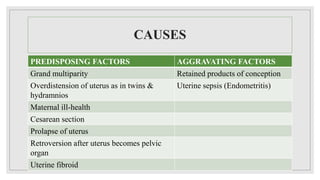
CAUSES
PREDISPOSING FACTORS AGGRAVATING FACTORS
Grand multiparity Retained products of conception
Overdistension of uterus as in twins &
hydramnios
Uterine sepsis (Endometritis)
Maternal ill-health
Cesarean section
Prolapse of uterus
Retroversion after uterus becomes pelvic
organ
Uterine fibroid
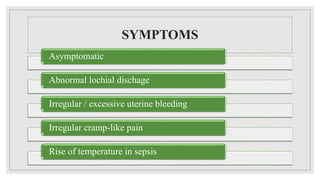
SYMPTOMS
Asymptomatic
Abnormal lochial dischage
Irregular / excessive uterine bleeding
Irregular cramp-like pain
Rise of temperature in sepsis
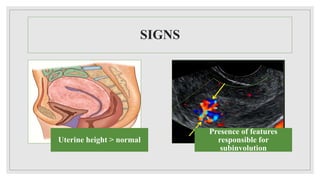
SIGNS
Uterine height > normal
Presence of features
responsible for
subinvolution
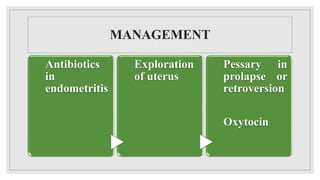
MANAGEMENT
Antibiotics
in
endometritis
Exploration
of uterus
Pessary in
prolapse or
retroversion
Oxytocin
URINARY COMPLICATIONS IN
PUERPERIUM
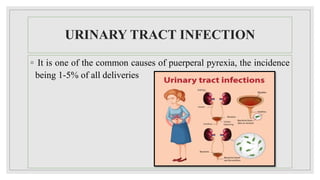
URINARY TRACT INFECTION
◦ It is one of the common causes of puerperal pyrexia, the incidence
being 1-5% of all deliveries
RISK FACTORS
◦ Reocurrance of previous cystitis or pyelitis
◦ Asymptomatic bacteriuria becomes overt
◦ Infection contracted for the first time during puerperium is due to:
 Effect of frequent catheterization
 Stasis f urine during early puerperium
CLINICAL FEATURES
◦ Elevated temperature and chills
◦ Urinary frequency
◦ Painful micturition
◦ Flank pain
DIAGNOSIS
◦ Urine analysis
◦ Urine culture
◦ Blood test
MANAGEMENT
◦ Increase fluid intake
◦ Empty the bladder frequently
◦ Appropriate rest
◦ Administer suitable antibiotic, analgesics & spasmodics
RETENTION OF URINE
◦ This is a common complication in early puerperium
CAUSES
 Bruising and edema of the bladder neck
 Reflex from the perineal injury
 Unaccustomed position
TREATMENT
◦ Simple measures to initiate micturition
◦ Indwelling catheter in situ for about 48 hours
◦ If more than 100ml of urine is measured after removal of catheter,
continuous drainage is resumed
◦ Appropriate urinary antiseptics should be administered for about 5-
7 days.
INCONTINENCE OF URINE
◦ Uncommon symptom following birth
TYPES
 Overflow incontinence
 Stress incontinence
 True incontinence (genitourinary fistula)
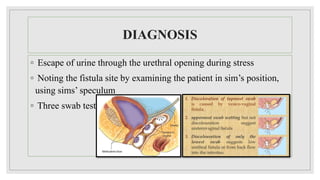
DIAGNOSIS
◦ Escape of urine through the urethral opening during stress
◦ Noting the fistula site by examining the patient in sim’s position,
using sims’ speculum
◦ Three swab test
SUPPRESSION OF URINE (AKI)
◦ If the 24 hours urine excretion is < 400 ml or less, suppression of urine is
diagnosed.
CAUSES
 EARLY PREGNANCY: Acute & massive hemorrhage,
Severe dehydration, septic abortion
 LATE PREGNANCY: Acute & massive hemorrhage,
Abruptio placenta, severe pre-eclampsia,
eclampsia, severe infection
CAUSES
 OTHER CAUSES IN PREGNANCY:
- Mismatched blood transfusion
- Renal disease
- obstructive causes
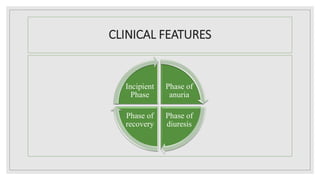
CLINICAL FEATURES
Phase of
anuria
Phase of
diuresis
Phase of
recovery
Incipient
Phase
INCIPIENT PHASE
◦ Short lasting phase
◦ Marked diminution in urinary output
PHASE OF ANURIA
◦ Lasts From a few hours to as long as 3 weeks
◦ Urinary output is < 400 ml in 24 hrs.
◦ Initially, patient remains alert and looks well
◦ Gradually anorexia, vomiting and diarrhea may occur
◦ Then patient looks toxic; BP raises, distended abdomen
◦ Still untreated, patient becomes drowsy, has chyne-stroke
respiration with dry, furred tongue, twitching of muscles and mental
confusion
◦ Delirium followed by coma is the end result
PHASE OF EARLY DIURESIS
◦ Delayed tubular reabsorption
◦ Increased excretion of urine
◦ Rise in potassium, sodium, creatinine and chloride
◦ Low specific gravity of the urine
PHASE OF LATE DIURESIS
◦ DIURESES due to:
 Osmotic diuresis d/t high blood urea
 Functional inadequacy of tubular reabsorption
 Release of surplus fluid and electrolytes (NA, K)
PHASE OF RECOVERY
◦ Regeneration of tubular reabsorption
◦ Re-establishment of tubular function with glomerular activity
◦ Concentration of electrolytes returns to normal and so the specific
gravity of the urine
◦ It may take about 1 year for restoration of fully function
MANAGEMENT
◦ Mannitol, 100ml of 20% mannitol, IV, 10 minutes, rpt-2hrs
◦ Furosemide, 80-120mg, IV, 2 doses in 2 hrs. interval
◦ Fluid balance
◦ Nutrition- restrict protein & salt and adequate carbohydrates
◦ 10 units of soluble insulin & calcium gluconate for treating
hyperkalemia
◦ Dialysis
Subinvolution  & UTI IN PUERPERIUM

Subinvolution & UTI IN PUERPERIUM

  • 1.
  • 2.
    SUBINVOLUTION ◦ When theinvolution is impaired or retarded, it is called subinvolution. ◦ The uterus is the most common organ affected in subinvolution. ◦ As it is most accessible organ to be measured per abdomen, the uterine involvement is considered clinically as an index to assess subinvolution.
  • 3.
    CAUSES PREDISPOSING FACTORS AGGRAVATINGFACTORS Grand multiparity Retained products of conception Overdistension of uterus as in twins & hydramnios Uterine sepsis (Endometritis) Maternal ill-health Cesarean section Prolapse of uterus Retroversion after uterus becomes pelvic organ Uterine fibroid
  • 4.
    SYMPTOMS Asymptomatic Abnormal lochial dischage Irregular/ excessive uterine bleeding Irregular cramp-like pain Rise of temperature in sepsis
  • 5.
    SIGNS Uterine height >normal Presence of features responsible for subinvolution
  • 6.
  • 7.
  • 8.
    URINARY TRACT INFECTION ◦It is one of the common causes of puerperal pyrexia, the incidence being 1-5% of all deliveries
  • 9.
    RISK FACTORS ◦ Reocurranceof previous cystitis or pyelitis ◦ Asymptomatic bacteriuria becomes overt ◦ Infection contracted for the first time during puerperium is due to:  Effect of frequent catheterization  Stasis f urine during early puerperium
  • 10.
    CLINICAL FEATURES ◦ Elevatedtemperature and chills ◦ Urinary frequency ◦ Painful micturition ◦ Flank pain
  • 11.
    DIAGNOSIS ◦ Urine analysis ◦Urine culture ◦ Blood test
  • 12.
    MANAGEMENT ◦ Increase fluidintake ◦ Empty the bladder frequently ◦ Appropriate rest ◦ Administer suitable antibiotic, analgesics & spasmodics
  • 13.
    RETENTION OF URINE ◦This is a common complication in early puerperium CAUSES  Bruising and edema of the bladder neck  Reflex from the perineal injury  Unaccustomed position
  • 14.
    TREATMENT ◦ Simple measuresto initiate micturition ◦ Indwelling catheter in situ for about 48 hours ◦ If more than 100ml of urine is measured after removal of catheter, continuous drainage is resumed ◦ Appropriate urinary antiseptics should be administered for about 5- 7 days.
  • 15.
    INCONTINENCE OF URINE ◦Uncommon symptom following birth TYPES  Overflow incontinence  Stress incontinence  True incontinence (genitourinary fistula)
  • 16.
    DIAGNOSIS ◦ Escape ofurine through the urethral opening during stress ◦ Noting the fistula site by examining the patient in sim’s position, using sims’ speculum ◦ Three swab test
  • 17.
    SUPPRESSION OF URINE(AKI) ◦ If the 24 hours urine excretion is < 400 ml or less, suppression of urine is diagnosed. CAUSES  EARLY PREGNANCY: Acute & massive hemorrhage, Severe dehydration, septic abortion  LATE PREGNANCY: Acute & massive hemorrhage, Abruptio placenta, severe pre-eclampsia, eclampsia, severe infection
  • 18.
    CAUSES  OTHER CAUSESIN PREGNANCY: - Mismatched blood transfusion - Renal disease - obstructive causes
  • 19.
    CLINICAL FEATURES Phase of anuria Phaseof diuresis Phase of recovery Incipient Phase
  • 20.
    INCIPIENT PHASE ◦ Shortlasting phase ◦ Marked diminution in urinary output
  • 21.
    PHASE OF ANURIA ◦Lasts From a few hours to as long as 3 weeks ◦ Urinary output is < 400 ml in 24 hrs. ◦ Initially, patient remains alert and looks well ◦ Gradually anorexia, vomiting and diarrhea may occur ◦ Then patient looks toxic; BP raises, distended abdomen ◦ Still untreated, patient becomes drowsy, has chyne-stroke respiration with dry, furred tongue, twitching of muscles and mental confusion ◦ Delirium followed by coma is the end result
  • 22.
    PHASE OF EARLYDIURESIS ◦ Delayed tubular reabsorption ◦ Increased excretion of urine ◦ Rise in potassium, sodium, creatinine and chloride ◦ Low specific gravity of the urine
  • 23.
    PHASE OF LATEDIURESIS ◦ DIURESES due to:  Osmotic diuresis d/t high blood urea  Functional inadequacy of tubular reabsorption  Release of surplus fluid and electrolytes (NA, K)
  • 24.
    PHASE OF RECOVERY ◦Regeneration of tubular reabsorption ◦ Re-establishment of tubular function with glomerular activity ◦ Concentration of electrolytes returns to normal and so the specific gravity of the urine ◦ It may take about 1 year for restoration of fully function
  • 25.
    MANAGEMENT ◦ Mannitol, 100mlof 20% mannitol, IV, 10 minutes, rpt-2hrs ◦ Furosemide, 80-120mg, IV, 2 doses in 2 hrs. interval ◦ Fluid balance ◦ Nutrition- restrict protein & salt and adequate carbohydrates ◦ 10 units of soluble insulin & calcium gluconate for treating hyperkalemia ◦ Dialysis