



EVIDENCE BASED PRACTICE-
AN INTRODUCTION
Presented by:
Adahlia T. Basco, Ed.D, MAN, RN
 Define what is evidence based practice (EBP).
 Understand Research and EBP
 Discuss the history of EBP.
 Identify Evidence-Based Practice: The Iowa
Model.
 Discuss how to Framing a Clinical Question
using the PICO model.
 List the Steps of EBP
 Familiarize with the Literature Review and
Search Techniques.
Objectives
EBP
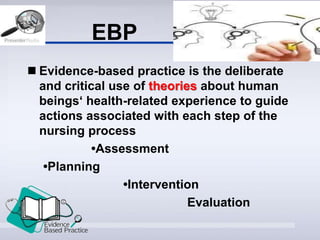
 Evidence-based practice is the deliberate
and critical use of theories about human
beings‘ health-related experience to guide
actions associated with each step of the
nursing process
•Assessment
•Planning
•Intervention
Evaluation
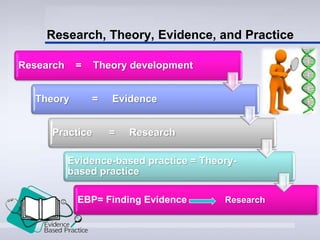
Research, Theory, Evidence, and Practice
Research = Theory development
Theory = Evidence
Practice = Research
Evidence-based practice = Theory-
based practice
EBP= Finding Evidence Research
Why Evidence-Based Practice?
Quality Care
Positive
Patient
Outcomes
Enhance
Professional
Environment
Cost
Containment
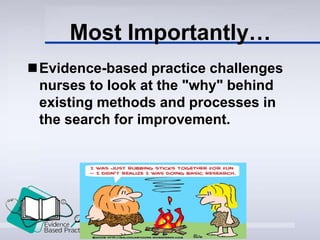
Most Importantly…
Evidence-based practice challenges
nurses to look at the "why" behind
existing methods and processes in
the search for improvement.
What is
Evidence-Based Research?
 Clinically relevant research based on
medical science; this research is patient-
centered.
 Research Utilization: Use of the knowledge
found from research.
 Cochrane Center (meta-analysis reviews)
(Melnyk & Fineout-Overholt, 2005; Sackett et al, 2000)
Thinking EBP?
Improving patients care
outcomes
 uses current research evidence combined with
clinical expertise and patient values to formulate
sound interventions.
Magnet Definition of EBP
is a science-to-service model of engagement of
critical thinking to apply research-based
evidence (scientific knowledge) and practice-
based evidence (art of nursing) within the context
of patient values to deliver quality, cost-sensitive
care.
How…
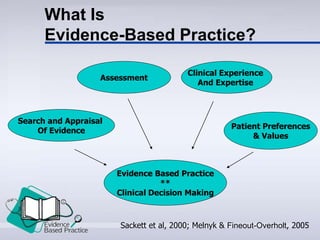
What Is
Evidence-Based Practice?
Patient Preferences
& Values
Clinical Experience
And Expertise
Assessment
Search and Appraisal
Of Evidence
Evidence Based Practice
**
Clinical Decision Making
Sackett et al, 2000; Melnyk & Fineout-Overholt, 2005
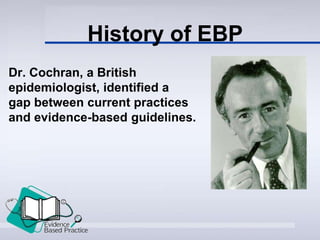
Dr. Cochran, a British
epidemiologist, identified a
gap between current practices
and evidence-based guidelines.
History of EBP
Considers the entire health
care system:
 Provider
 Patient
 Infrastructure
Implementing EBP:
The Iowa Model
1. Identify a trigger –
problem focused or
knowledge focused
2. Determine clinical
relevance – is it
important to the
organization or
culture
Implementing EBP
Implementing EBP
Find the evidence
Critically appraise and
synthesize the evidence
Translate and implement
the evidence
Evaluate EBP change
WHERE TO BEGIN. . . .
Once we agree upon the question that poses an
opportunity for improvement, then we must find the
evidence
Where should we look
All forms of evidence equivalent in quality
Finding the time, access, and research expertise that
are needed to search and analyze the evidence to find
answers to their clinical questions
PICO (T) Model
P = Who is the Patient Population?
I = What is the potential Intervention or area of
Interest?
C = Is there a Comparison intervention or Control
group?
O= What is the desired Outcome?
T= Time (Optional)
Your question drives your research!
Steps of
Evidence-Based Practice
Step 1:
Melnyk & Fineout-Overholt, 2005
What is the
clinical question?
Framing the Clinical Question
What to include what to exclude?
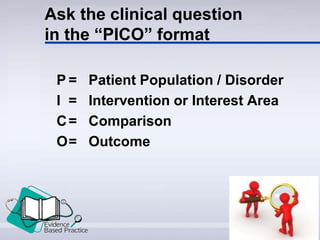
P = Patient Population / Disorder
I = Intervention or Interest Area
C= Comparison
O= Outcome
Ask the clinical question
in the “PICO” format
PICO
P = Elderly nephrology patients
I = Psychosocial issues
C = Effect on compliance
O = Patient will be able to adapt to
changes related to diagnosis
and treatment
Example:
Steps of
Evidenced-Based Practice
Step 2: Find the best evidence to
answer the question
 Systematic review of the literature
 Meta-analysis or clinical practice
guidelines
 Rigorous process
 Preset criteria
 Overcomes bias
 Valid / credible results
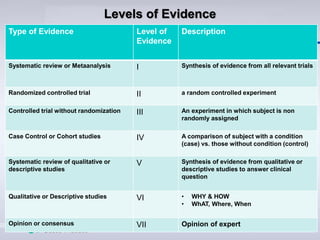
Levels of Evidence
Type of Evidence Level of
Evidence
Description
Systematic review or Metaanalysis I Synthesis of evidence from all relevant trials
Randomized controlled trial II a random controlled experiment
Controlled trial without randomization III An experiment in which subject is non
randomly assigned
Case Control or Cohort studies IV A comparison of subject with a condition
(case) vs. those without condition (control)
Systematic review of qualitative or
descriptive studies
V Synthesis of evidence from qualitative or
descriptive studies to answer clinical
question
Qualitative or Descriptive studies VI • WHY & HOW
• WhAT, Where, When
Opinion or consensus VII Opinion of expert
Example
 a health care provider recommends
acetaminophen to treat arthritis pain in a
patient who has recently had stomach
bleeding. The health care provider makes
this recommendation because research
shows that acetaminophen is associated
with less risk for stomach bleeds than
other common pain relievers. The health
care provider's recommendation is an
example of evidenced-based practice.
KEY QUESTIONS TO MOVE EBP INTO
NURSING PRACTICE
What methods are used by leading/benchmark,
organizations
Do the findings of recent research suggest an
alternative method
Are organizational barriers inhibiting the
application of best practices in this situation
Is there a review of the research on this topic
Are there nationally recognized standards of care,
practice guidelines, or protocols that apply
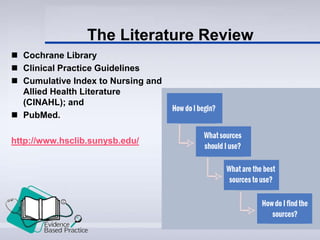
The Literature Review
 Cochrane Library
 Clinical Practice Guidelines
 Cumulative Index to Nursing and
Allied Health Literature
(CINAHL); and
 PubMed.
http://www.hsclib.sunysb.edu/
Guideline Databases
 National Guideline Clearinghouse (NGC)
http://www.guideline.gov
 National Institute for Clinical Excellence (NICE)
http://www.nice.org.uk/catcg2.asp?c=20034
 National Kidney Foundation K/DOQI Guidelines:
http://www.kidney.org/professionals/doqi/guidelineindex.cfm
Steps of
Evidence-Based Practice
Step 3: Appraise the evidence
1. What were the results of the study?
2. Are the results valid?
3. Will the results facilitate patient care?
Critical Questions to Ask:
Step 4:
Steps of
Evidence-Based Practice
Integrate the evidence,
patient assessment
information, clinical
expertise, patient
preferences and values.
Steps of
Evidence-Based Practice
Evaluate the change
in the clinical area.
Step 5:
Implementing EBP:
The Barriers
 Translating the meaning and
relevance of EBP
 Knowledge deficit
 Being overwhelmed by the evidence
 The need for dedicated time
 Negative views about research
 Organizational constraints
VanBuskirk, 2005; Melnyk & Fineout-Overholt, 2005
Facilitation of EBP
Promote Acceptance
 Access with surveys; focus
groups
 Identify baseline knowledge
 Identify real case scenarios
 Analyze the culture of the
environment
Facilitation of EBP
Correct Misperceptions
 Have key leaders attend nursing
centers
 Teach the basics of EBP
 Expose to useful databases
Facilitation of EBP
Question Clinical Practices
 Prioritize problems
 Utilize clinical practice
guidelines and research
 Promote a culture of
organizational acceptance
for EBP
ADMINISTRATION'S ROLE
Encourage inquisitive minds
Promote risk-taking and flexibility in the clinical
environment
Incorporate EBP activities into performance evaluations
Provide time & resources – unit internet access
Provide support personnel
Empower staff to make EB practice changes
Acknowledge and reward EB improvements
Evidence Based Practice An Introduction

Evidence Based Practice An Introduction

  • 1.
    EVIDENCE BASED PRACTICE- ANINTRODUCTION Presented by: Adahlia T. Basco, Ed.D, MAN, RN
  • 2.
     Define whatis evidence based practice (EBP).  Understand Research and EBP  Discuss the history of EBP.  Identify Evidence-Based Practice: The Iowa Model.  Discuss how to Framing a Clinical Question using the PICO model.  List the Steps of EBP  Familiarize with the Literature Review and Search Techniques. Objectives
  • 3.
    EBP  Evidence-based practiceis the deliberate and critical use of theories about human beings‘ health-related experience to guide actions associated with each step of the nursing process •Assessment •Planning •Intervention Evaluation
  • 4.
    Research, Theory, Evidence,and Practice Research = Theory development Theory = Evidence Practice = Research Evidence-based practice = Theory- based practice EBP= Finding Evidence Research
  • 5.
    Why Evidence-Based Practice? QualityCare Positive Patient Outcomes Enhance Professional Environment Cost Containment
  • 6.
    Most Importantly… Evidence-based practicechallenges nurses to look at the "why" behind existing methods and processes in the search for improvement.
  • 7.
    What is Evidence-Based Research? Clinically relevant research based on medical science; this research is patient- centered.  Research Utilization: Use of the knowledge found from research.  Cochrane Center (meta-analysis reviews) (Melnyk & Fineout-Overholt, 2005; Sackett et al, 2000)
  • 8.
  • 9.
     uses currentresearch evidence combined with clinical expertise and patient values to formulate sound interventions. Magnet Definition of EBP is a science-to-service model of engagement of critical thinking to apply research-based evidence (scientific knowledge) and practice- based evidence (art of nursing) within the context of patient values to deliver quality, cost-sensitive care. How…
  • 10.
    What Is Evidence-Based Practice? PatientPreferences & Values Clinical Experience And Expertise Assessment Search and Appraisal Of Evidence Evidence Based Practice ** Clinical Decision Making Sackett et al, 2000; Melnyk & Fineout-Overholt, 2005
  • 11.
    Dr. Cochran, aBritish epidemiologist, identified a gap between current practices and evidence-based guidelines. History of EBP
  • 12.
    Considers the entirehealth care system:  Provider  Patient  Infrastructure Implementing EBP: The Iowa Model
  • 13.
    1. Identify atrigger – problem focused or knowledge focused 2. Determine clinical relevance – is it important to the organization or culture Implementing EBP
  • 14.
    Implementing EBP Find theevidence Critically appraise and synthesize the evidence Translate and implement the evidence Evaluate EBP change
  • 15.
    WHERE TO BEGIN.. . . Once we agree upon the question that poses an opportunity for improvement, then we must find the evidence Where should we look All forms of evidence equivalent in quality Finding the time, access, and research expertise that are needed to search and analyze the evidence to find answers to their clinical questions
  • 16.
    PICO (T) Model P= Who is the Patient Population? I = What is the potential Intervention or area of Interest? C = Is there a Comparison intervention or Control group? O= What is the desired Outcome? T= Time (Optional) Your question drives your research!
  • 17.
    Steps of Evidence-Based Practice Step1: Melnyk & Fineout-Overholt, 2005 What is the clinical question?
  • 18.
    Framing the ClinicalQuestion What to include what to exclude?
  • 19.
    P = PatientPopulation / Disorder I = Intervention or Interest Area C= Comparison O= Outcome Ask the clinical question in the “PICO” format
  • 20.
    PICO P = Elderlynephrology patients I = Psychosocial issues C = Effect on compliance O = Patient will be able to adapt to changes related to diagnosis and treatment Example:
  • 21.
    Steps of Evidenced-Based Practice Step2: Find the best evidence to answer the question  Systematic review of the literature  Meta-analysis or clinical practice guidelines  Rigorous process  Preset criteria  Overcomes bias  Valid / credible results
  • 22.
    Levels of Evidence Typeof Evidence Level of Evidence Description Systematic review or Metaanalysis I Synthesis of evidence from all relevant trials Randomized controlled trial II a random controlled experiment Controlled trial without randomization III An experiment in which subject is non randomly assigned Case Control or Cohort studies IV A comparison of subject with a condition (case) vs. those without condition (control) Systematic review of qualitative or descriptive studies V Synthesis of evidence from qualitative or descriptive studies to answer clinical question Qualitative or Descriptive studies VI • WHY & HOW • WhAT, Where, When Opinion or consensus VII Opinion of expert
  • 23.
    Example  a healthcare provider recommends acetaminophen to treat arthritis pain in a patient who has recently had stomach bleeding. The health care provider makes this recommendation because research shows that acetaminophen is associated with less risk for stomach bleeds than other common pain relievers. The health care provider's recommendation is an example of evidenced-based practice.
  • 24.
    KEY QUESTIONS TOMOVE EBP INTO NURSING PRACTICE What methods are used by leading/benchmark, organizations Do the findings of recent research suggest an alternative method Are organizational barriers inhibiting the application of best practices in this situation Is there a review of the research on this topic Are there nationally recognized standards of care, practice guidelines, or protocols that apply
  • 25.
    The Literature Review Cochrane Library  Clinical Practice Guidelines  Cumulative Index to Nursing and Allied Health Literature (CINAHL); and  PubMed. http://www.hsclib.sunysb.edu/
  • 28.
    Guideline Databases  NationalGuideline Clearinghouse (NGC) http://www.guideline.gov  National Institute for Clinical Excellence (NICE) http://www.nice.org.uk/catcg2.asp?c=20034  National Kidney Foundation K/DOQI Guidelines: http://www.kidney.org/professionals/doqi/guidelineindex.cfm
  • 29.
    Steps of Evidence-Based Practice Step3: Appraise the evidence 1. What were the results of the study? 2. Are the results valid? 3. Will the results facilitate patient care? Critical Questions to Ask:
  • 30.
    Step 4: Steps of Evidence-BasedPractice Integrate the evidence, patient assessment information, clinical expertise, patient preferences and values.
  • 31.
    Steps of Evidence-Based Practice Evaluatethe change in the clinical area. Step 5:
  • 32.
    Implementing EBP: The Barriers Translating the meaning and relevance of EBP  Knowledge deficit  Being overwhelmed by the evidence  The need for dedicated time  Negative views about research  Organizational constraints VanBuskirk, 2005; Melnyk & Fineout-Overholt, 2005
  • 33.
    Facilitation of EBP PromoteAcceptance  Access with surveys; focus groups  Identify baseline knowledge  Identify real case scenarios  Analyze the culture of the environment
  • 34.
    Facilitation of EBP CorrectMisperceptions  Have key leaders attend nursing centers  Teach the basics of EBP  Expose to useful databases
  • 35.
    Facilitation of EBP QuestionClinical Practices  Prioritize problems  Utilize clinical practice guidelines and research  Promote a culture of organizational acceptance for EBP
  • 36.
    ADMINISTRATION'S ROLE Encourage inquisitiveminds Promote risk-taking and flexibility in the clinical environment Incorporate EBP activities into performance evaluations Provide time & resources – unit internet access Provide support personnel Empower staff to make EB practice changes Acknowledge and reward EB improvements