SEMINAR
ON
EVIDENCE BASED NURSING
PRACTICE
GUIDED BY:-
Mr. KAUSHAL PATIDAR
ASST. PROFESSOR
J.C.N. BHANDU
OUTLINE OFTHE TOPIC:-
• INTRODUCTION OF EBP.
• DEFINITION OF EBP.
• PURPOSE AND OBJECTIVE OF EBP.
• AIMS OF EBP.
• IMPORTANCE OF EBP.
• STEPS OF EBP.
• PROMOTION OF EBP.
• BARRIER OF EBP.
INTRODUCTION:-
 During the 1980s, the term “evidence-based
medicine” emerged to describe the approach that used
scientific evidence to determine the best practice. Later,
the term shifted to become “evidence-based practice” as
clinicians other than physicians recognized the
importance of scientific evidence in clinical decision-
making.
 It started in medicine as evidence-based medicine
(EBM) and spread to other field such as dentistry,
nursing, pathology, education, library and information
science and other fields.
DEFINITION:-
A problem solving approach to clinical decision making
that incorporates a search for the best and latest evidence,
clinical expertise and assessment, and patient preference
value within a context of caring.
(ICN 2012)
Evidence Based practice is the conscientious, explicit,
and judicious use of the current best evidence in making
decisions about the care of individual patients.
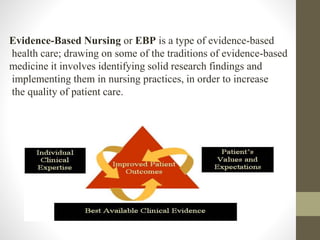
Evidence-Based Nursing or EBP is a type of evidence-based
health care; drawing on some of the traditions of evidence-based
medicine it involves identifying solid research findings and
implementing them in nursing practices, in order to increase
the quality of patient care.
Purpose and Objectives:-
• Evidence based practice seeks to replace practice as
usual, with practice guided by rigorous outcome-oriented
research, ideally randomized controlled trials. It also
seeks to make practice a less subjective enterprise, and to
raise it to a higher level of accountability. It is associated
with efforts to identify best practices in nursing and other
disciplines.
Evidence based nursing aims:-
• To provide the highest quality and most cost-efficient
nursing care possible.
• To advance quality of care provided by nurses.
• To increases satisfaction of patients
• To focus on nursing practice away from habits and
tradition to evidence and research.
IMPORTANCE OF EBP:-
• Evidence-based practice helps nurses provide high-
quality patient care based on research and knowledge
rather than because “this is the way we have always done
it,” or based on traditions, myths, hunches, advice of
colleagues, or outdated textbooks.
• It results in better patient outcomes
• It contributes to the science of nursing
• It keeps practice current and relevant
• It increases confidence in decision-making
• Policies and procedures are current and include the latest
research,
• Integration of EBP into nursing practice is essential for
high-quality patient care and achievement.
EBPIMPLICATIONS FOR NURSES:-
• Nurses serve instrumental roles in ensuring and providing
evidence-based practice.
• Nurses are also well positioned to work with other
members of the health care team to identify clinical
problems and use existing evidence to improve practice.
Numerous opportunities exist for nurses to question
current nursing practices and use evidence to make care
more effective.
• For example, a recently published evidence-based project
describes the potential benefits of discontinuing the
routine practice of listening to the bowel sounds of
patients who have undergone elective abdominal surgery.
The authors reviewed the literature and conducted an
assessment of current practice, and they subsequently
developed and evaluated a new practice guideline.
FOR NURSE EDUCATOR:-
• Evidence-based nursing practice is an approach to
nursing care that is essential to the improvement of
patient outcomes.
• Situational issues present within clinical practice settings
have made a more evidence-based approach difficult to
attain for many registered nurses.
• Clinical nurse educators have the opportunity to become
potential change agents in the facilitation of evidence-
based nursing within the clinical practice setting.
FOR CLINICALNURSING
EDUCATION:-
• Nurse educators have the opportunity to promote
improved patient outcomes in the future by facilitating an
evidence-based nursing approach within clinical nursing
education. They also suggested that, to provide rationales
for quality nursing actions, nursing faculty could help
students recognize the importance of current research
evidence and other sources of knowledge, such as ethical,
personal, and aesthetic.
• The students enhanced their evidence-based knowledge
by creating guided research questions, conducting
systematic searches, reading and critiquing the strength of
the evidence, synthesizing the evidence, and preparing
evidence-based recommendations.
STEPS FOR EVIDENCE BASED
PRACTICE:-
• Step 1: Formulating a clear question based on a
clinical problem.
• Step 2: Literature review to search for the best
available evidence.
• Step 3: Critically analyze the evidence.
• Step 4: Implement useful finding in clinical practice
based on valid evidence.
• Step 5: Evaluate change in practice and maintain
change in practice.
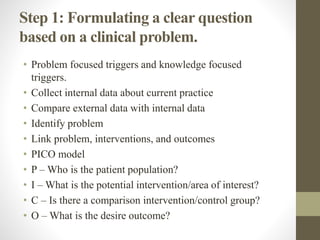
Step 1: Formulating a clear question
based on a clinical problem.
• Problem focused triggers and knowledge focused
triggers.
• Collect internal data about current practice
• Compare external data with internal data
• Identify problem
• Link problem, interventions, and outcomes
• PICO model
• P – Who is the patient population?
• I – What is the potential intervention/area of interest?
• C – Is there a comparison intervention/control group?
• O – What is the desire outcome?
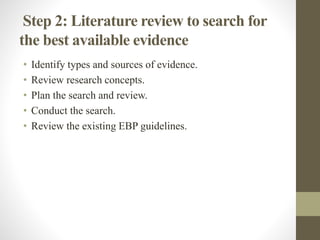
Step 2: Literature review to search for
the best available evidence
• Identify types and sources of evidence.
• Review research concepts.
• Plan the search and review.
• Conduct the search.
• Review the existing EBP guidelines.
Step 3: Critically analyze the evidence.
• Critically appraise and weigh the evidence.
• Synthesize the best evidence.
• Assess feasibility, benefits, and risks of new practice.
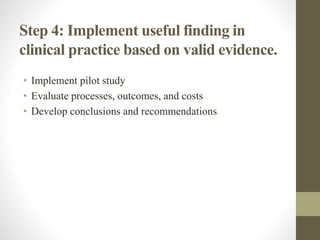
Step 4: Implement useful finding in
clinical practice based on valid evidence.
• Implement pilot study
• Evaluate processes, outcomes, and costs
• Develop conclusions and recommendations
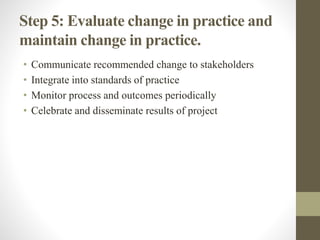
Step 5: Evaluate change in practice and
maintain change in practice.
• Communicate recommended change to stakeholders
• Integrate into standards of practice
• Monitor process and outcomes periodically
• Celebrate and disseminate results of project
PROMOTION OF EBP:-
• Leaders can promote evidence-based nursing practice at
the individual level by: Role modeling evidence-based
nursing practice (demonstrating commitment and
championing the cause);
• Nurse Managers’ knowledge and understanding of
competencies are greater than their ability to implement
them.
• Providing psycho-social support that will encourage and
enable nurses to perform desired competencies.
• Organizations should adopt evidence-based nursing
practice as policy and integrate it at all organizational
levels.
• Leaders need to manage change by understanding the
organization’s culture and gaining the help of “early
adopters.” They can also encourage nurses to establish
best practices based on client outcomes.
• Access to research resources, training and development,
and rewards and recognition also help.
• Evidence-based nursing practice flourishes when work
environments understand the importance of sound human
health resources in improving patient outcomes and cost
efficiency and encourage nurses to ask questions about
their practice.
• Managers that act as role models by using research evidence to
make more effective management decisions and organizations that
put their entire focus on learning make a significant difference as
well.
• Clinical nurse educators play an influential role in the development
of orientation programs for new nursing staff and have the
opportunity to promote best evidence-based nursing practices.
• Clinical nurse educators can provide support by setting up computer
links to local library databases, providing relevant systematic reviews
that summarize findings, circulating valid and reliable research
literature within clinical settings.
• Professional development courses on evidence-based nursing and
research inquiry courses can assist nurses in critically examining
evidence directly related to current clinical field.
BARRIERS:-
• Lack of professional ability.
• Lack of knowledge of clinical methods.
• Lack of administrative support.
• Lack of knowledgeable mentors.
• Insufficient time to conduct research
• Lack of education about the research process
• Lack of awareness about research or evidence-based practice
• Difficulty accessing research reports and articles.
evidence based practice

evidence based practice

  • 1.
    SEMINAR ON EVIDENCE BASED NURSING PRACTICE GUIDEDBY:- Mr. KAUSHAL PATIDAR ASST. PROFESSOR J.C.N. BHANDU
  • 2.
    OUTLINE OFTHE TOPIC:- •INTRODUCTION OF EBP. • DEFINITION OF EBP. • PURPOSE AND OBJECTIVE OF EBP. • AIMS OF EBP. • IMPORTANCE OF EBP. • STEPS OF EBP. • PROMOTION OF EBP. • BARRIER OF EBP.
  • 3.
    INTRODUCTION:-  During the1980s, the term “evidence-based medicine” emerged to describe the approach that used scientific evidence to determine the best practice. Later, the term shifted to become “evidence-based practice” as clinicians other than physicians recognized the importance of scientific evidence in clinical decision- making.  It started in medicine as evidence-based medicine (EBM) and spread to other field such as dentistry, nursing, pathology, education, library and information science and other fields.
  • 4.
    DEFINITION:- A problem solvingapproach to clinical decision making that incorporates a search for the best and latest evidence, clinical expertise and assessment, and patient preference value within a context of caring. (ICN 2012) Evidence Based practice is the conscientious, explicit, and judicious use of the current best evidence in making decisions about the care of individual patients.
  • 5.
    Evidence-Based Nursing orEBP is a type of evidence-based health care; drawing on some of the traditions of evidence-based medicine it involves identifying solid research findings and implementing them in nursing practices, in order to increase the quality of patient care.
  • 6.
    Purpose and Objectives:- •Evidence based practice seeks to replace practice as usual, with practice guided by rigorous outcome-oriented research, ideally randomized controlled trials. It also seeks to make practice a less subjective enterprise, and to raise it to a higher level of accountability. It is associated with efforts to identify best practices in nursing and other disciplines.
  • 7.
    Evidence based nursingaims:- • To provide the highest quality and most cost-efficient nursing care possible. • To advance quality of care provided by nurses. • To increases satisfaction of patients • To focus on nursing practice away from habits and tradition to evidence and research.
  • 8.
    IMPORTANCE OF EBP:- •Evidence-based practice helps nurses provide high- quality patient care based on research and knowledge rather than because “this is the way we have always done it,” or based on traditions, myths, hunches, advice of colleagues, or outdated textbooks. • It results in better patient outcomes • It contributes to the science of nursing • It keeps practice current and relevant • It increases confidence in decision-making • Policies and procedures are current and include the latest research, • Integration of EBP into nursing practice is essential for high-quality patient care and achievement.
  • 9.
    EBPIMPLICATIONS FOR NURSES:- •Nurses serve instrumental roles in ensuring and providing evidence-based practice. • Nurses are also well positioned to work with other members of the health care team to identify clinical problems and use existing evidence to improve practice. Numerous opportunities exist for nurses to question current nursing practices and use evidence to make care more effective. • For example, a recently published evidence-based project describes the potential benefits of discontinuing the routine practice of listening to the bowel sounds of patients who have undergone elective abdominal surgery. The authors reviewed the literature and conducted an assessment of current practice, and they subsequently developed and evaluated a new practice guideline.
  • 10.
    FOR NURSE EDUCATOR:- •Evidence-based nursing practice is an approach to nursing care that is essential to the improvement of patient outcomes. • Situational issues present within clinical practice settings have made a more evidence-based approach difficult to attain for many registered nurses. • Clinical nurse educators have the opportunity to become potential change agents in the facilitation of evidence- based nursing within the clinical practice setting.
  • 11.
    FOR CLINICALNURSING EDUCATION:- • Nurseeducators have the opportunity to promote improved patient outcomes in the future by facilitating an evidence-based nursing approach within clinical nursing education. They also suggested that, to provide rationales for quality nursing actions, nursing faculty could help students recognize the importance of current research evidence and other sources of knowledge, such as ethical, personal, and aesthetic. • The students enhanced their evidence-based knowledge by creating guided research questions, conducting systematic searches, reading and critiquing the strength of the evidence, synthesizing the evidence, and preparing evidence-based recommendations.
  • 12.
    STEPS FOR EVIDENCEBASED PRACTICE:- • Step 1: Formulating a clear question based on a clinical problem. • Step 2: Literature review to search for the best available evidence. • Step 3: Critically analyze the evidence. • Step 4: Implement useful finding in clinical practice based on valid evidence. • Step 5: Evaluate change in practice and maintain change in practice.
  • 13.
    Step 1: Formulatinga clear question based on a clinical problem. • Problem focused triggers and knowledge focused triggers. • Collect internal data about current practice • Compare external data with internal data • Identify problem • Link problem, interventions, and outcomes • PICO model • P – Who is the patient population? • I – What is the potential intervention/area of interest? • C – Is there a comparison intervention/control group? • O – What is the desire outcome?
  • 14.
    Step 2: Literaturereview to search for the best available evidence • Identify types and sources of evidence. • Review research concepts. • Plan the search and review. • Conduct the search. • Review the existing EBP guidelines.
  • 15.
    Step 3: Criticallyanalyze the evidence. • Critically appraise and weigh the evidence. • Synthesize the best evidence. • Assess feasibility, benefits, and risks of new practice.
  • 16.
    Step 4: Implementuseful finding in clinical practice based on valid evidence. • Implement pilot study • Evaluate processes, outcomes, and costs • Develop conclusions and recommendations
  • 17.
    Step 5: Evaluatechange in practice and maintain change in practice. • Communicate recommended change to stakeholders • Integrate into standards of practice • Monitor process and outcomes periodically • Celebrate and disseminate results of project
  • 18.
    PROMOTION OF EBP:- •Leaders can promote evidence-based nursing practice at the individual level by: Role modeling evidence-based nursing practice (demonstrating commitment and championing the cause); • Nurse Managers’ knowledge and understanding of competencies are greater than their ability to implement them. • Providing psycho-social support that will encourage and enable nurses to perform desired competencies. • Organizations should adopt evidence-based nursing practice as policy and integrate it at all organizational levels.
  • 19.
    • Leaders needto manage change by understanding the organization’s culture and gaining the help of “early adopters.” They can also encourage nurses to establish best practices based on client outcomes. • Access to research resources, training and development, and rewards and recognition also help. • Evidence-based nursing practice flourishes when work environments understand the importance of sound human health resources in improving patient outcomes and cost efficiency and encourage nurses to ask questions about their practice.
  • 20.
    • Managers thatact as role models by using research evidence to make more effective management decisions and organizations that put their entire focus on learning make a significant difference as well. • Clinical nurse educators play an influential role in the development of orientation programs for new nursing staff and have the opportunity to promote best evidence-based nursing practices. • Clinical nurse educators can provide support by setting up computer links to local library databases, providing relevant systematic reviews that summarize findings, circulating valid and reliable research literature within clinical settings. • Professional development courses on evidence-based nursing and research inquiry courses can assist nurses in critically examining evidence directly related to current clinical field.
  • 21.
    BARRIERS:- • Lack ofprofessional ability. • Lack of knowledge of clinical methods. • Lack of administrative support. • Lack of knowledgeable mentors. • Insufficient time to conduct research • Lack of education about the research process • Lack of awareness about research or evidence-based practice • Difficulty accessing research reports and articles.