EVIDENCE BASED
APPROACH
PRESENTED BY: Ms. Meenakshi P. Dhyani
Nursing Lect.
INTRODUCTION
• Evidence-based practice (EBP) is a problem-
solving approach to the delivery of health care
that integrates the best evidence from studies
and patient care data with clinician expertise and
patient preferences and values.
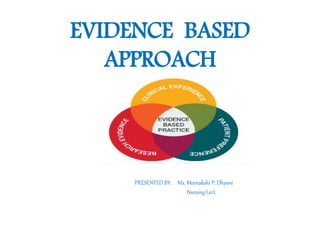
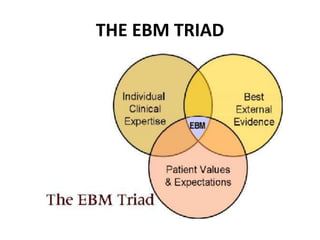
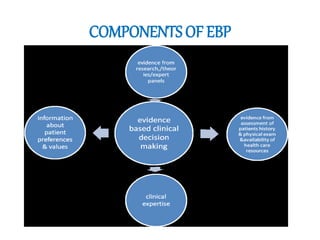
• EBP is the integration of clinical expertise, patient
values, and the best research evidence into the
decision making process for patient care. Clinical
expertise refers to the clinician’s cumulated
experience, education and clinical skills.
DEFINITIONS
• Evidence Based Nursing: “An integration of the best
evidence available, nursing expertise, and the values
and preferences of the individuals, families, and
communities who are served”.
• “Evidence-based practice is the conscientious ,explicit
and judicious use of current best evidence in making
decisions about the care of individual patients.
• "Evidence-based decision-making is a continuous
interactive process involving the explicit, conscientious
and judicious consideration of the best available
evidence to provide care."
AIMS OF EBP
• To provide the high quality and most cost-
efficient nursing care possible.
• To advance quality of care provided by nurses.
• To increase satisfaction among patients.
• To focus on nursing practice away from habits
and tradition to evidence and research.
• It results in better patient outcomes.
• It contributes to the science of nursing.
• It keeps practices current and relevant.
• It increases confidence in decision-making.
PURPOSES OF EBP
• Evidence based practice seeks to replace
practice as usual, with practice guided by
rigorous outcome oriented research, ideally
randomized controlled trials.
• It also seeks to make practice a less subjective
enterprise, and to raise it to a higher level of
accountability.
• It is associated with efforts to identify best
practices in nursing and other disciplines.
FEATURES OF EBP
• Problem based and within the scope of the practitioners experience.
• It brings together the best available evidence and current practice by
combining research with knowledge and theory. So it narrows the
research practice gap.
• It facilitates application of research into practice by including both
primary and secondary research findings.
• It concerned with quality of service and is therefore a Quality assurance
activity.
• EBP projects are team projects and therefore require team support and
collaborative action.
• It support research projects and outcomes that are cost effective EBP de-
emphasizes unsystematic clinical experiences ungrounded opinions and
tradition as a basis of practice.
• It stresses the use of research findings.
• EBP is more focused on the science of nursing than on the art of nursing.
NEED OF EBP
• Needed to help bridge the research- practice gap by:
• Strengthening the evidence base so that we know what works and
what doesn’t work in providing patients with the best outcomes.
• Standardizing evidence across fields to reach the best outcome for
the patient.
• Housing evidence in online databases providing reviews of the
evidence base.
• Translating and consolidating state of the science into clinical
recommendations.
• Improve patient outcomes
• Decreased unnecessary procedures & complications
• Greater provider job satisfaction.
• Effective nursing practice requires information, judgment, and skills.
THE EBM TRIAD
COMPONENTS OF EBP
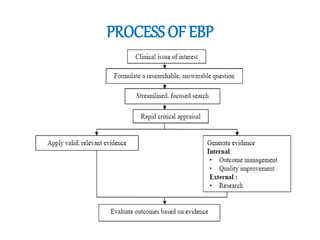
PROCESS OF EBP
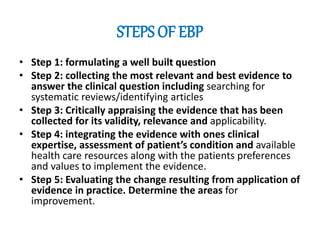
STEPS OF EBP
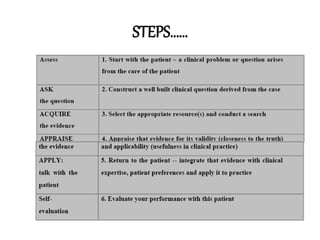
• Step 1: formulating a well built question
• Step 2: collecting the most relevant and best evidence to
answer the clinical question including searching for
systematic reviews/identifying articles
• Step 3: Critically appraising the evidence that has been
collected for its validity, relevance and applicability.
• Step 4: integrating the evidence with ones clinical
expertise, assessment of patient’s condition and available
health care resources along with the patients preferences
and values to implement the evidence.
• Step 5: Evaluating the change resulting from application of
evidence in practice. Determine the areas for
improvement.
STEPS……
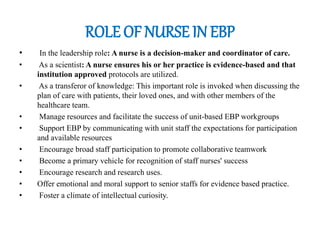
ROLE OF NURSE IN EBP
• In the leadership role: A nurse is a decision-maker and coordinator of care.
• As a scientist: A nurse ensures his or her practice is evidence-based and that
institution approved protocols are utilized.
• As a transferor of knowledge: This important role is invoked when discussing the
plan of care with patients, their loved ones, and with other members of the
healthcare team.
• Manage resources and facilitate the success of unit-based EBP workgroups
• Support EBP by communicating with unit staff the expectations for participation
and available resources
• Encourage broad staff participation to promote collaborative teamwork
• Become a primary vehicle for recognition of staff nurses' success
• Encourage research and research uses.
• Offer emotional and moral support to senior staffs for evidence based practice.
• Foster a climate of intellectual curiosity.
Cont….
• Attend and encourage junior staffs to conference
• The registered nurse participates, as appropriate to education level
and position, in the formulation of evidence-based practice through
research.
• The registered nurse utilizes current evidence- based nursing
knowledge, including research findings, to guide practice.
• Know basis for nursing practice
• Expect that evidence is the foundation of practice
• Participate in EBP projects
• Disseminate project findings in various forums
• Collaborate with the healthcare team to provide quality care
THANK YOU

Evidence based approach

  • 1.
    EVIDENCE BASED APPROACH PRESENTED BY:Ms. Meenakshi P. Dhyani Nursing Lect.
  • 2.
    INTRODUCTION • Evidence-based practice(EBP) is a problem- solving approach to the delivery of health care that integrates the best evidence from studies and patient care data with clinician expertise and patient preferences and values. • EBP is the integration of clinical expertise, patient values, and the best research evidence into the decision making process for patient care. Clinical expertise refers to the clinician’s cumulated experience, education and clinical skills.
  • 3.
    DEFINITIONS • Evidence BasedNursing: “An integration of the best evidence available, nursing expertise, and the values and preferences of the individuals, families, and communities who are served”. • “Evidence-based practice is the conscientious ,explicit and judicious use of current best evidence in making decisions about the care of individual patients. • "Evidence-based decision-making is a continuous interactive process involving the explicit, conscientious and judicious consideration of the best available evidence to provide care."
  • 4.
    AIMS OF EBP •To provide the high quality and most cost- efficient nursing care possible. • To advance quality of care provided by nurses. • To increase satisfaction among patients. • To focus on nursing practice away from habits and tradition to evidence and research. • It results in better patient outcomes. • It contributes to the science of nursing. • It keeps practices current and relevant. • It increases confidence in decision-making.
  • 5.
    PURPOSES OF EBP •Evidence based practice seeks to replace practice as usual, with practice guided by rigorous outcome oriented research, ideally randomized controlled trials. • It also seeks to make practice a less subjective enterprise, and to raise it to a higher level of accountability. • It is associated with efforts to identify best practices in nursing and other disciplines.
  • 6.
    FEATURES OF EBP •Problem based and within the scope of the practitioners experience. • It brings together the best available evidence and current practice by combining research with knowledge and theory. So it narrows the research practice gap. • It facilitates application of research into practice by including both primary and secondary research findings. • It concerned with quality of service and is therefore a Quality assurance activity. • EBP projects are team projects and therefore require team support and collaborative action. • It support research projects and outcomes that are cost effective EBP de- emphasizes unsystematic clinical experiences ungrounded opinions and tradition as a basis of practice. • It stresses the use of research findings. • EBP is more focused on the science of nursing than on the art of nursing.
  • 7.
    NEED OF EBP •Needed to help bridge the research- practice gap by: • Strengthening the evidence base so that we know what works and what doesn’t work in providing patients with the best outcomes. • Standardizing evidence across fields to reach the best outcome for the patient. • Housing evidence in online databases providing reviews of the evidence base. • Translating and consolidating state of the science into clinical recommendations. • Improve patient outcomes • Decreased unnecessary procedures & complications • Greater provider job satisfaction. • Effective nursing practice requires information, judgment, and skills.
  • 8.
  • 9.
  • 10.
  • 11.
    STEPS OF EBP •Step 1: formulating a well built question • Step 2: collecting the most relevant and best evidence to answer the clinical question including searching for systematic reviews/identifying articles • Step 3: Critically appraising the evidence that has been collected for its validity, relevance and applicability. • Step 4: integrating the evidence with ones clinical expertise, assessment of patient’s condition and available health care resources along with the patients preferences and values to implement the evidence. • Step 5: Evaluating the change resulting from application of evidence in practice. Determine the areas for improvement.
  • 12.
  • 13.
    ROLE OF NURSEIN EBP • In the leadership role: A nurse is a decision-maker and coordinator of care. • As a scientist: A nurse ensures his or her practice is evidence-based and that institution approved protocols are utilized. • As a transferor of knowledge: This important role is invoked when discussing the plan of care with patients, their loved ones, and with other members of the healthcare team. • Manage resources and facilitate the success of unit-based EBP workgroups • Support EBP by communicating with unit staff the expectations for participation and available resources • Encourage broad staff participation to promote collaborative teamwork • Become a primary vehicle for recognition of staff nurses' success • Encourage research and research uses. • Offer emotional and moral support to senior staffs for evidence based practice. • Foster a climate of intellectual curiosity.
  • 14.
    Cont…. • Attend andencourage junior staffs to conference • The registered nurse participates, as appropriate to education level and position, in the formulation of evidence-based practice through research. • The registered nurse utilizes current evidence- based nursing knowledge, including research findings, to guide practice. • Know basis for nursing practice • Expect that evidence is the foundation of practice • Participate in EBP projects • Disseminate project findings in various forums • Collaborate with the healthcare team to provide quality care
  • 15.