
EVIDENCE BASED
NURSING PRACTICE
PRESENTED TO: PRESENTED BY:
DR. SUKHPAL KAUR MONIKA
ASSOCIATE PROFESSOR M.SC. NURSING 1ST YEAR
NINE, PGIMER NINE, PGIMER
INTRODUCTION
Nursing research is essential to generate scientific knowledge for
use in clinical practice.
EBP in nursing is a process of locating, appraising, and applying the
best evidence from the nursing and medical literature to improve the
quality of clinical nursing practices.
Nursing practice is based on research evidence to achieving client
outcome, making nursing practice credible and provide cost effective
safe practice.
CONCEPT OF EVIDENCE BASED NURSING
PRACTICE
Evidence is the collection of the data that are assumed to be
true. EBP is the conduct of health care according to the
principle that all interventions should be based on the best
currently available scientific evidence.
Health care profession need recent advance in health care
in order satisfy the queries of the patient and to base their
care intervention on the sound scientific knowledge.
CONCEPT OF EVIDENCE BASED NURSING
PRACTICE Cont.…..
Evidence based nursing is a type of evidence based healthcare. It
involves identifying solid research findings and implementing them
in nursing practices. The aim of EBNP is provide the patient with
highest quality and cost effective nursing care.
IN HEALTH CARE, EVIDENCE COULD BE
EXTERNAL AND INTERNAL EVIDENCE
• Involve a methodical investigation and judicious
evaluation
EXTERNAL EVIDENCE
• This is engendered though initiative taken for
practice.
• May include managing the outcomes, or project
undertaken for improvement of care in setting.
INTERNAL EVIDENCE
NEED OF EVIDENCE BASED PRACTICE
Providing evidence based care is recognized as an important skill for
the health care providers.
If an individual is ignorant of the available research evidence, the
important opportunities to benefit the patient may be missed in the
health care delivery system.
ELEMENTS OF EVIDENCE BASED
PRACTICE
Key component to evidence based practice:
Using the best available current evidence.
Using own expertise and experience to make decisions.
Considering the preference and characteristics of the individual
client.
Environmental and organizational context.
Decision making.
SOURCES OF LITERATURE FOR EVIDENCE
BASED PRACTICE
The literature from journals in the print from are available in
libraries or online database.
Online databases have enhanced the process of placing research
and evidence summaries relevant to current practice.
Database is simply the collection of data or information organized
for rapid search and retrieval, especially by a computer.
SOURCES OF LITERATURE FOR EVIDENCE
BASED PRACTICE Cont…..
Few databases are:-
Cumulative index to nursing and alliel health literature(CINAHL)
Medical literature analysis and retrieval system(MEDLARS)
PubMed
The Cochrane library
Journals @ovid
Psyclnfo
Scopus
dynaMed
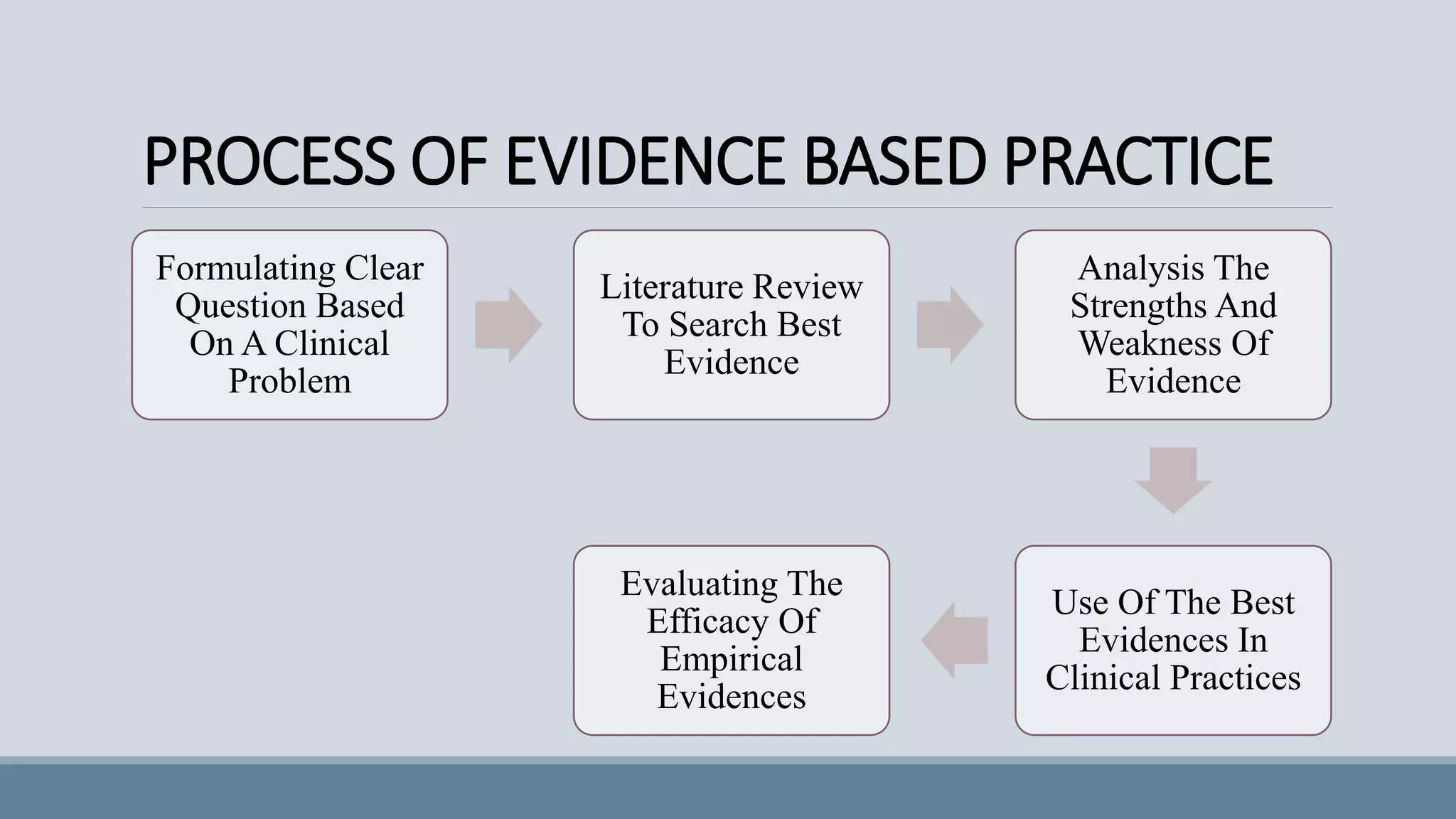
PROCESS OF EVIDENCE BASED PRACTICE
Formulating Clear
Question Based
On A Clinical
Problem
Literature Review
To Search Best
Evidence
Analysis The
Strengths And
Weakness Of
Evidence
Use Of The Best
Evidences In
Clinical Practices
Evaluating The
Efficacy Of
Empirical
Evidences
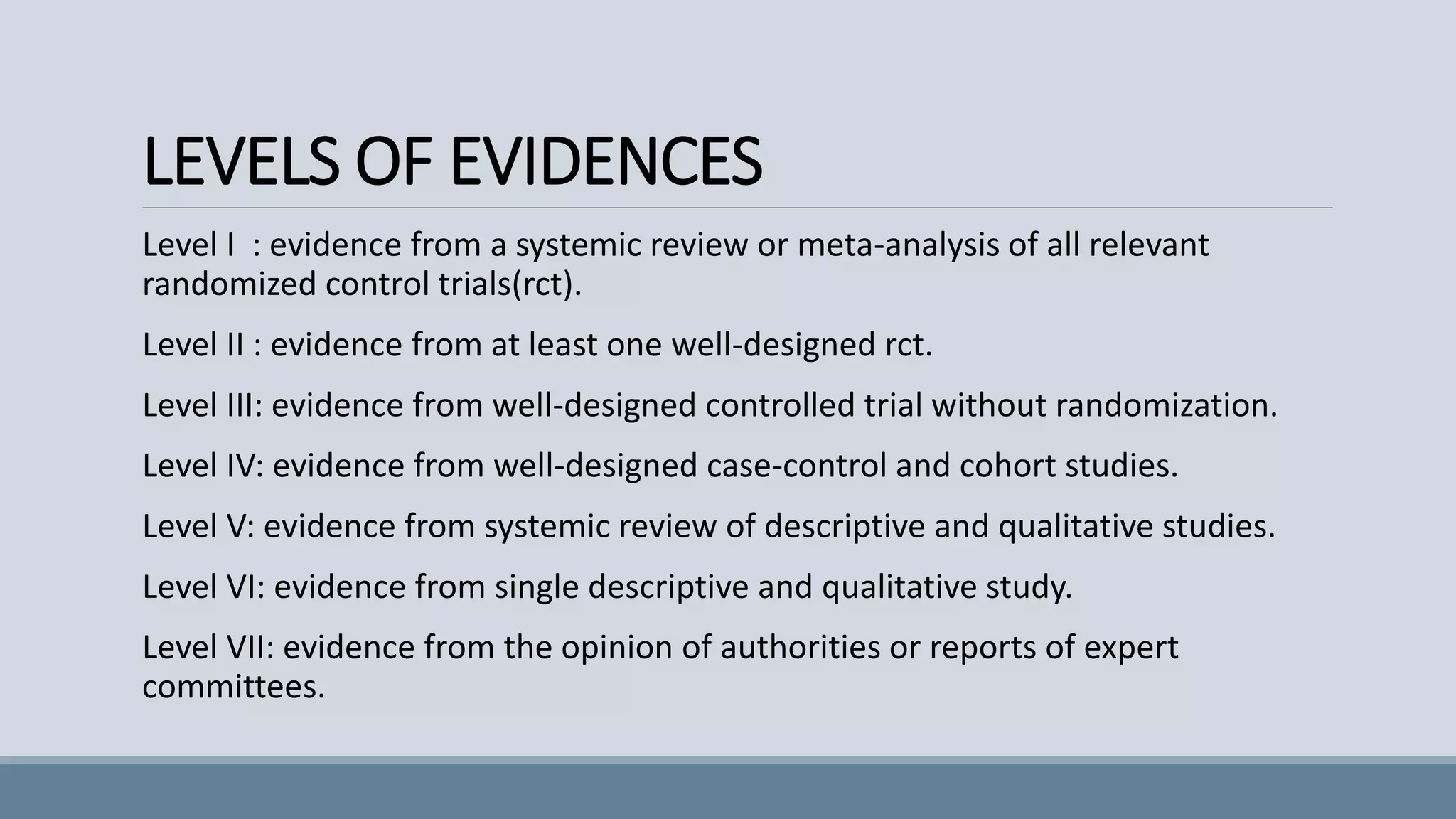
LEVELS OF EVIDENCES
Level I : evidence from a systemic review or meta-analysis of all relevant
randomized control trials(rct).
Level II : evidence from at least one well-designed rct.
Level III: evidence from well-designed controlled trial without randomization.
Level IV: evidence from well-designed case-control and cohort studies.
Level V: evidence from systemic review of descriptive and qualitative studies.
Level VI: evidence from single descriptive and qualitative study.
Level VII: evidence from the opinion of authorities or reports of expert
committees.
PURPOSES OF EBP
EBP is an approach that tries to specify the way in which professions or other
decision makers should make decision by identifying such evidence.
Its goal is to eliminate unsound or excessively risky practices in favors of those
that have better outcomes.
EBP has contributed a lot towards better patient outcomes.
The ultimate goal of EBN is to provide the highest quality and most effective
nursing care possible.
The purpose or utility of EBP is to provide the highest quality and most cost
effective care possible.
BARRIERS OF EBP
There are many barriers to promoting EBP; nurses should aware of these barriers-
Overwhelming amount of information available in the literature.
Lack of professional ability to critically appraise research.
Lack of time, workload pressure.
Lack of knowledge of research methods is also one of significant barriers.
Lack of support from professional colleagues and organizations.
Lack of confidence and authority in research arena.
Shortage of research in some areas of nursing.
Cultural barriers in health organizations.
BARRIERS OF EBP Cont.…
Change always face the resistance.
Lack of continuing educational programs for nurses in India, especially for bedside
 nurses.
Lack of initiatives among nursing leaders and managers to create the environment of EBP
practices.
Junior staff are scared to suggest their older superiors to implement better newer evidence in
clinical practice.
Physicians dominance in clinical practice, thus nurses are not given autonomy to implement
newer, better clinical nursing evidence practices.
Lack of administrative support or incentives for implementation of EBN practice.
LIST OF REFERANCE
1. Kaur S, Nursing research in 21st century, edition 2021, CBS
publishers & distributors pvt. Ltd. p516-525.
2. Sharma S, Nursing research & statistics, edition 2014, Elsevier
India pvt. Ltd. p29-34.
EVIDENCE BASED NURSING PRACTICE

EVIDENCE BASED NURSING PRACTICE

  • 1.
    EVIDENCE BASED NURSING PRACTICE PRESENTEDTO: PRESENTED BY: DR. SUKHPAL KAUR MONIKA ASSOCIATE PROFESSOR M.SC. NURSING 1ST YEAR NINE, PGIMER NINE, PGIMER
  • 2.
    INTRODUCTION Nursing research isessential to generate scientific knowledge for use in clinical practice. EBP in nursing is a process of locating, appraising, and applying the best evidence from the nursing and medical literature to improve the quality of clinical nursing practices. Nursing practice is based on research evidence to achieving client outcome, making nursing practice credible and provide cost effective safe practice.
  • 3.
    CONCEPT OF EVIDENCEBASED NURSING PRACTICE Evidence is the collection of the data that are assumed to be true. EBP is the conduct of health care according to the principle that all interventions should be based on the best currently available scientific evidence. Health care profession need recent advance in health care in order satisfy the queries of the patient and to base their care intervention on the sound scientific knowledge.
  • 4.
    CONCEPT OF EVIDENCEBASED NURSING PRACTICE Cont.….. Evidence based nursing is a type of evidence based healthcare. It involves identifying solid research findings and implementing them in nursing practices. The aim of EBNP is provide the patient with highest quality and cost effective nursing care.
  • 5.
    IN HEALTH CARE,EVIDENCE COULD BE EXTERNAL AND INTERNAL EVIDENCE • Involve a methodical investigation and judicious evaluation EXTERNAL EVIDENCE • This is engendered though initiative taken for practice. • May include managing the outcomes, or project undertaken for improvement of care in setting. INTERNAL EVIDENCE
  • 6.
    NEED OF EVIDENCEBASED PRACTICE Providing evidence based care is recognized as an important skill for the health care providers. If an individual is ignorant of the available research evidence, the important opportunities to benefit the patient may be missed in the health care delivery system.
  • 7.
    ELEMENTS OF EVIDENCEBASED PRACTICE Key component to evidence based practice: Using the best available current evidence. Using own expertise and experience to make decisions. Considering the preference and characteristics of the individual client. Environmental and organizational context. Decision making.
  • 8.
    SOURCES OF LITERATUREFOR EVIDENCE BASED PRACTICE The literature from journals in the print from are available in libraries or online database. Online databases have enhanced the process of placing research and evidence summaries relevant to current practice. Database is simply the collection of data or information organized for rapid search and retrieval, especially by a computer.
  • 9.
    SOURCES OF LITERATUREFOR EVIDENCE BASED PRACTICE Cont….. Few databases are:- Cumulative index to nursing and alliel health literature(CINAHL) Medical literature analysis and retrieval system(MEDLARS) PubMed The Cochrane library Journals @ovid Psyclnfo Scopus dynaMed
  • 10.
    PROCESS OF EVIDENCEBASED PRACTICE Formulating Clear Question Based On A Clinical Problem Literature Review To Search Best Evidence Analysis The Strengths And Weakness Of Evidence Use Of The Best Evidences In Clinical Practices Evaluating The Efficacy Of Empirical Evidences
  • 11.
    LEVELS OF EVIDENCES LevelI : evidence from a systemic review or meta-analysis of all relevant randomized control trials(rct). Level II : evidence from at least one well-designed rct. Level III: evidence from well-designed controlled trial without randomization. Level IV: evidence from well-designed case-control and cohort studies. Level V: evidence from systemic review of descriptive and qualitative studies. Level VI: evidence from single descriptive and qualitative study. Level VII: evidence from the opinion of authorities or reports of expert committees.
  • 12.
    PURPOSES OF EBP EBPis an approach that tries to specify the way in which professions or other decision makers should make decision by identifying such evidence. Its goal is to eliminate unsound or excessively risky practices in favors of those that have better outcomes. EBP has contributed a lot towards better patient outcomes. The ultimate goal of EBN is to provide the highest quality and most effective nursing care possible. The purpose or utility of EBP is to provide the highest quality and most cost effective care possible.
  • 13.
    BARRIERS OF EBP Thereare many barriers to promoting EBP; nurses should aware of these barriers- Overwhelming amount of information available in the literature. Lack of professional ability to critically appraise research. Lack of time, workload pressure. Lack of knowledge of research methods is also one of significant barriers. Lack of support from professional colleagues and organizations. Lack of confidence and authority in research arena. Shortage of research in some areas of nursing. Cultural barriers in health organizations.
  • 14.
    BARRIERS OF EBPCont.… Change always face the resistance. Lack of continuing educational programs for nurses in India, especially for bedside  nurses. Lack of initiatives among nursing leaders and managers to create the environment of EBP practices. Junior staff are scared to suggest their older superiors to implement better newer evidence in clinical practice. Physicians dominance in clinical practice, thus nurses are not given autonomy to implement newer, better clinical nursing evidence practices. Lack of administrative support or incentives for implementation of EBN practice.
  • 15.
    LIST OF REFERANCE 1.Kaur S, Nursing research in 21st century, edition 2021, CBS publishers & distributors pvt. Ltd. p516-525. 2. Sharma S, Nursing research & statistics, edition 2014, Elsevier India pvt. Ltd. p29-34.