




PRESENTER-MS. RITIKA SONI
AP, SNC, SHIMLA
INTRODUCTION:
• During 1980’s the term evidence based medicine/ practice
emerged to describe the approach that used scientific
evidence to determine the best practice. Evidence based
practice movement started in England in the early 1990’s.
• Evidence based medicine/ practice, is the judicious use of
the best current evidence in making decisions about the care
of the individual patients.
• Evidence based medicine/ practice represents both an
ideology and method. The ideology means that clients
deserve to be provided with the most effective interventions
possible. The method of EBP is the way we go about
finding and then implementing those interventions.
• Furthermore, nursing practices are generally based on nurses
‘past experiences ; however there is little scientific evidence to
support nurses ‘ clinical decision making and expected outcomes.
While nursing practices based on research evidences contribute
to achieving client outcome and making nursing practices
credible.
• Therefore, nurses need to base their practices on empirical
evidences to optimize client outcomes, to provide cost-
effectiveness safe practices, and to enhance the credibility of
nursing care.
• Roots of EBN can be traced to Florence Nightingale’s era of
nursing practices. Her concept of promoting health, prevention of
disease, care of sick were central ideas of her system. It involves
identifying solid research findings and implementing them in
nursing practices, in order to increase the quality of patient care.
Definitions
• Evidence- It is something that furnishes proof or testimony
and something ;legally submitted to ascertain in the truth of
matter.
• Evidence based practice- using the best evidence available
to guide clinical decision making.
According to Benefield
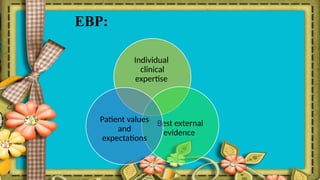
EBP:
Individual
clinical
expertise
Best external
evidence
Patient values
and
expectations
• Evidence based practice is ‘the integration of best
research evidence with best available scientific research,
clinical expertise and patient values, which when applied
by practitioners will ultimately lead to improved patient
outcome.
• Evidence based nursing- is a recently emerged term
and EBN is a type of EBP in nursing . It involves
identifying solid research findings and implementing
them in nursing practices to increase the quality of
patient care.
• Evidence based nursing is a process of locating ,
appraising and applying the best evidence from the
nursing and medical literature to improve the quality of
clinical nursing practices.
Purposes/ Need of EBP
• EBP is an approach that tries to specify the way in which professionals
or other decision makers should make decisions by identifying such
evidence that there may be for a practice and rating it according to how
scientifically sound it may be.
• For making sure that each client get the best possible services
• Update knowledge and is essential for lifelong learning.
• Provide clinical judgment
• To eliminate unsound or excessively risky practices in favor of those
that have better outcomes. ‘Heater and colleagues reported that
patients who receive research based nursing care make sizable gains in
behavioral knowledge and physiological and psychosocial outcomes
compared with those receiving routine nursing care’.
• To provide the highest quality and most- efficient nursing care possible.
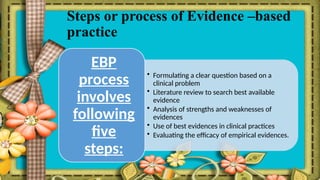
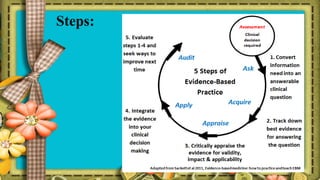
Steps or process of Evidence –based
practice
• Formulating a clear question based on a
clinical problem
• Literature review to search best available
evidence
• Analysis of strengths and weaknesses of
evidences
• Use of best evidences in clinical practices
• Evaluating the efficacy of empirical evidences.
EBP
process
involves
following
five
steps:
Steps:
Sources of Evidence
Research evidence has assumed priority over other sources of
evidence in the delivery of evidence based health care. It
includes:
• Filtered sources- clinical experts and subject specialist pose
a question and then synthesize evidence to state
conclusions based on available research. These sources are
helpful because the literature has been searched and results
evaluated to provide an answer to clinical question.
• Unfiltered source (primary literature)- it provide most
recent information. E.g.- MEDLINE, CINAHL etc. provide
primary and secondary literature for medicine.
• Clinical experiences- knowledge through professional
practices and life experiences make up the second part in the
evidenced based , person centered care.
• Knowledge from patients- evidence delivered from patients
knowledge of themselves , their bodies and social lives.
• Knowledge from local contexts- audit and performance data,
patients stories and narratives, knowledge about the culture of the
organization and individuals within it, social and professional
networks, information from feedback, local and national policy.
• Research evidence- preferably peer reviewed research / scientific
literature
• Work based research (trial and error testing)
• Feedback from organization and customers/clients/stakeholders
• Practitioners experience and expertise
LEVELS OF EVIDENCE
BARRIERS IN EBP
There are many barriers to promoting EBP ; nurses need to aware of the
barriers surrounding EBP both within their own professional group, in
the health and in the social services. Some of the significant barriers
in EBP are discussed below:
• Overwhelming amount of information available in the literature and
sometimes contradictory findings of the research studies further create
confusion among practitioners.
• Lack of professional ability to critically appraise research. This
includes having a considerable amount of research evaluation skills,
access to journals, clinic / hospital support to spend time on EBN are
limited for the nurses.
• Lack of time, workload pressure and competing priorities of patient
care can impede use of EBP’s.
• Lack of knowledge of research methods is also one of the significant
barriers in promotion of EBP’s.
• Lack of support from professional colleagues and organizations, lack
of confidence and authority in the research arena.
• Shortage of research in some areas of nursing, which is useful in
identifying the effectiveness of nursing care.
• Change always faces the resistance and the same is true for EBP as
well. There is reluctance to believe results of research study over
safe , traditional practices and cost-effectiveness of new practices.
• Lack of continuing education programmes for nurses in India,
especially for bedside nurses.
• Lack of initiatives among nursing leaders and managers to create the
environment of EBP practices in Indian scenario. The junior staff are
scared to suggest their older superiors to implement better newer
evidences in clinical practices.
• Physician’s dominance in clinical practices, thus nurses are not given
autonomy to implement newer , better clinical nursing evidences in
practices.
• The lack of administrative support or incentives for implementation of
EBN practices.
Evidence Based Practice-chapter-1-Evidence Based Nursing  PPT

Evidence Based Practice-chapter-1-Evidence Based Nursing PPT

  • 1.
  • 2.
    INTRODUCTION: • During 1980’sthe term evidence based medicine/ practice emerged to describe the approach that used scientific evidence to determine the best practice. Evidence based practice movement started in England in the early 1990’s. • Evidence based medicine/ practice, is the judicious use of the best current evidence in making decisions about the care of the individual patients. • Evidence based medicine/ practice represents both an ideology and method. The ideology means that clients deserve to be provided with the most effective interventions possible. The method of EBP is the way we go about finding and then implementing those interventions.
  • 3.
    • Furthermore, nursingpractices are generally based on nurses ‘past experiences ; however there is little scientific evidence to support nurses ‘ clinical decision making and expected outcomes. While nursing practices based on research evidences contribute to achieving client outcome and making nursing practices credible. • Therefore, nurses need to base their practices on empirical evidences to optimize client outcomes, to provide cost- effectiveness safe practices, and to enhance the credibility of nursing care. • Roots of EBN can be traced to Florence Nightingale’s era of nursing practices. Her concept of promoting health, prevention of disease, care of sick were central ideas of her system. It involves identifying solid research findings and implementing them in nursing practices, in order to increase the quality of patient care.
  • 4.
    Definitions • Evidence- Itis something that furnishes proof or testimony and something ;legally submitted to ascertain in the truth of matter. • Evidence based practice- using the best evidence available to guide clinical decision making. According to Benefield
  • 5.
  • 6.
    • Evidence basedpractice is ‘the integration of best research evidence with best available scientific research, clinical expertise and patient values, which when applied by practitioners will ultimately lead to improved patient outcome.
  • 7.
    • Evidence basednursing- is a recently emerged term and EBN is a type of EBP in nursing . It involves identifying solid research findings and implementing them in nursing practices to increase the quality of patient care. • Evidence based nursing is a process of locating , appraising and applying the best evidence from the nursing and medical literature to improve the quality of clinical nursing practices.
  • 8.
    Purposes/ Need ofEBP • EBP is an approach that tries to specify the way in which professionals or other decision makers should make decisions by identifying such evidence that there may be for a practice and rating it according to how scientifically sound it may be. • For making sure that each client get the best possible services • Update knowledge and is essential for lifelong learning. • Provide clinical judgment • To eliminate unsound or excessively risky practices in favor of those that have better outcomes. ‘Heater and colleagues reported that patients who receive research based nursing care make sizable gains in behavioral knowledge and physiological and psychosocial outcomes compared with those receiving routine nursing care’. • To provide the highest quality and most- efficient nursing care possible.
  • 9.
    Steps or processof Evidence –based practice • Formulating a clear question based on a clinical problem • Literature review to search best available evidence • Analysis of strengths and weaknesses of evidences • Use of best evidences in clinical practices • Evaluating the efficacy of empirical evidences. EBP process involves following five steps:
  • 10.
  • 11.
    Sources of Evidence Researchevidence has assumed priority over other sources of evidence in the delivery of evidence based health care. It includes: • Filtered sources- clinical experts and subject specialist pose a question and then synthesize evidence to state conclusions based on available research. These sources are helpful because the literature has been searched and results evaluated to provide an answer to clinical question. • Unfiltered source (primary literature)- it provide most recent information. E.g.- MEDLINE, CINAHL etc. provide primary and secondary literature for medicine.
  • 12.
    • Clinical experiences-knowledge through professional practices and life experiences make up the second part in the evidenced based , person centered care. • Knowledge from patients- evidence delivered from patients knowledge of themselves , their bodies and social lives. • Knowledge from local contexts- audit and performance data, patients stories and narratives, knowledge about the culture of the organization and individuals within it, social and professional networks, information from feedback, local and national policy. • Research evidence- preferably peer reviewed research / scientific literature • Work based research (trial and error testing) • Feedback from organization and customers/clients/stakeholders • Practitioners experience and expertise
  • 13.
  • 14.
    BARRIERS IN EBP Thereare many barriers to promoting EBP ; nurses need to aware of the barriers surrounding EBP both within their own professional group, in the health and in the social services. Some of the significant barriers in EBP are discussed below: • Overwhelming amount of information available in the literature and sometimes contradictory findings of the research studies further create confusion among practitioners. • Lack of professional ability to critically appraise research. This includes having a considerable amount of research evaluation skills, access to journals, clinic / hospital support to spend time on EBN are limited for the nurses. • Lack of time, workload pressure and competing priorities of patient care can impede use of EBP’s. • Lack of knowledge of research methods is also one of the significant barriers in promotion of EBP’s.
  • 15.
    • Lack ofsupport from professional colleagues and organizations, lack of confidence and authority in the research arena. • Shortage of research in some areas of nursing, which is useful in identifying the effectiveness of nursing care. • Change always faces the resistance and the same is true for EBP as well. There is reluctance to believe results of research study over safe , traditional practices and cost-effectiveness of new practices. • Lack of continuing education programmes for nurses in India, especially for bedside nurses. • Lack of initiatives among nursing leaders and managers to create the environment of EBP practices in Indian scenario. The junior staff are scared to suggest their older superiors to implement better newer evidences in clinical practices. • Physician’s dominance in clinical practices, thus nurses are not given autonomy to implement newer , better clinical nursing evidences in practices. • The lack of administrative support or incentives for implementation of EBN practices.