King George medical
University
KGMU COLLEGE OF NURSING.
PRESENTATION
Evidence based practice in nursing
Presented by:-
ASHUTOSH KUMAR
MSc. Nursing 1st year
INTRODUCTION
• Evidence based practice is an approach that
enables clinician to provide the highest quality of
care in meeting the multiphase needs to their
parents and family.
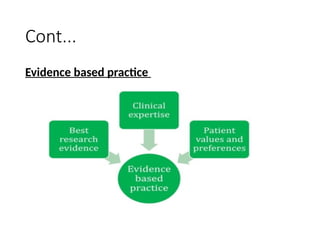
Cont...
Evidence based practice
HISTORICAL OVERVIEW
• During 1980s the term ' Evidence based medicine '
emerged to describe the approach that used
scientific evidence to determine the best practice.
• Later the term shifted to become 'Evidence based
practice ' as clinician other than physician
recognised the importance of scientific evidence in
clinical decision making.
DEFINITION
• Evidence based practice in nursing is a process of
locating, appraising and applying the best evidence
from the nursing and medical literature to improve
the quality of clinical nursing practice.
AIMS OF EBP
• To provide the high quality care.
• To advance quality of care provided by health
workers.
• To increase satisfaction among patients.
• It results in better patient outcomes.
• It keeps practice current and relevant.
• It increases confidence in decision makin
PURPOSE OF EBP
• EBP is one approach that improves patient
outcome.
• EBP allows nurses to enrich their clinical training
and experience with up-to-date research.
• EBP is an approach that tries to specify the way.
Cont...
• Its goal is to eliminate unsound or excessively risky
practices in favour of those that have better
outcomes.
• EBP has contributed a lot towards better patient
outcome.
• The ultimate goal of EBN is to provide the highest
quality and most cost-efficient nursing care
possible.
• The purpose or utility of EBP in nursing is mainly to
improve the quality of nursing.
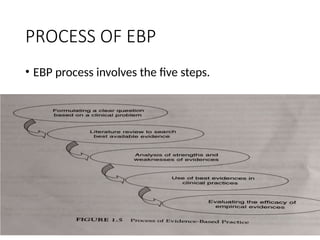
PROCESS OF EBP
• EBP process involves the five steps.
Step:-1
• Formulate a clear question based on clinical
problems.
• The source for formulating a question is generally
categorised into two broader classes.
• 1). Problem-based sources.- the health care
professionals get an idea about relevant question
for EBP from the clinical or risk assessment data,
such as data of quality improvement, risk
surveillance, benchmarking data, financial data,
recurrent clinical problems, etc.
Cont...
2). Knowledge-based sources: The health care
professionals may obtain knowledge of newer
evidences from the scientific journals, publications,
research conferences or EBP guide- lines published
by statuary bodies, which may enhance nursing care
practices.
Step:-2
• Literature review to search for the best available evidence: The
literature review for EBP must start with theoretical and clinical
articles to have an overview about the topic of concern, which
should be followed by well-known existing EBP guidelines, if any
available then should go for reading and critiquing the original
research articles. It is better to include high level of evidences for
review, such as meta-analysis and systemic reviews of randomized
control trials, original randomized clinical trials, etc. It must be
ensured that an extensive literature review is carried out including
electronically as well as non-electronically available literature.
However, the reviewer must be very careful about the facts given
in literature because sometimes an article appears to be precise
and factual on the surface but with further and much closer
examination, flaws can be found.
Cont...
• On the other hand, the article can be loaded with
opinionated and/or biased statements that could
taint the findings, thus lowering the creditability
and quality of the article. Time management is
another factor, which is very crucial for information
retrieval, and current and fresh
information/evidences are considered more
weighted than the older one
Step :-3
• Evaluating and analysing the strengths and
weaknesses of that evidence :- Use of rating
systems to determine the quality of the research is
crucial to the development of EBP.
• There are several rating scales proposed to
determine the validity, strengths, and weaknesses
of the available evidence, a comprehensive and
more practical rating scale derived from the work of
Guyatt and Rennie (2002), Harris et al. (2001), and
Melnyk and Fineout (2005).
Step :-4
• Implementing useful findings in clinical practice
based on valid evidence: Once study findings are
analysed for strengths, weaknesses, internal and
external validity, a decision is made about
appropriateness of evidence for the particular
question initiated for EBP.
• The final evidences must be extensively discussed
among the users with risk-benefit ratio of evidence
and extent and level of harms are involved with
particular evidence.
Step:-5
• Evaluating efficacy and performance of
evidences :- after the implementation of the useful
findings for the clinical practices, efficacy and
performance is evaluated through processes of self-
reflection, internal or external audit or peer
assessment.
BARRIERS IN EBP
• Overwhelming amount of information available in
the literature.
• Lack of professional ability to critically appraise
research.
• Lack of time, workload pressures, and competing
priorities of patient care can impede use of EBPS.
• Lack of knowledge of research methods is also one
of the significant barriers in promotion of EBPS.
Cont...
• Lack of support from professional colleagues and organizations,
and lack of confidence and authority in the research arena.
• Shortage of research in some areas of nursing.
• Lack of continuing education programmes for nurses in India,
especially for bedside nurses.
• Lack of initiatives among nursing leaders and managers to create
the environment of EBP practices in Indian scenario.
• Physicians' dominance in clinical practices, thus nurses are not
given autonomy to implement newer, better clinical nursing
evidences in practice.
• The lack of administrative support or incentives for
implementation of EBN practices.
Research abstract
• Translating research into practice: case study of a community- based
dementia caregiver intervention. (Mittelman MS, Bartels SJ.)
• Evidence from randomized clinical trials has demonstrated the
effectiveness of providing psychosocial interventions for caregivers to
lessen their burden. This case study describes outcomes of the
implementation of an evidence-based intervention in a multisite
program in Minnesota. Consistent with the original randomized clinical
trial of the intervention, assessments of this program showed decreased
depression and distress among caregivers. Some of the challenges in the
community setting included having caregivers complete the full six
counseling sessions and acquiring complete outcome data. Given the
challenges faced in the community setting, web-based training for
providers may be a cost-effective way to realize the maximum benefits
of the intervention for vulnerable adults with dementia and their
families.
SUMMARY
CONCLUSION
• Evidence-based nursing care is a lifelong approach to clinical
decision making and excellence in practice. Evidence-based
nursing care is informed by research findings, clinical
expertise, and patients' values, and its use can improve
patients' outcomes. Use of research evidence in clinical
practice is an expected standard of practice for nurses and
health care organizations, but numerous barriers exist that
create a gap between new knowledge and implementation
of that knowledge to improve patient care. Using the levels
of evidence, nurses can determine the strength of research
studies, assess the findings, and evaluate the evidence for
potential implementation into best practice.
1evidence based practice in nursing.pptx

1evidence based practice in nursing.pptx

  • 1.
    King George medical University KGMUCOLLEGE OF NURSING. PRESENTATION Evidence based practice in nursing Presented by:- ASHUTOSH KUMAR MSc. Nursing 1st year
  • 2.
    INTRODUCTION • Evidence basedpractice is an approach that enables clinician to provide the highest quality of care in meeting the multiphase needs to their parents and family.
  • 3.
  • 4.
    HISTORICAL OVERVIEW • During1980s the term ' Evidence based medicine ' emerged to describe the approach that used scientific evidence to determine the best practice. • Later the term shifted to become 'Evidence based practice ' as clinician other than physician recognised the importance of scientific evidence in clinical decision making.
  • 5.
    DEFINITION • Evidence basedpractice in nursing is a process of locating, appraising and applying the best evidence from the nursing and medical literature to improve the quality of clinical nursing practice.
  • 6.
    AIMS OF EBP •To provide the high quality care. • To advance quality of care provided by health workers. • To increase satisfaction among patients. • It results in better patient outcomes. • It keeps practice current and relevant. • It increases confidence in decision makin
  • 7.
    PURPOSE OF EBP •EBP is one approach that improves patient outcome. • EBP allows nurses to enrich their clinical training and experience with up-to-date research. • EBP is an approach that tries to specify the way.
  • 8.
    Cont... • Its goalis to eliminate unsound or excessively risky practices in favour of those that have better outcomes. • EBP has contributed a lot towards better patient outcome. • The ultimate goal of EBN is to provide the highest quality and most cost-efficient nursing care possible. • The purpose or utility of EBP in nursing is mainly to improve the quality of nursing.
  • 9.
    PROCESS OF EBP •EBP process involves the five steps.
  • 10.
    Step:-1 • Formulate aclear question based on clinical problems. • The source for formulating a question is generally categorised into two broader classes. • 1). Problem-based sources.- the health care professionals get an idea about relevant question for EBP from the clinical or risk assessment data, such as data of quality improvement, risk surveillance, benchmarking data, financial data, recurrent clinical problems, etc.
  • 11.
    Cont... 2). Knowledge-based sources:The health care professionals may obtain knowledge of newer evidences from the scientific journals, publications, research conferences or EBP guide- lines published by statuary bodies, which may enhance nursing care practices.
  • 12.
    Step:-2 • Literature reviewto search for the best available evidence: The literature review for EBP must start with theoretical and clinical articles to have an overview about the topic of concern, which should be followed by well-known existing EBP guidelines, if any available then should go for reading and critiquing the original research articles. It is better to include high level of evidences for review, such as meta-analysis and systemic reviews of randomized control trials, original randomized clinical trials, etc. It must be ensured that an extensive literature review is carried out including electronically as well as non-electronically available literature. However, the reviewer must be very careful about the facts given in literature because sometimes an article appears to be precise and factual on the surface but with further and much closer examination, flaws can be found.
  • 13.
    Cont... • On theother hand, the article can be loaded with opinionated and/or biased statements that could taint the findings, thus lowering the creditability and quality of the article. Time management is another factor, which is very crucial for information retrieval, and current and fresh information/evidences are considered more weighted than the older one
  • 14.
    Step :-3 • Evaluatingand analysing the strengths and weaknesses of that evidence :- Use of rating systems to determine the quality of the research is crucial to the development of EBP. • There are several rating scales proposed to determine the validity, strengths, and weaknesses of the available evidence, a comprehensive and more practical rating scale derived from the work of Guyatt and Rennie (2002), Harris et al. (2001), and Melnyk and Fineout (2005).
  • 15.
    Step :-4 • Implementinguseful findings in clinical practice based on valid evidence: Once study findings are analysed for strengths, weaknesses, internal and external validity, a decision is made about appropriateness of evidence for the particular question initiated for EBP. • The final evidences must be extensively discussed among the users with risk-benefit ratio of evidence and extent and level of harms are involved with particular evidence.
  • 16.
    Step:-5 • Evaluating efficacyand performance of evidences :- after the implementation of the useful findings for the clinical practices, efficacy and performance is evaluated through processes of self- reflection, internal or external audit or peer assessment.
  • 17.
    BARRIERS IN EBP •Overwhelming amount of information available in the literature. • Lack of professional ability to critically appraise research. • Lack of time, workload pressures, and competing priorities of patient care can impede use of EBPS. • Lack of knowledge of research methods is also one of the significant barriers in promotion of EBPS.
  • 18.
    Cont... • Lack ofsupport from professional colleagues and organizations, and lack of confidence and authority in the research arena. • Shortage of research in some areas of nursing. • Lack of continuing education programmes for nurses in India, especially for bedside nurses. • Lack of initiatives among nursing leaders and managers to create the environment of EBP practices in Indian scenario. • Physicians' dominance in clinical practices, thus nurses are not given autonomy to implement newer, better clinical nursing evidences in practice. • The lack of administrative support or incentives for implementation of EBN practices.
  • 19.
    Research abstract • Translatingresearch into practice: case study of a community- based dementia caregiver intervention. (Mittelman MS, Bartels SJ.) • Evidence from randomized clinical trials has demonstrated the effectiveness of providing psychosocial interventions for caregivers to lessen their burden. This case study describes outcomes of the implementation of an evidence-based intervention in a multisite program in Minnesota. Consistent with the original randomized clinical trial of the intervention, assessments of this program showed decreased depression and distress among caregivers. Some of the challenges in the community setting included having caregivers complete the full six counseling sessions and acquiring complete outcome data. Given the challenges faced in the community setting, web-based training for providers may be a cost-effective way to realize the maximum benefits of the intervention for vulnerable adults with dementia and their families.
  • 20.
  • 21.
    CONCLUSION • Evidence-based nursingcare is a lifelong approach to clinical decision making and excellence in practice. Evidence-based nursing care is informed by research findings, clinical expertise, and patients' values, and its use can improve patients' outcomes. Use of research evidence in clinical practice is an expected standard of practice for nurses and health care organizations, but numerous barriers exist that create a gap between new knowledge and implementation of that knowledge to improve patient care. Using the levels of evidence, nurses can determine the strength of research studies, assess the findings, and evaluate the evidence for potential implementation into best practice.