PRESENTED TO:- PRESENTED BY:-
MR. AJESH KUMAR AMANDEEP KAUR
Associate professor M.Sc. Nsg. 1st year
(Mental Health Nsg.) 1915703
GOOD
MORNING
NURSING
DEFINITION:-
(acc. To WHO)
Nursing encompasses autonomous and
collaborative care of individuals of all ages,
families, groups and communities, sick or
well and in all settings. It includes the
promotion of health, the prevention of
illness, and the care of ill, disabled and
dying people
MODERN NURSING
DEFINITION:-
โ€œThe art of using the latest technology &
science to promote quality of life as
defined by patients and families through
out their life experiences from birth to the
end of life.โ€
FUTURSTIC NURSING
INTRODUCTION:-
โ€ข It is time for nursing to question and redefine its role
within system and take steps to bring about the
future that the nursing profession is to achieve.
FUTURSTIC
MEANING:-
(INNOVATIVE/REVOLUTIONARY)
Innovation is the action of introducing a
new method , idea or product.
ASPECTS OF FUTURISTIC NURSING
๏ถNursing education
๏ถNursing services
1.) NURSING EDUCATION
FUTURE ISSUES:-
โ€ขMultiple settings
โ€ขCritical thinking
โ€ข Require extensive knowledge
โ€ขMore Complex Specialized practice
CAUSES OF CHANGES IN NURSING
EDUCATION
๏ถChanging demographics
๏ถTechnological explosion
๏ถGlobalization
๏ถChanging era
๏ถShift to population based care & increasing
complexity of patient care
CAUSES OF CHANGES IN NURSING
EDUCATION contiโ€ฆ..
๏ถCost of health care & challenge of managed care
๏ถImpact of health policy
๏ถCollaborative practice
๏ถNursing shortage
๏ถSignificant advances in nursing science &
research
Future direction for studentsโ€™
education
๏‚ง In 1993, three major organizations issued
statements and reports about nursing
education for the twenty first century.
๏‚ง Their reports addressed the new directions
of nursing education needed to take in the
future.
AREAS OF EMPHASIS
1. Schools should recruit diverse students and
facilities that reflect the multicultural nature of
society.
2. Curricula and learning activities should
develop students critical thinking skills.
3. Curricula should emphasize students
abilities.
AREAS OF EMPHASIS
4. Curricula should emphasize health
promotion & health maintenance.
5. Emphasis should be placed on community โ€“
based care .
6. Faculty should develop programe that
facilitate articulation
AREAS OF EMPHASIS
7. Development activities should support
excellence in practice teaching & research.
8. Cost effectiveness of care should be focus in
nursing curricula.
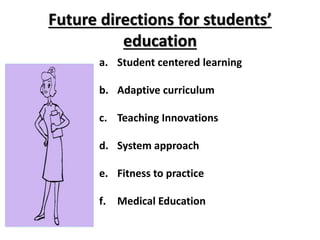
Future directions for studentsโ€™
education
a. Student centered learning
b. Adaptive curriculum
c. Teaching Innovations
d. System approach
e. Fitness to practice
f. Medical Education
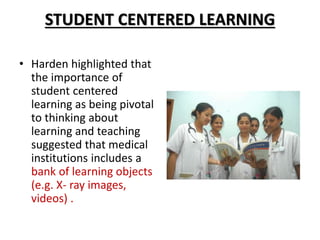
STUDENT CENTERED LEARNING
โ€ข Harden highlighted that
the importance of
student centered
learning as being pivotal
to thinking about
learning and teaching
suggested that medical
institutions includes a
bank of learning objects
(e.g. X- ray images,
videos) .
ADAPTIVE CURRICULUM
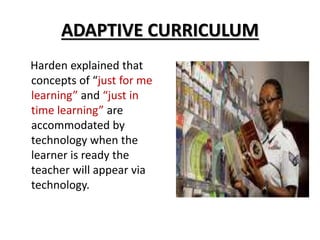
Harden explained that
concepts of โ€œjust for me
learningโ€ and โ€œjust in
time learningโ€ are
accommodated by
technology when the
learner is ready the
teacher will appear via
technology.
TEACHING INNOVATIONS
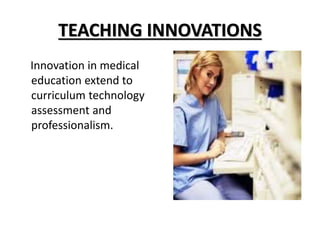
Innovation in medical
education extend to
curriculum technology
assessment and
professionalism.
SYSTEM APPROACH
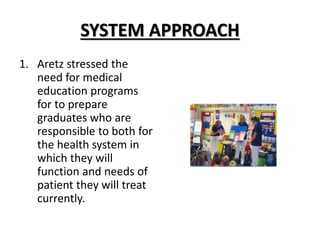
1. Aretz stressed the
need for medical
education programs
for to prepare
graduates who are
responsible to both for
the health system in
which they will
function and needs of
patient they will treat
currently.
SYSTEM APPROACH
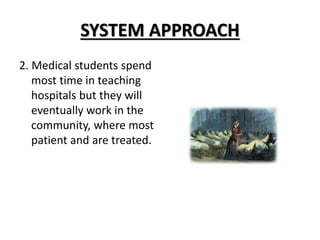
2. Medical students spend
most time in teaching
hospitals but they will
eventually work in the
community, where most
patient and are treated.
FITNESS TO PRACTICE
๏‚ง According to Walton, fitness to practice is an
issue with which all medical schools are
currently grappling overall we are probably
handling the issues of knowledge and skills
quite well.
FITNESS TO PRACTICE
โ€ข There is still debate
about what it really
means , what its
components are and
what we need to do
much better.
MEDICAL EDUCATION RESEARCH
โ€ข In order to validate the
effectiveness of new
teaching approaches
medical education
research must emphasis
appropriate
methodology.
2.) NURSING SERVICES
โ€ข By the year 2020- less than 15 years from now
a study from occupational health and safety
administration predict that the need for
โ€ข registered nurses in nursing homes will
increase -66%
โ€ข Licensed practical and vocational nurses-72%
โ€ข Certified nursing assistants-69%
โ€ข Nurses work in home setting-250%
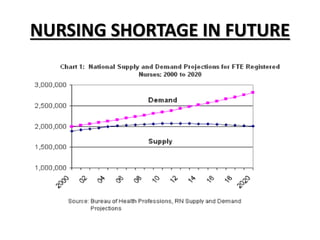
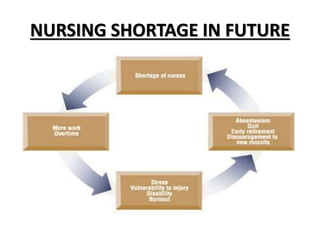
NURSING SHORTAGE IN FUTURE
โ€ข According to Dr.Peter Buerhaus in
Austrelia
โ€ข Shortage of RNโ€™s by 2025 be as high as
500000
โ€ข Demand of RNโ€™s is expected to grow by 2%
or 3% each year
NURSING SHORTAGE IN FUTURE
EFFECTS OF NURSING SHORTAGE IN
FUTURE
๏ถ Hospitals will be reserved only for sickest
๏ถ Nurses will do much more population based or
community health care
๏ถIncrease nursesโ€™ patientโ€™s loads
๏ถIncreases the risk for error
๏ถIncrease risk of spreading infection to patients and
staffs
EFFECTS OF NURSING SHORTAGE IN
FUTURE
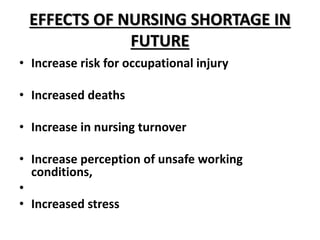
โ€ข Increase risk for occupational injury
โ€ข Increased deaths
โ€ข Increase in nursing turnover
โ€ข Increase perception of unsafe working
conditions,
โ€ข
โ€ข Increased stress
NURSING SHORTAGE IN FUTURE
SOLUTION TO NURSING SHORTAGE
In April 2001, New York state Board
of Regents named a Blue Ribbon
Task Force on Future of the
Nursing, chaired by Regent Diane.
The Regents Blue Ribbon Task Force
has a solution to nursing shortage,
SOLUTIONS TO NURSING SHORTAGE
IN FUTURE
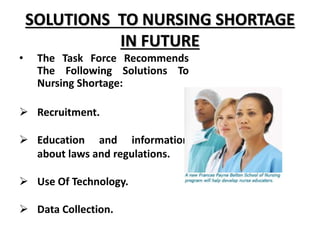
โ€ข The Task Force Recommends
The Following Solutions To
Nursing Shortage:
๏ƒ˜ Recruitment.
๏ƒ˜ Education and information
about laws and regulations.
๏ƒ˜ Use Of Technology.
๏ƒ˜ Data Collection.
SOLUTIONS TO NURSING SHORTAGE
IN FUTURE
๏ƒ˜Clarify existing laws and regulations.
And
๏ƒ˜Technological advancement.
TELEMEDICINE
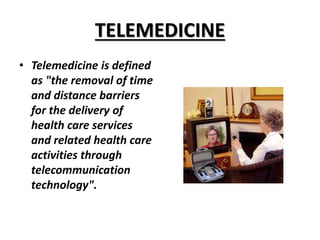
โ€ข Telemedicine is defined
as "the removal of time
and distance barriers
for the delivery of
health care services
and related health care
activities through
telecommunication
technology".
IMPACT OF TELEHEALTH
NURSING
โ€ข Telehealth is direct communication between the
patient and the provider
โ€ข It integrates information and technology to
facilitate health care delivery.
โ€ข Telehealth removes time and distance barriers via
videophones, video camera.
โ€ข The telehealth contributes to positive outcomes in
terms of self management and compliance.
NANOTECHNOLOGY
โ€ข Nanotechnology is use of atomic and
molecular structure as core building to
create new products and devices.
โ€ข These new products and devices collectively
called as nanomaterials.
NANOTECHNOLOGY &
NURSING
โ€ข These include main three fields:
i. New pharmaceuticals and drug delivery
mechanism,
ii. Patient monitoring devices
iii. Regenerative sciences.
โ€ข Nanotechnology provides significant ways of
diagnosing , treating prime position to
influence and advocate for safe use of these
new technologies.
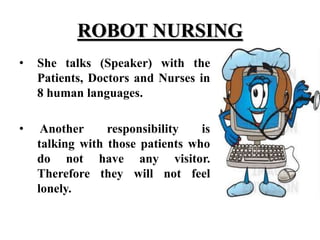
ROBOT NURSING
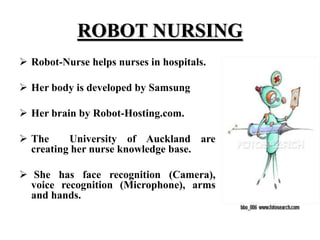
๏ƒ˜ Robot-Nurse helps nurses in hospitals.
๏ƒ˜ Her body is developed by Samsung
๏ƒ˜ Her brain by Robot-Hosting.com.
๏ƒ˜ The University of Auckland are
creating her nurse knowledge base.
๏ƒ˜ She has face recognition (Camera),
voice recognition (Microphone), arms
and hands.
ROBOT NURSING
โ€ข She talks (Speaker) with the
Patients, Doctors and Nurses in
8 human languages.
โ€ข Another responsibility is
talking with those patients who
do not have any visitor.
Therefore they will not feel
lonely.
FUTURSTIC CYBER NURSING
con...
๏‚ง Patientโ€™s chemistry, hematology report will be there with
a small hand held device .
๏‚ง Nurses will verbalize order into the hand held which
goes directly to pharmacy which fills the orders
automatically .
๏‚ง Most diagnosis will have a system for auto care plans
upon patient admission
๏‚ง Nurses getting laptops and using intranet to do their
jobs.
FUTURSTIC CYBER NURSING
con...
๏ฑIn future:-
๏ฑWhen you arrive at work, your I.D. tag is
automatically detected and you are clocked in
as you walk through the door.
๏ฑThe patient is being monitored by
automatic vital signs.
๏ฑThe paper file of yesterday will be a computer
disk or chip.
FUTURSTIC CYBER NURSING
con...
๏ฑNurses will assessment verbally into hand held
device that converts it to readable notes .
๏ฑNurses will carry pocket computers on their
uniforms belts to record data .
๏ฑPatients have a bedside computer to access
educational tools and progress of their
recovery or stay.
FUTURE & HEALTH CARE
SYSTEM
๏ฑLength of stay in hospital will be shorter
๏ฑ Preparing the client for recovery will be the
major aspect of the nurse role .
๏ฑTo provide effective care nurses will need to
increase their knowledge, physiologic &
psychological functioning ,technologic
monitoring system ,client care and computer.
FUTURE & HEALTH CARE
SYSTEM
๏ฑSeriously ill patients confined to a hospital bed will
require intensive care administered by professionals
๏ฑNurses will administer medicine using computer
driven equipment.
โ€ข The hospital beds of tomorrow will be designed to
rotate the occupant periodically.
โ€ข The professional nurse will assign dressing changes
& other treatments to the multiskilled workers .
FUTURE & HEALTH CARE
SYSTEM
๏ฑ Nurses will focus on wellness and prevention
๏ฑThey will also have to keep abreast of the most
recent research.
๏ฑ Nurses will also need to take an active role in
preparing healthy citizens for the future
๏ฑNurses will teach children about exercise
,nutrition, safety and other habits are learned .
SUMMARY
So today we discussed about:-
๏ƒผNursing
๏ƒผModern nursing
๏ƒผFuturistic nursing
๏ƒผAspects of futuristic nursing
โ€ข Nursing education
โ€ข Nursing services.
๏ƒผTechnological advancement.
CONCLUSION
โ€ข Future of nursing is of great scope. The nurses
can make use of the great scope for their
professional advancements and to safeguard
their lives.
Abstract
โ€ข Consumer-centered nursing with ICT: A
futuristic viewpoint.
Stud Health Technol Inform. 2006;122:425-9.
โ€ข Jauhiainen A1, Saranto K, Tossavainen K.
โ€ข Author information
โ€ข 1School of Health Professions, Savonia
University of Applied Sciences, Iisalmi,
Finland. annikki.jauhiainen@savonia-amk.fi
Abstract
โ€ข The purpose of this paper is to describe the views of
health care and information technology professionals
and patients about the future use and scenarios of
information and communication technologies (ICT) in
nursing practice. The perspective was set at the year
2010. The Delphi method was used, and the data were
gathered during the years 2001 and 2002 with three
Delphi rounds from a Finnish expert panel (N = 81).
The experts consisted of clinical nurses, clinical nurse
managers, nurse educators, professionals of
development, research and information technology and
patients. The data were gathered and analysed with
qualitative and quantitative methods
AbstractCONโ€ฆโ€ฆ.
โ€ข . The use of ICT was observed from the
viewpoints of probability and desirability. The
experts agreed more often about the desirability
than the probability of the use of ICT. Three
future nursing scenarios were outlined based on
the results: nursing knowledge management and
development, patient orientation and self-care,
and technology vs. the human being. The
scenarios will be take-off points for development
in nursing practice and education.
THANK YOU

ppt futurstic nursing

  • 1.
    PRESENTED TO:- PRESENTEDBY:- MR. AJESH KUMAR AMANDEEP KAUR Associate professor M.Sc. Nsg. 1st year (Mental Health Nsg.) 1915703
  • 2.
  • 3.
    NURSING DEFINITION:- (acc. To WHO) Nursingencompasses autonomous and collaborative care of individuals of all ages, families, groups and communities, sick or well and in all settings. It includes the promotion of health, the prevention of illness, and the care of ill, disabled and dying people
  • 4.
    MODERN NURSING DEFINITION:- โ€œThe artof using the latest technology & science to promote quality of life as defined by patients and families through out their life experiences from birth to the end of life.โ€
  • 5.
    FUTURSTIC NURSING INTRODUCTION:- โ€ข Itis time for nursing to question and redefine its role within system and take steps to bring about the future that the nursing profession is to achieve.
  • 6.
    FUTURSTIC MEANING:- (INNOVATIVE/REVOLUTIONARY) Innovation is theaction of introducing a new method , idea or product.
  • 7.
    ASPECTS OF FUTURISTICNURSING ๏ถNursing education ๏ถNursing services
  • 8.
    1.) NURSING EDUCATION FUTUREISSUES:- โ€ขMultiple settings โ€ขCritical thinking โ€ข Require extensive knowledge โ€ขMore Complex Specialized practice
  • 9.
    CAUSES OF CHANGESIN NURSING EDUCATION ๏ถChanging demographics ๏ถTechnological explosion ๏ถGlobalization ๏ถChanging era ๏ถShift to population based care & increasing complexity of patient care
  • 10.
    CAUSES OF CHANGESIN NURSING EDUCATION contiโ€ฆ.. ๏ถCost of health care & challenge of managed care ๏ถImpact of health policy ๏ถCollaborative practice ๏ถNursing shortage ๏ถSignificant advances in nursing science & research
  • 11.
    Future direction forstudentsโ€™ education ๏‚ง In 1993, three major organizations issued statements and reports about nursing education for the twenty first century. ๏‚ง Their reports addressed the new directions of nursing education needed to take in the future.
  • 12.
    AREAS OF EMPHASIS 1.Schools should recruit diverse students and facilities that reflect the multicultural nature of society. 2. Curricula and learning activities should develop students critical thinking skills. 3. Curricula should emphasize students abilities.
  • 13.
    AREAS OF EMPHASIS 4.Curricula should emphasize health promotion & health maintenance. 5. Emphasis should be placed on community โ€“ based care . 6. Faculty should develop programe that facilitate articulation
  • 14.
    AREAS OF EMPHASIS 7.Development activities should support excellence in practice teaching & research. 8. Cost effectiveness of care should be focus in nursing curricula.
  • 15.
    Future directions forstudentsโ€™ education a. Student centered learning b. Adaptive curriculum c. Teaching Innovations d. System approach e. Fitness to practice f. Medical Education
  • 16.
    STUDENT CENTERED LEARNING โ€ขHarden highlighted that the importance of student centered learning as being pivotal to thinking about learning and teaching suggested that medical institutions includes a bank of learning objects (e.g. X- ray images, videos) .
  • 17.
    ADAPTIVE CURRICULUM Harden explainedthat concepts of โ€œjust for me learningโ€ and โ€œjust in time learningโ€ are accommodated by technology when the learner is ready the teacher will appear via technology.
  • 18.
    TEACHING INNOVATIONS Innovation inmedical education extend to curriculum technology assessment and professionalism.
  • 19.
    SYSTEM APPROACH 1. Aretzstressed the need for medical education programs for to prepare graduates who are responsible to both for the health system in which they will function and needs of patient they will treat currently.
  • 20.
    SYSTEM APPROACH 2. Medicalstudents spend most time in teaching hospitals but they will eventually work in the community, where most patient and are treated.
  • 21.
    FITNESS TO PRACTICE ๏‚งAccording to Walton, fitness to practice is an issue with which all medical schools are currently grappling overall we are probably handling the issues of knowledge and skills quite well.
  • 22.
    FITNESS TO PRACTICE โ€ขThere is still debate about what it really means , what its components are and what we need to do much better.
  • 23.
    MEDICAL EDUCATION RESEARCH โ€ขIn order to validate the effectiveness of new teaching approaches medical education research must emphasis appropriate methodology.
  • 24.
    2.) NURSING SERVICES โ€ขBy the year 2020- less than 15 years from now a study from occupational health and safety administration predict that the need for โ€ข registered nurses in nursing homes will increase -66% โ€ข Licensed practical and vocational nurses-72% โ€ข Certified nursing assistants-69% โ€ข Nurses work in home setting-250%
  • 26.
    NURSING SHORTAGE INFUTURE โ€ข According to Dr.Peter Buerhaus in Austrelia โ€ข Shortage of RNโ€™s by 2025 be as high as 500000 โ€ข Demand of RNโ€™s is expected to grow by 2% or 3% each year
  • 27.
  • 28.
    EFFECTS OF NURSINGSHORTAGE IN FUTURE ๏ถ Hospitals will be reserved only for sickest ๏ถ Nurses will do much more population based or community health care ๏ถIncrease nursesโ€™ patientโ€™s loads ๏ถIncreases the risk for error ๏ถIncrease risk of spreading infection to patients and staffs
  • 29.
    EFFECTS OF NURSINGSHORTAGE IN FUTURE โ€ข Increase risk for occupational injury โ€ข Increased deaths โ€ข Increase in nursing turnover โ€ข Increase perception of unsafe working conditions, โ€ข โ€ข Increased stress
  • 30.
  • 31.
    SOLUTION TO NURSINGSHORTAGE In April 2001, New York state Board of Regents named a Blue Ribbon Task Force on Future of the Nursing, chaired by Regent Diane. The Regents Blue Ribbon Task Force has a solution to nursing shortage,
  • 32.
    SOLUTIONS TO NURSINGSHORTAGE IN FUTURE โ€ข The Task Force Recommends The Following Solutions To Nursing Shortage: ๏ƒ˜ Recruitment. ๏ƒ˜ Education and information about laws and regulations. ๏ƒ˜ Use Of Technology. ๏ƒ˜ Data Collection.
  • 33.
    SOLUTIONS TO NURSINGSHORTAGE IN FUTURE ๏ƒ˜Clarify existing laws and regulations. And ๏ƒ˜Technological advancement.
  • 34.
    TELEMEDICINE โ€ข Telemedicine isdefined as "the removal of time and distance barriers for the delivery of health care services and related health care activities through telecommunication technology".
  • 35.
    IMPACT OF TELEHEALTH NURSING โ€ขTelehealth is direct communication between the patient and the provider โ€ข It integrates information and technology to facilitate health care delivery. โ€ข Telehealth removes time and distance barriers via videophones, video camera. โ€ข The telehealth contributes to positive outcomes in terms of self management and compliance.
  • 36.
    NANOTECHNOLOGY โ€ข Nanotechnology isuse of atomic and molecular structure as core building to create new products and devices. โ€ข These new products and devices collectively called as nanomaterials.
  • 37.
    NANOTECHNOLOGY & NURSING โ€ข Theseinclude main three fields: i. New pharmaceuticals and drug delivery mechanism, ii. Patient monitoring devices iii. Regenerative sciences. โ€ข Nanotechnology provides significant ways of diagnosing , treating prime position to influence and advocate for safe use of these new technologies.
  • 38.
    ROBOT NURSING ๏ƒ˜ Robot-Nursehelps nurses in hospitals. ๏ƒ˜ Her body is developed by Samsung ๏ƒ˜ Her brain by Robot-Hosting.com. ๏ƒ˜ The University of Auckland are creating her nurse knowledge base. ๏ƒ˜ She has face recognition (Camera), voice recognition (Microphone), arms and hands.
  • 39.
    ROBOT NURSING โ€ข Shetalks (Speaker) with the Patients, Doctors and Nurses in 8 human languages. โ€ข Another responsibility is talking with those patients who do not have any visitor. Therefore they will not feel lonely.
  • 40.
    FUTURSTIC CYBER NURSING con... ๏‚งPatientโ€™s chemistry, hematology report will be there with a small hand held device . ๏‚ง Nurses will verbalize order into the hand held which goes directly to pharmacy which fills the orders automatically . ๏‚ง Most diagnosis will have a system for auto care plans upon patient admission ๏‚ง Nurses getting laptops and using intranet to do their jobs.
  • 41.
    FUTURSTIC CYBER NURSING con... ๏ฑInfuture:- ๏ฑWhen you arrive at work, your I.D. tag is automatically detected and you are clocked in as you walk through the door. ๏ฑThe patient is being monitored by automatic vital signs. ๏ฑThe paper file of yesterday will be a computer disk or chip.
  • 42.
    FUTURSTIC CYBER NURSING con... ๏ฑNurseswill assessment verbally into hand held device that converts it to readable notes . ๏ฑNurses will carry pocket computers on their uniforms belts to record data . ๏ฑPatients have a bedside computer to access educational tools and progress of their recovery or stay.
  • 43.
    FUTURE & HEALTHCARE SYSTEM ๏ฑLength of stay in hospital will be shorter ๏ฑ Preparing the client for recovery will be the major aspect of the nurse role . ๏ฑTo provide effective care nurses will need to increase their knowledge, physiologic & psychological functioning ,technologic monitoring system ,client care and computer.
  • 44.
    FUTURE & HEALTHCARE SYSTEM ๏ฑSeriously ill patients confined to a hospital bed will require intensive care administered by professionals ๏ฑNurses will administer medicine using computer driven equipment. โ€ข The hospital beds of tomorrow will be designed to rotate the occupant periodically. โ€ข The professional nurse will assign dressing changes & other treatments to the multiskilled workers .
  • 45.
    FUTURE & HEALTHCARE SYSTEM ๏ฑ Nurses will focus on wellness and prevention ๏ฑThey will also have to keep abreast of the most recent research. ๏ฑ Nurses will also need to take an active role in preparing healthy citizens for the future ๏ฑNurses will teach children about exercise ,nutrition, safety and other habits are learned .
  • 46.
    SUMMARY So today wediscussed about:- ๏ƒผNursing ๏ƒผModern nursing ๏ƒผFuturistic nursing ๏ƒผAspects of futuristic nursing โ€ข Nursing education โ€ข Nursing services. ๏ƒผTechnological advancement.
  • 47.
    CONCLUSION โ€ข Future ofnursing is of great scope. The nurses can make use of the great scope for their professional advancements and to safeguard their lives.
  • 48.
    Abstract โ€ข Consumer-centered nursingwith ICT: A futuristic viewpoint. Stud Health Technol Inform. 2006;122:425-9. โ€ข Jauhiainen A1, Saranto K, Tossavainen K. โ€ข Author information โ€ข 1School of Health Professions, Savonia University of Applied Sciences, Iisalmi, Finland. annikki.jauhiainen@savonia-amk.fi
  • 49.
    Abstract โ€ข The purposeof this paper is to describe the views of health care and information technology professionals and patients about the future use and scenarios of information and communication technologies (ICT) in nursing practice. The perspective was set at the year 2010. The Delphi method was used, and the data were gathered during the years 2001 and 2002 with three Delphi rounds from a Finnish expert panel (N = 81). The experts consisted of clinical nurses, clinical nurse managers, nurse educators, professionals of development, research and information technology and patients. The data were gathered and analysed with qualitative and quantitative methods
  • 50.
    AbstractCONโ€ฆโ€ฆ. โ€ข . Theuse of ICT was observed from the viewpoints of probability and desirability. The experts agreed more often about the desirability than the probability of the use of ICT. Three future nursing scenarios were outlined based on the results: nursing knowledge management and development, patient orientation and self-care, and technology vs. the human being. The scenarios will be take-off points for development in nursing practice and education.
  • 52.