



EVIDENCE BASED NURSING

PRACTICE
Ms. NAMITA BATRA GUIN
Associate Professor
• Nursing research is a systematic
enquiry designed to develop
trustworthy evidence about issues of
importance to the nursing profession,
including nursing practice, education,
administration and informatics.
NURSING RESEARCH
EVIDENCE
Evidence is information based on
historical or scientific evaluation
of a practice that is accessible to
decision makers in health care
system.
EVIDENCE BASED
DECISION MAKING
It is the explicit ,conscientious
and judicious consideration of
the best available evidence in
the provision of health care.
EVIDENCE BASED
PRACTICE
It refers to the decision making
approach based on integrating
clinical expertise with the best
a v a i l a b l e e v i d e n c e s f r o m
systematic research.
EVIDENCE BASED
NURSING PRACTICE
Evidence based nursing practice is the
conscientious use of current best evidence in
making clinical decision about patient care.
{Sackett et.al.2000}
Evidence based nursing practice is the process by
which nurses make clinical decision using the best
available research evidence , their clinical
expertise and patient preferences, in the context of
available resources.
{Di Censo A, Cullum N.1998}
EVIDENCE BASED
NURSING PRACTICE
• Evidence based practice movement started in England in
the early 1990s.
• Cochrane collaboration was formed in 1993 works to
prepare, maintain and disseminate systematic research
reviews, the evidence needed for health care decision-
making.
• A publication by Stetler et al (1998) in U S provides a
definition of evidence-based nursing.
• Rosswurm and Larrabe (1999) have developed a model to
guide nurses and other health care professionals for
evidence based practice.
• A Multidisciplinary evidence based practice model
developed at the university of Colorado hospital by C J
Goode and F Piedalue in 1999.
HISTORICAL
PERSPECTIVE
• Provide practicing nurse the
evidence based data to deliver
effective care.
• Resolve problem in clinical
setting.
• Achieve excellence in care
delivery.
• Reduces the variations in nursing
care and assist with efficient ,and
effective decision making.
GOALS OF EVIDENCE BASED
NURSING PRACTICE
CURRENT TRENDS DRIVING DEVELOPMENT
OF EBP IN NURSING
• Increased number of well designed randomised controlled trials.
• Need for decreased variability in implementation of practice
• Need for implementation of research evidence in practice.
• Demands of few health professions commission or statutory bodies.
• Growth of advanced practice roles.
• Increased experience in clinical pathways, standards, protocols and
algorithms
• Increase in integrated systematic reviews of research studies.
• Need for outcome data to guide patient care.
• Explosion in the information technology.
• Improved knowledge base facilitating research.
• Need to collaborate in complex decision making.
• Requirement for evidence based standards of care implemented by
the joint commission on accreditation of health care organizations
(JCAHO)
CURRENT TRENDS DRIVING
DEVELOPMENT OF EBP IN
NURSING
CONCERNS RELATED TO EBN
EBP is more focused on the science of nursing than
on the art of nursing.
Fear among professionals
Nursing would get reduced to technical practice.
Research involving human being is complex and
findings are open to interpretation and should not be
the sole basis for practice.
Health care reimbursement only linked to the
interventions that can be substantiated by a
documented body of evidence.
Not all practice in health professionals can or should
be based on science when developing a plan of care,
strict reliance on EBP can create void.
CONCERNS RELATED TO
EVIDENCE BASED NURSING
PRACTICE
BARRIERS TO RESEARCH UTILIZATION AND EBP
Lack of confidence in critical appraisal skills
Insufficient time & resistance to change
Lack of organizational infrastructure and
support
Lack of disseminated of nursing research
Insufficient access to research findings
Shortage of research evidence
Lack of understanding of research reports.
BARRIERS TO RESEARCH
UTILIZATION &EBP
➢ It is not the same and are not
synonymous
➢They are both scholarly processes but
focus on different phases of knowledge
development-Application versus
discovery.
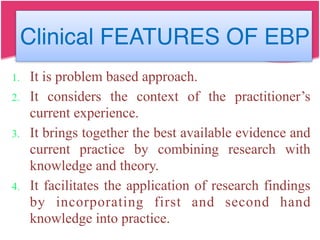
Clinical FEATURES OF EBP
1. It is problem based approach.
2. It considers the context of the practitioner’s
current experience.
3. It brings together the best available evidence and
current practice by combining research with
knowledge and theory.
4. It facilitates the application of research findings
by incorporating first and second hand
knowledge into practice.
ASPECTS OF EVIDENCE BASED PRACTICE
Research utilization
Literature review
Integrative literature review
Meta analysis
Clinical decision-making
ASPECTS OF EVIDENCE
BASED PRACTICE
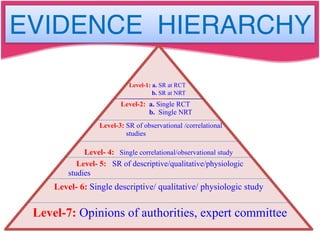
EVIDENCE HIERARCHY
Level-1: a. SR at RCT
b. SR at NRT
Level-2: a. Single RCT
b. Single NRT
Level-3: SR of observational /correlational
studies
Level- 4: Single correlational/observational study
Level- 5: SR of descriptive/qualitative/physiologic
studies
Level- 6: Single descriptive/ qualitative/ physiologic study
Level-7: Opinions of authorities, expert committee
SOURCES OF EVIDENCE
BASED PRACTICE.
➢ Systematic reviews.
➢ Clinical practice guidelines.
➢ Other reappraised evidence.
➢ Research findings on EBP and barriers to RU.
➢ Models and theories for (EBP) Evidence based
practice.
In systematic review all evidence
are about a clinical problem is gathered,
evaluated and synthesized so that conclusion
can be drawn about effective practices.
Systematic reviews:
FORMS OF SYSTEMATIC
REVIEW
➢TRADITIONAL NARRATIVE
QUALITATIVE INTEGRATION
➢METAANALYSIS
➢META SYNTHESIS
TRADITIONAL NARRATIVE
It is to merge and synthesize
research findings.
META ANALYSIS
It is a technique for integrating
quantitative research findings
statistically
METASYNTHESIS
It is integration of qualitative
research findings. It is less about
reducing information and more about
amplifying and interpreting it.
SYSTEMATIC REVIEWS ARE
AVAILABLE AT
• PROFESSIONAL JOURNALS
• DATABASES
• AGENCY FOR HEALTH CARE RESEARCH AND
QUALITY
• EVIDENCE BASED PRACTICE CENTERS
• CENTER FOR REVIEWS AND DISSEMINATION.
(Database of Abstracts of Reviews of Effects)
CLINICAL PRACTICE GUIDELINES
These are based on systematic reviews
and give specific practice
recommendations and prescriptions for
evidence based decision making.
CLINICAL PRACTICE
GUIDELINES ARE AVAILABLE AT
➢ NATIONAL GUIDELINE CLEARING HOUSE. (CANADA)
➢ REGISTERED NURSES ASSOCIATION OF ONTARIO
➢ CANADIAN MEDICAL ASSOCIATION
➢ TRANSLATING RESEARCH INTO PRACTICE DATABASE
➢ NATIONAL INSTITUTE FOR CLINICAL EXCELLENCE
➢ ASSOCIATION OF WOMEN’S HEALTH,OBSTETRICS AND
NEONATAL NURSING (AWHONN)
EVIDENCE BASED PRACTICE
MODELS
MODELS AND THEORIES FOR
EVIDENCE BASED PRACTICE
➢ The models offer framework for
understanding the evidence based process
and for designing and implementing an
evidence based practice project in a
practice setting.
MODELS OF EVIDENCE BASED PRACTICE
!Stetler model
!Iowa model
!Rossworm and larrabee model
!D.Censo model of evidence based practice
MODELS OF EVIDENCE
BASED PRACTICE
MODELS Of ebp
➢Stetler model of research utilization (Stetler 2001)
➢Iowa model of research in practice (Titler et.al.,2001)
➢Rosswurm and Larrabee Model of translating evidence
into clinical practice.(Rosswurm & Larrabee, 1999)
➢Framework for adopting an evidence –based innovation
(Dicenso et al.,2005)
➢Diffusion of innovations theory (Rogers,1995)
➢Advancing research and clinical practice through close
collaboration (ARCC) Model (Melnyk & fineout-overholt, 2005)
➢Groove’s Model for implementing EBP guidelines in
training. (Groove
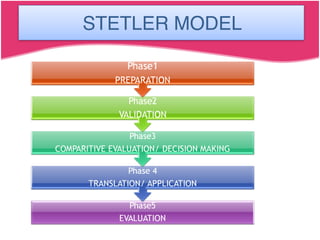
STETLER MODEL
• Developed as ‘practitioner oriented’ model
in 1994
• Revised in 2001 without a change in its
focus on critical thinking.
• Deemphasized unsystematic clinical
experiences.
• Raised awareness about the importance of
applying research findings in nursing
practice.
STETLER MODEL
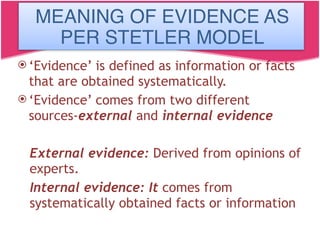
MEANING OF ‘EVIDENCE’ AS PER STETLER
MODEL
⦿‘Evidence’ is defined as information or facts
that are obtained systematically.
⦿‘Evidence’ comes from two different
sources-external and internal evidence
External evidence: Derived from opinions of
experts.
Internal evidence: It comes from
systematically obtained facts or information
MEANING OF EVIDENCE AS
PER STETLER MODEL
STETLER MODELSTETLER MODEL
FIVE PROGRESSIVE CATEGORIES OF
STETLER MODEL:-
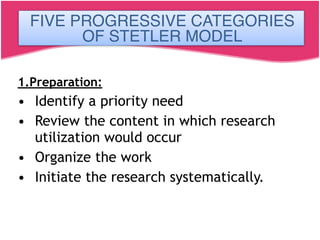
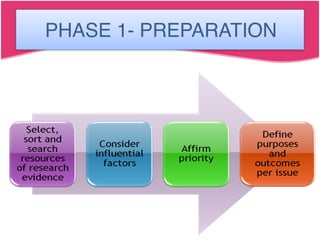
1.Preparation:
• Identify a priority need
• Review the content in which research
utilization would occur
• Organize the work
• Initiate the research systematically.
FIVE PROGRESSIVE CATEGORIES
OF STETLER MODEL
FIVE PROGRESSIVE CATEGORIES OF
STETLER MODEL:-(Contd..)
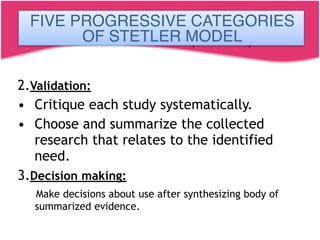
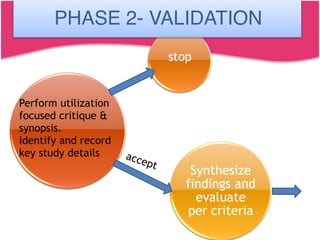
2.Validation:
• Critique each study systematically.
• Choose and summarize the collected
research that relates to the identified
need.
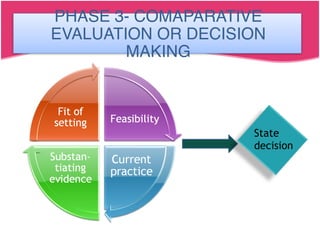
3.Decision making:
Make decisions about use after synthesizing body of
summarized evidence.
FIVE PROGRESSIVE CATEGORIES
OF STETLER MODEL
FIVE PROGRESSIVE CATEGORIES OF
STETLER MODEL:-(Contd..)
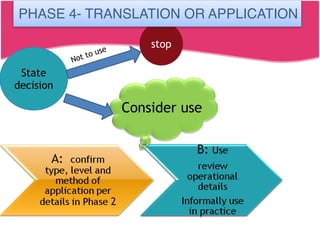
4.Translation:
Converting findings, planning their
application, putting the plan to use and
then implementing use with an evidence
based practice.
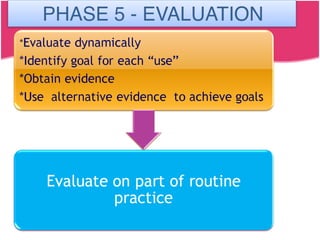
5. Evaluation:
Evaluate the plan in terms of goals.
FIVE PROGRESSIVE CATEGORIES
OF STETLER MODEL
PHASE 1- PREPARATION
Perform utilization
focused critique &
synopsis.
Identify and record
key study details accept
PHASE 2- VALIDATION
State
decision
PHASE 3- COMAPARATIVE
EVALUATION OR DECISION
MAKING
Consider use
State
decision
stop
Not to use
PHASE 4- TRANSLATION OR APPLICATION
PHASE 5 - EVALUATION
CRITICAL ASSUMPTIONS
• Both formal and informal use of research findings can occur
in the practice setting.
• Individual, research utilization competent practitioners also
can use the model’s process and interaction with others.
• Skills are required for effective use of findings
• Research findings may be used in multiple ways
• Contextual and personal factors can influence research
evidence
• The data provides probabilistic information about individuals
for whom the evidence is generally believed to fit
CRITICAL ASSUMPTIONS
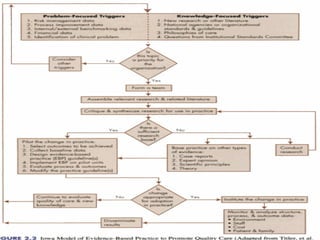
IOWA MODEL
• It incorporates the use of research and other
forms of evidence
• Infrastructure to support research use might
involve every level of the organization
• Evidence based practice is linked to quality
assurance.
• Staff are given recognition for research work.
• Clinicians are given time and resources for
research work.
• Utilizes multidisciplinary team approach
IOWA MODEL
IOWA MODEL
• Multiple resources available to aid in
implementation.
• Algorithm that can easily be applied to
practice.
• Applicable to quality improvement
projects as well as nursing research
WHY IOWA MODEL?
Selecting a Topic
“The Burning Question”
• Problem Focused Triggers
– Risk management data
– Identification of a clinical problem
– QI or Financial Data
• Knowledge Focused Triggers
– New research or other literature
– Philosophies of Care
– Agencies or Organizational Standards and guidelines
SELECTING A TOPIC -THE
BURNING QUESTION?
Priority for Organization
• Organizational goals and objectives
• Clinician interest
• Potential impact
• Executive leadership support
PRIORITY FOR
ORGANIZATION
Forming a Team
• Makeup driven by topic
• Multidisciplinary
• Based upon expertise, interest and role
responsibility
• Involvement of key stakeholders
FORMING A TEAM
Finding and Critiquing the Evidence
• Skilled librarian
• Group approach
• Literature Review grids
• Grading of evidence
FINDING AND CRITIQUING THE
EVIDENCE
Is There Sufficient Research To Guide
Practice?
• Consistency of findings across studies
• Types and quality of studies
• Clinical relevance
• If the answer is yes….Then…
SUFFICIENT RESEARCH TO
GUIDE PRACTICE?
Pilot the change in practice
– Select outcomes
– Collect Baseline data
– EBP guidelines
– Implement on pilot units
– Evaluate
PILOT THE CHANGE INTO
PRACTICE
If the answer is No….
• Research
– Monetary resources
– Expertise in scientific methods
• Base practice on other types of Evidence
– Combine research with other scientific
principles
– EBP guidelines
IF ANSWER IS NO….
Institute Change in Practice
Remember….
– Decision to implement is based on outcomes
– Involves changing behavior and practices
– Requires various strategies to be investigated
“the diffusion of an innovation is influenced by the nature of the
innovation and the manner in which it is communicated to
members of a social system”
Everett Rogers
1995
INSTITUTE CHANGE INTO
PRACTICE
Evaluation
• Monitoring outcomes
• Establish data collection criteria and
frequency
• Feedback for users
• Modify as appropriate
EVALUATION
Dissemination of Information
• Poster presentations
• Organizational Newsletters
• Podium presentations
• Shared Governance Meetings
• Computer-Based Learning Modules
• Manuscripts
Publish-Publish-Publish!!!
DISSEMINATION OF
INFORMATION
ROSSWORM AND LARRABEE MODEL
• Developed by Rossworm and Larabee in
1999.
• It is based on theoretical and research
literature
• It begins with the assessment of need and
integration of an evidence based protocol
ROSSWORM AND LARRABEE
MODEL
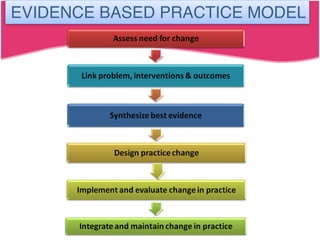
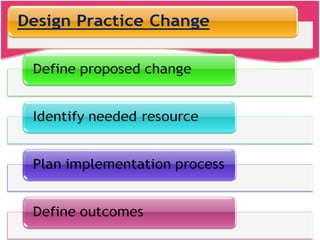
STAGES OF ROSSWORM AND LARRABEE
MODEL
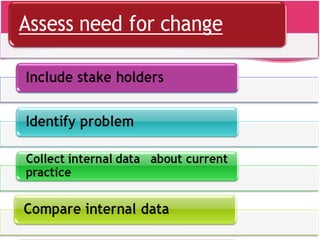
• Assess needs of stakeholders
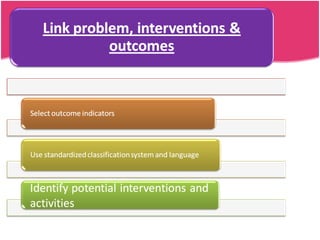
• Build bridges, make connections
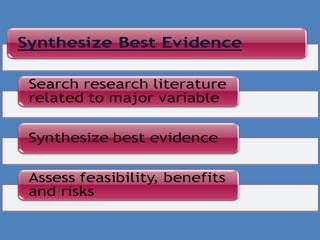
• Synthesize the evidence and determine
relevancy
• Plan the practice change
• Implement and evaluate the practice
change
• Integrate and maintain the practice change
STAGES OF ROSSWORM AND
LARRABEE MODEL
Evidence Based Practice ModelEVIDENCE BASED PRACTICE MODEL
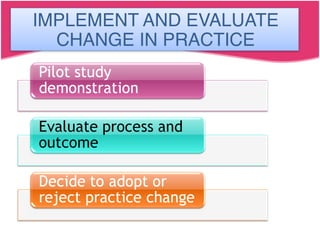
Implement and evaluate change in
practice
IMPLEMENT AND EVALUATE
CHANGE IN PRACTICE
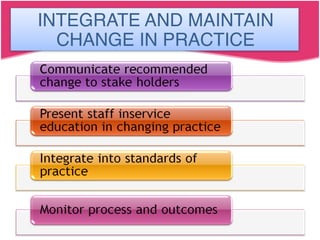
Integrate and maintain change in
practice
INTEGRATE AND MAINTAIN
CHANGE IN PRACTICE
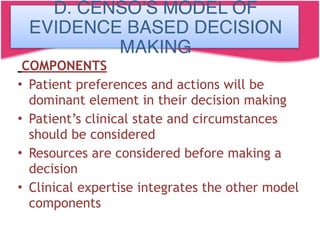
COMPONENTS
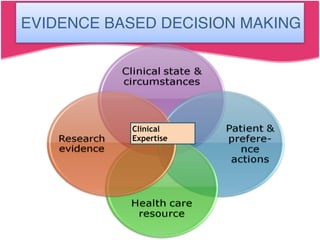
• Patient preferences and actions will be
dominant element in their decision making
• Patient’s clinical state and circumstances
should be considered
• Resources are considered before making a
decision
• Clinical expertise integrates the other model
components
D. CENSO’S MODEL OF
EVIDENCE BASED DECISION
MAKING
Clinical
Expertise
EVIDENCE BASED DECISION MAKING
STEPS IN EVIDENCE BASED DECISION
MAKING
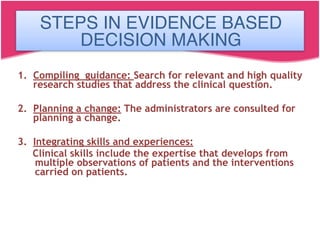
1. Compiling guidance: Search for relevant and high quality
research studies that address the clinical question.
2. Planning a change: The administrators are consulted for
planning a change.
3. Integrating skills and experiences:
Clinical skills include the expertise that develops from
multiple observations of patients and the interventions
carried on patients.
STEPS IN EVIDENCE BASED
DECISION MAKING
CLINICAL EXPERTISE
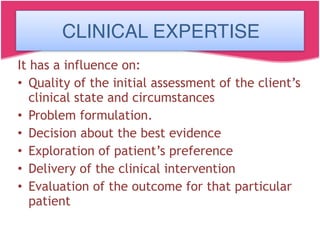
It has a influence on:
• Quality of the initial assessment of the client’s
clinical state and circumstances
• Problem formulation.
• Decision about the best evidence
• Exploration of patient’s preference
• Delivery of the clinical intervention
• Evaluation of the outcome for that particular
patient
CLINICAL EXPERTISE
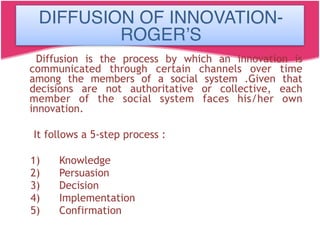
Diffusion is the process by which an innovation is
communicated through certain channels over time
among the members of a social system .Given that
decisions are not authoritative or collective, each
member of the social system faces his/her own
innovation.
It follows a 5-step process :
1)      Knowledge
2)      Persuasion
3)      Decision
4)      Implementation
5)      Confirmation
DIFFUSION OF INNOVATION-
ROGER’S
1)      Knowledge – person becomes aware of an
innovation and has some idea of how it functions,
2)      Persuasion – person forms a favorable or
unfavorable attitude toward the innovation,
3)      Decision – person engages in activities that lead
to a choice to adopt or reject the innovation,
4)      Implementation – person puts an innovation into
use,
5)      Confirmation – person evaluates the results of an
innovation-decision already made.
DIFFUSION PROCESS FOLLOWS
A 5 STEP PROCESS
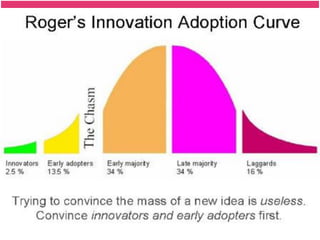
Each individual’s innovation-decision is largely framed by personal
characteristics. For a successful innovation, the adopter distribution follow a
bell-shaped curve, the derivative of the S-shaped diffusion curve, over time and
approach normality. Diffusion scholars divide this bell-shaped curve to
characterize five categories of system member innovativeness, where
innovativeness is defined as the degree to which an individual is relatively
earlier in adopting new ideas than other members of a system.
These groups are:
1) innovators,
2) early adopters,
3) early majority,
4) late majority, and
5) laggards .
DIFFUSION OF INNOVATION-
ROGER’S
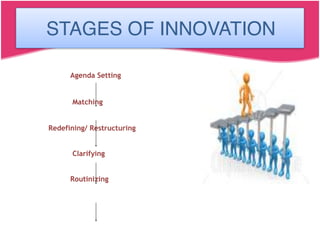
Stages of Innovation
Agenda Setting
Matching
Redefining/ Restructuring
Clarifying
Routinizing
STAGES OF INNOVATION
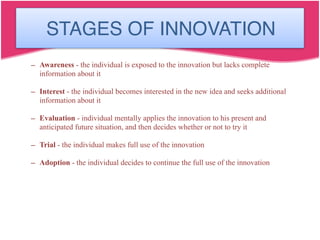
Stages of Innovation
– Awareness - the individual is exposed to the innovation but lacks complete
information about it
– Interest - the individual becomes interested in the new idea and seeks additional
information about it
– Evaluation - individual mentally applies the innovation to his present and
anticipated future situation, and then decides whether or not to try it
– Trial - the individual makes full use of the innovation
– Adoption - the individual decides to continue the full use of the innovation
STAGES OF INNOVATION
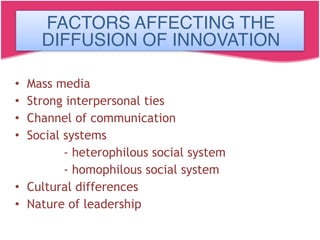
Factors affecting the diffusion of
Innovation
• Mass media
• Strong interpersonal ties
• Channel of communication
• Social systems
- heterophilous social system
- homophilous social system
• Cultural differences
• Nature of leadership
FACTORS AFFECTING THE
DIFFUSION OF INNOVATION

Evidenced based nursing practice

  • 1.
    EVIDENCE BASED NURSING
 PRACTICE Ms.NAMITA BATRA GUIN Associate Professor
  • 2.
    • Nursing researchis a systematic enquiry designed to develop trustworthy evidence about issues of importance to the nursing profession, including nursing practice, education, administration and informatics. NURSING RESEARCH
  • 3.
    EVIDENCE Evidence is informationbased on historical or scientific evaluation of a practice that is accessible to decision makers in health care system.
  • 4.
    EVIDENCE BASED DECISION MAKING Itis the explicit ,conscientious and judicious consideration of the best available evidence in the provision of health care.
  • 5.
    EVIDENCE BASED PRACTICE It refersto the decision making approach based on integrating clinical expertise with the best a v a i l a b l e e v i d e n c e s f r o m systematic research.
  • 6.
    EVIDENCE BASED NURSING PRACTICE Evidencebased nursing practice is the conscientious use of current best evidence in making clinical decision about patient care. {Sackett et.al.2000}
  • 7.
    Evidence based nursingpractice is the process by which nurses make clinical decision using the best available research evidence , their clinical expertise and patient preferences, in the context of available resources. {Di Censo A, Cullum N.1998} EVIDENCE BASED NURSING PRACTICE
  • 8.
    • Evidence basedpractice movement started in England in the early 1990s. • Cochrane collaboration was formed in 1993 works to prepare, maintain and disseminate systematic research reviews, the evidence needed for health care decision- making. • A publication by Stetler et al (1998) in U S provides a definition of evidence-based nursing. • Rosswurm and Larrabe (1999) have developed a model to guide nurses and other health care professionals for evidence based practice. • A Multidisciplinary evidence based practice model developed at the university of Colorado hospital by C J Goode and F Piedalue in 1999. HISTORICAL PERSPECTIVE
  • 9.
    • Provide practicingnurse the evidence based data to deliver effective care. • Resolve problem in clinical setting. • Achieve excellence in care delivery. • Reduces the variations in nursing care and assist with efficient ,and effective decision making. GOALS OF EVIDENCE BASED NURSING PRACTICE
  • 10.
    CURRENT TRENDS DRIVINGDEVELOPMENT OF EBP IN NURSING • Increased number of well designed randomised controlled trials. • Need for decreased variability in implementation of practice • Need for implementation of research evidence in practice. • Demands of few health professions commission or statutory bodies. • Growth of advanced practice roles. • Increased experience in clinical pathways, standards, protocols and algorithms • Increase in integrated systematic reviews of research studies. • Need for outcome data to guide patient care. • Explosion in the information technology. • Improved knowledge base facilitating research. • Need to collaborate in complex decision making. • Requirement for evidence based standards of care implemented by the joint commission on accreditation of health care organizations (JCAHO) CURRENT TRENDS DRIVING DEVELOPMENT OF EBP IN NURSING
  • 11.
    CONCERNS RELATED TOEBN EBP is more focused on the science of nursing than on the art of nursing. Fear among professionals Nursing would get reduced to technical practice. Research involving human being is complex and findings are open to interpretation and should not be the sole basis for practice. Health care reimbursement only linked to the interventions that can be substantiated by a documented body of evidence. Not all practice in health professionals can or should be based on science when developing a plan of care, strict reliance on EBP can create void. CONCERNS RELATED TO EVIDENCE BASED NURSING PRACTICE
  • 12.
    BARRIERS TO RESEARCHUTILIZATION AND EBP Lack of confidence in critical appraisal skills Insufficient time & resistance to change Lack of organizational infrastructure and support Lack of disseminated of nursing research Insufficient access to research findings Shortage of research evidence Lack of understanding of research reports. BARRIERS TO RESEARCH UTILIZATION &EBP
  • 13.
    ➢ It isnot the same and are not synonymous ➢They are both scholarly processes but focus on different phases of knowledge development-Application versus discovery.
  • 14.
    Clinical FEATURES OFEBP 1. It is problem based approach. 2. It considers the context of the practitioner’s current experience. 3. It brings together the best available evidence and current practice by combining research with knowledge and theory. 4. It facilitates the application of research findings by incorporating first and second hand knowledge into practice.
  • 15.
    ASPECTS OF EVIDENCEBASED PRACTICE Research utilization Literature review Integrative literature review Meta analysis Clinical decision-making ASPECTS OF EVIDENCE BASED PRACTICE
  • 16.
    EVIDENCE HIERARCHY Level-1: a.SR at RCT b. SR at NRT Level-2: a. Single RCT b. Single NRT Level-3: SR of observational /correlational studies Level- 4: Single correlational/observational study Level- 5: SR of descriptive/qualitative/physiologic studies Level- 6: Single descriptive/ qualitative/ physiologic study Level-7: Opinions of authorities, expert committee
  • 17.
    SOURCES OF EVIDENCE BASEDPRACTICE. ➢ Systematic reviews. ➢ Clinical practice guidelines. ➢ Other reappraised evidence. ➢ Research findings on EBP and barriers to RU. ➢ Models and theories for (EBP) Evidence based practice.
  • 18.
    In systematic reviewall evidence are about a clinical problem is gathered, evaluated and synthesized so that conclusion can be drawn about effective practices. Systematic reviews:
  • 19.
    FORMS OF SYSTEMATIC REVIEW ➢TRADITIONALNARRATIVE QUALITATIVE INTEGRATION ➢METAANALYSIS ➢META SYNTHESIS
  • 20.
    TRADITIONAL NARRATIVE It isto merge and synthesize research findings.
  • 21.
    META ANALYSIS It isa technique for integrating quantitative research findings statistically
  • 22.
    METASYNTHESIS It is integrationof qualitative research findings. It is less about reducing information and more about amplifying and interpreting it.
  • 23.
    SYSTEMATIC REVIEWS ARE AVAILABLEAT • PROFESSIONAL JOURNALS • DATABASES • AGENCY FOR HEALTH CARE RESEARCH AND QUALITY • EVIDENCE BASED PRACTICE CENTERS • CENTER FOR REVIEWS AND DISSEMINATION. (Database of Abstracts of Reviews of Effects)
  • 24.
    CLINICAL PRACTICE GUIDELINES Theseare based on systematic reviews and give specific practice recommendations and prescriptions for evidence based decision making.
  • 25.
    CLINICAL PRACTICE GUIDELINES AREAVAILABLE AT ➢ NATIONAL GUIDELINE CLEARING HOUSE. (CANADA) ➢ REGISTERED NURSES ASSOCIATION OF ONTARIO ➢ CANADIAN MEDICAL ASSOCIATION ➢ TRANSLATING RESEARCH INTO PRACTICE DATABASE ➢ NATIONAL INSTITUTE FOR CLINICAL EXCELLENCE ➢ ASSOCIATION OF WOMEN’S HEALTH,OBSTETRICS AND NEONATAL NURSING (AWHONN)
  • 26.
  • 27.
    MODELS AND THEORIESFOR EVIDENCE BASED PRACTICE ➢ The models offer framework for understanding the evidence based process and for designing and implementing an evidence based practice project in a practice setting.
  • 28.
    MODELS OF EVIDENCEBASED PRACTICE !Stetler model !Iowa model !Rossworm and larrabee model !D.Censo model of evidence based practice MODELS OF EVIDENCE BASED PRACTICE
  • 29.
    MODELS Of ebp ➢Stetlermodel of research utilization (Stetler 2001) ➢Iowa model of research in practice (Titler et.al.,2001) ➢Rosswurm and Larrabee Model of translating evidence into clinical practice.(Rosswurm & Larrabee, 1999) ➢Framework for adopting an evidence –based innovation (Dicenso et al.,2005) ➢Diffusion of innovations theory (Rogers,1995) ➢Advancing research and clinical practice through close collaboration (ARCC) Model (Melnyk & fineout-overholt, 2005) ➢Groove’s Model for implementing EBP guidelines in training. (Groove
  • 30.
    STETLER MODEL • Developedas ‘practitioner oriented’ model in 1994 • Revised in 2001 without a change in its focus on critical thinking. • Deemphasized unsystematic clinical experiences. • Raised awareness about the importance of applying research findings in nursing practice. STETLER MODEL
  • 31.
    MEANING OF ‘EVIDENCE’AS PER STETLER MODEL ⦿‘Evidence’ is defined as information or facts that are obtained systematically. ⦿‘Evidence’ comes from two different sources-external and internal evidence External evidence: Derived from opinions of experts. Internal evidence: It comes from systematically obtained facts or information MEANING OF EVIDENCE AS PER STETLER MODEL
  • 32.
  • 33.
    FIVE PROGRESSIVE CATEGORIESOF STETLER MODEL:- 1.Preparation: • Identify a priority need • Review the content in which research utilization would occur • Organize the work • Initiate the research systematically. FIVE PROGRESSIVE CATEGORIES OF STETLER MODEL
  • 34.
    FIVE PROGRESSIVE CATEGORIESOF STETLER MODEL:-(Contd..) 2.Validation: • Critique each study systematically. • Choose and summarize the collected research that relates to the identified need. 3.Decision making: Make decisions about use after synthesizing body of summarized evidence. FIVE PROGRESSIVE CATEGORIES OF STETLER MODEL
  • 35.
    FIVE PROGRESSIVE CATEGORIESOF STETLER MODEL:-(Contd..) 4.Translation: Converting findings, planning their application, putting the plan to use and then implementing use with an evidence based practice. 5. Evaluation: Evaluate the plan in terms of goals. FIVE PROGRESSIVE CATEGORIES OF STETLER MODEL
  • 36.
  • 37.
    Perform utilization focused critique& synopsis. Identify and record key study details accept PHASE 2- VALIDATION
  • 38.
  • 39.
    Consider use State decision stop Not touse PHASE 4- TRANSLATION OR APPLICATION
  • 40.
    PHASE 5 -EVALUATION
  • 41.
    CRITICAL ASSUMPTIONS • Bothformal and informal use of research findings can occur in the practice setting. • Individual, research utilization competent practitioners also can use the model’s process and interaction with others. • Skills are required for effective use of findings • Research findings may be used in multiple ways • Contextual and personal factors can influence research evidence • The data provides probabilistic information about individuals for whom the evidence is generally believed to fit CRITICAL ASSUMPTIONS
  • 42.
    IOWA MODEL • Itincorporates the use of research and other forms of evidence • Infrastructure to support research use might involve every level of the organization • Evidence based practice is linked to quality assurance. • Staff are given recognition for research work. • Clinicians are given time and resources for research work. • Utilizes multidisciplinary team approach IOWA MODEL
  • 43.
    IOWA MODEL • Multipleresources available to aid in implementation. • Algorithm that can easily be applied to practice. • Applicable to quality improvement projects as well as nursing research WHY IOWA MODEL?
  • 45.
    Selecting a Topic “TheBurning Question” • Problem Focused Triggers – Risk management data – Identification of a clinical problem – QI or Financial Data • Knowledge Focused Triggers – New research or other literature – Philosophies of Care – Agencies or Organizational Standards and guidelines SELECTING A TOPIC -THE BURNING QUESTION?
  • 46.
    Priority for Organization •Organizational goals and objectives • Clinician interest • Potential impact • Executive leadership support PRIORITY FOR ORGANIZATION
  • 47.
    Forming a Team •Makeup driven by topic • Multidisciplinary • Based upon expertise, interest and role responsibility • Involvement of key stakeholders FORMING A TEAM
  • 48.
    Finding and Critiquingthe Evidence • Skilled librarian • Group approach • Literature Review grids • Grading of evidence FINDING AND CRITIQUING THE EVIDENCE
  • 49.
    Is There SufficientResearch To Guide Practice? • Consistency of findings across studies • Types and quality of studies • Clinical relevance • If the answer is yes….Then… SUFFICIENT RESEARCH TO GUIDE PRACTICE?
  • 50.
    Pilot the changein practice – Select outcomes – Collect Baseline data – EBP guidelines – Implement on pilot units – Evaluate PILOT THE CHANGE INTO PRACTICE
  • 51.
    If the answeris No…. • Research – Monetary resources – Expertise in scientific methods • Base practice on other types of Evidence – Combine research with other scientific principles – EBP guidelines IF ANSWER IS NO….
  • 52.
    Institute Change inPractice Remember…. – Decision to implement is based on outcomes – Involves changing behavior and practices – Requires various strategies to be investigated “the diffusion of an innovation is influenced by the nature of the innovation and the manner in which it is communicated to members of a social system” Everett Rogers 1995 INSTITUTE CHANGE INTO PRACTICE
  • 53.
    Evaluation • Monitoring outcomes •Establish data collection criteria and frequency • Feedback for users • Modify as appropriate EVALUATION
  • 54.
    Dissemination of Information •Poster presentations • Organizational Newsletters • Podium presentations • Shared Governance Meetings • Computer-Based Learning Modules • Manuscripts Publish-Publish-Publish!!! DISSEMINATION OF INFORMATION
  • 55.
    ROSSWORM AND LARRABEEMODEL • Developed by Rossworm and Larabee in 1999. • It is based on theoretical and research literature • It begins with the assessment of need and integration of an evidence based protocol ROSSWORM AND LARRABEE MODEL
  • 56.
    STAGES OF ROSSWORMAND LARRABEE MODEL • Assess needs of stakeholders • Build bridges, make connections • Synthesize the evidence and determine relevancy • Plan the practice change • Implement and evaluate the practice change • Integrate and maintain the practice change STAGES OF ROSSWORM AND LARRABEE MODEL
  • 57.
    Evidence Based PracticeModelEVIDENCE BASED PRACTICE MODEL
  • 62.
    Implement and evaluatechange in practice IMPLEMENT AND EVALUATE CHANGE IN PRACTICE
  • 63.
    Integrate and maintainchange in practice INTEGRATE AND MAINTAIN CHANGE IN PRACTICE
  • 64.
    COMPONENTS • Patient preferencesand actions will be dominant element in their decision making • Patient’s clinical state and circumstances should be considered • Resources are considered before making a decision • Clinical expertise integrates the other model components D. CENSO’S MODEL OF EVIDENCE BASED DECISION MAKING
  • 65.
  • 66.
    STEPS IN EVIDENCEBASED DECISION MAKING 1. Compiling guidance: Search for relevant and high quality research studies that address the clinical question. 2. Planning a change: The administrators are consulted for planning a change. 3. Integrating skills and experiences: Clinical skills include the expertise that develops from multiple observations of patients and the interventions carried on patients. STEPS IN EVIDENCE BASED DECISION MAKING
  • 67.
    CLINICAL EXPERTISE It hasa influence on: • Quality of the initial assessment of the client’s clinical state and circumstances • Problem formulation. • Decision about the best evidence • Exploration of patient’s preference • Delivery of the clinical intervention • Evaluation of the outcome for that particular patient CLINICAL EXPERTISE
  • 68.
    Diffusion is theprocess by which an innovation is communicated through certain channels over time among the members of a social system .Given that decisions are not authoritative or collective, each member of the social system faces his/her own innovation. It follows a 5-step process : 1)      Knowledge 2)      Persuasion 3)      Decision 4)      Implementation 5)      Confirmation DIFFUSION OF INNOVATION- ROGER’S
  • 69.
    1)      Knowledge –person becomes aware of an innovation and has some idea of how it functions, 2)      Persuasion – person forms a favorable or unfavorable attitude toward the innovation, 3)      Decision – person engages in activities that lead to a choice to adopt or reject the innovation, 4)      Implementation – person puts an innovation into use, 5)      Confirmation – person evaluates the results of an innovation-decision already made. DIFFUSION PROCESS FOLLOWS A 5 STEP PROCESS
  • 70.
    Each individual’s innovation-decisionis largely framed by personal characteristics. For a successful innovation, the adopter distribution follow a bell-shaped curve, the derivative of the S-shaped diffusion curve, over time and approach normality. Diffusion scholars divide this bell-shaped curve to characterize five categories of system member innovativeness, where innovativeness is defined as the degree to which an individual is relatively earlier in adopting new ideas than other members of a system. These groups are: 1) innovators, 2) early adopters, 3) early majority, 4) late majority, and 5) laggards . DIFFUSION OF INNOVATION- ROGER’S
  • 72.
    Stages of Innovation AgendaSetting Matching Redefining/ Restructuring Clarifying Routinizing STAGES OF INNOVATION
  • 73.
    Stages of Innovation –Awareness - the individual is exposed to the innovation but lacks complete information about it – Interest - the individual becomes interested in the new idea and seeks additional information about it – Evaluation - individual mentally applies the innovation to his present and anticipated future situation, and then decides whether or not to try it – Trial - the individual makes full use of the innovation – Adoption - the individual decides to continue the full use of the innovation STAGES OF INNOVATION
  • 74.
    Factors affecting thediffusion of Innovation • Mass media • Strong interpersonal ties • Channel of communication • Social systems - heterophilous social system - homophilous social system • Cultural differences • Nature of leadership FACTORS AFFECTING THE DIFFUSION OF INNOVATION