What is
Professionalism in
Nursing
A JOURNEY TO BACCALAUREATE TRANSFORMATION
What is professionalism?
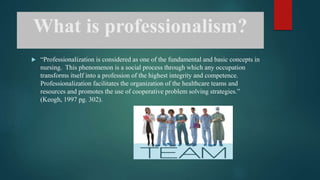
 “Professionalization is considered as one of the fundamental and basic concepts in
nursing. This phenomenon is a social process through which any occupation
transforms itself into a profession of the highest integrity and competence.
Professionalization facilitates the organization of the healthcare teams and
resources and promotes the use of cooperative problem solving strategies.”
(Keogh, 1997 pg. 302).
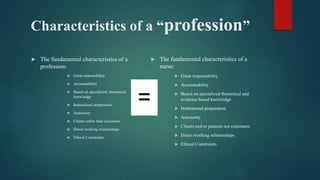
Characteristics of a “profession”
 The fundamental characteristics of a
profession:
 Great responsibility
 Accountability
 Based on specialized, theoretical
knowledge
 Institutional preparation
 Autonomy
 Clients rather than customers
 Direct working relationships
 Ethical Constraints
 The fundamental characteristics of a
nurse:
 Great responsibility
 Accountability
 Based on specialized theoretical and
evidence based knowledge
 Institutional preparation
 Autonomy
 Clients and or patients not customers
 Direct working relationships
 Ethical Constraints
Facilitators and barriers of professionalism in nursing.

Facilitators
 Acquiring knowledge and skill.
 Organizations and certifications “expert
nurse.”
 Life long learning acquired from evidence
based practice.
 Enhancing the image of nursing, by
enabling structures and processes.
 Implementing educational standards.
 Increased student awareness
 Political, public, and media support in
change of nursing image
Barriers
 Inequalities in education.
 Gender politics.
 Cost.
 Historical perception “support-role”
 Lack of involvement or professional
outlook “just a paycheck”
 Time for degree and work overload.
Facilitating knowledge and skill
promotion for growth
1. Continuing education credits
2. Conferences and peer review
3. Employment based classes and skill review
4. Simulation lab training
5. Mock scenarios
6. Mock codes
7. Core Competencies
8. ADN to BSN promotion
Joining a national nursing organization
promotes professionalism
ANCC
American Nurses Credentialing Center
 Acquiring a life long learning of practice and skill through evidence based
practice, and promotion of professionalism is a continuum.
www.nursecredentialing.org
 Acute Care Nurse Practitioner ACNP-BC
 Adult Nurse Practitioner ANP-BC
 Family Nurse Practitioner FNP-BC
 Pediatric Clinical Nurse Specialist PCNS-BC
 Clinical Nurse Specialist CNS-BC
 Public/Community Health Clinical Nurse Specialist PHCNS-BC
 The list goes on……
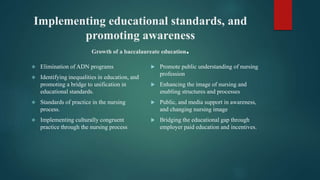
Implementing educational standards, and
promoting awareness
Growth of a baccalaureate education.
 Elimination of ADN programs
 Identifying inequalities in education, and
promoting a bridge to unification in
educational standards.
 Standards of practice in the nursing
process.
 Implementing culturally congruent
practice through the nursing process
 Promote public understanding of nursing
profession
 Enhancing the image of nursing and
enabling structures and processes
 Public, and media support in awareness,
and changing nursing image
 Bridging the educational gap through
employer paid education and incentives.
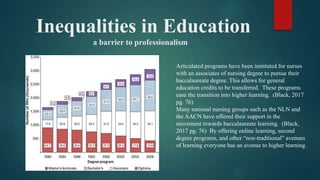
Inequalities in Education
a barrier to professionalism
Articulated programs have been instituted for nurses
with an associates of nursing degree to pursue their
baccalaureate degree. This allows for general
education credits to be transferred. These programs
ease the transition into higher learning. (Black, 2017
pg. 76)
Many national nursing groups such as the NLN and
the AACN have offered their support in the
movement towards baccalaureate learning. (Black,
2017 pg. 76) By offering online learning, second
degree programs, and other “non-traditional” avenues
of learning everyone has an avenue to higher learning.
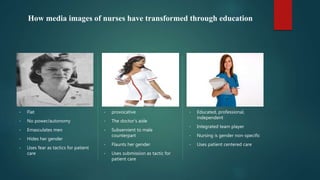
Historical Perception of the image of
Nursing through education
Nurse Ratchet The Sexy Nurse The Professional Nurse
How media images of nurses have transformed through education
• Flat
• No power/autonomy
• Emasculates men
• Hides her gender
• Uses fear as tactics for patient
care
• provocative
• The doctor’s aide
• Subservient to male
counterpart
• Flaunts her gender
• Uses submission as tactic for
patient care
• Educated, professional,
independent
• Integrated team player
• Nursing is gender non-specific
• Uses patient centered care
COST$$$$$$
What’s a Bachelor’s Worth?
 Moving entry into nursing practice to the
baccalaureate level poses many economic, social, and
personal barriers. A baccalaureate degree costs more
money, and takes more time. According to Castleton
University’s tuition information page nursing full time
tuition for Vermont on campus residents is $14,208
per year. A rough estimate would calculate an ADN
would cost $28,416.00, and a BSN would cost
$56,832.00. I fortunately live off campus so some
cost is defrayed, but I still would choose the cheaper
option. By obtaining and utilizing an ADN degree I
will have less educational debt, and already be
making money in the nursing profession in less time.
Cost and time are huge factors that can be great
deterrents while considering a BSN degree.
 As a single parent the cheaper option, and the option
with less time means I have more time to earn for my
family, and spend time with my family!!
My Family…..
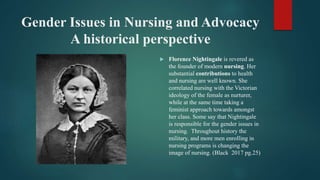
Gender Issues in Nursing and Advocacy
A historical perspective
 Florence Nightingale is revered as
the founder of modern nursing. Her
substantial contributions to health
and nursing are well known. She
correlated nursing with the Victorian
ideology of the female as nurturer,
while at the same time taking a
feminist approach towards amongst
her class. Some say that Nightingale
is responsible for the gender issues in
nursing. Throughout history the
military, and more men enrolling in
nursing programs is changing the
image of nursing. (Black 2017 pg.25)
A profession is a “calling, vocation, or form of employment that
provides a needed service to society.” (Black, 2017 pg. 53)
WE ALL FACE BARRIERS IN PROFESSIONALISM, BUT UNIFIED WE ARE
MAKING LEAPS AND BOUNDS!
References
Adams D, Miller BK. Professionalism in Nursing, Behaviors of Nurse Practitioners. Journal of Professional
Nursing. 2001; 17 (4): 203-10
American Nurses Credentialing Center - ANCC. (n.d.). Retrieved September 17, 2017, from
http://www.nursecredentialing.org/
Black, B.P. (8th ed.) (2017) Professional Nursing, Concepts & Challenges St. Louis, MO: Elsevier, Inc.
Keogh J. Professionalization of Nursing: Development, Difficulties, and Solutions. Journal of Advanced
Nursing. 1997; 25 (2): 302-8
Matthews J. Role of Professional Organizations in Advocating for the Nursing Profession OJIN: The Online
Journal of Issues in Nursing. 2012; 17 (1)
Yam, BM. From Vocation to Profession: The quest for Professionalization o Nursing: British Journal of
Nursing (Mark Allen Publishing). 2004; 13 (16): 978-82

What is professionalism in nursing

  • 1.
    What is Professionalism in Nursing AJOURNEY TO BACCALAUREATE TRANSFORMATION
  • 2.
    What is professionalism? “Professionalization is considered as one of the fundamental and basic concepts in nursing. This phenomenon is a social process through which any occupation transforms itself into a profession of the highest integrity and competence. Professionalization facilitates the organization of the healthcare teams and resources and promotes the use of cooperative problem solving strategies.” (Keogh, 1997 pg. 302).
  • 3.
    Characteristics of a“profession”  The fundamental characteristics of a profession:  Great responsibility  Accountability  Based on specialized, theoretical knowledge  Institutional preparation  Autonomy  Clients rather than customers  Direct working relationships  Ethical Constraints  The fundamental characteristics of a nurse:  Great responsibility  Accountability  Based on specialized theoretical and evidence based knowledge  Institutional preparation  Autonomy  Clients and or patients not customers  Direct working relationships  Ethical Constraints
  • 4.
    Facilitators and barriersof professionalism in nursing. Facilitators  Acquiring knowledge and skill.  Organizations and certifications “expert nurse.”  Life long learning acquired from evidence based practice.  Enhancing the image of nursing, by enabling structures and processes.  Implementing educational standards.  Increased student awareness  Political, public, and media support in change of nursing image Barriers  Inequalities in education.  Gender politics.  Cost.  Historical perception “support-role”  Lack of involvement or professional outlook “just a paycheck”  Time for degree and work overload.
  • 5.
    Facilitating knowledge andskill promotion for growth 1. Continuing education credits 2. Conferences and peer review 3. Employment based classes and skill review 4. Simulation lab training 5. Mock scenarios 6. Mock codes 7. Core Competencies 8. ADN to BSN promotion
  • 6.
    Joining a nationalnursing organization promotes professionalism
  • 7.
    ANCC American Nurses CredentialingCenter  Acquiring a life long learning of practice and skill through evidence based practice, and promotion of professionalism is a continuum. www.nursecredentialing.org  Acute Care Nurse Practitioner ACNP-BC  Adult Nurse Practitioner ANP-BC  Family Nurse Practitioner FNP-BC  Pediatric Clinical Nurse Specialist PCNS-BC  Clinical Nurse Specialist CNS-BC  Public/Community Health Clinical Nurse Specialist PHCNS-BC  The list goes on……
  • 8.
    Implementing educational standards,and promoting awareness Growth of a baccalaureate education.  Elimination of ADN programs  Identifying inequalities in education, and promoting a bridge to unification in educational standards.  Standards of practice in the nursing process.  Implementing culturally congruent practice through the nursing process  Promote public understanding of nursing profession  Enhancing the image of nursing and enabling structures and processes  Public, and media support in awareness, and changing nursing image  Bridging the educational gap through employer paid education and incentives.
  • 9.
    Inequalities in Education abarrier to professionalism Articulated programs have been instituted for nurses with an associates of nursing degree to pursue their baccalaureate degree. This allows for general education credits to be transferred. These programs ease the transition into higher learning. (Black, 2017 pg. 76) Many national nursing groups such as the NLN and the AACN have offered their support in the movement towards baccalaureate learning. (Black, 2017 pg. 76) By offering online learning, second degree programs, and other “non-traditional” avenues of learning everyone has an avenue to higher learning.
  • 10.
    Historical Perception ofthe image of Nursing through education Nurse Ratchet The Sexy Nurse The Professional Nurse
  • 11.
    How media imagesof nurses have transformed through education • Flat • No power/autonomy • Emasculates men • Hides her gender • Uses fear as tactics for patient care • provocative • The doctor’s aide • Subservient to male counterpart • Flaunts her gender • Uses submission as tactic for patient care • Educated, professional, independent • Integrated team player • Nursing is gender non-specific • Uses patient centered care
  • 12.
    COST$$$$$$ What’s a Bachelor’sWorth?  Moving entry into nursing practice to the baccalaureate level poses many economic, social, and personal barriers. A baccalaureate degree costs more money, and takes more time. According to Castleton University’s tuition information page nursing full time tuition for Vermont on campus residents is $14,208 per year. A rough estimate would calculate an ADN would cost $28,416.00, and a BSN would cost $56,832.00. I fortunately live off campus so some cost is defrayed, but I still would choose the cheaper option. By obtaining and utilizing an ADN degree I will have less educational debt, and already be making money in the nursing profession in less time. Cost and time are huge factors that can be great deterrents while considering a BSN degree.  As a single parent the cheaper option, and the option with less time means I have more time to earn for my family, and spend time with my family!! My Family…..
  • 13.
    Gender Issues inNursing and Advocacy A historical perspective  Florence Nightingale is revered as the founder of modern nursing. Her substantial contributions to health and nursing are well known. She correlated nursing with the Victorian ideology of the female as nurturer, while at the same time taking a feminist approach towards amongst her class. Some say that Nightingale is responsible for the gender issues in nursing. Throughout history the military, and more men enrolling in nursing programs is changing the image of nursing. (Black 2017 pg.25)
  • 14.
    A profession isa “calling, vocation, or form of employment that provides a needed service to society.” (Black, 2017 pg. 53) WE ALL FACE BARRIERS IN PROFESSIONALISM, BUT UNIFIED WE ARE MAKING LEAPS AND BOUNDS!
  • 15.
    References Adams D, MillerBK. Professionalism in Nursing, Behaviors of Nurse Practitioners. Journal of Professional Nursing. 2001; 17 (4): 203-10 American Nurses Credentialing Center - ANCC. (n.d.). Retrieved September 17, 2017, from http://www.nursecredentialing.org/ Black, B.P. (8th ed.) (2017) Professional Nursing, Concepts & Challenges St. Louis, MO: Elsevier, Inc. Keogh J. Professionalization of Nursing: Development, Difficulties, and Solutions. Journal of Advanced Nursing. 1997; 25 (2): 302-8 Matthews J. Role of Professional Organizations in Advocating for the Nursing Profession OJIN: The Online Journal of Issues in Nursing. 2012; 17 (1) Yam, BM. From Vocation to Profession: The quest for Professionalization o Nursing: British Journal of Nursing (Mark Allen Publishing). 2004; 13 (16): 978-82