



PRESENTATION
ON
EVIDENCE BASED PRACTICE
BY DEEPAK K V
1ST YEAR M.Sc
INTRODUCTION
• Health professionals currently advice their
patients to stop smoking. Why do they give
this advice? The reason is that evidences are
available which demonstrate that
• High levels of smoking are associated with
increased risk of lung cancer.
• Stopping smoking reduces the risk of lung
cancer.
DEFINITIONS
• In 1997, Sackett et al. published the first textbook on
evidenced based medicine and defined it as:
“The conscientious, explicit and judicious use of current
best evidence in making decisions about the healthcare of
the patients.”
-Dr. David Sackett
• The definition proposed by the Sigma Theta Tau
International (2008) is as follows:
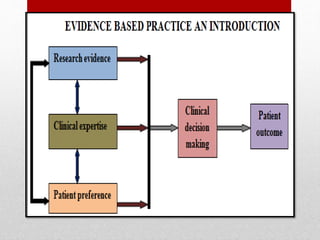
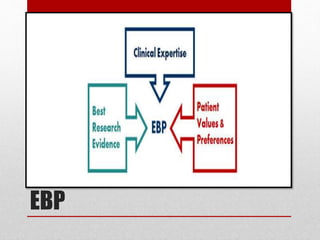
The process of shared decision-making between
practitioner, patient, and others significant to them based
on research evidence, the patient’s experience and
preferences, clinical-expertise or know-how, and other
available robust source of information.”
BACKGROUND OF EVIDENCE
BASED NURSING PRACTICE
• Under this section we will try to understand
the context of EBP. We will be putting light to
an very closely related concept of EBP that is
the “Research Utilization”.
RESEARCH UTILIZATION
• For decades, nurses have used the available research
to guide nursing practice and their efforts to improve
patient’s outcomes.
• This process involved critical analysis and evaluation
of research findings and then determining how they fit
into clinical practice.
• In research utilization the emphasis is on translating
the research findings in to the real world applications.
EBP
USE OF EBP IN HEALTH CARE
• Assessment of patient condition.
• Diagnosis of patient problems.
• Planning patient care.
• Intervention to improve the patient functions,
conditions, or to prevent complications.
• Evaluation of patient responses to
interventions.
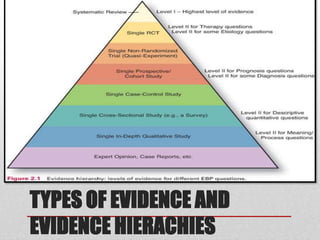
TYPES OF EVIDENCE AND
EVIDENCE HIERACHIES
EBP IN INDIVIDUAL
NURSING PRACTICE
CLINICAL SCENARIOS AND THE NEED FOR
EVIDENCE
• CLINICAL SCENARIO I: You work on an intensive
care unit and notice that Clostridium difficile
infection has become more prevalent among surgical
patients in your hospital. You want to know if there is
a reliable screening tool for assessing the risk of
infection so that preventive measures could be
initiated in a more timely and effective manner
ASKING CLINICAL
QUESTIONS: PLO AND PICO
• A crucial first step in EBP involves asking relevant
clinical questions that reflect uncertainties in clinical
practice.
• Most guidelines for EBP use the acronyms PIO or
PICO to help practitioners develop well-worded
questions that facilitate a search for evidence.
ASKING CLINICAL
QUESTIONS: PLO AND PICO
• In the most basic PIO form, the clinical question is
worded to identify three components:
• P: the population or patients (What are the
characteristics of the patients or people?)
• I: the intervention, influence or exposure (what are
the Interventions or therapies of interest? or, what are
the potentially harmful influences/exposures of
concern?)
• O: the outcomes
FINDING RESEARCH
EVIDENCE
• By wording clinical queries as PIO or P1CO question,
you should be able to search the research literature
for the information you need.
• For an individual EBP endeavor, the best place to
begin is by searching for evidence in a systematic
review, clinical practice guideline, or other
preprocessed sources because this approach leads to a
quicker answer and, if your methodological skills are
limited, potentially a superior answer as well.
APPRAISING THE EVIDENCE
FOR EBP
• Evidence should be appraised before clinical action is
taken.
• The critical appraisal of evidence for the purposes of
EBP may involve several types of assessments, but
often focuses primarily on evidence quality.
EVIDENCE QUALITY
• The first appraisal issue is the extent to which the
findings are valid.
• That is, were the study methods sufficiently rigorous
that the evidence is credible?
• We offer guidance on critiquing studies and
evaluating the strength of evidence from primary
studies throughout this book.
MAGNITUDE OF EFFECTS
• You also need to assess what the results actually are
and whether they are clinically important.
• This criterion considers not whether the results are
valid but what they are and how powerful are the
effect.
PRECISION OF ESTIMATES
• Another consideration, relevant with quantitative
evidence is how precise the estimate of effect is.
• This level of appraisal requires some statistical
sophistication.
• Suffice it to say that research results provide only an
estimate of effects and it is useful to understand not
only the exact estimate but also the range within
which the actual effect probably lies.
PERIPHERAL EFFECTS
• framing your clinical question, you would have
identified the key outcomes in which you were
interested for example, weight stabilization or weight
gain for interventions to address cancer cachexia.
FINANCIAL ISSUES
• Another issue concerns the financial cost of using the
evidence.
• In some cases, costs may be small or non- existent.
ACTIONS BASED ON
EVIDENCE APPRAISALS
• Appraisals of the evidence may lead you to different
courses of action.
• You may reach this point and conclude that the
evidence is not sufficiently sound, or that the likely
effect is too small, or that the cost of applying the
evidence is too high.
• The integration of appraisal information may suggest
that “usual care” is the best strategy or it may suggest
the need for a new EBP inquiry.
INTEGRATING EVIDENCE
• As the definition for EBP implies, research evidence
needs to be integrated with other types of information,
including your own clinical expertise and knowledge
of your clinical setting.
IMPLEMENTING THE EVIDENCE
AND EVALUATING OUTCOMES
• After the first four steps of the EBP process have been
completed, you can use the resulting information to
make an evidence-based decision or provide research-
informed advice.
• Although the steps in the process, as just described,
may seem complicated, in reality, the process can be
efficient if there is an adequate evidence base.
BARRIERS TO USING RESEARCH
IN NURSING PRACTICE
• RESEARCH RELATED BARRIERS
• NURSE RELATED BARRIERS
• ORGANIZATIONAL BARRIERS
• BARRIERS RELATED TO THE NURSING
PROFESSION
THE PROCESS OF USING RESEARCH
IN NURSING PRACTICE
• THE STETLER MODEL
• THE IOWA MODEL
• JOHNS HOPKINS NURSING EVIDENCE-BASED
PRACTICE MODEL
STEPS IN USING RESEARCH
IN NURSING PRACTICE
• SELECTING A TOPIC OR PROBLEM
• ASSEMBLING AND EVALUATING EVIDENCE
• ASSESSING IMPLEMENTING POTENTIAL
SUMMARY
CONCLUSION
Presentation on ebp

Presentation on ebp

  • 1.
  • 3.
    INTRODUCTION • Health professionalscurrently advice their patients to stop smoking. Why do they give this advice? The reason is that evidences are available which demonstrate that • High levels of smoking are associated with increased risk of lung cancer. • Stopping smoking reduces the risk of lung cancer.
  • 4.
    DEFINITIONS • In 1997,Sackett et al. published the first textbook on evidenced based medicine and defined it as: “The conscientious, explicit and judicious use of current best evidence in making decisions about the healthcare of the patients.” -Dr. David Sackett • The definition proposed by the Sigma Theta Tau International (2008) is as follows: The process of shared decision-making between practitioner, patient, and others significant to them based on research evidence, the patient’s experience and preferences, clinical-expertise or know-how, and other available robust source of information.”
  • 5.
    BACKGROUND OF EVIDENCE BASEDNURSING PRACTICE • Under this section we will try to understand the context of EBP. We will be putting light to an very closely related concept of EBP that is the “Research Utilization”.
  • 6.
    RESEARCH UTILIZATION • Fordecades, nurses have used the available research to guide nursing practice and their efforts to improve patient’s outcomes. • This process involved critical analysis and evaluation of research findings and then determining how they fit into clinical practice. • In research utilization the emphasis is on translating the research findings in to the real world applications.
  • 8.
  • 9.
    USE OF EBPIN HEALTH CARE • Assessment of patient condition. • Diagnosis of patient problems. • Planning patient care. • Intervention to improve the patient functions, conditions, or to prevent complications. • Evaluation of patient responses to interventions.
  • 10.
    TYPES OF EVIDENCEAND EVIDENCE HIERACHIES
  • 11.
    EBP IN INDIVIDUAL NURSINGPRACTICE CLINICAL SCENARIOS AND THE NEED FOR EVIDENCE • CLINICAL SCENARIO I: You work on an intensive care unit and notice that Clostridium difficile infection has become more prevalent among surgical patients in your hospital. You want to know if there is a reliable screening tool for assessing the risk of infection so that preventive measures could be initiated in a more timely and effective manner
  • 12.
    ASKING CLINICAL QUESTIONS: PLOAND PICO • A crucial first step in EBP involves asking relevant clinical questions that reflect uncertainties in clinical practice. • Most guidelines for EBP use the acronyms PIO or PICO to help practitioners develop well-worded questions that facilitate a search for evidence.
  • 13.
    ASKING CLINICAL QUESTIONS: PLOAND PICO • In the most basic PIO form, the clinical question is worded to identify three components: • P: the population or patients (What are the characteristics of the patients or people?) • I: the intervention, influence or exposure (what are the Interventions or therapies of interest? or, what are the potentially harmful influences/exposures of concern?) • O: the outcomes
  • 14.
    FINDING RESEARCH EVIDENCE • Bywording clinical queries as PIO or P1CO question, you should be able to search the research literature for the information you need. • For an individual EBP endeavor, the best place to begin is by searching for evidence in a systematic review, clinical practice guideline, or other preprocessed sources because this approach leads to a quicker answer and, if your methodological skills are limited, potentially a superior answer as well.
  • 15.
    APPRAISING THE EVIDENCE FOREBP • Evidence should be appraised before clinical action is taken. • The critical appraisal of evidence for the purposes of EBP may involve several types of assessments, but often focuses primarily on evidence quality.
  • 16.
    EVIDENCE QUALITY • Thefirst appraisal issue is the extent to which the findings are valid. • That is, were the study methods sufficiently rigorous that the evidence is credible? • We offer guidance on critiquing studies and evaluating the strength of evidence from primary studies throughout this book.
  • 17.
    MAGNITUDE OF EFFECTS •You also need to assess what the results actually are and whether they are clinically important. • This criterion considers not whether the results are valid but what they are and how powerful are the effect.
  • 18.
    PRECISION OF ESTIMATES •Another consideration, relevant with quantitative evidence is how precise the estimate of effect is. • This level of appraisal requires some statistical sophistication. • Suffice it to say that research results provide only an estimate of effects and it is useful to understand not only the exact estimate but also the range within which the actual effect probably lies.
  • 19.
    PERIPHERAL EFFECTS • framingyour clinical question, you would have identified the key outcomes in which you were interested for example, weight stabilization or weight gain for interventions to address cancer cachexia.
  • 20.
    FINANCIAL ISSUES • Anotherissue concerns the financial cost of using the evidence. • In some cases, costs may be small or non- existent.
  • 21.
    ACTIONS BASED ON EVIDENCEAPPRAISALS • Appraisals of the evidence may lead you to different courses of action. • You may reach this point and conclude that the evidence is not sufficiently sound, or that the likely effect is too small, or that the cost of applying the evidence is too high. • The integration of appraisal information may suggest that “usual care” is the best strategy or it may suggest the need for a new EBP inquiry.
  • 22.
    INTEGRATING EVIDENCE • Asthe definition for EBP implies, research evidence needs to be integrated with other types of information, including your own clinical expertise and knowledge of your clinical setting.
  • 23.
    IMPLEMENTING THE EVIDENCE ANDEVALUATING OUTCOMES • After the first four steps of the EBP process have been completed, you can use the resulting information to make an evidence-based decision or provide research- informed advice. • Although the steps in the process, as just described, may seem complicated, in reality, the process can be efficient if there is an adequate evidence base.
  • 24.
    BARRIERS TO USINGRESEARCH IN NURSING PRACTICE • RESEARCH RELATED BARRIERS • NURSE RELATED BARRIERS • ORGANIZATIONAL BARRIERS • BARRIERS RELATED TO THE NURSING PROFESSION
  • 25.
    THE PROCESS OFUSING RESEARCH IN NURSING PRACTICE • THE STETLER MODEL • THE IOWA MODEL • JOHNS HOPKINS NURSING EVIDENCE-BASED PRACTICE MODEL
  • 26.
    STEPS IN USINGRESEARCH IN NURSING PRACTICE • SELECTING A TOPIC OR PROBLEM • ASSEMBLING AND EVALUATING EVIDENCE • ASSESSING IMPLEMENTING POTENTIAL
  • 27.