TOPIC:APPLICATION OF EPIDEMIOLOGY IN HEALTH CARE DELIVERY, HEALTH SURVELLIANCE AND HEALTH INFORMATICS
The document discusses the application of epidemiology in healthcare delivery, health surveillance, and health informatics. It defines primary, secondary, and tertiary prevention and describes activities for each level. It also discusses epidemiological surveillance, the surveillance process, health informatics definitions and objectives, and sources of health information data. The role of nurses in areas like disease prevention, control, health education, and data collection is also covered.
COLLEGE OF NURSINGWANLESS HOSPITAL-
MIRAJ
SUBJECT: ADVANCED NURSING PRACTICE
TOPIC:APPLICATION OF EPIDEMIOLOGY IN
HEALTH CARE DELIVERY, HEALTH
SURVELLIANCE AND HEALTH INFORMATICS
PRESENTED BY:
MR.TUSHAR KEDAR
MSc (N)
3.
APPLICATION OF EPIDEMIOLOGYIN HEALTH
CARE DELIVERY, HEALTH SURVELLIANCE AND
HEALTH INFORMATICS
Introduction:
The ultimate goals of health care services are
to promote and protect health, to alleviate and
minimize suffering and disabilities and regain
health so as to lead socially useful and
economically productive life.
4.
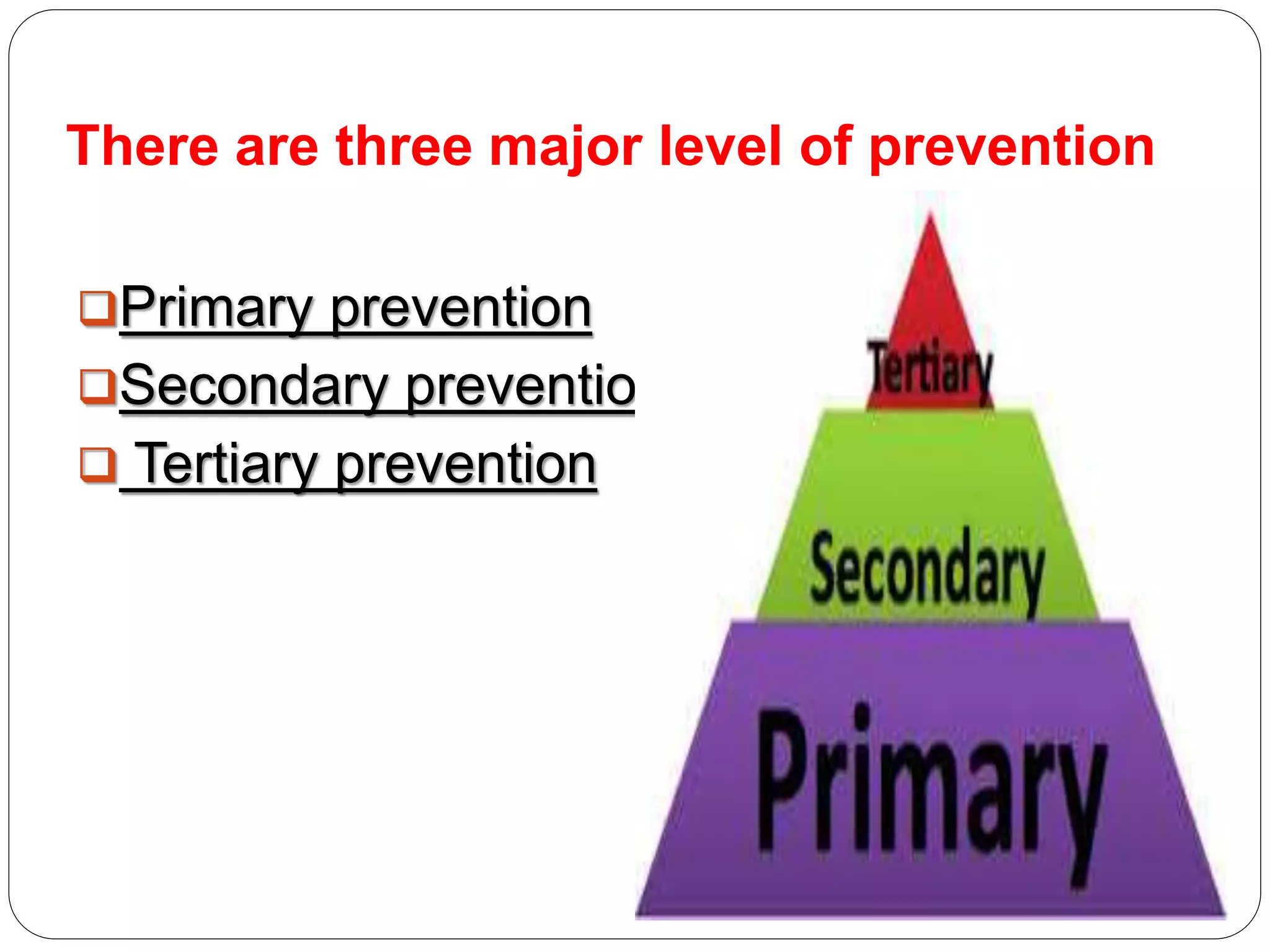
There are threemajor level of prevention
Primary prevention
Secondary prevention
Tertiary prevention
5.
PRIMARY PREVENTION:
“primary preventioncan be defined as
“action taken prior to the onset of disease,
which removes the possibility that disease
will ever occur”.
The specific intervention are:
Health promotion
Specific protection
6.
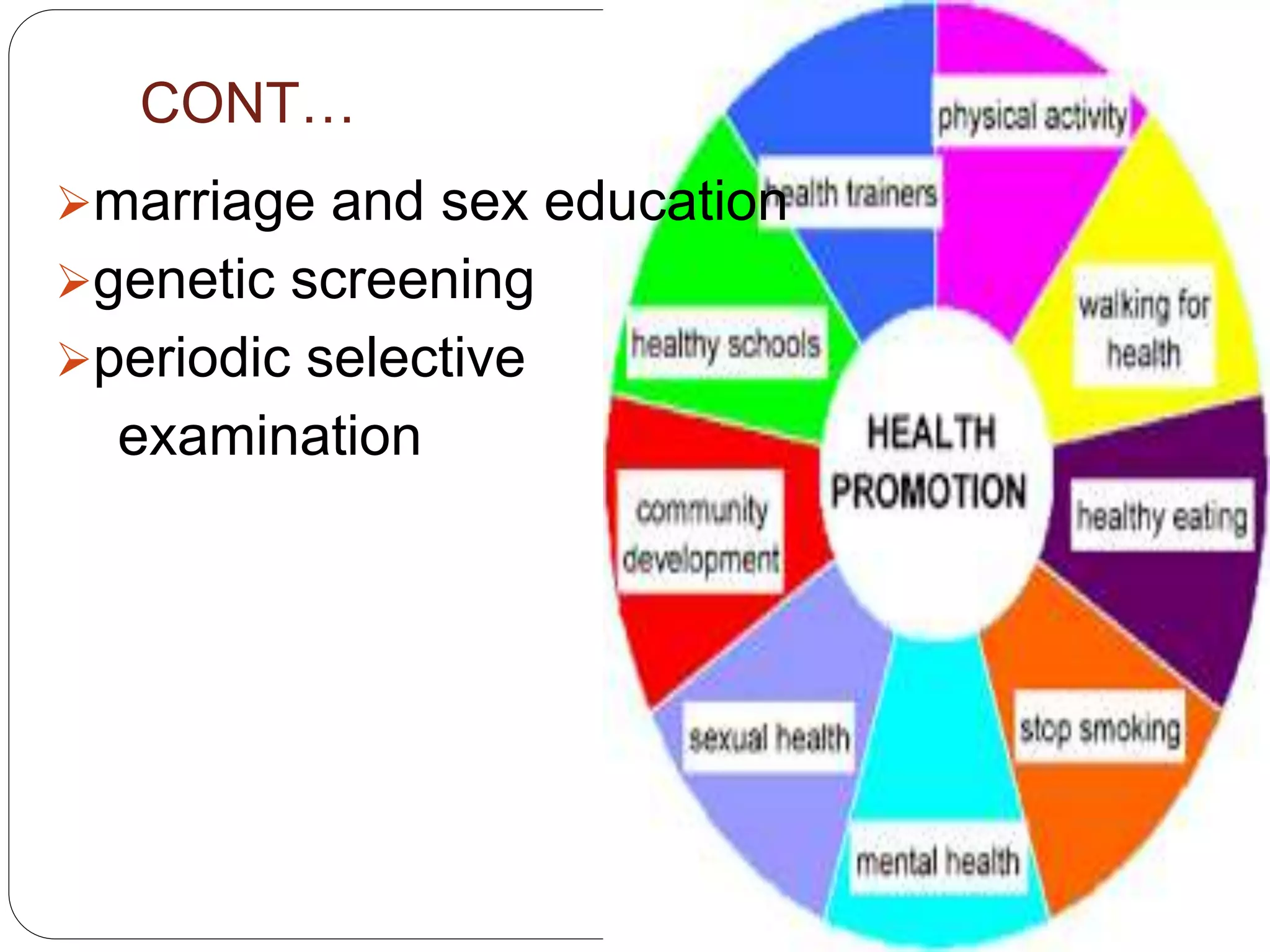
HEALTH PROMOTION
Improve theenvironment and favor healthy
living.
The health promotion activities are
summarized below:
health education
good standard of nutrition adjusted to
developmental stage of life
attention to personality development
provision of adequate housing and
recreation and agreeable working
SPECIFIC PREVENTION
protectionindividual against specific
agents
e.g. immunization against
poliomyelitis, or pasteurization of milk or
chlorination of water.
The activities of specific protection will
include:
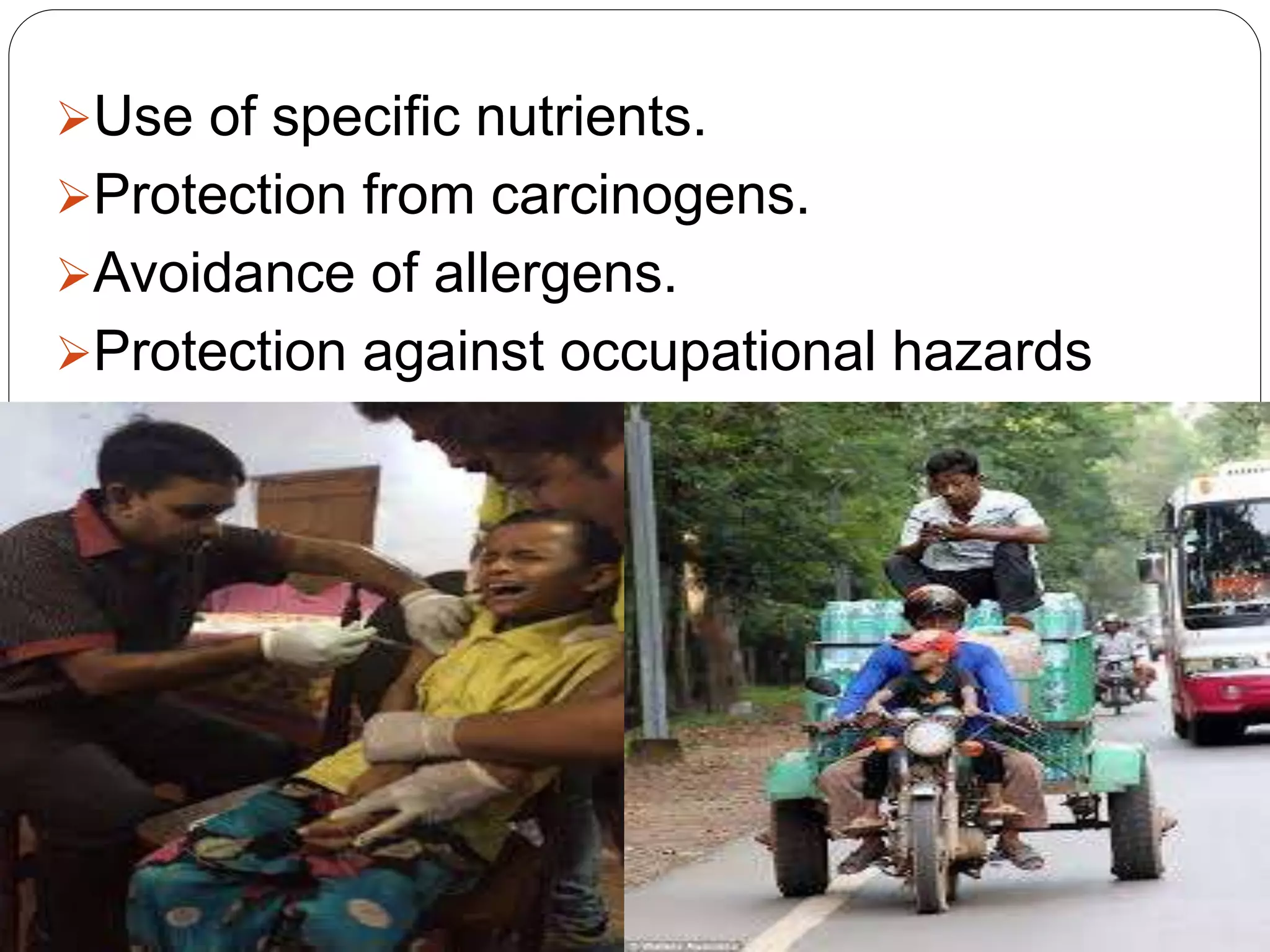
Use of specific immunization, e.g.
vaccination.
Attention to personal hygiene for self-care.
Use of environmental sanitation,
9.
Use of specificnutrients.
Protection from carcinogens.
Avoidance of allergens.
Protection against occupational hazards
10.
SECONDARY PREVENTION:
“Secondaryprevention focuses on the
individuals who are experiencing health
problems or illnesses and who are at risk
for developing complication.”
The objective of secondary preventive
measures are :
Early diagnosis and treatment
Disability limitation:
11.
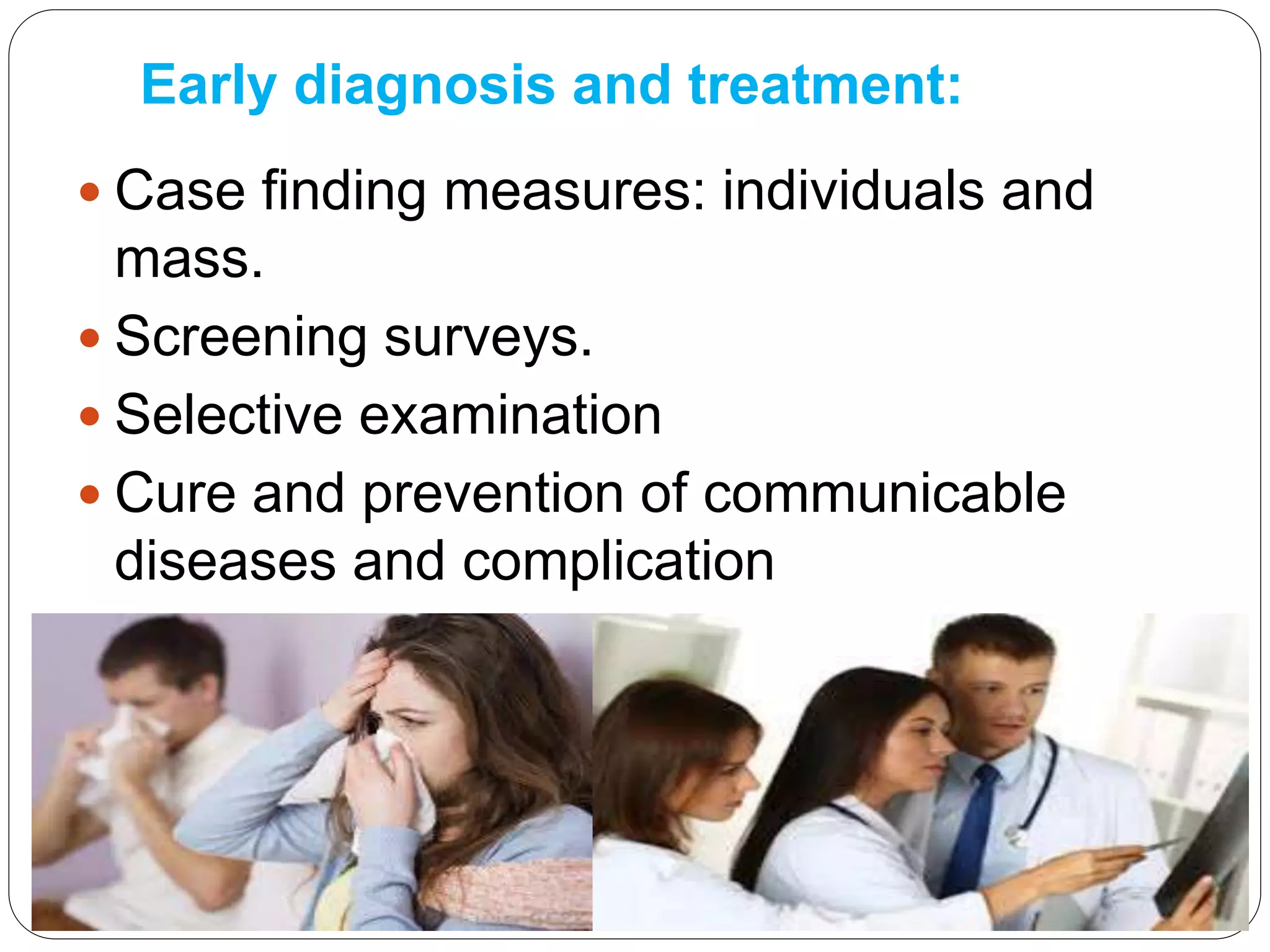
Early diagnosis andtreatment:
Case finding measures: individuals and
mass.
Screening surveys.
Selective examination
Cure and prevention of communicable
diseases and complication
12.
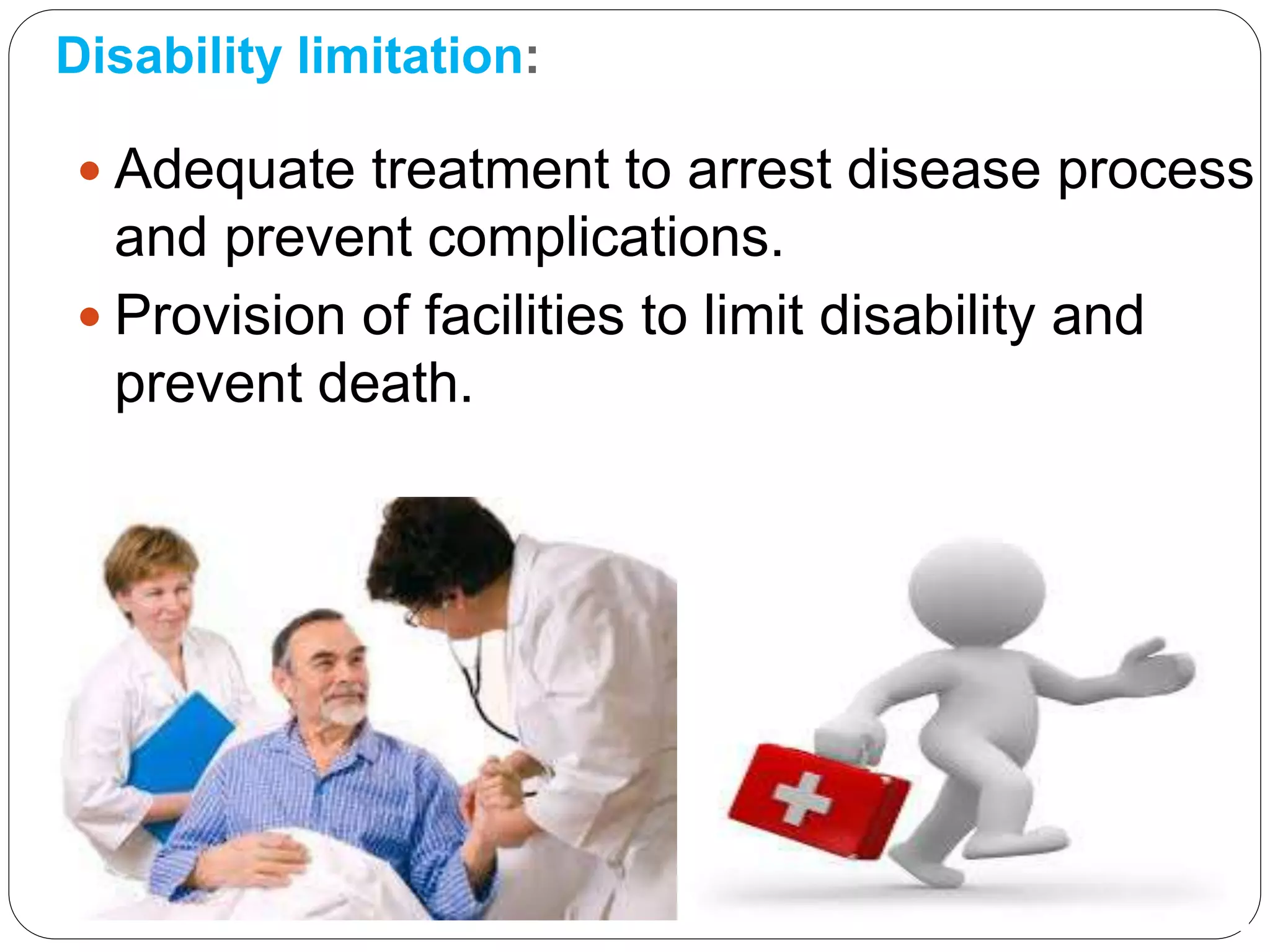
Disability limitation:
Adequatetreatment to arrest disease process
and prevent complications.
Provision of facilities to limit disability and
prevent death.
13.
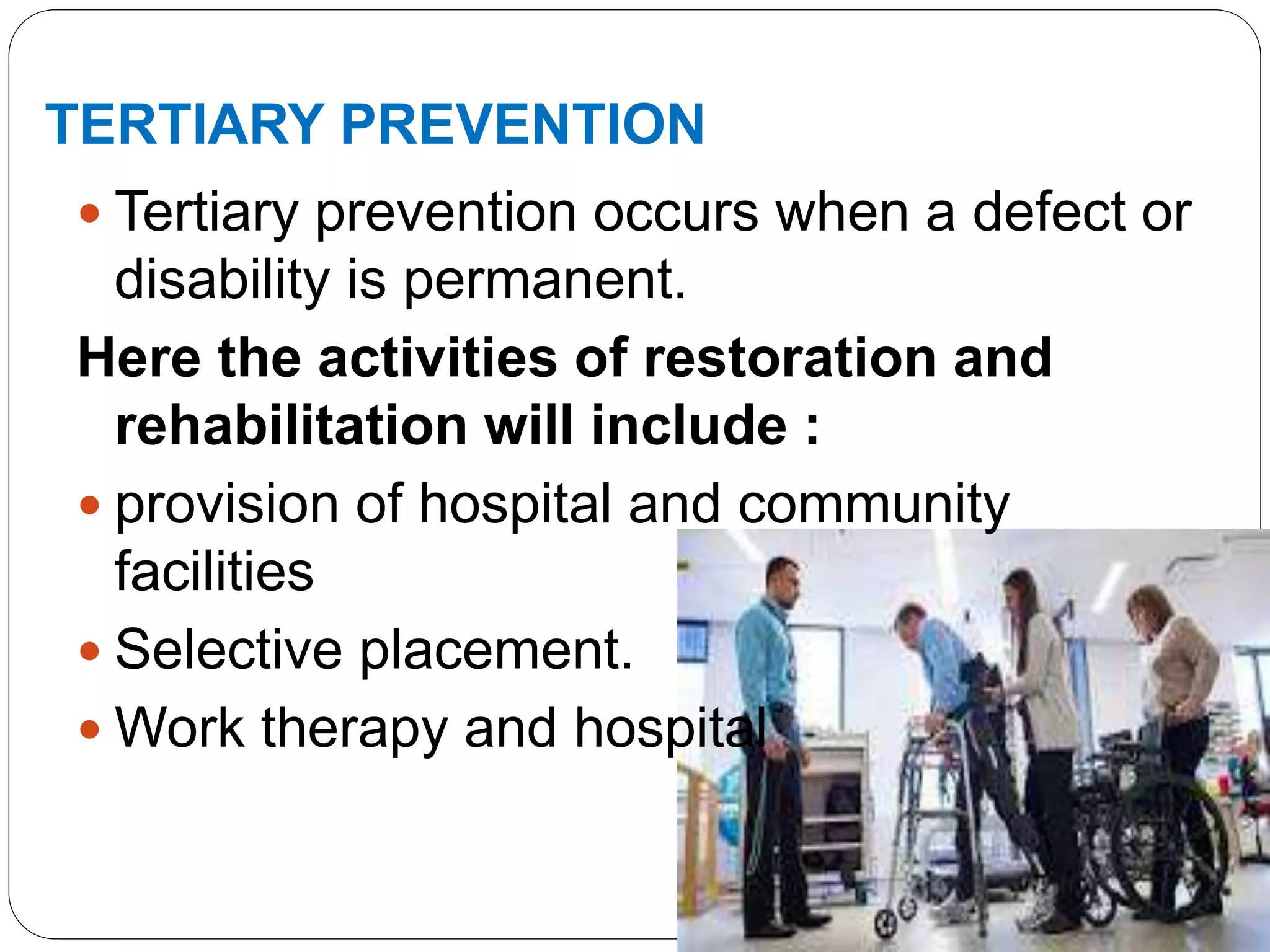
TERTIARY PREVENTION
Tertiaryprevention occurs when a defect or
disability is permanent.
Here the activities of restoration and
rehabilitation will include :
provision of hospital and community
facilities
Selective placement.
Work therapy and hospital
14.
Implication of epidemiologyin community
health nursing
Essential to nursing practice.
Epidemiology methods used in the study of
disease causation and the body of
knowledge arises
Epidemiology is a tool in conducting the
investigation to evaluate and explain
phenomena
As tools for assessing community needs and
evaluating the impact of community health
programmes
15.
CONT....
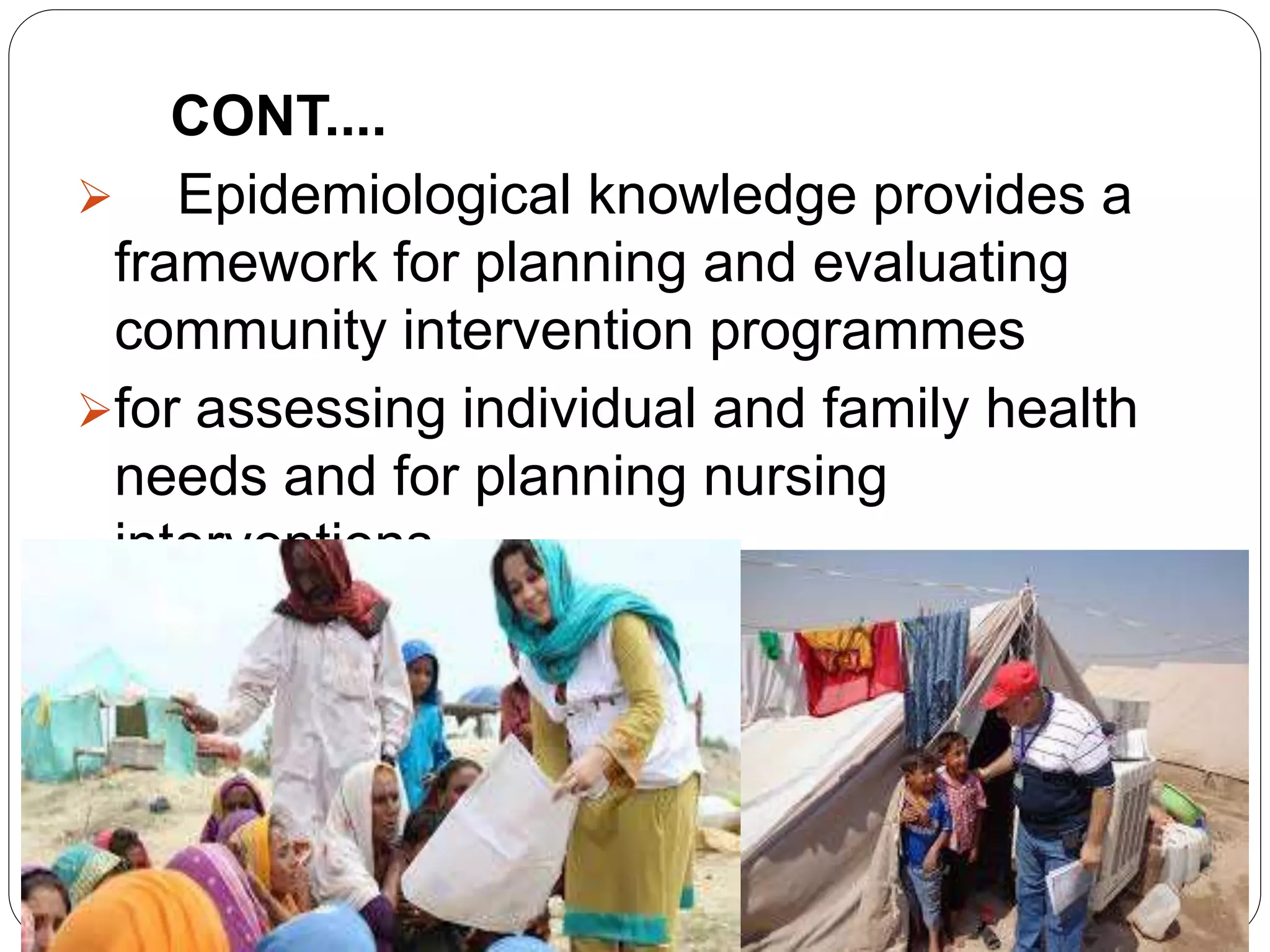
Epidemiological knowledgeprovides a
framework for planning and evaluating
community intervention programmes
for assessing individual and family health
needs and for planning nursing
interventions.
16.
HEALTH SURVEILLEANCE:
Introduction
The surveillancemeans supervision or
close watch especially on suspected
person.
It involves identification of missed and
suspected cases and contacts, their
conformation by source of infection and
channel of transmission.
17.
The epidemiological surveillancecan be
done at the following levels
INDIVIDUAL / FAMILY SURVEILLANCE
It includes surveillance of an infected
person in a family as long as the individual
is the source of infection to other e.g.
typhoid case carriers.
18.
Cont…
COMMUNITY / LOCALPOPULATION
SURVEILLANCE
It include surveillance of the whole
community for early detection and
prevention and control of disease
e.g. malaria.
NATIONAL SURVEILLANCE
It include surveillance at the national level
e.g. surveillance of small pox after its
eradication.
19.
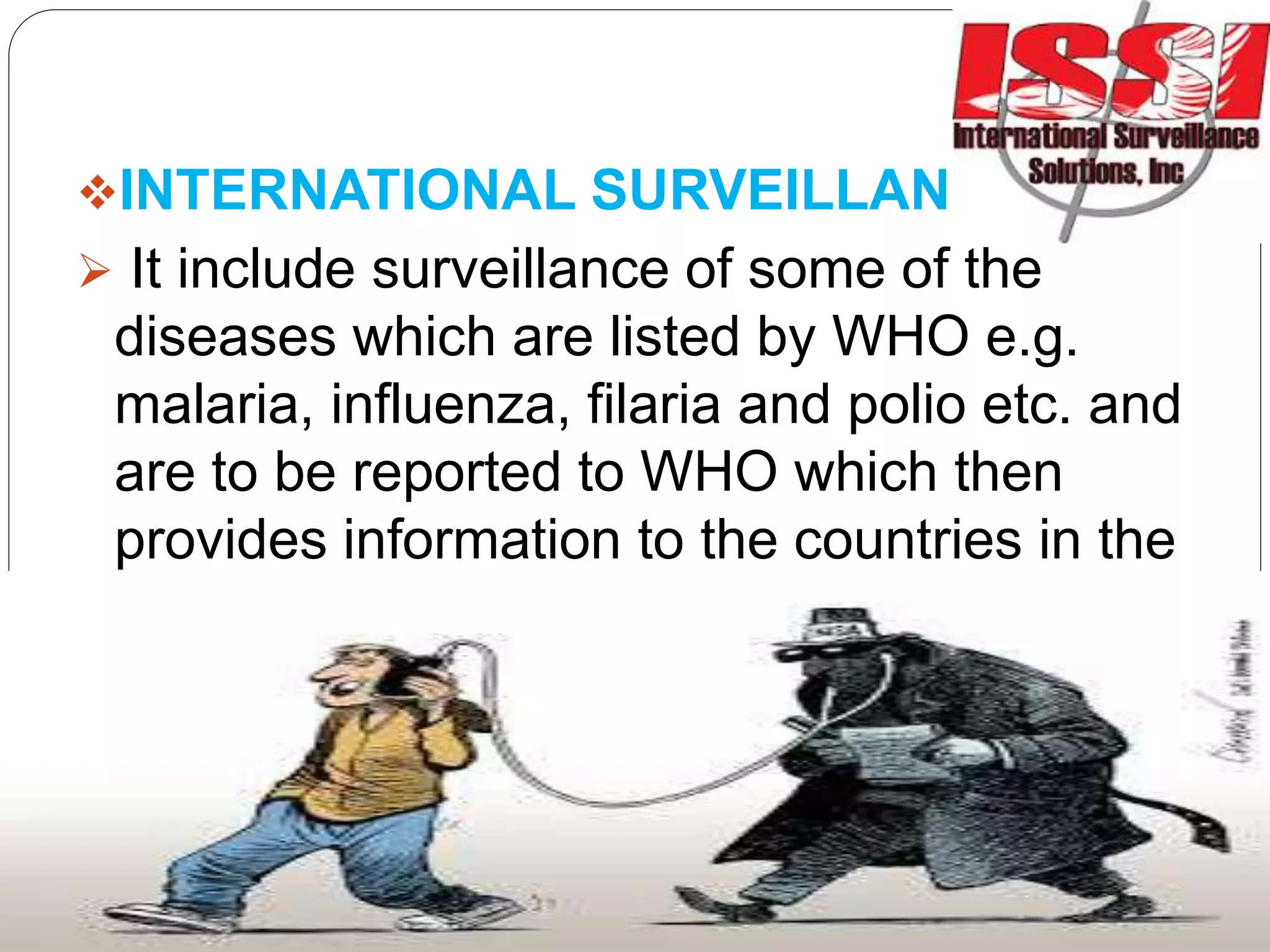
INTERNATIONAL SURVEILLANCE:
Itinclude surveillance of some of the
diseases which are listed by WHO e.g.
malaria, influenza, filaria and polio etc. and
are to be reported to WHO which then
provides information to the countries in the
world to take timely actions.
20.
SURVEILLANCE PROCESS:
Surveillanceis the systematic process .
The main steps involved are:
Collection of relevant information about the
disease
Effectiveness of surveillance system
depends upon identification of cases,
collection of relevant information about
disease, their recording and reporting.
It may be easier to find some diseases and
may be difficult to identify some other.
because of this difficulty no single method
can be adopted for surveillance of all
21.
THE VARIOUSMETHODS OF
SURVEILLANCE ARE AS UNDER:
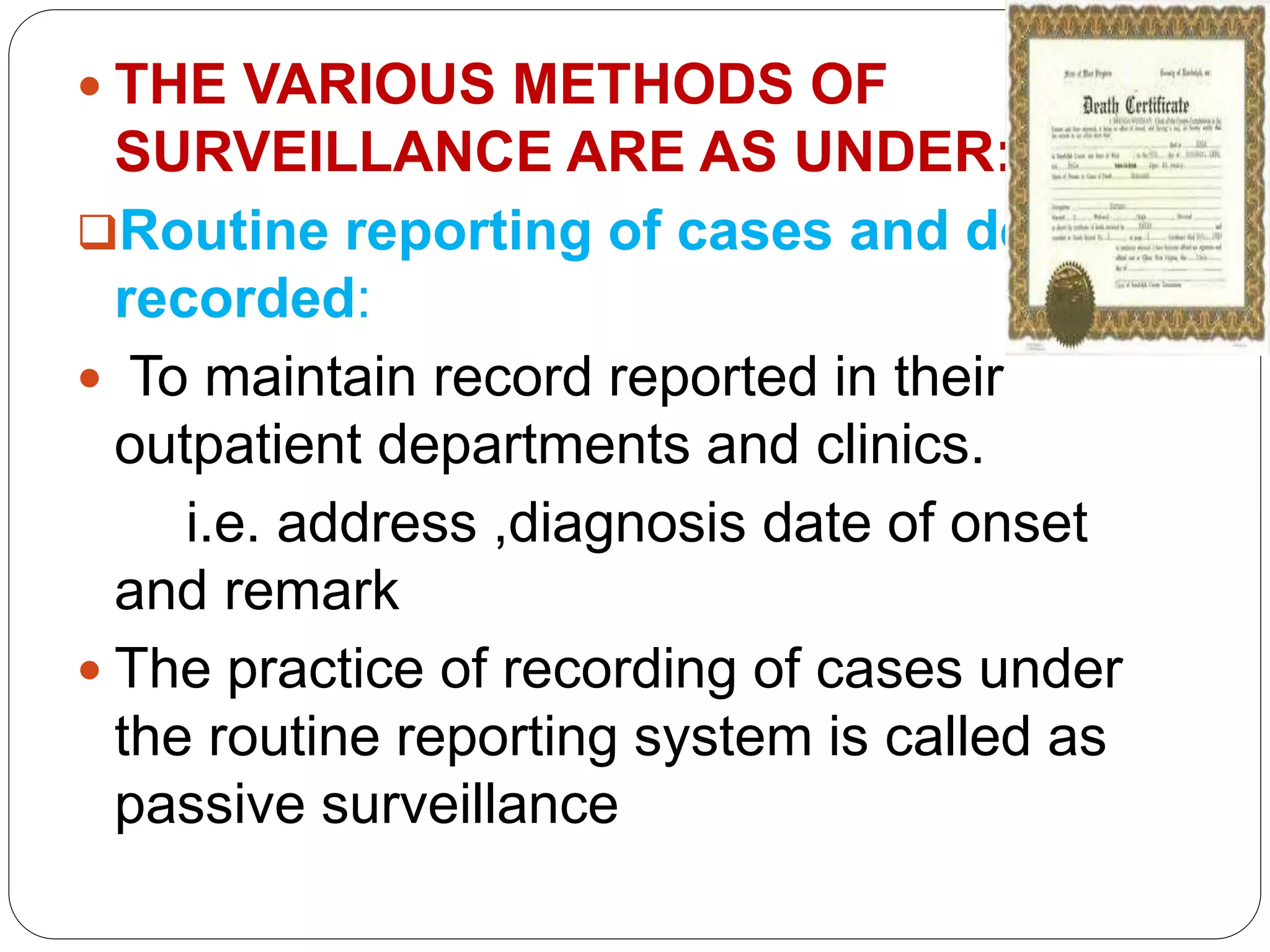
Routine reporting of cases and death
recorded:
To maintain record reported in their
outpatient departments and clinics.
i.e. address ,diagnosis date of onset
and remark
The practice of recording of cases under
the routine reporting system is called as
passive surveillance
22.
CONT…
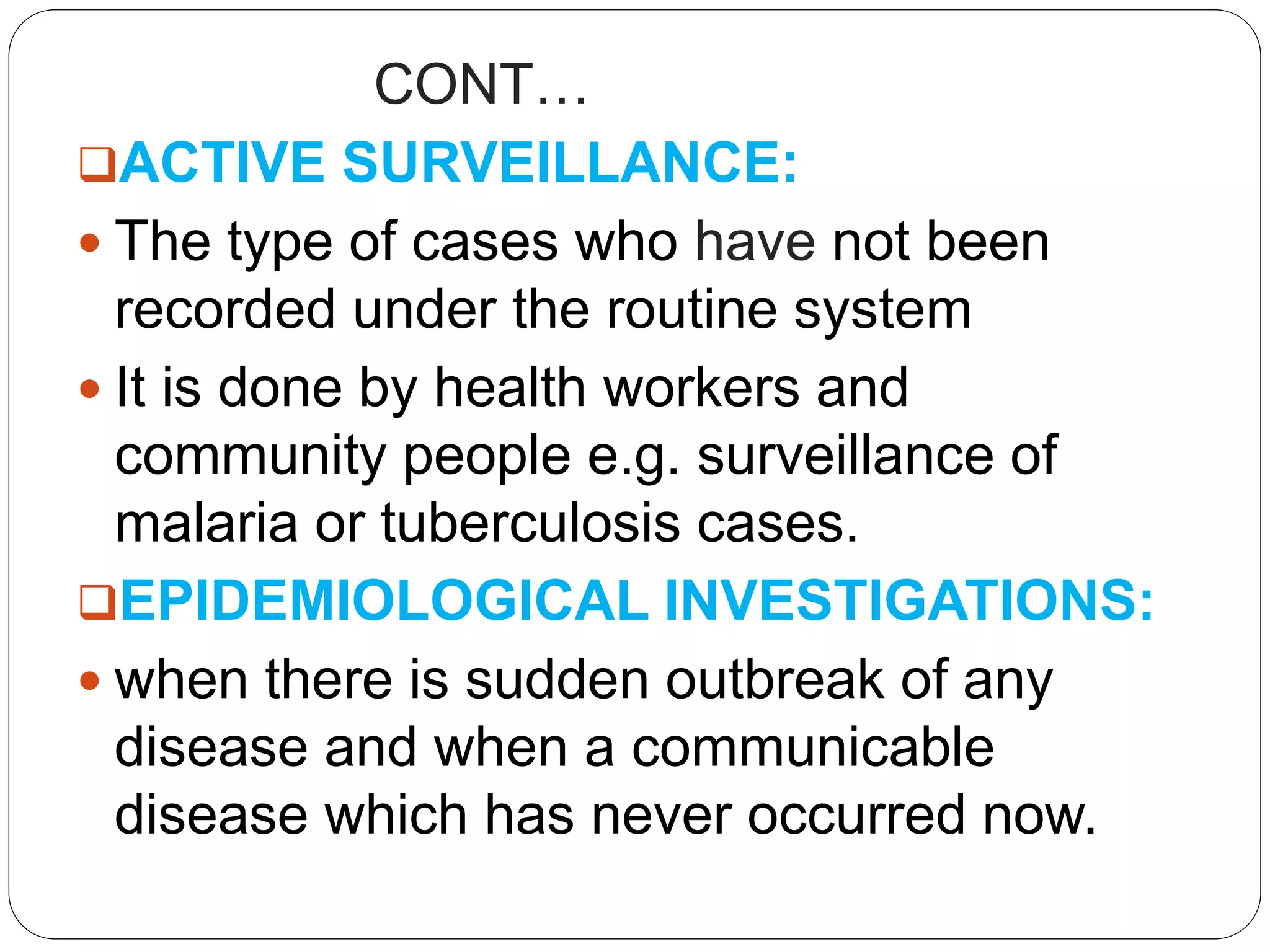
ACTIVE SURVEILLANCE:
Thetype of cases who have not been
recorded under the routine system
It is done by health workers and
community people e.g. surveillance of
malaria or tuberculosis cases.
EPIDEMIOLOGICAL INVESTIGATIONS:
when there is sudden outbreak of any
disease and when a communicable
disease which has never occurred now.
23.
SENTINEL CENTERS
Sentinelcenters are those hospital, health
centers, laboratories etc. which are
identified for collecting information for
selected diseases.
The information is collected complied and
forwarded to higher action and for making
future plans and policies.
24.
SPECIAL SAMPLE SURVEY:
There are different sample of survey but
the survey by cluster sampling technique is
recommended by the WHO.
The target population , the sample size
vary from disease to disease
e.g. the target population for
poliomyelitis is 5-9 years for diarrhea 0-4
years ,
25.
CONT….
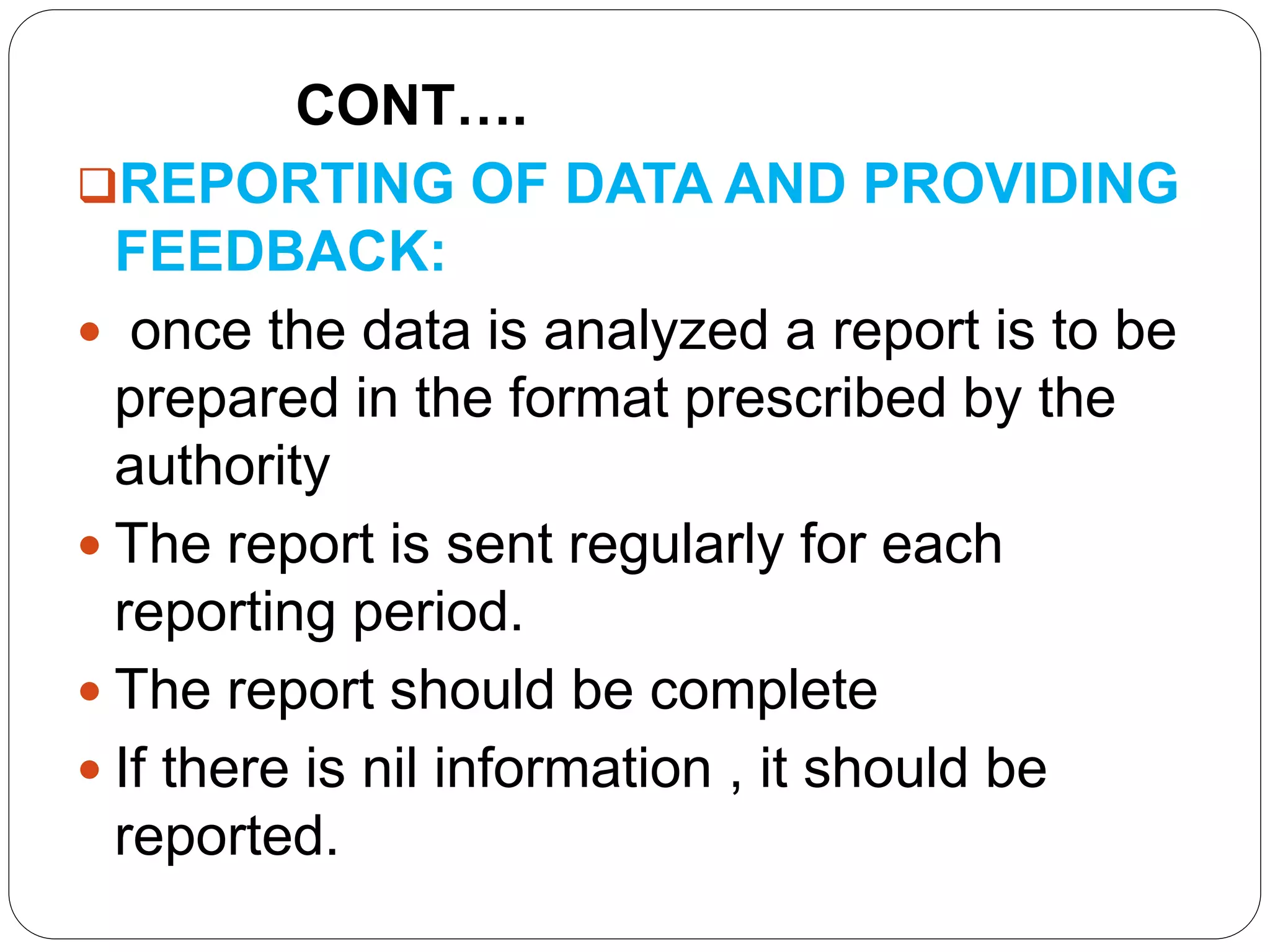
REPORTING OF DATAAND PROVIDING
FEEDBACK:
once the data is analyzed a report is to be
prepared in the format prescribed by the
authority
The report is sent regularly for each
reporting period.
The report should be complete
If there is nil information , it should be
reported.
26.
If someinformation is missed or received
late, it should be included in the next
reporting period
feedback should be given to all the
members of health team as to how the
data are used which are collected by them
and reported through regular meetings and
when desired by anyone.
Definition:
“A mechanism forthe collection
,processing analysis and transmission of
information required for organizing and
operating health service and also for
research and training.”
29.
OBJECTIVES
To providereliable , up to date , adequate ,
timely and reasonably complete
information
To share technical and scientific
information
To provide periodic intervals the data that
will show the general performance of the
health services.
30.
Requirements to besatisfied by health
information system:
The system should be population based
The system should avoid the unnecessary
data
The system should be problem oriented.
Express information briefly and
imaginatively
(e.g. tables, charts, percentage)
The system should make provision for
feedback of data
31.
COMPONENTS OF
SYSTEM:
Demography and vital events
Environmental health statistics
Health status ;mortality ; morbidity ;
disability and quality ,of life
Health resources ;facilities
Utilization and non-utilization of health
services ;attendance ,admission waiting
list.
32.
USES OFHEALTH INFORMATION
To measure the health status of people
For local national and international
comparison of health status
For assessing the attitude and degree of
satisfaction of beneficiaries with the health
system.
For research into particular problems of
health and disease
33.
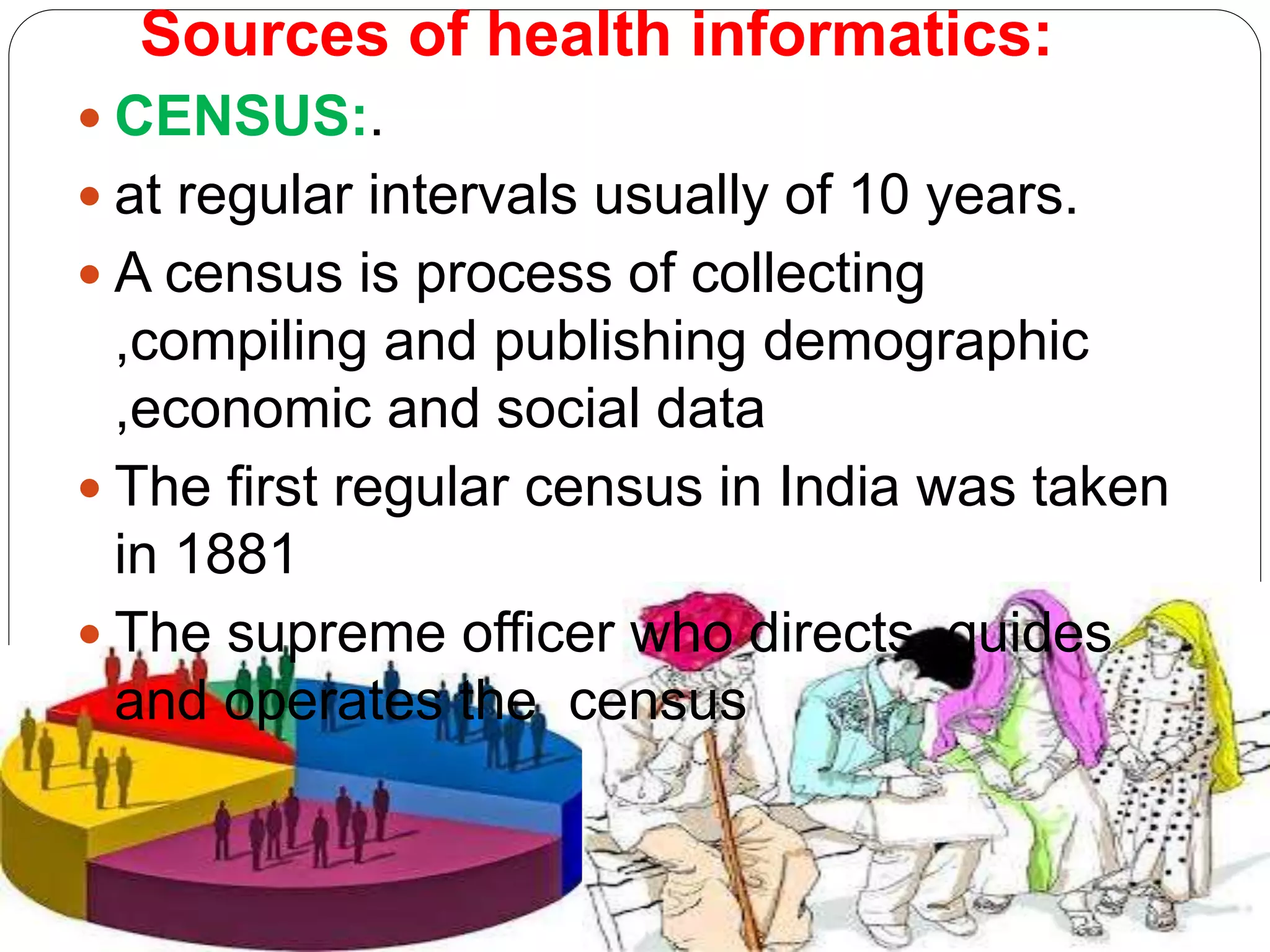
Sources of healthinformatics:
CENSUS:.
at regular intervals usually of 10 years.
A census is process of collecting
,compiling and publishing demographic
,economic and social data
The first regular census in India was taken
in 1881
The supreme officer who directs ,guides
and operates the census
34.
REGISTARION OF VITALEVENTS:
Registration of vital events
i.e. live births, deaths, fetal deaths,
marriages ,divorces, adoptions, legal
limitations, recognitions, annulments and
legal separations.
The time event for registering the event of
birth is 14 days and that for deaths is 7
days.
35.
SAMPLE REGISTRATION SYSTEM:
SRS was initiated in mid-1960’s to provide
reliable estimates of births and death rates
at the national and state level.
It is a Independence survey every 6
months by an investigator supervisor.
This system is more reliable for information
on birth and death rate , age specific
fertility and mortality and mortality rates,
infant and adult mortality etc.
36.
NOTIFICATION OF DISEASES:
Focus on prevention and control of the
disease.
Notification is also a valuable source of
morbidity data
It covers only a small part of the total
sickness in the community
37.
HOSPITAL RECORDS:
hospitaldata constitute a basic primary
source of information about diseases
prevalent in the community.
They provide information on only those
patients who seek medical care.
38.
DISEASE REGISTERS
Morbidityregisters exist only for certain
diseases such as stroke, myocardial
infarction, cancer blindness, and
congenital defects.
The useful information can be obtained
provide useful data on morbidity
39.
RECORD LINKAGE
theprocess of bringing together records
relating to one individual the record
originating in different times or places.
The events commonly recorded are birth ,
marriage death , hospital admission
It has been applied only on a limited scale
e.g. measurement of morbidity, chronic
disease epidemiology
40.
EPIDEMIOLOGICAL SURVEILLANCE
setup to report on the occurrence of new
cases and on efforts to control the
diseases.
E.g. immunization is performed.
considerable morbidity and mortality data
for specific disease.
41.
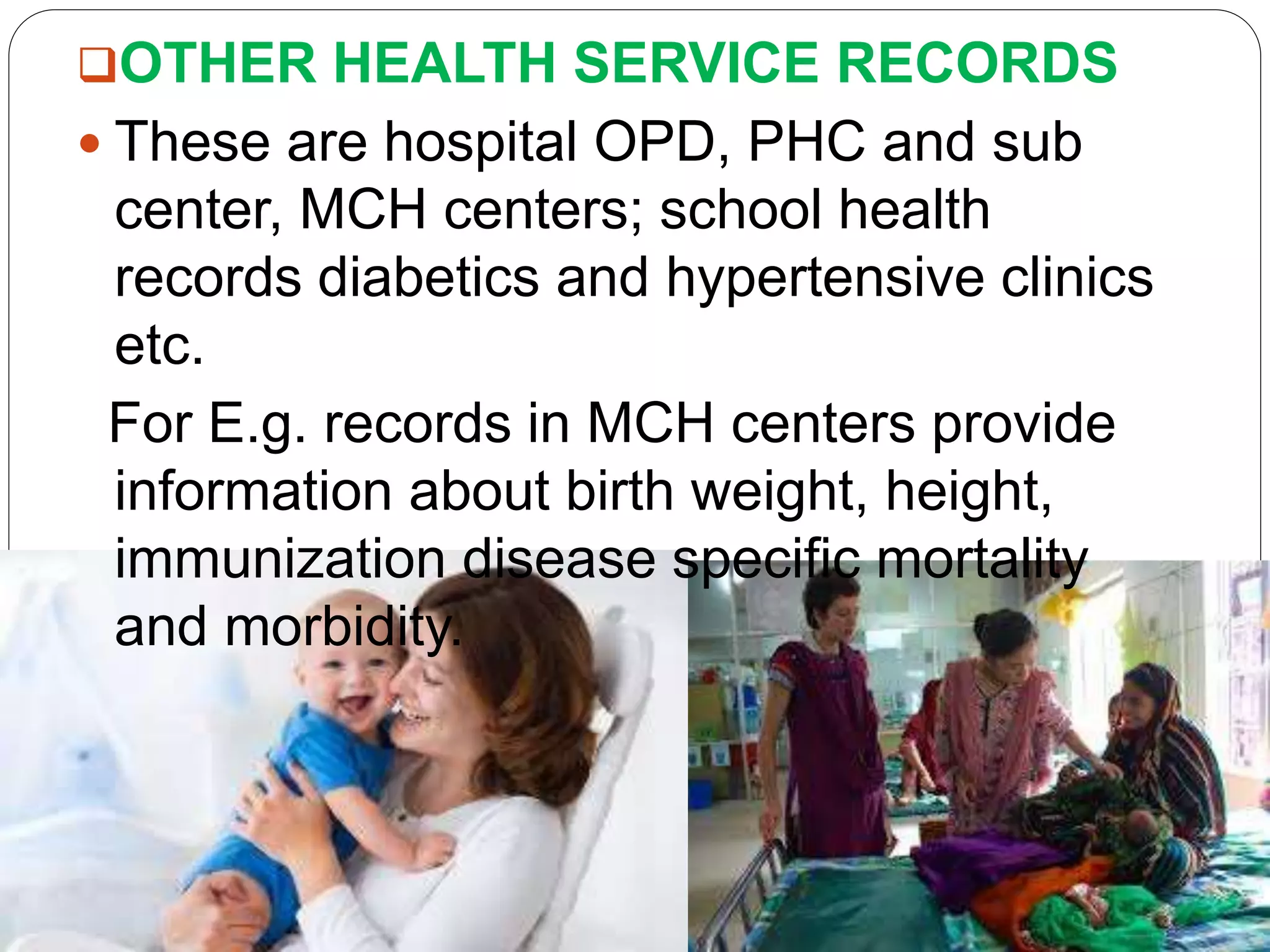
OTHER HEALTH SERVICERECORDS
These are hospital OPD, PHC and sub
center, MCH centers; school health
records diabetics and hypertensive clinics
etc.
For E.g. records in MCH centers provide
information about birth weight, height,
immunization disease specific mortality
and morbidity.
42.
ENVIRONMENTAL HEALTH DATA
provide data on various aspect of air water
and noise pollution; harmful food additives;
industrial toxicants etc.
It is helpful identification and quantification
of a factors causative of diseases.
43.
ROLE OF NURSE:
The prevention and control of diseases at
various levels.
The nurse participates in prevention and
control of communicable diseases .
The nurse provide health education
Investigates regarding frequency and
distribution and possible determinants and
analyzes the information collected.
provides ongoing in-service training .
44.
Cont.
The nurseconducts studies to
determine risk factor leading to
infections.
She participate in data collection , data
analysis ,planning, implementation and
evaluation.
She also participates in national
programs
45.
CONCLUSION:
Epidemiology isvery important to study in
order to find out the disease causation in
our country in an earlier stage and to find
proper solution for it. Epidemiology can be
well utilized by the health care
professionals to protect and saves the life
of people in our country.
46.
SUMMERY:
Today wediscussed regarding the
levels of prevention , Epidemiological
surveillance level, surveillance process ,
health informatics definition, objective,
requirements to be satisfied by health
informatics system ,uses and sources of
health informatics system. I hope u
understood my presentation and use this
knowledge in clinical settings.
47.
BIBLOGRAPHY:
Basher SP,SY. khan, a concise textbook of advanced
nursing practice, Emmess medical publishers,
S. kamalam, essentials in community health nursing
practice, jaypee brothers publication, 1st ed.2005,P.
555-9
S.Soni, textbook of advanced nursing practice, jaypee
brother’s medical publishers,1st ed.P.228-6
www.google.com