Earned Value Analysis
Final 6-1
Syed Saqib Raza RizviSyed Saqib Raza Rizvi
Earned Value - What
is it?
•Simply, it is a project monitoring and
measurement system that:
1. Establishes a clear relationship between plannedplanned
accomplishments and actualactual accomplishments
2.2. ReinforcesReinforces and rewards Good planningGood planning practices
2
Earned Value - What is
it?
•Basic concepts of Earned Value Management (EVM)
•Each task in a project earns value as planned workplanned work is
completed
•For example (perhaps), if you were paid on this basis,
you would earnearn $$ at key milestones based on the
value of what you have completed (Earned value)
•Earned value can be compared to actual cost and
budgeted cost to determine variance and predict
future performance
3
Earned Value - What is
it?
•The budgeted costbudgeted cost (e.g., dollars, person-hours,
person-days, etc.) in terms of your baselinebaseline
plan/budgetplan/budget of the work performed up to a
specified point in time
• Also known as Budgeted Cost of Work Performed (BCWPBCWP)
•Each task in the Work Breakdown Structure (WBS)
is assigned a BCWP based on its individual cost.
• Project BCWP is total of BCWP for all tasks required to
complete the project
4
Earned Value
Components•Planned Value
• How much work (person-hours) you planned to have
accomplished at a given point in time (this is from the WBS in
your plan)
•Actual Cost
• How much work (person-hours) you have actually spent at a
given point in time
•Earned Value
• The value (person-hours) in terms of your base budget of what
you have accomplished at a given point in time (or, % complete
X Planned Value)
5
Earned Value:
Example
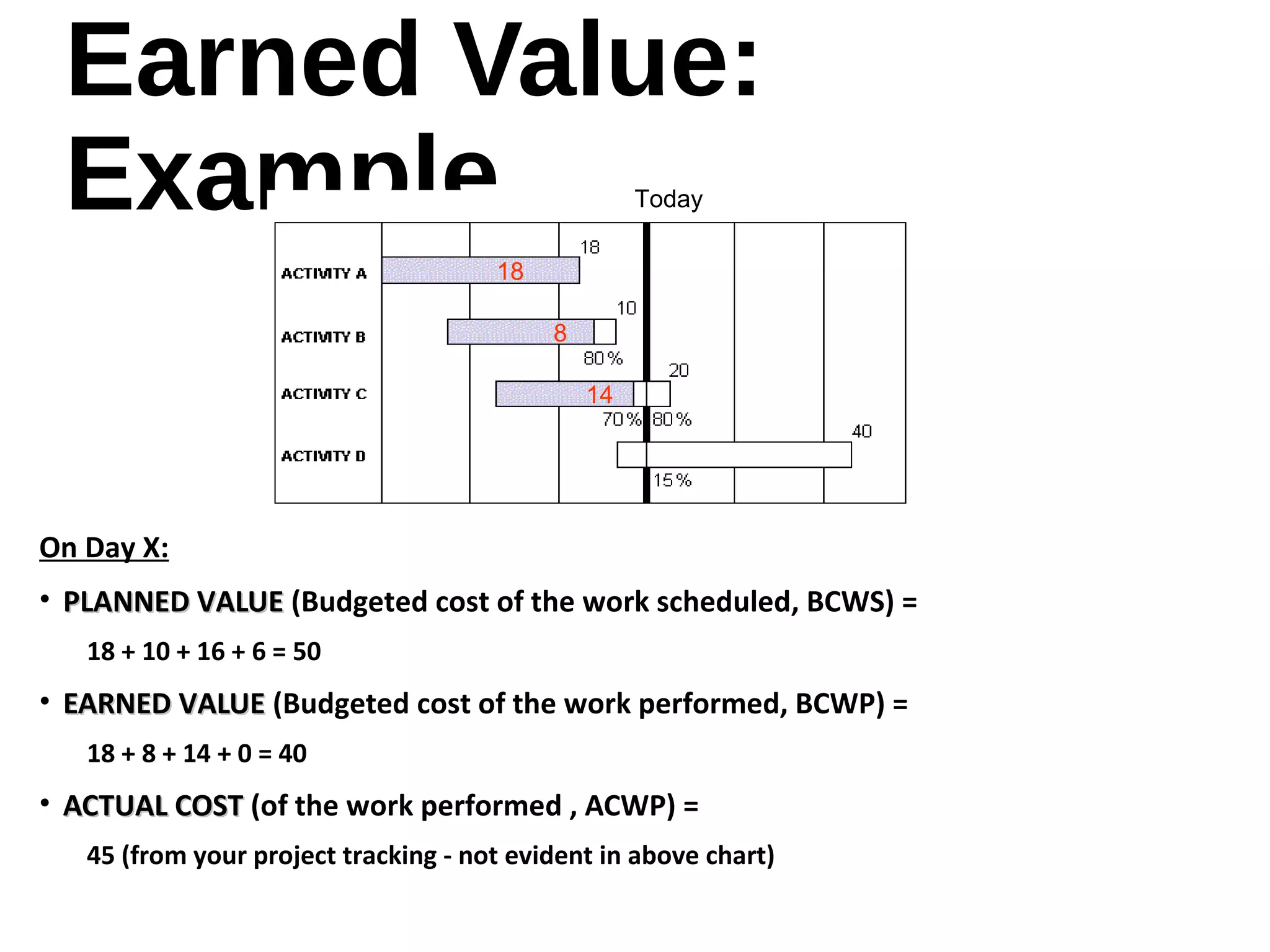
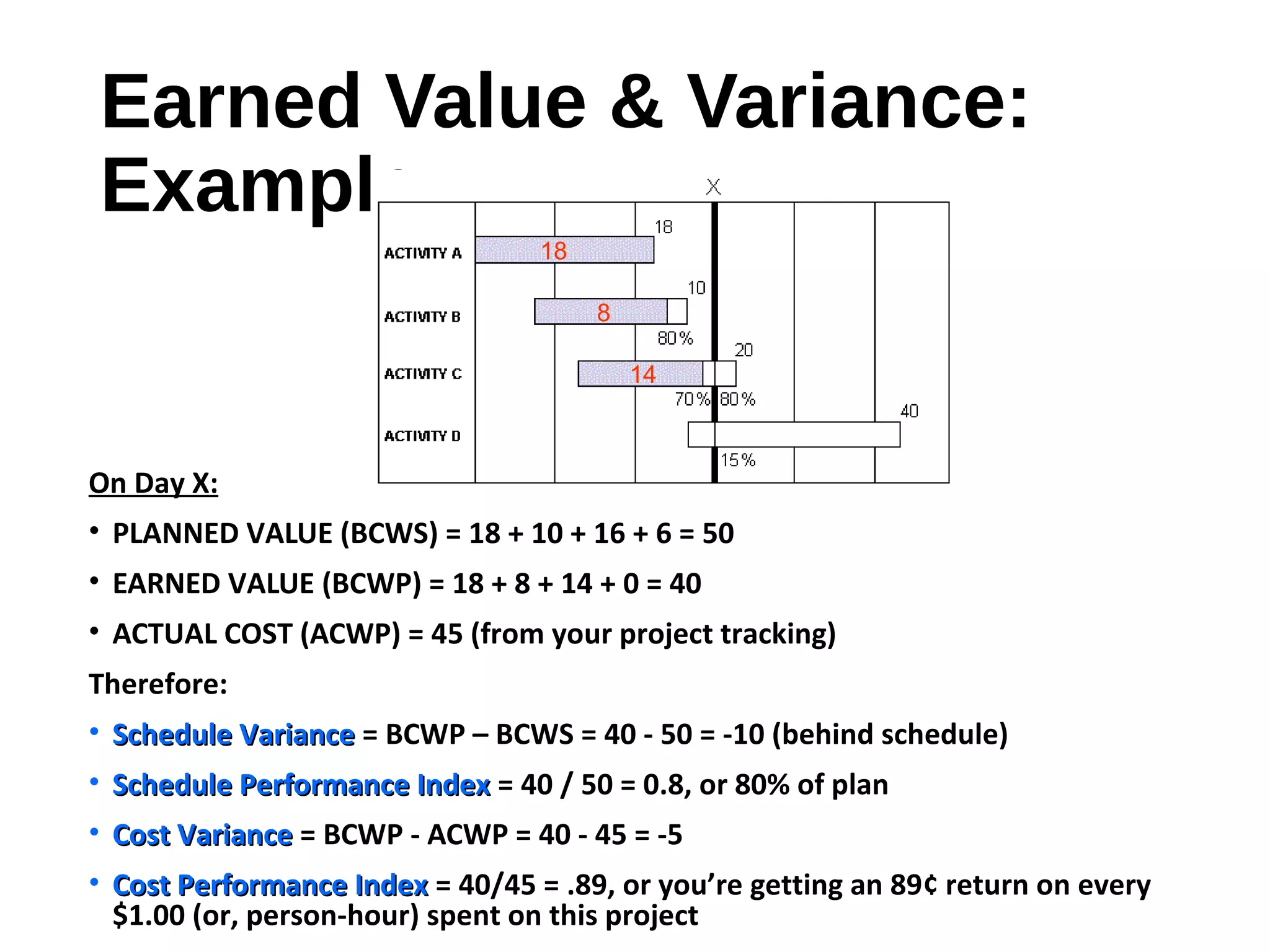
On Day X:
• PLANNED VALUEPLANNED VALUE (Budgeted cost of the work scheduled, BCWS) =
18 + 10 + 16 + 6 = 50
• EARNED VALUEEARNED VALUE (Budgeted cost of the work performed, BCWP) =
18 + 8 + 14 + 0 = 40
• ACTUAL COSTACTUAL COST (of the work performed , ACWP) =
45 (from your project tracking - not evident in above chart)
6
18
8
14
Today
Earned Value:
Example
7
Cost(Person-Hours)
Time (Date)
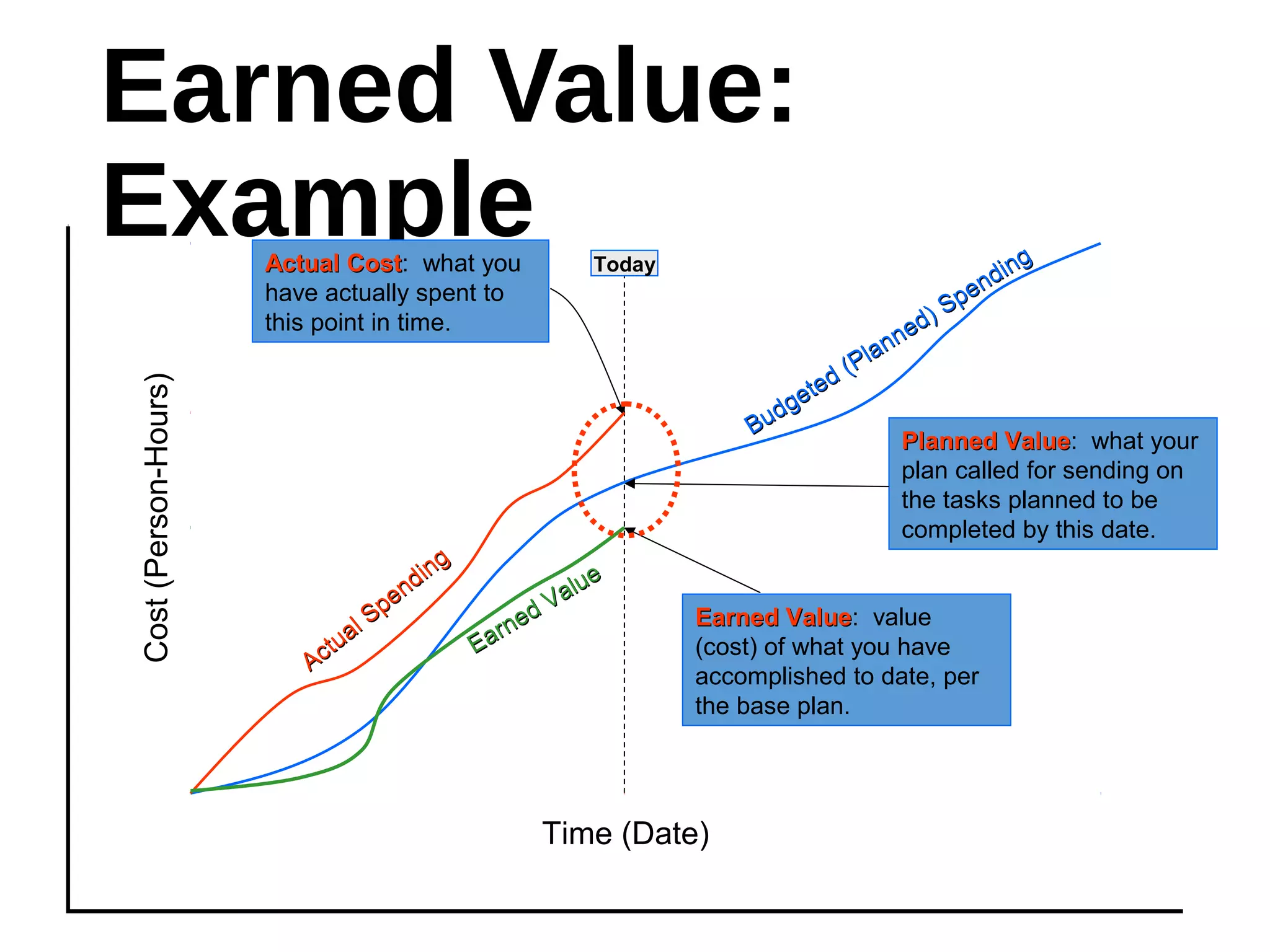
Planned ValuePlanned Value: what your
plan called for sending on
the tasks planned to be
completed by this date.
Today
Earned ValueEarned Value: value
(cost) of what you have
accomplished to date, per
the base plan.
Actual CostActual Cost: what you
have actually spent to
this point in time.
Budgeted (Planned) Spending
Actual Spending
Actual Spending
Earned Value
Earned Value
Earned Value:
Example
8
Cost(Person-Hours)
Time (Date)
Today
Budgeted (Planned) Spending
Actual Spending
Actual Spending
Earned Value
Earned Value
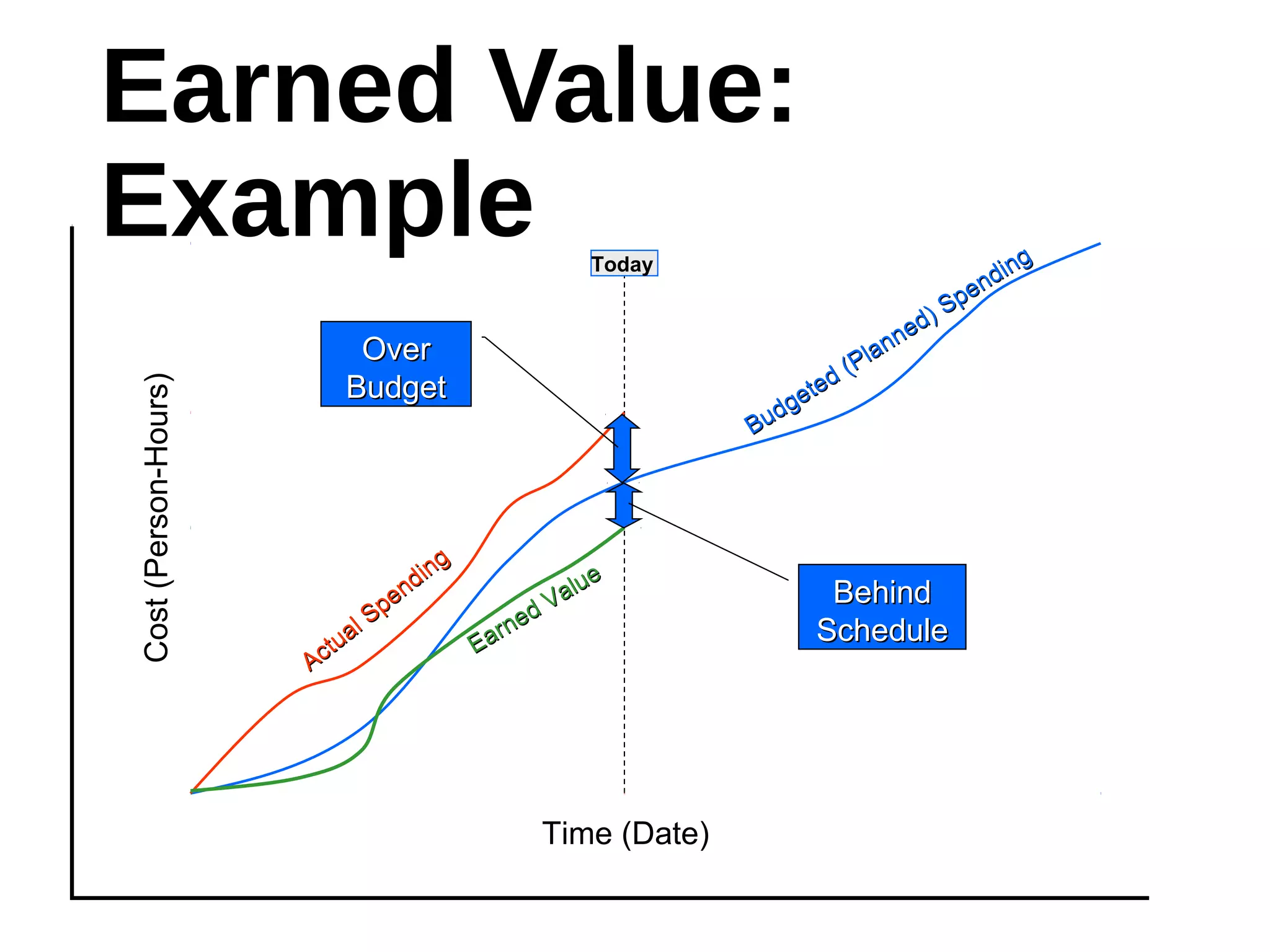
BehindBehind
ScheduleSchedule
OverOver
BudgetBudget
Variance
•Any schedule or costschedule or cost deviationdeviation from a specific plan.
•Used within an organization to verify the budget and
schedule for a project
•Frequently used as a key component of plan reviewsplan reviews
andand performance measurementperformance measurement
9
Variance
•Must compare scheduling and budget variance at the
same time
• Schedule varianceSchedule variance: deviations from work planned
• Cost varianceCost variance: deviations from the
budget
10
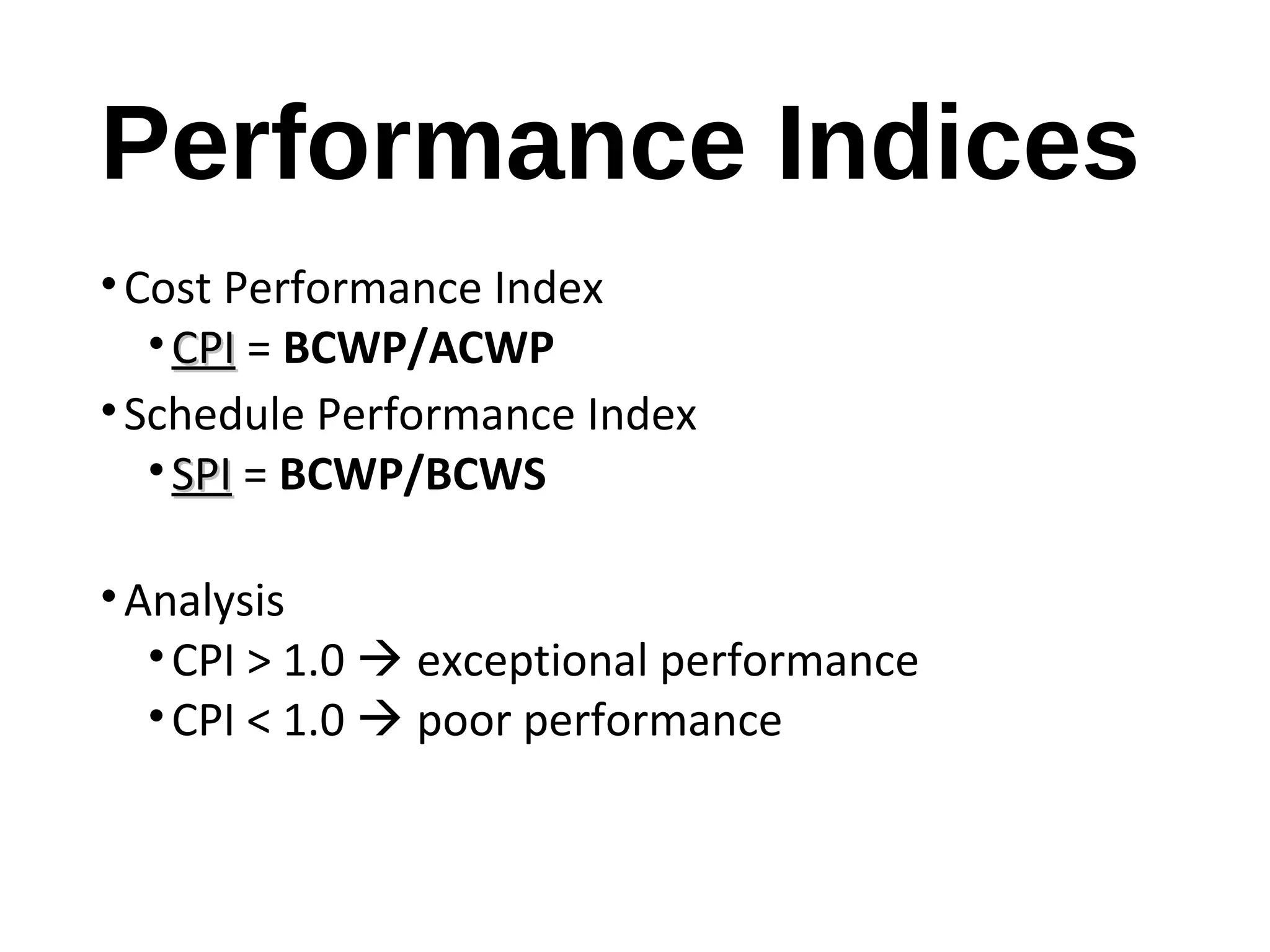
Performance Indices
•Cost Performance Index
• CPICPI = BCWP/ACWP
•Schedule Performance Index
• SPISPI = BCWP/BCWS
•Analysis
•CPI > 1.0  exceptional performance
•CPI < 1.0  poor performance
11
Earned Value & Variance:
Example
On Day X:
• PLANNED VALUE (BCWS) = 18 + 10 + 16 + 6 = 50
• EARNED VALUE (BCWP) = 18 + 8 + 14 + 0 = 40
• ACTUAL COST (ACWP) = 45 (from your project tracking)
Therefore:
• Schedule VarianceSchedule Variance = BCWP – BCWS = 40 - 50 = -10 (behind schedule)
• Schedule Performance IndexSchedule Performance Index = 40 / 50 = 0.8, or 80% of plan
• Cost VarianceCost Variance = BCWP - ACWP = 40 - 45 = -5
• Cost Performance IndexCost Performance Index = 40/45 = .89, or you’re getting an 89¢ return on every
$1.00 (or, person-hour) spent on this project 12
18
8
14
Another Example
Project
•Plans to spend $100K in each of first 4 weeks
(baseline budget, per documented planper documented plan)
•Actuals, at end of week 4 show: $325K spent
•BCWS = $400K ($100K x 4)
•ACWP = $325K
•What conclusions can you draw?
•Under budget?
•Is project on schedule?
13
Earned Value
Management
•How can you use this information?
• Careful analysis of variance and trends
• Resetting schedule or budget, when appropriate
•Variance Analysis Questions
• What is the problem causing the variance?
• What is the impact on time, cost and performance?
• What is the impact on other efforts, if any?
• What corrective action is planned or under way?
• What are the expected results of the corrective action?
14
Earned Value
Management
•Extraordinary variance or alarming trends may be
cause for reset or cancellation ofreset or cancellation of a project, but where
do you draw the line?
•How much variance to allow depends on a number of
factors:
• Life-cycle phase
• Length of life-cycle phase
• Length of project
• Type of estimate
• Accuracy of estimate
15
Summary
•Cost, in the form of Earned Value or BCWP, can be
used to analyze progressanalyze progress of a project
•Using Earned Value data to make critical project
decisions must be based on careful analysiscareful analysis of
data, variances and trends
16
•Thank You
17

Earned Value Analysis

  • 1.
    Earned Value Analysis Final6-1 Syed Saqib Raza RizviSyed Saqib Raza Rizvi
  • 2.
    Earned Value -What is it? •Simply, it is a project monitoring and measurement system that: 1. Establishes a clear relationship between plannedplanned accomplishments and actualactual accomplishments 2.2. ReinforcesReinforces and rewards Good planningGood planning practices 2
  • 3.
    Earned Value -What is it? •Basic concepts of Earned Value Management (EVM) •Each task in a project earns value as planned workplanned work is completed •For example (perhaps), if you were paid on this basis, you would earnearn $$ at key milestones based on the value of what you have completed (Earned value) •Earned value can be compared to actual cost and budgeted cost to determine variance and predict future performance 3
  • 4.
    Earned Value -What is it? •The budgeted costbudgeted cost (e.g., dollars, person-hours, person-days, etc.) in terms of your baselinebaseline plan/budgetplan/budget of the work performed up to a specified point in time • Also known as Budgeted Cost of Work Performed (BCWPBCWP) •Each task in the Work Breakdown Structure (WBS) is assigned a BCWP based on its individual cost. • Project BCWP is total of BCWP for all tasks required to complete the project 4
  • 5.
    Earned Value Components•Planned Value •How much work (person-hours) you planned to have accomplished at a given point in time (this is from the WBS in your plan) •Actual Cost • How much work (person-hours) you have actually spent at a given point in time •Earned Value • The value (person-hours) in terms of your base budget of what you have accomplished at a given point in time (or, % complete X Planned Value) 5
  • 6.
    Earned Value: Example On DayX: • PLANNED VALUEPLANNED VALUE (Budgeted cost of the work scheduled, BCWS) = 18 + 10 + 16 + 6 = 50 • EARNED VALUEEARNED VALUE (Budgeted cost of the work performed, BCWP) = 18 + 8 + 14 + 0 = 40 • ACTUAL COSTACTUAL COST (of the work performed , ACWP) = 45 (from your project tracking - not evident in above chart) 6 18 8 14 Today
  • 7.
    Earned Value: Example 7 Cost(Person-Hours) Time (Date) PlannedValuePlanned Value: what your plan called for sending on the tasks planned to be completed by this date. Today Earned ValueEarned Value: value (cost) of what you have accomplished to date, per the base plan. Actual CostActual Cost: what you have actually spent to this point in time. Budgeted (Planned) Spending Budgeted (Planned) Spending Actual Spending Actual Spending Earned Value Earned Value
  • 8.
    Earned Value: Example 8 Cost(Person-Hours) Time (Date) Today Budgeted(Planned) Spending Budgeted (Planned) Spending Actual Spending Actual Spending Earned Value Earned Value BehindBehind ScheduleSchedule OverOver BudgetBudget
  • 9.
    Variance •Any schedule orcostschedule or cost deviationdeviation from a specific plan. •Used within an organization to verify the budget and schedule for a project •Frequently used as a key component of plan reviewsplan reviews andand performance measurementperformance measurement 9
  • 10.
    Variance •Must compare schedulingand budget variance at the same time • Schedule varianceSchedule variance: deviations from work planned • Cost varianceCost variance: deviations from the budget 10
  • 11.
    Performance Indices •Cost PerformanceIndex • CPICPI = BCWP/ACWP •Schedule Performance Index • SPISPI = BCWP/BCWS •Analysis •CPI > 1.0  exceptional performance •CPI < 1.0  poor performance 11
  • 12.
    Earned Value &Variance: Example On Day X: • PLANNED VALUE (BCWS) = 18 + 10 + 16 + 6 = 50 • EARNED VALUE (BCWP) = 18 + 8 + 14 + 0 = 40 • ACTUAL COST (ACWP) = 45 (from your project tracking) Therefore: • Schedule VarianceSchedule Variance = BCWP – BCWS = 40 - 50 = -10 (behind schedule) • Schedule Performance IndexSchedule Performance Index = 40 / 50 = 0.8, or 80% of plan • Cost VarianceCost Variance = BCWP - ACWP = 40 - 45 = -5 • Cost Performance IndexCost Performance Index = 40/45 = .89, or you’re getting an 89¢ return on every $1.00 (or, person-hour) spent on this project 12 18 8 14
  • 13.
    Another Example Project •Plans tospend $100K in each of first 4 weeks (baseline budget, per documented planper documented plan) •Actuals, at end of week 4 show: $325K spent •BCWS = $400K ($100K x 4) •ACWP = $325K •What conclusions can you draw? •Under budget? •Is project on schedule? 13
  • 14.
    Earned Value Management •How canyou use this information? • Careful analysis of variance and trends • Resetting schedule or budget, when appropriate •Variance Analysis Questions • What is the problem causing the variance? • What is the impact on time, cost and performance? • What is the impact on other efforts, if any? • What corrective action is planned or under way? • What are the expected results of the corrective action? 14
  • 15.
    Earned Value Management •Extraordinary varianceor alarming trends may be cause for reset or cancellation ofreset or cancellation of a project, but where do you draw the line? •How much variance to allow depends on a number of factors: • Life-cycle phase • Length of life-cycle phase • Length of project • Type of estimate • Accuracy of estimate 15
  • 16.
    Summary •Cost, in theform of Earned Value or BCWP, can be used to analyze progressanalyze progress of a project •Using Earned Value data to make critical project decisions must be based on careful analysiscareful analysis of data, variances and trends 16
  • 17.