Earned Value Analysis Training
GPA – Confidential
2
Earned Value Analysis Training
Contents
Context
What is EVA
Why Use It?
How will we use it
EVA examples
EVA and MSP
What next?
Who to contact
GPA – Confidential
3
Earned Value Analysis Training
Context
GPA – Confidential
4
Earned Value Analysis Training
GPA – Confidential
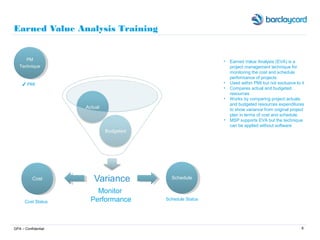
PM
Technique
• Earned Value Analysis (EVA) is a
project management technique for
monitoring the cost and schedule
performance of projects
5
Earned Value Analysis Training
GPA – Confidential
PM
Technique
✔ PMI
• Earned Value Analysis (EVA) is a
project management technique for
monitoring the cost and schedule
performance of projects
• Used within PMI but not exclusive to it
6
Earned Value Analysis Training
GPA – Confidential
PM
Technique
✔ PMI
• Earned Value Analysis (EVA) is a
project management technique for
monitoring the cost and schedule
performance of projects
• Used within PMI but not exclusive to it
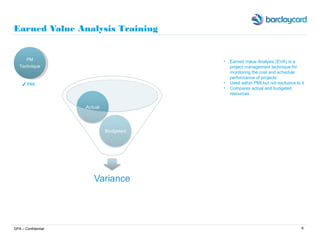
• Compares actual and budgeted
resources
7
Earned Value Analysis Training
GPA – Confidential
PM
Technique
Cost Schedule
Cost Status
Schedule Status
✔ PMI
• Earned Value Analysis (EVA) is a
project management technique for
monitoring the cost and schedule
performance of projects
• Used within PMI but not exclusive to it
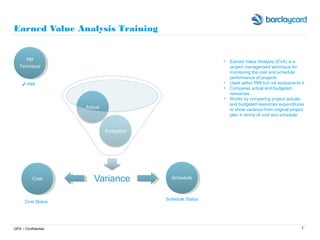
• Compares actual and budgeted
resources
• Works by comparing project actuals
and budgeted resources expenditures
to show variance from original project
plan in terms of cost and schedule.
8
Earned Value Analysis Training
GPA – Confidential
PM
Technique
Cost Schedule
Monitor
PerformanceCost Status
Schedule Status
✔ PMI
• Earned Value Analysis (EVA) is a
project management technique for
monitoring the cost and schedule
performance of projects
• Used within PMI but not exclusive to it
• Compares actual and budgeted
resources
• Works by comparing project actuals
and budgeted resources expenditures
to show variance from original project
plan in terms of cost and schedule.
• MSP supports EVA but the technique
can be applied without software
9
Earned Value Analysis Training
GPA – Confidential
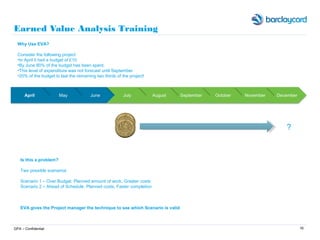
Why Use EVA?
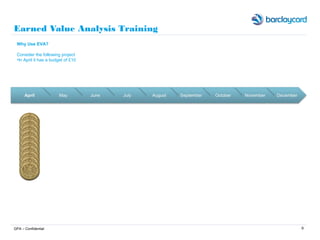
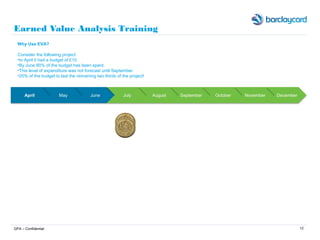
Consider the following project
•In April it has a budget of £10
10
Earned Value Analysis Training
GPA – Confidential
Why Use EVA?
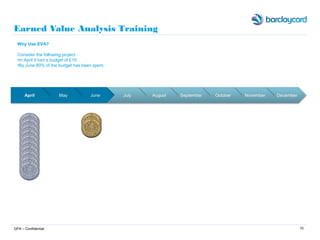
Consider the following project
•In April it had a budget of £10
•By June 80% of the budget has been spent.
11
Earned Value Analysis Training
GPA – Confidential
Why Use EVA?
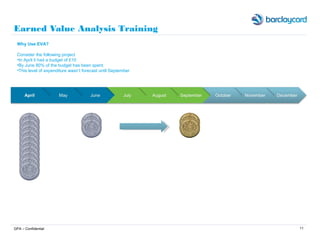
Consider the following project
•In April it had a budget of £10
•By June 80% of the budget has been spent.
•This level of expenditure wasn’t forecast until September
12
Earned Value Analysis Training
GPA – Confidential
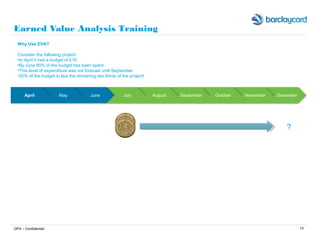
Why Use EVA?
Consider the following project
•In April it had a budget of £10
•By June 80% of the budget has been spent.
•This level of expenditure was not forecast until September
•20% of the budget to last the remaining two thirds of the project!
13
Earned Value Analysis Training
GPA – Confidential
Why Use EVA?
Consider the following project
•In April it had a budget of £10
•By June 80% of the budget has been spent.
•This level of expenditure was not forecast until September
•20% of the budget to last the remaining two thirds of the project!
?
14
Earned Value Analysis Training
GPA – Confidential
Why Use EVA?
Consider the following project
•In April it had a budget of £10
•By June 80% of the budget has been spent.
•This level of expenditure was not forecast until September
•20% of the budget to last the remaining two thirds of the project!
?
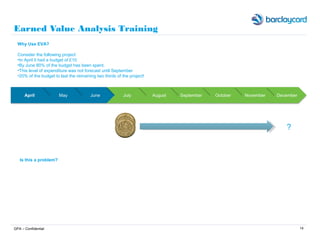
Is this a problem?
15
Earned Value Analysis Training
GPA – Confidential
Why Use EVA?
Consider the following project
•In April it had a budget of £10
•By June 80% of the budget has been spent.
•This level of expenditure was not forecast until September
•20% of the budget to last the remaining two thirds of the project!
?
Is this a problem?
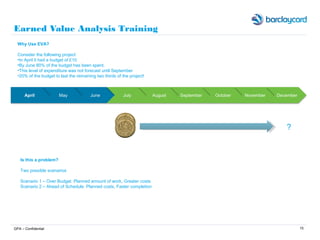
Two possible scenarios
Scenario 1 – Over Budget. Planned amount of work, Greater costs
Scenario 2 – Ahead of Schedule. Planned costs, Faster completion
16
Earned Value Analysis Training
GPA – Confidential
Why Use EVA?
Consider the following project
•In April it had a budget of £10
•By June 80% of the budget has been spent.
•This level of expenditure was not forecast until September
•20% of the budget to last the remaining two thirds of the project!
?
Is this a problem?
Two possible scenarios
Scenario 1 – Over Budget. Planned amount of work, Greater costs
Scenario 2 – Ahead of Schedule. Planned costs, Faster completion
EVA gives the Project manager the technique to see which Scenario is valid
17
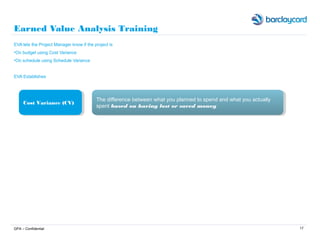
Earned Value Analysis Training
EVA lets the Project Manager know if the project is
•On budget using Cost Variance
•On schedule using Schedule Variance
EVA Establishes
GPA – Confidential
Cost Variance (CV)Cost Variance (CV) The difference between what you planned to spend and what you actually
spent based on having lost or saved money
The difference between what you planned to spend and what you actually
spent based on having lost or saved money
18
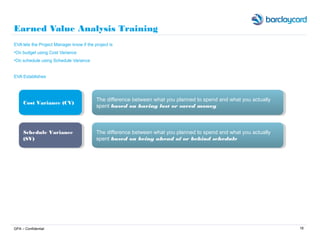
Earned Value Analysis Training
EVA lets the Project Manager know if the project is
•On budget using Cost Variance
•On schedule using Schedule Variance
EVA Establishes
GPA – Confidential
Cost Variance (CV)Cost Variance (CV)
Schedule Variance
(SV)
Schedule Variance
(SV)
The difference between what you planned to spend and what you actually
spent based on having lost or saved money
The difference between what you planned to spend and what you actually
spent based on having lost or saved money
The difference between what you planned to spend and what you actually
spent based on being ahead of or behind schedule
The difference between what you planned to spend and what you actually
spent based on being ahead of or behind schedule
19
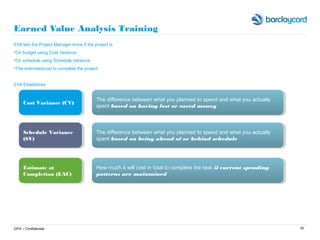
Earned Value Analysis Training
EVA lets the Project Manager know if the project is
•On budget using Cost Variance
•On schedule using Schedule Variance
•The estimatedcost to complete the project
EVA Establishes
GPA – Confidential
Cost Variance (CV)Cost Variance (CV)
Schedule Variance
(SV)
Schedule Variance
(SV)
The difference between what you planned to spend and what you actually
spent based on having lost or saved money
The difference between what you planned to spend and what you actually
spent based on having lost or saved money
The difference between what you planned to spend and what you actually
spent based on being ahead of or behind schedule
The difference between what you planned to spend and what you actually
spent based on being ahead of or behind schedule
Estimate at
Completion (EAC)
Estimate at
Completion (EAC)
How much it will cost in total to complete the task if current spending
patterns are maintained
How much it will cost in total to complete the task if current spending
patterns are maintained
20
Earned Value Analysis Training
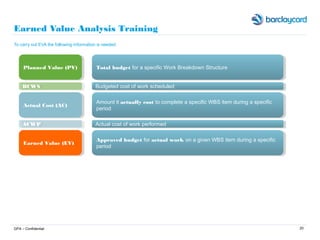
To carry out EVA the following information is needed
GPA – Confidential
Planned Value (PV)Planned Value (PV)
Actual Cost (AC)Actual Cost (AC)
Total budget for a specific Work Breakdown StructureTotal budget for a specific Work Breakdown Structure
Amount it actually cost to complete a specific WBS item during a specific
period
Amount it actually cost to complete a specific WBS item during a specific
period
Earned Value (EV)Earned Value (EV) Approved budget for actual work on a given WBS item during a specific
period
Approved budget for actual work on a given WBS item during a specific
period
BCWSBCWS Budgeted cost of work scheduledBudgeted cost of work scheduled
ACWPACWP Actual cost of work performedActual cost of work performed
21
Earned Value Analysis Training
GPA – Confidential
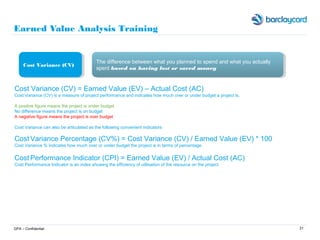
Cost Variance (CV)Cost Variance (CV) The difference between what you planned to spend and what you actually
spent based on having lost or saved money
The difference between what you planned to spend and what you actually
spent based on having lost or saved money
Cost Variance (CV) = Earned Value (EV) – Actual Cost (AC)
Cost Variance (CV) is a measure of project performance and indicates how much over or under budget a project is.
A positive figure means the project is under budget
No difference means the project is on budget
A negative figure means the project is over budget
Cost Variance can also be articulated as the following convenient indicators
Cost Variance Percentage (CV%) = Cost Variance (CV) / Earned Value (EV) * 100
Cost Variance % indicates how much over or under budget the project is in terms of percentage
Cost Performance Indicator (CPI) = Earned Value (EV) / Actual Cost (AC)
Cost Performance Indicator is an index showing the efficiency of utilisation of the resource on the project
22
Earned Value Analysis Training
GPA – Confidential
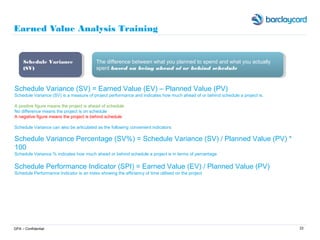
Schedule Variance (SV) = Earned Value (EV) – Planned Value (PV)
Schedule Variance (SV) is a measure of project performance and indicates how much ahead of or behind schedule a project is.
A positive figure means the project is ahead of schedule
No difference means the project is on schedule
A negative figure means the project is behind schedule
Schedule Variance can also be articulated as the following convenient indicators
Schedule Variance Percentage (SV%) = Schedule Variance (SV) / Planned Value (PV) *
100
Schedule Variance % indicates how much ahead or behind schedule a project is in terms of percentage
Schedule Performance Indicator (SPI) = Earned Value (EV) / Planned Value (PV)
Schedule Performance Indicator is an index showing the efficiency of time utilised on the project
Schedule Variance
(SV)
Schedule Variance
(SV)
The difference between what you planned to spend and what you actually
spent based on being ahead of or behind schedule
The difference between what you planned to spend and what you actually
spent based on being ahead of or behind schedule
23
Earned Value Analysis Training
GPA – Confidential
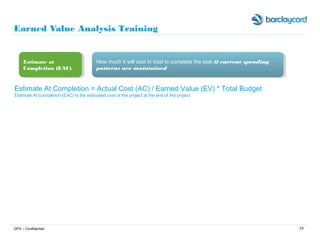
Estimate At Completion = Actual Cost (AC) / Earned Value (EV) * Total Budget
Estimate At Completion (EAC) is the estimated cost of the project at the end of the project
Estimate at
Completion (EAC)
Estimate at
Completion (EAC)
How much it will cost in total to complete the task if current spending
patterns are maintained
How much it will cost in total to complete the task if current spending
patterns are maintained
24
Earned Value Analysis Training
GPA – Confidential
A Practical Example
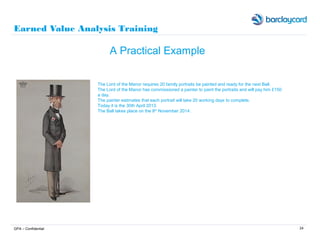
The Lord of the Manor requires 20 family portraits be painted and ready for the next Ball.
The Lord of the Manor has commissioned a painter to paint the portraits and will pay him £150
a day.
The painter estimates that each portrait will take 20 working days to complete.
Today it is the 30th April 2013.
The Ball takes place on the 8th
November 2014.
25
Earned Value Analysis Training
GPA – Confidential
Start 30th
April
Start 30th
April
End 8th
Nov
End 8th
Nov
Update
1st
Sept
Update
1st
Sept
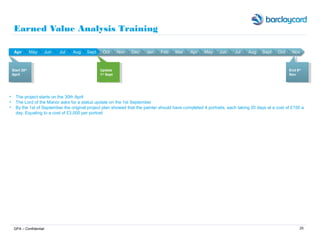
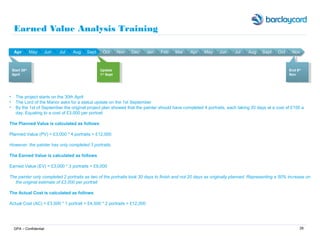
• The project starts on the 30th April
• The Lord of the Manor asks for a status update on the 1st September
• By the 1st of September the original project plan showed that the painter should have completed 4 portraits, each taking 20 days at a cost of £150 a
day. Equating to a cost of £3,000 per portrait
26
Earned Value Analysis Training
GPA – Confidential
Start 30th
April
Start 30th
April
End 8th
Nov
End 8th
Nov
Update
1st
Sept
Update
1st
Sept
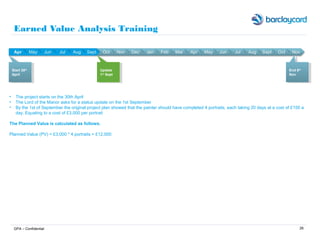
• The project starts on the 30th April
• The Lord of the Manor asks for a status update on the 1st September
• By the 1st of September the original project plan showed that the painter should have completed 4 portraits, each taking 20 days at a cost of £150 a
day. Equating to a cost of £3,000 per portrait
The Planned Value is calculated as follows.
Planned Value (PV) = £3,000 * 4 portraits = £12,000
27
Earned Value Analysis Training
GPA – Confidential
Start 30th
April
Start 30th
April
End 8th
Nov
End 8th
Nov
Update
1st
Sept
Update
1st
Sept
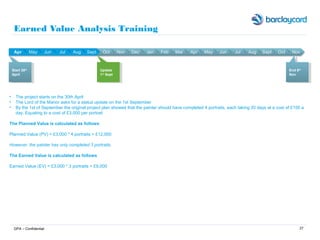
• The project starts on the 30th April
• The Lord of the Manor asks for a status update on the 1st September
• By the 1st of September the original project plan showed that the painter should have completed 4 portraits, each taking 20 days at a cost of £150 a
day. Equating to a cost of £3,000 per portrait
The Planned Value is calculated as follows
Planned Value (PV) = £3,000 * 4 portraits = £12,000
However, the painter has only completed 3 portraits.
The Earned Value is calculated as follows
Earned Value (EV) = £3,000 * 3 portraits = £9,000
28
Earned Value Analysis Training
GPA – Confidential
Start 30th
April
Start 30th
April
End 8th
Nov
End 8th
Nov
Update
1st
Sept
Update
1st
Sept
• The project starts on the 30th April
• The Lord of the Manor asks for a status update on the 1st September
• By the 1st of September the original project plan showed that the painter should have completed 4 portraits, each taking 20 days at a cost of £150 a
day. Equating to a cost of £3,000 per portrait
The Planned Value is calculated as follows
Planned Value (PV) = £3,000 * 4 portraits = £12,000
However, the painter has only completed 3 portraits.
The Earned Value is calculated as follows
Earned Value (EV) = £3,000 * 3 portraits = £9,000
The painter only completed 2 portraits as two of the portraits took 30 days to finish and not 20 days as originally planned. Representing a 50% increase on
the original estimate of £3,000 per portrait
The Actual Cost is calculated as follows
Actual Cost (AC) = £3,000 * 1 portrait + £4,500 * 2 portraits = £12,000
29
Earned Value Analysis Training
GPA – Confidential
Start 30th
April
Start 30th
April
End 8th
Nov
End 8th
Nov
Update
1st
Sept
Update
1st
Sept
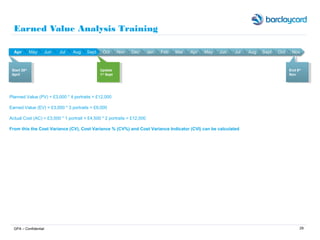
Planned Value (PV) = £3,000 * 4 portraits = £12,000
Earned Value (EV) = £3,000 * 3 portraits = £9,000
Actual Cost (AC) = £3,000 * 1 portrait + £4,500 * 2 portraits = £12,000
From this the Cost Variance (CV), Cost Variance % (CV%) and Cost Variance Indicator (CVI) can be calculated
30
Earned Value Analysis Training
GPA – Confidential
Start 30th
April
Start 30th
April
End 8th
Nov
End 8th
Nov
Update
1st
Sept
Update
1st
Sept
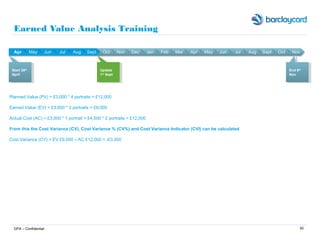
Planned Value (PV) = £3,000 * 4 portraits = £12,000
Earned Value (EV) = £3,000 * 3 portraits = £9,000
Actual Cost (AC) = £3,000 * 1 portrait + £4,500 * 2 portraits = £12,000
From this the Cost Variance (CV), Cost Variance % (CV%) and Cost Variance Indicator (CVI) can be calculated
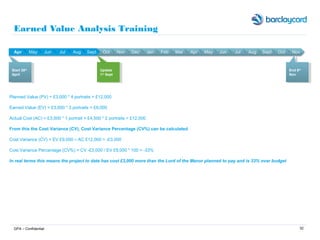
Cost Variance (CV) = EV £9,000 – AC £12,000 = -£3,000
31
Earned Value Analysis Training
GPA – Confidential
Start 30th
April
Start 30th
April
End 8th
Nov
End 8th
Nov
Update
1st
Sept
Update
1st
Sept
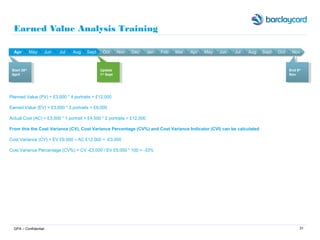
Planned Value (PV) = £3,000 * 4 portraits = £12,000
Earned Value (EV) = £3,000 * 3 portraits = £9,000
Actual Cost (AC) = £3,000 * 1 portrait + £4,500 * 2 portraits = £12,000
From this the Cost Variance (CV), Cost Variance Percentage (CV%) and Cost Variance Indicator (CVI) can be calculated
Cost Variance (CV) = EV £9,000 – AC £12,000 = -£3,000
Cost Variance Percentage (CV%) = CV -£3,000 / EV £9,000 * 100 = -33%
32
Earned Value Analysis Training
GPA – Confidential
Start 30th
April
Start 30th
April
End 8th
Nov
End 8th
Nov
Update
1st
Sept
Update
1st
Sept
Planned Value (PV) = £3,000 * 4 portraits = £12,000
Earned Value (EV) = £3,000 * 3 portraits = £9,000
Actual Cost (AC) = £3,000 * 1 portrait + £4,500 * 2 portraits = £12,000
From this the Cost Variance (CV), Cost Variance Percentage (CV%) can be calculated
Cost Variance (CV) = EV £9,000 – AC £12,000 = -£3,000
Cost Variance Percentage (CV%) = CV -£3,000 / EV £9,000 * 100 = -33%
In real terms this means the project to date has cost £3,000 more than the Lord of the Manor planned to pay and is 33% over budget
33
Earned Value Analysis Training
GPA – Confidential
Start 30th
April
Start 30th
April
End 8th
Nov
End 8th
Nov
Update
1st
Sept
Update
1st
Sept
Planned Value (PV) = £3,000 * 4 portraits = £12,000
Earned Value (EV) = £3,000 * 3 portraits = £9,000
Actual Cost (AC) = £3,000 * 1 portrait + £4,500 * 2 portraits = £12,000
Cost Variance (CV) = EV £9,000 – AC £12,000 = -£3,000
Cost Variance Percentage (CV%) = CV -£3,000 / EV £9,000 * 100 = -33%
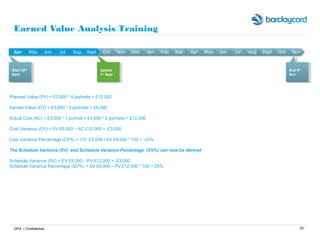
The Schedule Variance (SV) and Schedule Variance Percentage (SV%) can now be derived
Schedule Variance (SV) = EV £9,000 – PV £12,000 = -£3,000
Schedule Variance Percentage (SV%) = SV £9,000 – PV £12,000 * 100 = 25%
34
Earned Value Analysis Training
GPA – Confidential
Start 30th
April
Start 30th
April
End 8th
Nov
End 8th
Nov
Update
1st
Sept
Update
1st
Sept
Planned Value (PV) = £3,000 * 4 portraits = £12,000
Earned Value (EV) = £3,000 * 3 portraits = £9,000
Actual Cost (AC) = £3,000 * 1 portrait + £4,500 * 2 portraits = £12,000
Cost Variance (CV) = EV £9,000 – AC £12,000 = -£3,000
Cost Variance Percentage (CV%) = CV -£3,000 / EV £9,000 * 100 = -33%
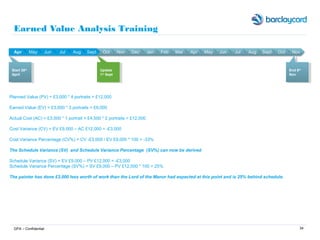
The Schedule Variance (SV) and Schedule Variance Percentage (SV%) can now be derived
Schedule Variance (SV) = EV £9,000 – PV £12,000 = -£3,000
Schedule Variance Percentage (SV%) = SV £9,000 – PV £12,000 * 100 = 25%
The painter has done £3,000 less worth of work than the Lord of the Manor had expected at this point and is 25% behind schedule.

Earned value analysis training

  • 1.
    Earned Value AnalysisTraining GPA – Confidential
  • 2.
    2 Earned Value AnalysisTraining Contents Context What is EVA Why Use It? How will we use it EVA examples EVA and MSP What next? Who to contact GPA – Confidential
  • 3.
    3 Earned Value AnalysisTraining Context GPA – Confidential
  • 4.
    4 Earned Value AnalysisTraining GPA – Confidential PM Technique • Earned Value Analysis (EVA) is a project management technique for monitoring the cost and schedule performance of projects
  • 5.
    5 Earned Value AnalysisTraining GPA – Confidential PM Technique ✔ PMI • Earned Value Analysis (EVA) is a project management technique for monitoring the cost and schedule performance of projects • Used within PMI but not exclusive to it
  • 6.
    6 Earned Value AnalysisTraining GPA – Confidential PM Technique ✔ PMI • Earned Value Analysis (EVA) is a project management technique for monitoring the cost and schedule performance of projects • Used within PMI but not exclusive to it • Compares actual and budgeted resources
  • 7.
    7 Earned Value AnalysisTraining GPA – Confidential PM Technique Cost Schedule Cost Status Schedule Status ✔ PMI • Earned Value Analysis (EVA) is a project management technique for monitoring the cost and schedule performance of projects • Used within PMI but not exclusive to it • Compares actual and budgeted resources • Works by comparing project actuals and budgeted resources expenditures to show variance from original project plan in terms of cost and schedule.
  • 8.
    8 Earned Value AnalysisTraining GPA – Confidential PM Technique Cost Schedule Monitor PerformanceCost Status Schedule Status ✔ PMI • Earned Value Analysis (EVA) is a project management technique for monitoring the cost and schedule performance of projects • Used within PMI but not exclusive to it • Compares actual and budgeted resources • Works by comparing project actuals and budgeted resources expenditures to show variance from original project plan in terms of cost and schedule. • MSP supports EVA but the technique can be applied without software
  • 9.
    9 Earned Value AnalysisTraining GPA – Confidential Why Use EVA? Consider the following project •In April it has a budget of £10
  • 10.
    10 Earned Value AnalysisTraining GPA – Confidential Why Use EVA? Consider the following project •In April it had a budget of £10 •By June 80% of the budget has been spent.
  • 11.
    11 Earned Value AnalysisTraining GPA – Confidential Why Use EVA? Consider the following project •In April it had a budget of £10 •By June 80% of the budget has been spent. •This level of expenditure wasn’t forecast until September
  • 12.
    12 Earned Value AnalysisTraining GPA – Confidential Why Use EVA? Consider the following project •In April it had a budget of £10 •By June 80% of the budget has been spent. •This level of expenditure was not forecast until September •20% of the budget to last the remaining two thirds of the project!
  • 13.
    13 Earned Value AnalysisTraining GPA – Confidential Why Use EVA? Consider the following project •In April it had a budget of £10 •By June 80% of the budget has been spent. •This level of expenditure was not forecast until September •20% of the budget to last the remaining two thirds of the project! ?
  • 14.
    14 Earned Value AnalysisTraining GPA – Confidential Why Use EVA? Consider the following project •In April it had a budget of £10 •By June 80% of the budget has been spent. •This level of expenditure was not forecast until September •20% of the budget to last the remaining two thirds of the project! ? Is this a problem?
  • 15.
    15 Earned Value AnalysisTraining GPA – Confidential Why Use EVA? Consider the following project •In April it had a budget of £10 •By June 80% of the budget has been spent. •This level of expenditure was not forecast until September •20% of the budget to last the remaining two thirds of the project! ? Is this a problem? Two possible scenarios Scenario 1 – Over Budget. Planned amount of work, Greater costs Scenario 2 – Ahead of Schedule. Planned costs, Faster completion
  • 16.
    16 Earned Value AnalysisTraining GPA – Confidential Why Use EVA? Consider the following project •In April it had a budget of £10 •By June 80% of the budget has been spent. •This level of expenditure was not forecast until September •20% of the budget to last the remaining two thirds of the project! ? Is this a problem? Two possible scenarios Scenario 1 – Over Budget. Planned amount of work, Greater costs Scenario 2 – Ahead of Schedule. Planned costs, Faster completion EVA gives the Project manager the technique to see which Scenario is valid
  • 17.
    17 Earned Value AnalysisTraining EVA lets the Project Manager know if the project is •On budget using Cost Variance •On schedule using Schedule Variance EVA Establishes GPA – Confidential Cost Variance (CV)Cost Variance (CV) The difference between what you planned to spend and what you actually spent based on having lost or saved money The difference between what you planned to spend and what you actually spent based on having lost or saved money
  • 18.
    18 Earned Value AnalysisTraining EVA lets the Project Manager know if the project is •On budget using Cost Variance •On schedule using Schedule Variance EVA Establishes GPA – Confidential Cost Variance (CV)Cost Variance (CV) Schedule Variance (SV) Schedule Variance (SV) The difference between what you planned to spend and what you actually spent based on having lost or saved money The difference between what you planned to spend and what you actually spent based on having lost or saved money The difference between what you planned to spend and what you actually spent based on being ahead of or behind schedule The difference between what you planned to spend and what you actually spent based on being ahead of or behind schedule
  • 19.
    19 Earned Value AnalysisTraining EVA lets the Project Manager know if the project is •On budget using Cost Variance •On schedule using Schedule Variance •The estimatedcost to complete the project EVA Establishes GPA – Confidential Cost Variance (CV)Cost Variance (CV) Schedule Variance (SV) Schedule Variance (SV) The difference between what you planned to spend and what you actually spent based on having lost or saved money The difference between what you planned to spend and what you actually spent based on having lost or saved money The difference between what you planned to spend and what you actually spent based on being ahead of or behind schedule The difference between what you planned to spend and what you actually spent based on being ahead of or behind schedule Estimate at Completion (EAC) Estimate at Completion (EAC) How much it will cost in total to complete the task if current spending patterns are maintained How much it will cost in total to complete the task if current spending patterns are maintained
  • 20.
    20 Earned Value AnalysisTraining To carry out EVA the following information is needed GPA – Confidential Planned Value (PV)Planned Value (PV) Actual Cost (AC)Actual Cost (AC) Total budget for a specific Work Breakdown StructureTotal budget for a specific Work Breakdown Structure Amount it actually cost to complete a specific WBS item during a specific period Amount it actually cost to complete a specific WBS item during a specific period Earned Value (EV)Earned Value (EV) Approved budget for actual work on a given WBS item during a specific period Approved budget for actual work on a given WBS item during a specific period BCWSBCWS Budgeted cost of work scheduledBudgeted cost of work scheduled ACWPACWP Actual cost of work performedActual cost of work performed
  • 21.
    21 Earned Value AnalysisTraining GPA – Confidential Cost Variance (CV)Cost Variance (CV) The difference between what you planned to spend and what you actually spent based on having lost or saved money The difference between what you planned to spend and what you actually spent based on having lost or saved money Cost Variance (CV) = Earned Value (EV) – Actual Cost (AC) Cost Variance (CV) is a measure of project performance and indicates how much over or under budget a project is. A positive figure means the project is under budget No difference means the project is on budget A negative figure means the project is over budget Cost Variance can also be articulated as the following convenient indicators Cost Variance Percentage (CV%) = Cost Variance (CV) / Earned Value (EV) * 100 Cost Variance % indicates how much over or under budget the project is in terms of percentage Cost Performance Indicator (CPI) = Earned Value (EV) / Actual Cost (AC) Cost Performance Indicator is an index showing the efficiency of utilisation of the resource on the project
  • 22.
    22 Earned Value AnalysisTraining GPA – Confidential Schedule Variance (SV) = Earned Value (EV) – Planned Value (PV) Schedule Variance (SV) is a measure of project performance and indicates how much ahead of or behind schedule a project is. A positive figure means the project is ahead of schedule No difference means the project is on schedule A negative figure means the project is behind schedule Schedule Variance can also be articulated as the following convenient indicators Schedule Variance Percentage (SV%) = Schedule Variance (SV) / Planned Value (PV) * 100 Schedule Variance % indicates how much ahead or behind schedule a project is in terms of percentage Schedule Performance Indicator (SPI) = Earned Value (EV) / Planned Value (PV) Schedule Performance Indicator is an index showing the efficiency of time utilised on the project Schedule Variance (SV) Schedule Variance (SV) The difference between what you planned to spend and what you actually spent based on being ahead of or behind schedule The difference between what you planned to spend and what you actually spent based on being ahead of or behind schedule
  • 23.
    23 Earned Value AnalysisTraining GPA – Confidential Estimate At Completion = Actual Cost (AC) / Earned Value (EV) * Total Budget Estimate At Completion (EAC) is the estimated cost of the project at the end of the project Estimate at Completion (EAC) Estimate at Completion (EAC) How much it will cost in total to complete the task if current spending patterns are maintained How much it will cost in total to complete the task if current spending patterns are maintained
  • 24.
    24 Earned Value AnalysisTraining GPA – Confidential A Practical Example The Lord of the Manor requires 20 family portraits be painted and ready for the next Ball. The Lord of the Manor has commissioned a painter to paint the portraits and will pay him £150 a day. The painter estimates that each portrait will take 20 working days to complete. Today it is the 30th April 2013. The Ball takes place on the 8th November 2014.
  • 25.
    25 Earned Value AnalysisTraining GPA – Confidential Start 30th April Start 30th April End 8th Nov End 8th Nov Update 1st Sept Update 1st Sept • The project starts on the 30th April • The Lord of the Manor asks for a status update on the 1st September • By the 1st of September the original project plan showed that the painter should have completed 4 portraits, each taking 20 days at a cost of £150 a day. Equating to a cost of £3,000 per portrait
  • 26.
    26 Earned Value AnalysisTraining GPA – Confidential Start 30th April Start 30th April End 8th Nov End 8th Nov Update 1st Sept Update 1st Sept • The project starts on the 30th April • The Lord of the Manor asks for a status update on the 1st September • By the 1st of September the original project plan showed that the painter should have completed 4 portraits, each taking 20 days at a cost of £150 a day. Equating to a cost of £3,000 per portrait The Planned Value is calculated as follows. Planned Value (PV) = £3,000 * 4 portraits = £12,000
  • 27.
    27 Earned Value AnalysisTraining GPA – Confidential Start 30th April Start 30th April End 8th Nov End 8th Nov Update 1st Sept Update 1st Sept • The project starts on the 30th April • The Lord of the Manor asks for a status update on the 1st September • By the 1st of September the original project plan showed that the painter should have completed 4 portraits, each taking 20 days at a cost of £150 a day. Equating to a cost of £3,000 per portrait The Planned Value is calculated as follows Planned Value (PV) = £3,000 * 4 portraits = £12,000 However, the painter has only completed 3 portraits. The Earned Value is calculated as follows Earned Value (EV) = £3,000 * 3 portraits = £9,000
  • 28.
    28 Earned Value AnalysisTraining GPA – Confidential Start 30th April Start 30th April End 8th Nov End 8th Nov Update 1st Sept Update 1st Sept • The project starts on the 30th April • The Lord of the Manor asks for a status update on the 1st September • By the 1st of September the original project plan showed that the painter should have completed 4 portraits, each taking 20 days at a cost of £150 a day. Equating to a cost of £3,000 per portrait The Planned Value is calculated as follows Planned Value (PV) = £3,000 * 4 portraits = £12,000 However, the painter has only completed 3 portraits. The Earned Value is calculated as follows Earned Value (EV) = £3,000 * 3 portraits = £9,000 The painter only completed 2 portraits as two of the portraits took 30 days to finish and not 20 days as originally planned. Representing a 50% increase on the original estimate of £3,000 per portrait The Actual Cost is calculated as follows Actual Cost (AC) = £3,000 * 1 portrait + £4,500 * 2 portraits = £12,000
  • 29.
    29 Earned Value AnalysisTraining GPA – Confidential Start 30th April Start 30th April End 8th Nov End 8th Nov Update 1st Sept Update 1st Sept Planned Value (PV) = £3,000 * 4 portraits = £12,000 Earned Value (EV) = £3,000 * 3 portraits = £9,000 Actual Cost (AC) = £3,000 * 1 portrait + £4,500 * 2 portraits = £12,000 From this the Cost Variance (CV), Cost Variance % (CV%) and Cost Variance Indicator (CVI) can be calculated
  • 30.
    30 Earned Value AnalysisTraining GPA – Confidential Start 30th April Start 30th April End 8th Nov End 8th Nov Update 1st Sept Update 1st Sept Planned Value (PV) = £3,000 * 4 portraits = £12,000 Earned Value (EV) = £3,000 * 3 portraits = £9,000 Actual Cost (AC) = £3,000 * 1 portrait + £4,500 * 2 portraits = £12,000 From this the Cost Variance (CV), Cost Variance % (CV%) and Cost Variance Indicator (CVI) can be calculated Cost Variance (CV) = EV £9,000 – AC £12,000 = -£3,000
  • 31.
    31 Earned Value AnalysisTraining GPA – Confidential Start 30th April Start 30th April End 8th Nov End 8th Nov Update 1st Sept Update 1st Sept Planned Value (PV) = £3,000 * 4 portraits = £12,000 Earned Value (EV) = £3,000 * 3 portraits = £9,000 Actual Cost (AC) = £3,000 * 1 portrait + £4,500 * 2 portraits = £12,000 From this the Cost Variance (CV), Cost Variance Percentage (CV%) and Cost Variance Indicator (CVI) can be calculated Cost Variance (CV) = EV £9,000 – AC £12,000 = -£3,000 Cost Variance Percentage (CV%) = CV -£3,000 / EV £9,000 * 100 = -33%
  • 32.
    32 Earned Value AnalysisTraining GPA – Confidential Start 30th April Start 30th April End 8th Nov End 8th Nov Update 1st Sept Update 1st Sept Planned Value (PV) = £3,000 * 4 portraits = £12,000 Earned Value (EV) = £3,000 * 3 portraits = £9,000 Actual Cost (AC) = £3,000 * 1 portrait + £4,500 * 2 portraits = £12,000 From this the Cost Variance (CV), Cost Variance Percentage (CV%) can be calculated Cost Variance (CV) = EV £9,000 – AC £12,000 = -£3,000 Cost Variance Percentage (CV%) = CV -£3,000 / EV £9,000 * 100 = -33% In real terms this means the project to date has cost £3,000 more than the Lord of the Manor planned to pay and is 33% over budget
  • 33.
    33 Earned Value AnalysisTraining GPA – Confidential Start 30th April Start 30th April End 8th Nov End 8th Nov Update 1st Sept Update 1st Sept Planned Value (PV) = £3,000 * 4 portraits = £12,000 Earned Value (EV) = £3,000 * 3 portraits = £9,000 Actual Cost (AC) = £3,000 * 1 portrait + £4,500 * 2 portraits = £12,000 Cost Variance (CV) = EV £9,000 – AC £12,000 = -£3,000 Cost Variance Percentage (CV%) = CV -£3,000 / EV £9,000 * 100 = -33% The Schedule Variance (SV) and Schedule Variance Percentage (SV%) can now be derived Schedule Variance (SV) = EV £9,000 – PV £12,000 = -£3,000 Schedule Variance Percentage (SV%) = SV £9,000 – PV £12,000 * 100 = 25%
  • 34.
    34 Earned Value AnalysisTraining GPA – Confidential Start 30th April Start 30th April End 8th Nov End 8th Nov Update 1st Sept Update 1st Sept Planned Value (PV) = £3,000 * 4 portraits = £12,000 Earned Value (EV) = £3,000 * 3 portraits = £9,000 Actual Cost (AC) = £3,000 * 1 portrait + £4,500 * 2 portraits = £12,000 Cost Variance (CV) = EV £9,000 – AC £12,000 = -£3,000 Cost Variance Percentage (CV%) = CV -£3,000 / EV £9,000 * 100 = -33% The Schedule Variance (SV) and Schedule Variance Percentage (SV%) can now be derived Schedule Variance (SV) = EV £9,000 – PV £12,000 = -£3,000 Schedule Variance Percentage (SV%) = SV £9,000 – PV £12,000 * 100 = 25% The painter has done £3,000 less worth of work than the Lord of the Manor had expected at this point and is 25% behind schedule.