
Project
Management
 Project Life Cycle & phases
By
Qadir Nawaz Abbasi
Mechanical Engineering Dept:
MUET SZAB Campus
Khairpur Mir’s
April, 2018
Project Life Cycle
 The Project management is about acquiring or
achieving the project goal
 Most projects need to be broken down into a
logical sequence of ‘phases’, known as the
project life cycle.
Phases of a Project
 Organisations normally break a
project down into several project
phases for better management control
 Collectively, the project phases are
known as the project life cycle
 Each project phase is marked by the
completion of one or more
deliverables.
Stage Gates
 Each phase ends with a review of the
deliverables and performance in order to
detect and correct errors and to decide if
the project should continue into the next
phase.
 The phase end reviews are often called
phase exits or stage gates.
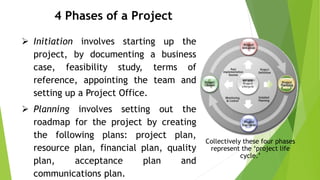
4 Phases of a Project
Collectively these four phases
represent the ‘project life
cycle.’
 Initiation involves starting up the
project, by documenting a business
case, feasibility study, terms of
reference, appointing the team and
setting up a Project Office.
 Planning involves setting out the
roadmap for the project by creating
the following plans: project plan,
resource plan, financial plan, quality
plan, acceptance plan and
communications plan.
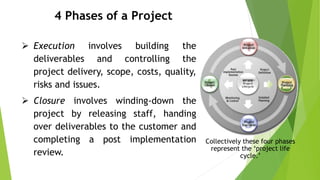
4 Phases of a Project
Collectively these four phases
represent the ‘project life
cycle.’
 Execution involves building the
deliverables and controlling the
project delivery, scope, costs, quality,
risks and issues.
 Closure involves winding-down the
project by releasing staff, handing
over deliverables to the customer and
completing a post implementation
review.
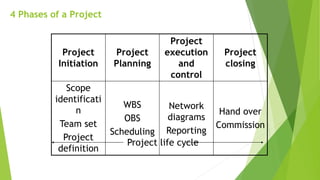
4 Phases of a Project
Project
Initiation
Project
Planning
Project
execution
and
control
Project
closing
Scope
identificati
n
Team set
Project
definition
WBS
OBS
Scheduling
Network
diagrams
Reporting
Hand over
Commission
Project life cycle
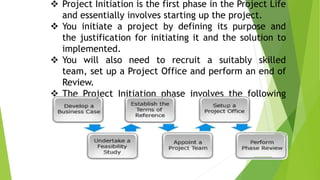
 Project Initiation is the first phase in the Project Life
and essentially involves starting up the project.
 You initiate a project by defining its purpose and
the justification for initiating it and the solution to
implemented.
 You will also need to recruit a suitably skilled
team, set up a Project Office and perform an end of
Review.
 The Project Initiation phase involves the following
steps:
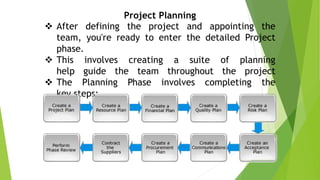
Project Planning
 After defining the project and appointing the
team, you're ready to enter the detailed Project
phase.
 This involves creating a suite of planning
help guide the team throughout the project
 The Planning Phase involves completing the
key steps:
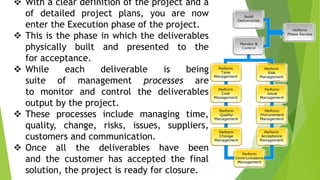
 With a clear definition of the project and a
of detailed project plans, you are now
enter the Execution phase of the project.
 This is the phase in which the deliverables
physically built and presented to the
for acceptance.
 While each deliverable is being
suite of management processes are
to monitor and control the deliverables
output by the project.
 These processes include managing time,
quality, change, risks, issues, suppliers,
customers and communication.
 Once all the deliverables have been
and the customer has accepted the final
solution, the project is ready for closure.
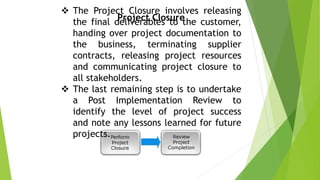
Project Closure
 The Project Closure involves releasing
the final deliverables to the customer,
handing over project documentation to
the business, terminating supplier
contracts, releasing project resources
and communicating project closure to
all stakeholders.
 The last remaining step is to undertake
a Post Implementation Review to
identify the level of project success
and note any lessons learned for future
projects.
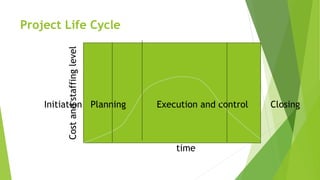
Project Life Cycle
Initiation Planning Execution and control Closing
time
Costandstaffinglevel
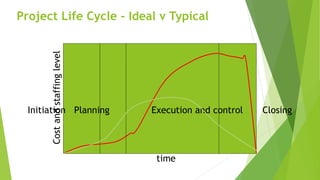
Project Life Cycle - Ideal v Typical
Initiation Planning Execution and control Closing
time
Costandstaffinglevel
Exercise
What does the chart tell you about
typical v ideal project life cycle?
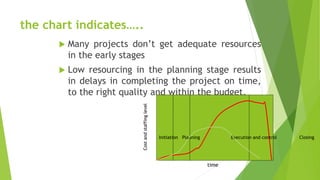
the chart indicates…..
 Many projects don’t get adequate resources
in the early stages
 Low resourcing in the planning stage results
in delays in completing the project on time,
to the right quality and within the budget.
Initiation Planning Execution and control Closing
time
Costandstaffinglevel
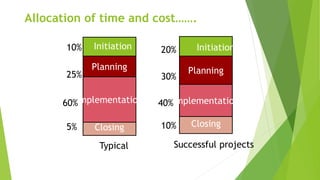
Allocation of time and cost…….
Closing
Implementation
Planning
Typical Successful projects
Initiation10%
25%
60%
5%
Initiation20%
30%
40%
10%
Planning
Implementation
Closing
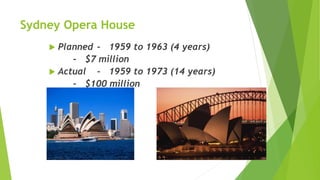
Sydney Opera House
 Good or bad project?
Sydney Opera House
 Planned - 1959 to 1963 (4 years)
- $7 million
 Actual - 1959 to 1973 (14 years)
- $100 million
Project Life Cycle (PLC) as a Tool
 PLC is a management tool to make it easier to
manage the project sequence
 The choice of phases vary from industry to
industry and the PLC will vary to suit the needs of
the participants
 Different project managers choose different PLC’s,
depending on the nature of the task i.e.
Engineering, software development etc.
Project Life Cycle (PLC) Uses
 To maintain an overview of the project
 To help identify tasks
 Break the project into manageable parts
 Integrate activities (bite sized chunks)
 To help with the timing of decisions
(go/no go)
 To guide the level of contingency needed
Common characteristics of PLCs
 Cost and staff levels low in early phases of the
project
 Probability of failure, risk and uncertainty are
highest in the early phases
 Ability of stakeholders to influence the outcome of
the project are highest at the beginning of the
project
 Although many projects have similar phase names,
with similar work requirements, few are identical
 Sub-projects within a project also have distinct
Project Stakeholders
 Project stakeholders are individuals and/ or
organisations who are actively involved in the
project and whose interests are directly affected by
the outcome of the project
Key stakeholders
 The project advocate or champion (promotes
the idea)
 The project sponsor (for funding)
 The project manager (for the execution)
 Customer or client (the user)
 The performing organisation (the team)
 Other categories of stakeholders can be
identified such as internal and external
clients, team members & families, suppliers,
contractors, government etc.
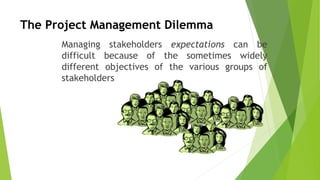
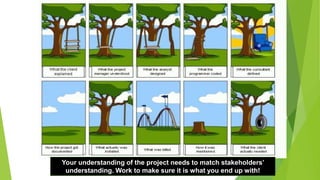
The Project Management Dilemma
Managing stakeholders expectations can be
difficult because of the sometimes widely
different objectives of the various groups of
stakeholders
Your understanding of the project needs to match stakeholders’
understanding. Work to make sure it is what you end up with!
In class ‘Test’
1. What is meant by the term ‘deliverable’?
2. What is meant by the term ‘stakeholder’?
3. List the 4 different phases of your FYP project life
cycle
4. List at least 3 benefits from using project life
cycle to manage projects

Lec 03 project life cycle

  • 1.
    Project Management  Project LifeCycle & phases By Qadir Nawaz Abbasi Mechanical Engineering Dept: MUET SZAB Campus Khairpur Mir’s April, 2018
  • 2.
    Project Life Cycle The Project management is about acquiring or achieving the project goal  Most projects need to be broken down into a logical sequence of ‘phases’, known as the project life cycle.
  • 3.
    Phases of aProject  Organisations normally break a project down into several project phases for better management control  Collectively, the project phases are known as the project life cycle  Each project phase is marked by the completion of one or more deliverables.
  • 4.
    Stage Gates  Eachphase ends with a review of the deliverables and performance in order to detect and correct errors and to decide if the project should continue into the next phase.  The phase end reviews are often called phase exits or stage gates.
  • 5.
    4 Phases ofa Project Collectively these four phases represent the ‘project life cycle.’  Initiation involves starting up the project, by documenting a business case, feasibility study, terms of reference, appointing the team and setting up a Project Office.  Planning involves setting out the roadmap for the project by creating the following plans: project plan, resource plan, financial plan, quality plan, acceptance plan and communications plan.
  • 6.
    4 Phases ofa Project Collectively these four phases represent the ‘project life cycle.’  Execution involves building the deliverables and controlling the project delivery, scope, costs, quality, risks and issues.  Closure involves winding-down the project by releasing staff, handing over deliverables to the customer and completing a post implementation review.
  • 7.
    4 Phases ofa Project Project Initiation Project Planning Project execution and control Project closing Scope identificati n Team set Project definition WBS OBS Scheduling Network diagrams Reporting Hand over Commission Project life cycle
  • 8.
     Project Initiationis the first phase in the Project Life and essentially involves starting up the project.  You initiate a project by defining its purpose and the justification for initiating it and the solution to implemented.  You will also need to recruit a suitably skilled team, set up a Project Office and perform an end of Review.  The Project Initiation phase involves the following steps:
  • 9.
    Project Planning  Afterdefining the project and appointing the team, you're ready to enter the detailed Project phase.  This involves creating a suite of planning help guide the team throughout the project  The Planning Phase involves completing the key steps:
  • 10.
     With aclear definition of the project and a of detailed project plans, you are now enter the Execution phase of the project.  This is the phase in which the deliverables physically built and presented to the for acceptance.  While each deliverable is being suite of management processes are to monitor and control the deliverables output by the project.  These processes include managing time, quality, change, risks, issues, suppliers, customers and communication.  Once all the deliverables have been and the customer has accepted the final solution, the project is ready for closure.
  • 11.
    Project Closure  TheProject Closure involves releasing the final deliverables to the customer, handing over project documentation to the business, terminating supplier contracts, releasing project resources and communicating project closure to all stakeholders.  The last remaining step is to undertake a Post Implementation Review to identify the level of project success and note any lessons learned for future projects.
  • 12.
    Project Life Cycle InitiationPlanning Execution and control Closing time Costandstaffinglevel
  • 13.
    Project Life Cycle- Ideal v Typical Initiation Planning Execution and control Closing time Costandstaffinglevel
  • 14.
    Exercise What does thechart tell you about typical v ideal project life cycle?
  • 15.
    the chart indicates….. Many projects don’t get adequate resources in the early stages  Low resourcing in the planning stage results in delays in completing the project on time, to the right quality and within the budget. Initiation Planning Execution and control Closing time Costandstaffinglevel
  • 16.
    Allocation of timeand cost……. Closing Implementation Planning Typical Successful projects Initiation10% 25% 60% 5% Initiation20% 30% 40% 10% Planning Implementation Closing
  • 17.
    Sydney Opera House Good or bad project?
  • 18.
    Sydney Opera House Planned - 1959 to 1963 (4 years) - $7 million  Actual - 1959 to 1973 (14 years) - $100 million
  • 19.
    Project Life Cycle(PLC) as a Tool  PLC is a management tool to make it easier to manage the project sequence  The choice of phases vary from industry to industry and the PLC will vary to suit the needs of the participants  Different project managers choose different PLC’s, depending on the nature of the task i.e. Engineering, software development etc.
  • 20.
    Project Life Cycle(PLC) Uses  To maintain an overview of the project  To help identify tasks  Break the project into manageable parts  Integrate activities (bite sized chunks)  To help with the timing of decisions (go/no go)  To guide the level of contingency needed
  • 21.
    Common characteristics ofPLCs  Cost and staff levels low in early phases of the project  Probability of failure, risk and uncertainty are highest in the early phases  Ability of stakeholders to influence the outcome of the project are highest at the beginning of the project  Although many projects have similar phase names, with similar work requirements, few are identical  Sub-projects within a project also have distinct
  • 22.
    Project Stakeholders  Projectstakeholders are individuals and/ or organisations who are actively involved in the project and whose interests are directly affected by the outcome of the project
  • 23.
    Key stakeholders  Theproject advocate or champion (promotes the idea)  The project sponsor (for funding)  The project manager (for the execution)  Customer or client (the user)  The performing organisation (the team)  Other categories of stakeholders can be identified such as internal and external clients, team members & families, suppliers, contractors, government etc.
  • 24.
    The Project ManagementDilemma Managing stakeholders expectations can be difficult because of the sometimes widely different objectives of the various groups of stakeholders
  • 25.
    Your understanding ofthe project needs to match stakeholders’ understanding. Work to make sure it is what you end up with!
  • 26.
    In class ‘Test’ 1.What is meant by the term ‘deliverable’? 2. What is meant by the term ‘stakeholder’? 3. List the 4 different phases of your FYP project life cycle 4. List at least 3 benefits from using project life cycle to manage projects