Module 7
Project Cost Management
Agus Suhanto
Module Overview
• Lesson 1: Key Concepts & Terms
• Lesson 2: Plan Cost Management
• Lesson 3: Estimate Costs
• Lesson 4: Determine Budget
• Lesson 7: Control Costs
Lesson 1: Key Concepts & Terms
• Project Cost Management
• Project Cost Management Processes
• Key Terms
• Trends & Emerging Practices
• Tailoring Considerations
• Considerations for Adaptive Environment
Project Cost Management
Project cost management is the processes
involved in planning, estimating, budgeting,
financing, funding, managing, and controlling costs
so that the project can be completed within the
approved budget.
Project Cost Management Processes
• Plan Cost Management
• Estimate Costs
• Determine Budget
• Control Costs
Key Terms
• Earned value management (EVM): a project
management technique for measuring project
performance and progress based on the comparison of
work performed and work planned.
• Life cycle costing: the concept of looking at cost over the
entire life of the product, not just the cost of the project to
create the product.
• Value analysis (value engineering): the concept that
focuses on finding a less costly way to do the same work.
• Cost risk: cost-related risks.
Key Terms (continued)
• Types of costs:
• Variable costs: costs that change with the amount of work.
• Fixed costs: costs that do not change with the amount of work.
• Direct costs: costs directly attributable to the work on the project
• Indirect costs: overhead items or costs incurred for the benefit of
more than one projects.
• Cost estimate ranges:
• Rough order of magnitude (ROM): used during project initiating;
typical range -25 to +75 percent.
• Budget estimate: when starting the plan iteration; typical range -10
to +25 percent.
• Definitive estimate: as progress planning progresses; typical range
± 10 percent or -5 to +10 percent.
Trends & Emerging Practices
• Expansion of EVM to include the concept of
earned schedule (ES)
Tailoring Considerations
• Knowledge management
• Estimating and budgeting
• Earned value management
• Use of agile approach
• Governance
Considerations for Adaptive Environments
• Agile practice uses lightweight estimation
methods to generate high-level forecast for
project costs.
• Detailed estimates are reserved for short-term
planning horizons in a just-in-time fashion.
• In a strict-budget projects, the scope and schedule
are more often adjusted to stay within the cost
constraints.
Lesson 2: Plan Cost Management
• Plan Cost Management Overview
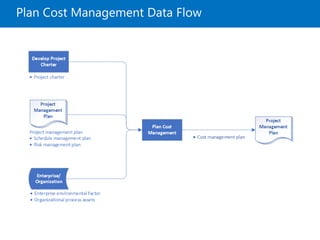
• Plan Cost Management Data Flow
• Plan Cost Management Input
• Plan Cost Management Tools & Technique
• Plan Cost Management Output
Plan Cost Management Overview
• Plan cost management is the process of defining
how the project costs will be estimated, budgeted,
managed, and controlled.

• The key benefit: it provides guidance and direction
on ho the project costs will be managed
throughout the project.
Plan Cost Management Data Flow
Plan Cost Management Input
• Project charter
• Project management plan
• Schedule management plan
• Risk management plan
• Enterprise environmental factors
• Organizational process assets
Plan Cost Management Tools & Techniques
• Expert judgment
• Data analysis
• Alternative analysis
• Meetings
Plan Cost Management Output
• Project management plan
• Cost management plan
• Units of measure
• Level of precision
• Level of accuracy
• Organizational procedure links
• Control thresholds
• Rules of performance measurements
• Reporting formats
• Additional details
Lesson 3: Estimate Costs
• Estimate Costs Overview
• Estimate Costs Data Flow
• Estimate Costs Input
• Estimate Costs Tools & Techniques
• Estimate Costs Output
Estimate Costs Overview
• Estimate costs is the process of developing an
approximation of cost of resources needed to
complete project work.
• Key benefit: it determines the monetary resources
required for the project.
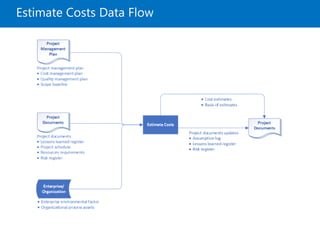
Estimate Costs Data Flow
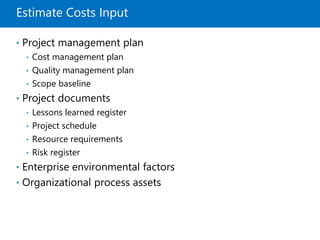
Estimate Costs Input
• Project management plan
• Cost management plan
• Quality management plan
• Scope baseline
• Project documents
• Lessons learned register
• Project schedule
• Resource requirements
• Risk register
• Enterprise environmental factors
• Organizational process assets
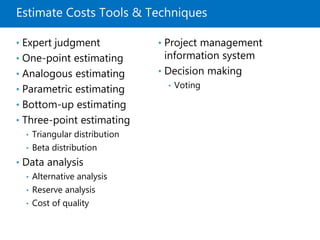
Estimate Costs Tools & Techniques
• Expert judgment
• One-point estimating
• Analogous estimating
• Parametric estimating
• Bottom-up estimating
• Three-point estimating
• Triangular distribution
• Beta distribution
• Data analysis
• Alternative analysis
• Reserve analysis
• Cost of quality
• Project management
information system
• Decision making
• Voting
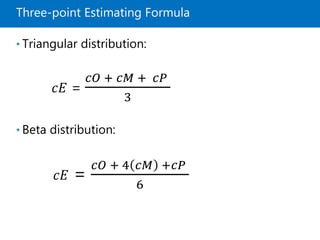
Three-point Estimating Formula
• Triangular distribution:
𝑐𝐸 =
𝑐𝑂 + 𝑐𝑀 + 𝑐𝑃
3
• Beta distribution:
𝑐𝐸 =
𝑐𝑂 + 4 𝑐𝑀 +𝑐𝑃
6
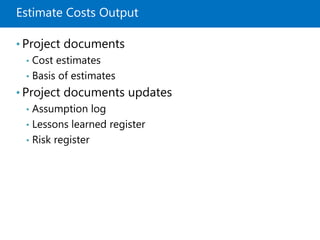
Estimate Costs Output
• Project documents
• Cost estimates
• Basis of estimates
• Project documents updates
• Assumption log
• Lessons learned register
• Risk register
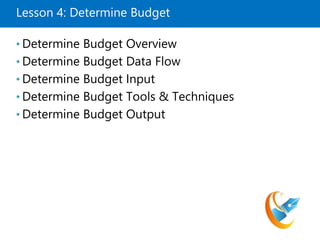
Lesson 4: Determine Budget
• Determine Budget Overview
• Determine Budget Data Flow
• Determine Budget Input
• Determine Budget Tools & Techniques
• Determine Budget Output
Determine Budget Overview
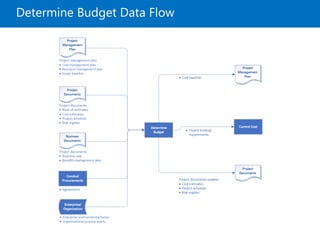
• Determine budget is the process of aggregating
the estimated costs of individual activities or work
packages to establish an authorized cost baseline.
• Key benefit: it determines the cost baseline
against which project performance can be
monitored or controlled.
Determine Budget Data Flow
Determine Budget Input
• Project management plan
• Cost management plan
• Resource management plan
• Scope baseline
• Projects documents
• Basis of estimates
• Cost estimates
• Project schedule
• Risk register
• Business documents
• Business case
• Benefits management plan
• Agreements
• Enterprise environmental
factors
• Organizational process
assets
Determine Budget Tools & Techniques
• Expert judgment
• Cost aggregation
• Data analysis
• Reserve analysis
• Historical information
review
• Funding limit
reconciliation
• Financing
Determine Budget Output
• Project management plan
• Cost baseline
• Project funding
requirements
• Project documents updates
• Cost estimates
• Project schedules
• Risk register
Lesson 7: Control Cost
• Control Cost Overview
• Control Cost Data Flow
• Control Cost Input
• Control Cost Tools & Techniques
• Control Cost Output
Control Cost Overview
• Control cost is the process of monitoring the
status of the project to update the project costs
and managing changes to the cost baseline.
• Key benefit: the cost baseline is maintained
throughout the project.
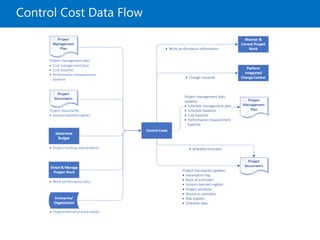
Control Cost Data Flow
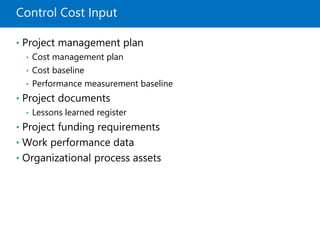
Control Cost Input
• Project management plan
• Cost management plan
• Cost baseline
• Performance measurement baseline
• Project documents
• Lessons learned register
• Project funding requirements
• Work performance data
• Organizational process assets
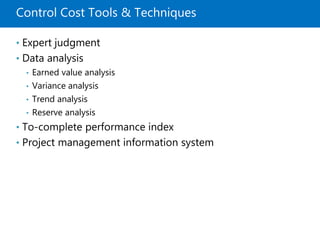
Control Cost Tools & Techniques
• Expert judgment
• Data analysis
• Earned value analysis
• Variance analysis
• Trend analysis
• Reserve analysis
• To-complete performance index
• Project management information system
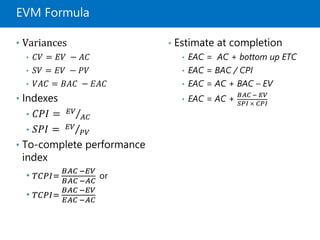
EVM Formula
• Variances
• 𝐶𝑉 = 𝐸𝑉 − 𝐴𝐶
• 𝑆𝑉 = 𝐸𝑉 − 𝑃𝑉
• 𝑉𝐴𝐶 = 𝐵𝐴𝐶 − 𝐸𝐴𝐶
• Indexes
• 𝐶𝑃𝐼 = 𝐸𝑉
𝐴𝐶
• 𝑆𝑃𝐼 = 𝐸𝑉
𝑃𝑉
• To-complete performance
index
• 𝑇𝐶𝑃𝐼=
𝐵𝐴𝐶 −𝐸𝑉
𝐵𝐴𝐶 −𝐴𝐶
or
• 𝑇𝐶𝑃𝐼=
𝐵𝐴𝐶 −𝐸𝑉
𝐸𝐴𝐶 −𝐴𝐶
• Estimate at completion
• EAC = AC + bottom up ETC
• EAC = BAC / CPI
• EAC = AC + BAC – EV
• EAC = AC +
𝐵𝐴𝐶 − 𝐸𝑉
𝑆𝑃𝐼 × 𝐶𝑃𝐼
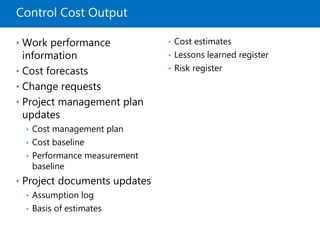
Control Cost Output
• Work performance
information
• Cost forecasts
• Change requests
• Project management plan
updates
• Cost management plan
• Cost baseline
• Performance measurement
baseline
• Project documents updates
• Assumption log
• Basis of estimates
• Cost estimates
• Lessons learned register
• Risk register
Quiz
Module Reviews
References
• [PMBOK6] – The PMBOK 6th edition from pmi.org
• [RITA9] – Rita Mulcahy’s PMP Exam Prep 9th
edition from RMC Publications™

Project Cost Management - PMBOK6

  • 1.
    Module 7 Project CostManagement Agus Suhanto
  • 2.
    Module Overview • Lesson1: Key Concepts & Terms • Lesson 2: Plan Cost Management • Lesson 3: Estimate Costs • Lesson 4: Determine Budget • Lesson 7: Control Costs
  • 3.
    Lesson 1: KeyConcepts & Terms • Project Cost Management • Project Cost Management Processes • Key Terms • Trends & Emerging Practices • Tailoring Considerations • Considerations for Adaptive Environment
  • 4.
    Project Cost Management Projectcost management is the processes involved in planning, estimating, budgeting, financing, funding, managing, and controlling costs so that the project can be completed within the approved budget.
  • 5.
    Project Cost ManagementProcesses • Plan Cost Management • Estimate Costs • Determine Budget • Control Costs
  • 6.
    Key Terms • Earnedvalue management (EVM): a project management technique for measuring project performance and progress based on the comparison of work performed and work planned. • Life cycle costing: the concept of looking at cost over the entire life of the product, not just the cost of the project to create the product. • Value analysis (value engineering): the concept that focuses on finding a less costly way to do the same work. • Cost risk: cost-related risks.
  • 7.
    Key Terms (continued) •Types of costs: • Variable costs: costs that change with the amount of work. • Fixed costs: costs that do not change with the amount of work. • Direct costs: costs directly attributable to the work on the project • Indirect costs: overhead items or costs incurred for the benefit of more than one projects. • Cost estimate ranges: • Rough order of magnitude (ROM): used during project initiating; typical range -25 to +75 percent. • Budget estimate: when starting the plan iteration; typical range -10 to +25 percent. • Definitive estimate: as progress planning progresses; typical range ± 10 percent or -5 to +10 percent.
  • 8.
    Trends & EmergingPractices • Expansion of EVM to include the concept of earned schedule (ES)
  • 9.
    Tailoring Considerations • Knowledgemanagement • Estimating and budgeting • Earned value management • Use of agile approach • Governance
  • 10.
    Considerations for AdaptiveEnvironments • Agile practice uses lightweight estimation methods to generate high-level forecast for project costs. • Detailed estimates are reserved for short-term planning horizons in a just-in-time fashion. • In a strict-budget projects, the scope and schedule are more often adjusted to stay within the cost constraints.
  • 11.
    Lesson 2: PlanCost Management • Plan Cost Management Overview • Plan Cost Management Data Flow • Plan Cost Management Input • Plan Cost Management Tools & Technique • Plan Cost Management Output
  • 12.
    Plan Cost ManagementOverview • Plan cost management is the process of defining how the project costs will be estimated, budgeted, managed, and controlled. • The key benefit: it provides guidance and direction on ho the project costs will be managed throughout the project.
  • 13.
  • 14.
    Plan Cost ManagementInput • Project charter • Project management plan • Schedule management plan • Risk management plan • Enterprise environmental factors • Organizational process assets
  • 15.
    Plan Cost ManagementTools & Techniques • Expert judgment • Data analysis • Alternative analysis • Meetings
  • 16.
    Plan Cost ManagementOutput • Project management plan • Cost management plan • Units of measure • Level of precision • Level of accuracy • Organizational procedure links • Control thresholds • Rules of performance measurements • Reporting formats • Additional details
  • 17.
    Lesson 3: EstimateCosts • Estimate Costs Overview • Estimate Costs Data Flow • Estimate Costs Input • Estimate Costs Tools & Techniques • Estimate Costs Output
  • 18.
    Estimate Costs Overview •Estimate costs is the process of developing an approximation of cost of resources needed to complete project work. • Key benefit: it determines the monetary resources required for the project.
  • 19.
  • 20.
    Estimate Costs Input •Project management plan • Cost management plan • Quality management plan • Scope baseline • Project documents • Lessons learned register • Project schedule • Resource requirements • Risk register • Enterprise environmental factors • Organizational process assets
  • 21.
    Estimate Costs Tools& Techniques • Expert judgment • One-point estimating • Analogous estimating • Parametric estimating • Bottom-up estimating • Three-point estimating • Triangular distribution • Beta distribution • Data analysis • Alternative analysis • Reserve analysis • Cost of quality • Project management information system • Decision making • Voting
  • 22.
    Three-point Estimating Formula •Triangular distribution: 𝑐𝐸 = 𝑐𝑂 + 𝑐𝑀 + 𝑐𝑃 3 • Beta distribution: 𝑐𝐸 = 𝑐𝑂 + 4 𝑐𝑀 +𝑐𝑃 6
  • 23.
    Estimate Costs Output •Project documents • Cost estimates • Basis of estimates • Project documents updates • Assumption log • Lessons learned register • Risk register
  • 24.
    Lesson 4: DetermineBudget • Determine Budget Overview • Determine Budget Data Flow • Determine Budget Input • Determine Budget Tools & Techniques • Determine Budget Output
  • 25.
    Determine Budget Overview •Determine budget is the process of aggregating the estimated costs of individual activities or work packages to establish an authorized cost baseline. • Key benefit: it determines the cost baseline against which project performance can be monitored or controlled.
  • 26.
  • 27.
    Determine Budget Input •Project management plan • Cost management plan • Resource management plan • Scope baseline • Projects documents • Basis of estimates • Cost estimates • Project schedule • Risk register • Business documents • Business case • Benefits management plan • Agreements • Enterprise environmental factors • Organizational process assets
  • 28.
    Determine Budget Tools& Techniques • Expert judgment • Cost aggregation • Data analysis • Reserve analysis • Historical information review • Funding limit reconciliation • Financing
  • 29.
    Determine Budget Output •Project management plan • Cost baseline • Project funding requirements • Project documents updates • Cost estimates • Project schedules • Risk register
  • 30.
    Lesson 7: ControlCost • Control Cost Overview • Control Cost Data Flow • Control Cost Input • Control Cost Tools & Techniques • Control Cost Output
  • 31.
    Control Cost Overview •Control cost is the process of monitoring the status of the project to update the project costs and managing changes to the cost baseline. • Key benefit: the cost baseline is maintained throughout the project.
  • 32.
  • 33.
    Control Cost Input •Project management plan • Cost management plan • Cost baseline • Performance measurement baseline • Project documents • Lessons learned register • Project funding requirements • Work performance data • Organizational process assets
  • 34.
    Control Cost Tools& Techniques • Expert judgment • Data analysis • Earned value analysis • Variance analysis • Trend analysis • Reserve analysis • To-complete performance index • Project management information system
  • 35.
    EVM Formula • Variances •𝐶𝑉 = 𝐸𝑉 − 𝐴𝐶 • 𝑆𝑉 = 𝐸𝑉 − 𝑃𝑉 • 𝑉𝐴𝐶 = 𝐵𝐴𝐶 − 𝐸𝐴𝐶 • Indexes • 𝐶𝑃𝐼 = 𝐸𝑉 𝐴𝐶 • 𝑆𝑃𝐼 = 𝐸𝑉 𝑃𝑉 • To-complete performance index • 𝑇𝐶𝑃𝐼= 𝐵𝐴𝐶 −𝐸𝑉 𝐵𝐴𝐶 −𝐴𝐶 or • 𝑇𝐶𝑃𝐼= 𝐵𝐴𝐶 −𝐸𝑉 𝐸𝐴𝐶 −𝐴𝐶 • Estimate at completion • EAC = AC + bottom up ETC • EAC = BAC / CPI • EAC = AC + BAC – EV • EAC = AC + 𝐵𝐴𝐶 − 𝐸𝑉 𝑆𝑃𝐼 × 𝐶𝑃𝐼
  • 36.
    Control Cost Output •Work performance information • Cost forecasts • Change requests • Project management plan updates • Cost management plan • Cost baseline • Performance measurement baseline • Project documents updates • Assumption log • Basis of estimates • Cost estimates • Lessons learned register • Risk register
  • 37.
  • 38.
  • 39.
    References • [PMBOK6] –The PMBOK 6th edition from pmi.org • [RITA9] – Rita Mulcahy’s PMP Exam Prep 9th edition from RMC Publications™

Editor's Notes

  • #2 Presentation: 80 minutes Lab: 90 minutes After completing this module, students will be able to: Describe the architectural features of Microsoft SharePoint 2016. Identify new, deprecated, and removed features in SharePoint 2016. Describe the editions for SharePoint 2016 on-premises and Microsoft SharePoint Online. Required materials To teach this module, you need the Microsoft PowerPoint file 20339-2A_01.pptx. Preparation tasks To prepare for this module: Read all of the materials for this module. Practice performing the demonstrations and labs. Work through the Module Review and Takeaways section, and determine how you will use the information to reinforce student learning and promote knowledge transfer to on-the-job performance. As you prepare for this class, it is imperative that you complete the labs yourself. This gives you an understanding of how the labs work and the concepts that each covers, so that you can provide meaningful hints to students who might have issues. Furthermore, it will help guide your lecture to ensure that you discuss the concepts that the labs cover. Ask the students to start 20339-2A-NYC-DC1-A at this point, as per step 1 of the Lab.