Time-Cost Trade offs
FPE 444: ENGINEERING
PROJECT MANAGEMENT
LECTURE EIGHT
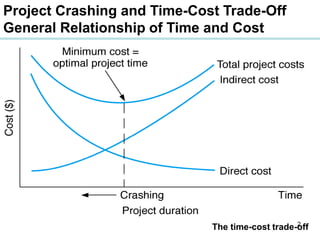
Project Crashing and Time-Cost Trade-Off
General Relationship of Time and Cost
The time-cost trade-off
2
Project Crashing and Time-Cost Trade-Off
General Relationship of Time and Cost
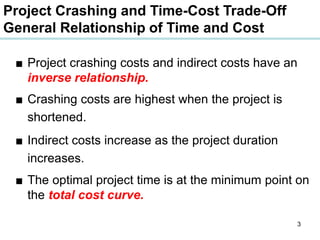
■ Project crashing costs and indirect costs have an
inverse relationship.
■ Crashing costs are highest when the project is
shortened.
■ Indirect costs increase as the project duration
increases.
■ The optimal project time is at the minimum point on
the total cost curve.
3
The main purpose of this lecture is to
demonstrate a procedure to determine activity
schedules to reduce the project duration time
with a minimum increase in the project
direct costs, by buying time along the
critical path (s) where it can be obtained at
least cost.
Purpose of Time Reduction Technique
Assumption: It is assumed in all of the procedures that are presented in
this topic that unlimited resources are available.
 The results of planning and scheduling stages of
the critical path method provide a network plan for
the activities making up the project and a set of
earliest and latest start and finish times for each
activity.
 In particular, the earliest occurrence time for the
network terminal event is the estimated “normal”
project duration time, based on “normal” activity
time estimates.
Time-Cost Trade-off
 To meet the customer contractually required time.
 To recover time of delays, that occur in the early stages
of the project, to avoid paying liquated damages, or
avoid damaging the company relationship with the
customer.
 To complete a project earlier than schedule in order to
free resources used and move on to another project.
 To avoid adverse weather.
 To receive an early-completion bonus.
 To meet a client’s desire for expediting the project.
Why Project Time Reduction
Buy Time
 Have the existing crew work overtime.
 Bring in additional workers (resources) up to
practical limit.
 Work on multiple shifts.
 Achieve more output by offering incentive
payments.
 Use better/more advanced equipment(s).
 Use more quickly installed materials.
 Use subcontractors.
 Change construction method.
How to Shorten Project Time
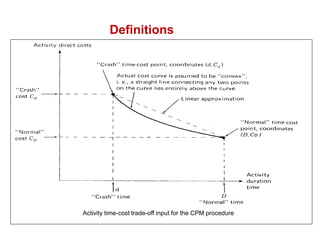
Definitions
Activity time-cost trade-off input for the CPM procedure
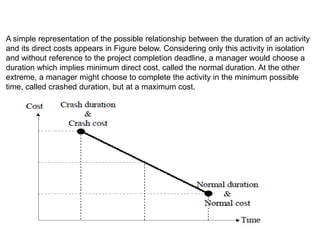
A simple representation of the possible relationship between the duration of an activity
and its direct costs appears in Figure below. Considering only this activity in isolation
and without reference to the project completion deadline, a manager would choose a
duration which implies minimum direct cost, called the normal duration. At the other
extreme, a manager might choose to complete the activity in the minimum possible
time, called crashed duration, but at a maximum cost.
The linear relationship shown above between these two points
implies that any intermediate duration could also be chosen. It
is possible that some intermediate point may represent the
ideal or optimal trade-off between time and cost for this activity.
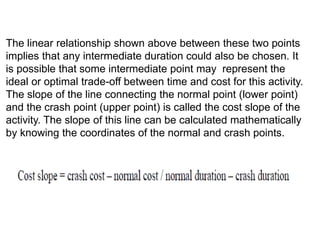
The slope of the line connecting the normal point (lower point)
and the crash point (upper point) is called the cost slope of the
activity. The slope of this line can be calculated mathematically
by knowing the coordinates of the normal and crash points.
1. Activity Direct Cost: It includes the cost of the
material, equipment, and direct labor required
to perform the activity in question. If the activity
is entirely performed by a subcontractor, then
the activity direct cost is equal to the price of
the subcontract, plus any added fees.
2. Project indirect cost: It includes, supervision
and other overhead costs, interest charges on
project investment, penalty costs due to poor
quality or delayed projects.
Definitions
3. Normal Activity Time: It is the normal time
that is used in the basic critical path planning
and scheduling based on the normal
level of resource.
4. Normal Activity Cost: The normal activity
cost is equal to the minimum of direct costs
required to perform the activity, and the
corresponding activity duration is called
the normal time.
Definitions
5. Crash Activity Time: Minimum
activity duration time that is technically
possible.
6. Crash Cost: is assumed to be the
minimum direct cost required to
achieve the crash performance time.
Definitions
 The relationship between the activity
direct cost and activity time may be
straight line, continuous curve, or point.
 The direct cost tends to increase if
less time is available for activity.
 Time reduction approach assumed here
will be based on simple linear time-
cost trade-off for each activity.
Activity Direct Cost / Time Relationship
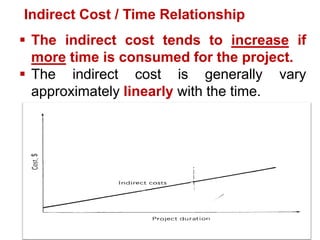
 The indirect cost tends to increase if
more time is consumed for the project.
 The indirect cost is generally vary
approximately linearly with the time.
Indirect Cost / Time Relationship
Total project costs include both direct costs and
indirect costs of performing the activities of the project.
Direct costs for the project include the costs of
materials, labor, equipment, and subcontractors.
Indirect costs, on the other hand, are the necessary
costs of doing work which can not be related to a
particular activity, and in some cases can not be
related to a specific project.
If each activity was scheduled for the duration that
resulted in the minimum direct cost in this way, the
time to complete the entire project might be too long
and substantial penalties associated with the late
project completion might be incurred.
Optimum Contract Duration
Optimum contract duration = project
schedule for minimum total cost
Thus, planners perform what is called time-cost trade-
off analysis to shorten the project duration. This
can be done by selecting some activities on the critical
path to shorten their duration.
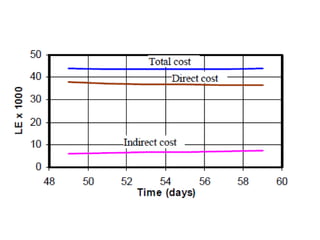
As the direct cost for the project equals the sum of the
direct costs of its activities, then the project direct cost
will increase by decreasing its duration.
On the other hand, the indirect cost will decrease by
decreasing the project duration, as the indirect cost
are almost a linear function with the project duration.
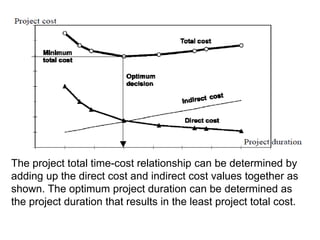
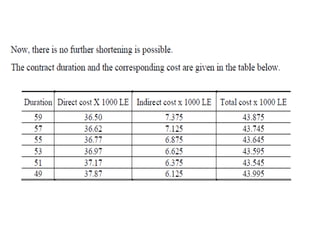
The project total time-cost relationship can be determined by
adding up the direct cost and indirect cost values together as
shown. The optimum project duration can be determined as
the project duration that results in the least project total cost.
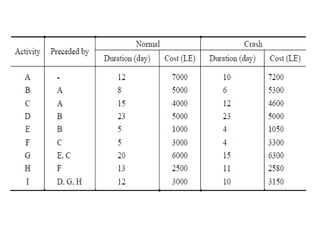
Example
The durations and direct costs for each activity
in the network of a small construction contract
under both normal and crash conditions are
given in the following table.
a) Establish the least cost for expediting the
contract.
b) Determine the optimum duration of the
contract assuming the indirect cost is 125€
/day.
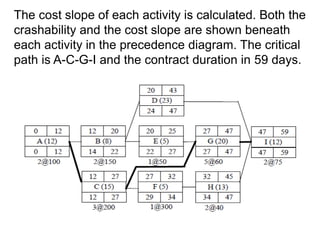
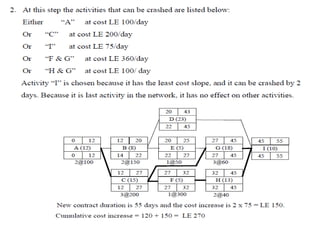
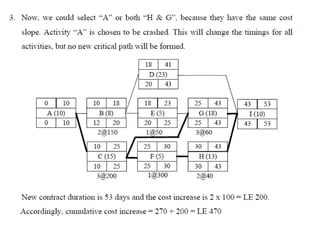
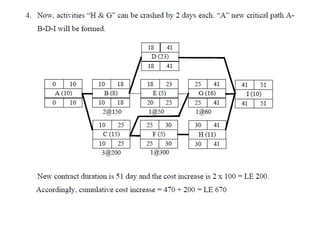
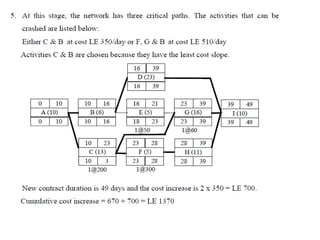
The cost slope of each activity is calculated. Both the
crashability and the cost slope are shown beneath
each activity in the precedence diagram. The critical
path is A-C-G-I and the contract duration in 59 days.
 time cost trade off
 time cost trade off
 time cost trade off
 time cost trade off
 time cost trade off
 time cost trade off
 time cost trade off
 time cost trade off

time cost trade off

  • 1.
    Time-Cost Trade offs FPE444: ENGINEERING PROJECT MANAGEMENT LECTURE EIGHT
  • 2.
    Project Crashing andTime-Cost Trade-Off General Relationship of Time and Cost The time-cost trade-off 2
  • 3.
    Project Crashing andTime-Cost Trade-Off General Relationship of Time and Cost ■ Project crashing costs and indirect costs have an inverse relationship. ■ Crashing costs are highest when the project is shortened. ■ Indirect costs increase as the project duration increases. ■ The optimal project time is at the minimum point on the total cost curve. 3
  • 4.
    The main purposeof this lecture is to demonstrate a procedure to determine activity schedules to reduce the project duration time with a minimum increase in the project direct costs, by buying time along the critical path (s) where it can be obtained at least cost. Purpose of Time Reduction Technique Assumption: It is assumed in all of the procedures that are presented in this topic that unlimited resources are available.
  • 5.
     The resultsof planning and scheduling stages of the critical path method provide a network plan for the activities making up the project and a set of earliest and latest start and finish times for each activity.  In particular, the earliest occurrence time for the network terminal event is the estimated “normal” project duration time, based on “normal” activity time estimates. Time-Cost Trade-off
  • 6.
     To meetthe customer contractually required time.  To recover time of delays, that occur in the early stages of the project, to avoid paying liquated damages, or avoid damaging the company relationship with the customer.  To complete a project earlier than schedule in order to free resources used and move on to another project.  To avoid adverse weather.  To receive an early-completion bonus.  To meet a client’s desire for expediting the project. Why Project Time Reduction
  • 7.
    Buy Time  Havethe existing crew work overtime.  Bring in additional workers (resources) up to practical limit.  Work on multiple shifts.  Achieve more output by offering incentive payments.  Use better/more advanced equipment(s).  Use more quickly installed materials.  Use subcontractors.  Change construction method. How to Shorten Project Time
  • 8.
    Definitions Activity time-cost trade-offinput for the CPM procedure
  • 9.
    A simple representationof the possible relationship between the duration of an activity and its direct costs appears in Figure below. Considering only this activity in isolation and without reference to the project completion deadline, a manager would choose a duration which implies minimum direct cost, called the normal duration. At the other extreme, a manager might choose to complete the activity in the minimum possible time, called crashed duration, but at a maximum cost.
  • 10.
    The linear relationshipshown above between these two points implies that any intermediate duration could also be chosen. It is possible that some intermediate point may represent the ideal or optimal trade-off between time and cost for this activity. The slope of the line connecting the normal point (lower point) and the crash point (upper point) is called the cost slope of the activity. The slope of this line can be calculated mathematically by knowing the coordinates of the normal and crash points.
  • 11.
    1. Activity DirectCost: It includes the cost of the material, equipment, and direct labor required to perform the activity in question. If the activity is entirely performed by a subcontractor, then the activity direct cost is equal to the price of the subcontract, plus any added fees. 2. Project indirect cost: It includes, supervision and other overhead costs, interest charges on project investment, penalty costs due to poor quality or delayed projects. Definitions
  • 12.
    3. Normal ActivityTime: It is the normal time that is used in the basic critical path planning and scheduling based on the normal level of resource. 4. Normal Activity Cost: The normal activity cost is equal to the minimum of direct costs required to perform the activity, and the corresponding activity duration is called the normal time. Definitions
  • 13.
    5. Crash ActivityTime: Minimum activity duration time that is technically possible. 6. Crash Cost: is assumed to be the minimum direct cost required to achieve the crash performance time. Definitions
  • 14.
     The relationshipbetween the activity direct cost and activity time may be straight line, continuous curve, or point.  The direct cost tends to increase if less time is available for activity.  Time reduction approach assumed here will be based on simple linear time- cost trade-off for each activity. Activity Direct Cost / Time Relationship
  • 15.
     The indirectcost tends to increase if more time is consumed for the project.  The indirect cost is generally vary approximately linearly with the time. Indirect Cost / Time Relationship
  • 16.
    Total project costsinclude both direct costs and indirect costs of performing the activities of the project. Direct costs for the project include the costs of materials, labor, equipment, and subcontractors. Indirect costs, on the other hand, are the necessary costs of doing work which can not be related to a particular activity, and in some cases can not be related to a specific project. If each activity was scheduled for the duration that resulted in the minimum direct cost in this way, the time to complete the entire project might be too long and substantial penalties associated with the late project completion might be incurred.
  • 17.
    Optimum Contract Duration Optimumcontract duration = project schedule for minimum total cost
  • 18.
    Thus, planners performwhat is called time-cost trade- off analysis to shorten the project duration. This can be done by selecting some activities on the critical path to shorten their duration. As the direct cost for the project equals the sum of the direct costs of its activities, then the project direct cost will increase by decreasing its duration. On the other hand, the indirect cost will decrease by decreasing the project duration, as the indirect cost are almost a linear function with the project duration.
  • 19.
    The project totaltime-cost relationship can be determined by adding up the direct cost and indirect cost values together as shown. The optimum project duration can be determined as the project duration that results in the least project total cost.
  • 20.
    Example The durations anddirect costs for each activity in the network of a small construction contract under both normal and crash conditions are given in the following table. a) Establish the least cost for expediting the contract. b) Determine the optimum duration of the contract assuming the indirect cost is 125€ /day.
  • 22.
    The cost slopeof each activity is calculated. Both the crashability and the cost slope are shown beneath each activity in the precedence diagram. The critical path is A-C-G-I and the contract duration in 59 days.