Earned Value Back to Basics
Stephen Jones 
SPER Programme Lead 
Chairman of APM PMC SIG 
Simon Taylor 
Head of Planning 
Introductions
What is Earned Value? 
Earned Value Management 
–Establishing and managing goals throughout the life of a project 
–Provides indication of Project efficiency 
Three pieces of Information 
–Earned Value 
–Actual Cost 
–Planned Value
Earned Value 
Budget Cost of Work Performed (BCWP) 
The value of the work actually done at a given point in time 
How do you decided on the Value of work done? 
It’s the portion of the budget which should have been spent to achieve the work done.
Actual Cost 
The Actual Cost of Work Performed(ACWP) is the cost of the work done. 
It is the amount reported as actually expended in completing the work accomplished within a given time period
Planned Value 
Budgeted Cost of Work Scheduled (BCWS) 
It is the value of the work that should have been done at a given point in time. 
It indicates the budget at a given point.
Example 
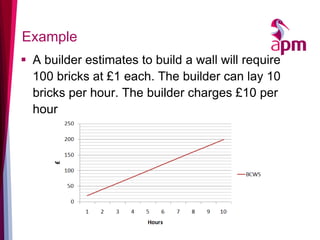
A builder estimates to build a wall will require 100 bricks at £1 each. The builder can lay 10 bricks per hour. The builder charges £10 per hour
Example 
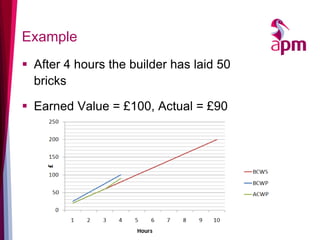
After 4 hours the builder has laid 50 bricks 
Earned Value = £100, Actual = £90
Schedule Performance Index 
SPI measures progress against the plan. 
Greater than 1.0 is good (ahead of plan) 
Less than 1.0 is bad (behind plan) 
Equals 1.0 when we are on plan 
SPI = BCWP / BCWS 
Schedule Variance = BCWP – BCWS
Example 
In our example 
Earned Value (BCWP) = £100 
Planned value (BCWS) = £80 
SPI = BCWP / BCWS 
SPI = 1.25 
The builder is ahead of schedule 
SV = 100 – 80 = +20
Cost Performance Index 
CPI is a ratio of the value of work to actual cost incurred. 
Greater than 1.0 is good (under budget) 
Less than 1.0 is bad (over budget) 
Equals 1.0 when we are on budget 
CPI = BCWP / ACWP 
Cost Variance = BCWP – ACWP
Example 
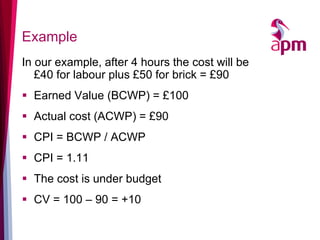
In our example, after 4 hours the cost will be £40 for labour plus £50 for brick = £90 
Earned Value (BCWP) = £100 
Actual cost (ACWP) = £90 
CPI = BCWP / ACWP 
CPI = 1.11 
The cost is under budget 
CV = 100 – 90 = +10
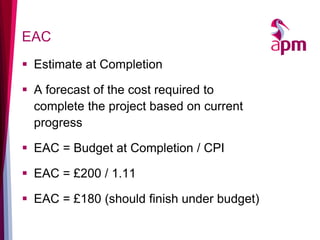
EAC 
Estimate at Completion 
A forecast of the cost required to complete the project based on current progress 
EAC = Budget at Completion / CPI 
EAC = £200 / 1.11 
EAC = £180 (should finish under budget)
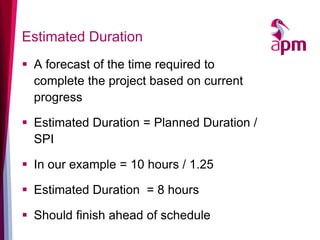
Estimated Duration 
A forecast of the time required to complete the project based on current progress 
Estimated Duration = Planned Duration / SPI 
In our example = 10 hours / 1.25 
Estimated Duration = 8 hours 
Should finish ahead of schedule
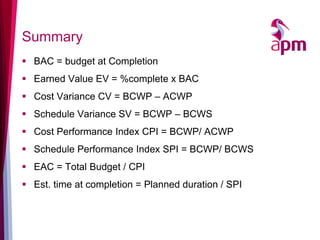
Summary 
BAC = budget at Completion 
Earned Value EV = %complete x BAC 
Cost Variance CV = BCWP – ACWP 
Schedule Variance SV = BCWP – BCWS 
Cost Performance Index CPI = BCWP/ ACWP 
Schedule Performance Index SPI = BCWP/ BCWS 
EAC = Total Budget / CPI 
Est. time at completion = Planned duration / SPI
Benefits of Earned Value Analysis 
Measures work done against expenditure 
Control is achieved by calculating variances 
Positive: good, negative: Bad 
Indices give a summary of project health 
>1.0: good, < 1.0: bad 
Generates forecast to completion based on current trends 
SPI and CPI can be used as a measure of efficiency
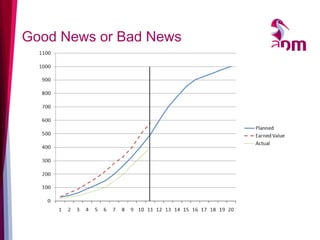
Good News or Bad News
Good News or Bad News 
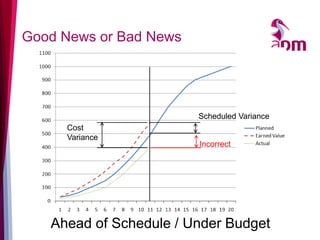
Ahead of Schedule / Under Budget 
Scheduled Variance 
Cost Variance 
Incorrect
Good News or Bad News
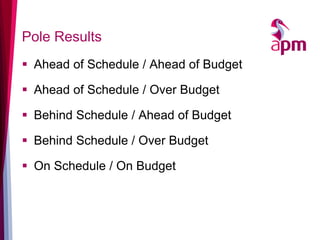
Pole Results 
Ahead of Schedule / Ahead of Budget 
Ahead of Schedule / Over Budget 
Behind Schedule / Ahead of Budget 
Behind Schedule / Over Budget 
On Schedule / On Budget
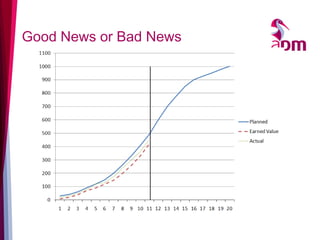
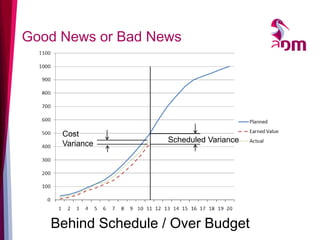
Good News or Bad News 
Behind Schedule / Over Budget 
Scheduled Variance 
Cost Variance
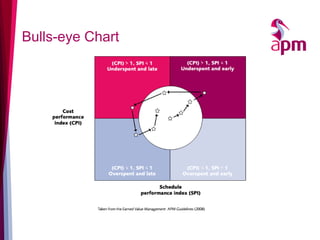
Bulls-eye Chart
EVM in projects
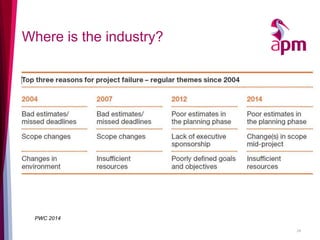
Where is the industry? 
24 
PWC 2014
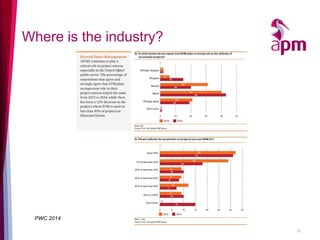
Where is the industry? 
25 
PWC 2014
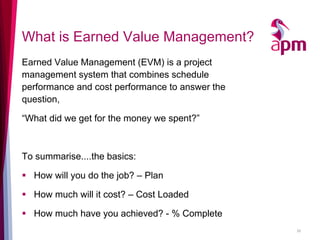
What is Earned Value Management? 
Earned Value Management (EVM) is a project management system that combines schedule performance and cost performance to answer the question, 
“What did we get for the money we spent?” 
To summarise....the basics: 
How will you do the job? – Plan 
How much will it cost? – Cost Loaded 
How much have you achieved? - % Complete 
26
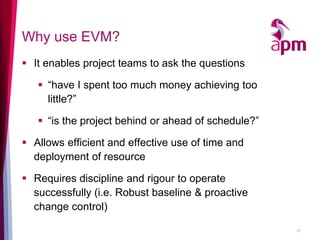
Why use EVM? 
It enables project teams to ask the questions 
“have I spent too much money achieving too little?” 
“is the project behind or ahead of schedule?” 
Allows efficient and effective use of time and deployment of resource 
Requires discipline and rigour to operate successfully (i.e. Robust baseline & proactive change control) 
27
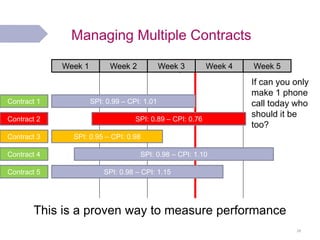
Managing Multiple Contracts 
28 
Week 1 
Week 2 
Week 4 
Week 5 
This is a proven way to measure performance 
Contract 2 
Contract 3 
Contract 4 
Contract 5 
Contract 1 
SPI: 0.95 – CPI: 0.98 
Week 3 
SPI: 0.99 – CPI: 1.01 
SPI: 0.89 – CPI: 0.76 
SPI: 0.98 – CPI: 1.10 
SPI: 0.98 – CPI: 1.15 
If can you only make 1 phone call today who should it be too?
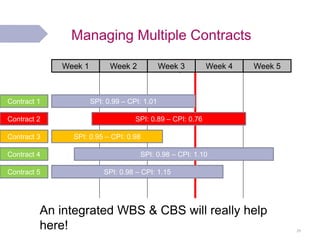
Managing Multiple Contracts 
29 
Week 1 
Week 2 
Week 4 
Week 5 
An integrated WBS & CBS will really help here! 
Contract 2 
Contract 3 
Contract 4 
Contract 5 
Contract 1 
SPI: 0.95 – CPI: 0.98 
Week 3 
SPI: 0.99 – CPI: 1.01 
SPI: 0.89 – CPI: 0.76 
SPI: 0.98 – CPI: 1.10 
SPI: 0.98 – CPI: 1.15
Trending EV Graphs 
30 
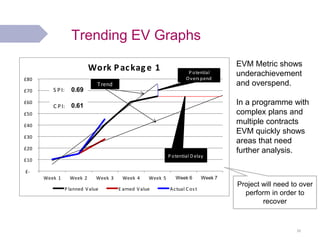
EVM Metric shows 
underachievement 
and overspend. 
In a programme with 
complex plans and 
multiple contracts 
EVM quickly shows 
areas that need 
further analysis. 
£- 
£10 
£20 
£30 
£40 
£50 
£60 
£70 
£80 
Week 1 Week 2 Week 3 Week 4 Week 5 
Work P ac kag e 1 
P lanned Value E arned Value Ac tual C os t 
0.69 
0.61 
S P I: 
C P I: 
P otential 
Overs pend 
P otential D elay 
Trend 
Week 6 Week 7 
Project will need to over 
perform in order to 
recover
EVM and progress 
% complete examples for 
–Software (closing logs or validated functionality) 
–Design, 25% across task, 75% on FDR 
–Units, RWI’s etc. 
–No persistent 99% crawl
EVM in Contracts 
NEC WI T&C’s as measuring in working schedule is preferred 
–Agree structure 
–Agree % complete for work type 
–Agree data format and align with systems 
–Separate EVM baseline outside of accepted schedule
EVM & Risk 
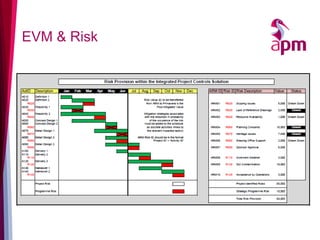
Risk monies not held in baseline plan as there is not 100% chance of occurrence and subsequent earn 
EV baseline budget = Project authority – Risk & Contingency 
Risk events are time phased activities
EVM & Risk
EVM & Risk 
As risk occurs the baseline is updated with the allocated funds maintaining historic performance measures and validity of baseline going forward 
As project proceeds EFC stays the same but baseline budget increases
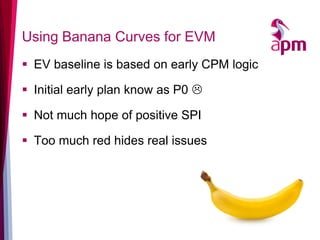
Using Banana Curves for EVM 
EV baseline is based on early CPM logic 
Initial early plan know as P0  
Not much hope of positive SPI 
Too much red hides real issues
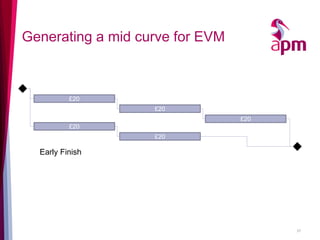
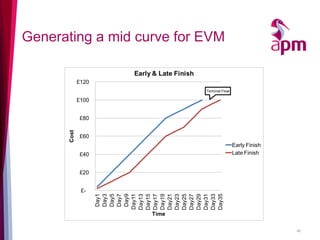
Generating a mid curve for EVM 
37 
£20 
£20 
£20 
Early Finish 
£20 
£20
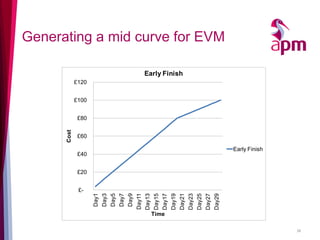
Generating a mid curve for EVM 
38 
£- £20 £40 £60 £80 £100 £120 Day1Day3Day5Day7Day9Day11Day13Day15Day17Day19Day21Day23Day25Day27Day29Cost TimeEarly FinishEarly Finish
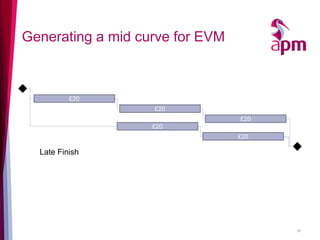
Generating a mid curve for EVM 
39 
£20 
£20 
£20 
£20 
£20 
Late Finish
£- 
£20 
£40 
£60 
£80 
£100 
£120 
Day1 
Day3 
Day5 
Day7 
Day9 
Day11 
Day13 
Day15 
Day17 
Day19 
Day21 
Day23 
Day25 
Day27 
Day29 
Day31 
Day33 
Day35 
Cost 
Time 
Early & Late Finish 
Early Finish 
Late Finish 
Generating a mid curve for EVM 
40 
Terminal Float
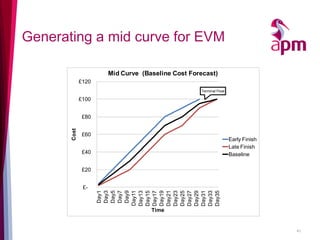
Generating a mid curve for EVM 
41 
£- 
£20 
£40 
£60 
£80 
£100 
£120 
Day1 
Day3 
Day5 
Day7 
Day9 
Day11 
Day13 
Day15 
Day17 
Day19 
Day21 
Day23 
Day25 
Day27 
Day29 
Day31 
Day33 
Day35 
Cost 
Time 
Mid Curve (Baseline Cost Forecast) 
Early Finish 
Late Finish 
Baseline 
Terminal Float
Using Banana Curves for EVM 
Done outside planning tool 
Requires some skill 
Is totally worth doing
Key Points 
Used to measure performance only at contract / project level by the project team (not summarised) 
Baseline midpoint generated from the approved working schedule 
Costs associated with non productivity based tasks will not be included in baseline (PM costs, Materials, Risk, Contingency etc.) 
Budgets and progress will be quantified using an agreed method of measuring progress (agreed units of measurement shall be identified and standardised wherever possible) 
EV based progress analysis and reporting should be part of any regular progress meetings 
Application for payment can be based on earned value achieved 
43
Common Issues around using EV 
Senior management reaction to low SPI & CPI 
Non effort based costs skewing EV figures 
Schedule quality and baseline control 
No standardised way of EV implementation across supply chain 
Varied levels of cost information from others 
Non standardised, scientific progress quantification to inform physical % complete 
Summarisation of EV at programme and portfolio level clouded real performance issues 
44
Publications www.apm.org.uk/publications
Earned Value Management Certification 
Foundation Level 
Practitioner Level 
http://www.apmg-international.com/earned- value.aspx
CARBs – Energising your project 
Full Day event, 21st January. £60+ vat 
Complex 
Agile 
Risk 
Benefits 
Lunch included 
http://www.apm.org.uk/event/carbs-energising-your-projects
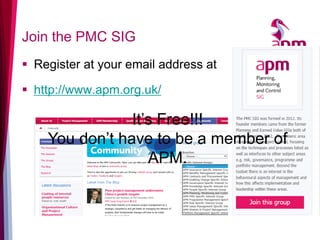
Join the PMC SIG 
Register at your email address at 
http://www.apm.org.uk/ 
It’s Free!!! You don’t have to be a member of APM.
This presentation was delivered for an APM webinar 
To find out more about upcoming events please visit our website www.apm.org.uk/events

Back to basics - Earned Value Management for beginners webinar

  • 1.
  • 2.
    Stephen Jones SPERProgramme Lead Chairman of APM PMC SIG Simon Taylor Head of Planning Introductions
  • 3.
    What is EarnedValue? Earned Value Management –Establishing and managing goals throughout the life of a project –Provides indication of Project efficiency Three pieces of Information –Earned Value –Actual Cost –Planned Value
  • 4.
    Earned Value BudgetCost of Work Performed (BCWP) The value of the work actually done at a given point in time How do you decided on the Value of work done? It’s the portion of the budget which should have been spent to achieve the work done.
  • 5.
    Actual Cost TheActual Cost of Work Performed(ACWP) is the cost of the work done. It is the amount reported as actually expended in completing the work accomplished within a given time period
  • 6.
    Planned Value BudgetedCost of Work Scheduled (BCWS) It is the value of the work that should have been done at a given point in time. It indicates the budget at a given point.
  • 7.
    Example A builderestimates to build a wall will require 100 bricks at £1 each. The builder can lay 10 bricks per hour. The builder charges £10 per hour
  • 8.
    Example After 4hours the builder has laid 50 bricks Earned Value = £100, Actual = £90
  • 9.
    Schedule Performance Index SPI measures progress against the plan. Greater than 1.0 is good (ahead of plan) Less than 1.0 is bad (behind plan) Equals 1.0 when we are on plan SPI = BCWP / BCWS Schedule Variance = BCWP – BCWS
  • 10.
    Example In ourexample Earned Value (BCWP) = £100 Planned value (BCWS) = £80 SPI = BCWP / BCWS SPI = 1.25 The builder is ahead of schedule SV = 100 – 80 = +20
  • 11.
    Cost Performance Index CPI is a ratio of the value of work to actual cost incurred. Greater than 1.0 is good (under budget) Less than 1.0 is bad (over budget) Equals 1.0 when we are on budget CPI = BCWP / ACWP Cost Variance = BCWP – ACWP
  • 12.
    Example In ourexample, after 4 hours the cost will be £40 for labour plus £50 for brick = £90 Earned Value (BCWP) = £100 Actual cost (ACWP) = £90 CPI = BCWP / ACWP CPI = 1.11 The cost is under budget CV = 100 – 90 = +10
  • 13.
    EAC Estimate atCompletion A forecast of the cost required to complete the project based on current progress EAC = Budget at Completion / CPI EAC = £200 / 1.11 EAC = £180 (should finish under budget)
  • 14.
    Estimated Duration Aforecast of the time required to complete the project based on current progress Estimated Duration = Planned Duration / SPI In our example = 10 hours / 1.25 Estimated Duration = 8 hours Should finish ahead of schedule
  • 15.
    Summary BAC =budget at Completion Earned Value EV = %complete x BAC Cost Variance CV = BCWP – ACWP Schedule Variance SV = BCWP – BCWS Cost Performance Index CPI = BCWP/ ACWP Schedule Performance Index SPI = BCWP/ BCWS EAC = Total Budget / CPI Est. time at completion = Planned duration / SPI
  • 16.
    Benefits of EarnedValue Analysis Measures work done against expenditure Control is achieved by calculating variances Positive: good, negative: Bad Indices give a summary of project health >1.0: good, < 1.0: bad Generates forecast to completion based on current trends SPI and CPI can be used as a measure of efficiency
  • 17.
    Good News orBad News
  • 18.
    Good News orBad News Ahead of Schedule / Under Budget Scheduled Variance Cost Variance Incorrect
  • 19.
    Good News orBad News
  • 20.
    Pole Results Aheadof Schedule / Ahead of Budget Ahead of Schedule / Over Budget Behind Schedule / Ahead of Budget Behind Schedule / Over Budget On Schedule / On Budget
  • 21.
    Good News orBad News Behind Schedule / Over Budget Scheduled Variance Cost Variance
  • 22.
  • 23.
  • 24.
    Where is theindustry? 24 PWC 2014
  • 25.
    Where is theindustry? 25 PWC 2014
  • 26.
    What is EarnedValue Management? Earned Value Management (EVM) is a project management system that combines schedule performance and cost performance to answer the question, “What did we get for the money we spent?” To summarise....the basics: How will you do the job? – Plan How much will it cost? – Cost Loaded How much have you achieved? - % Complete 26
  • 27.
    Why use EVM? It enables project teams to ask the questions “have I spent too much money achieving too little?” “is the project behind or ahead of schedule?” Allows efficient and effective use of time and deployment of resource Requires discipline and rigour to operate successfully (i.e. Robust baseline & proactive change control) 27
  • 28.
    Managing Multiple Contracts 28 Week 1 Week 2 Week 4 Week 5 This is a proven way to measure performance Contract 2 Contract 3 Contract 4 Contract 5 Contract 1 SPI: 0.95 – CPI: 0.98 Week 3 SPI: 0.99 – CPI: 1.01 SPI: 0.89 – CPI: 0.76 SPI: 0.98 – CPI: 1.10 SPI: 0.98 – CPI: 1.15 If can you only make 1 phone call today who should it be too?
  • 29.
    Managing Multiple Contracts 29 Week 1 Week 2 Week 4 Week 5 An integrated WBS & CBS will really help here! Contract 2 Contract 3 Contract 4 Contract 5 Contract 1 SPI: 0.95 – CPI: 0.98 Week 3 SPI: 0.99 – CPI: 1.01 SPI: 0.89 – CPI: 0.76 SPI: 0.98 – CPI: 1.10 SPI: 0.98 – CPI: 1.15
  • 30.
    Trending EV Graphs 30 EVM Metric shows underachievement and overspend. In a programme with complex plans and multiple contracts EVM quickly shows areas that need further analysis. £- £10 £20 £30 £40 £50 £60 £70 £80 Week 1 Week 2 Week 3 Week 4 Week 5 Work P ac kag e 1 P lanned Value E arned Value Ac tual C os t 0.69 0.61 S P I: C P I: P otential Overs pend P otential D elay Trend Week 6 Week 7 Project will need to over perform in order to recover
  • 31.
    EVM and progress % complete examples for –Software (closing logs or validated functionality) –Design, 25% across task, 75% on FDR –Units, RWI’s etc. –No persistent 99% crawl
  • 32.
    EVM in Contracts NEC WI T&C’s as measuring in working schedule is preferred –Agree structure –Agree % complete for work type –Agree data format and align with systems –Separate EVM baseline outside of accepted schedule
  • 33.
    EVM & Risk Risk monies not held in baseline plan as there is not 100% chance of occurrence and subsequent earn EV baseline budget = Project authority – Risk & Contingency Risk events are time phased activities
  • 34.
  • 35.
    EVM & Risk As risk occurs the baseline is updated with the allocated funds maintaining historic performance measures and validity of baseline going forward As project proceeds EFC stays the same but baseline budget increases
  • 36.
    Using Banana Curvesfor EVM EV baseline is based on early CPM logic Initial early plan know as P0  Not much hope of positive SPI Too much red hides real issues
  • 37.
    Generating a midcurve for EVM 37 £20 £20 £20 Early Finish £20 £20
  • 38.
    Generating a midcurve for EVM 38 £- £20 £40 £60 £80 £100 £120 Day1Day3Day5Day7Day9Day11Day13Day15Day17Day19Day21Day23Day25Day27Day29Cost TimeEarly FinishEarly Finish
  • 39.
    Generating a midcurve for EVM 39 £20 £20 £20 £20 £20 Late Finish
  • 40.
    £- £20 £40 £60 £80 £100 £120 Day1 Day3 Day5 Day7 Day9 Day11 Day13 Day15 Day17 Day19 Day21 Day23 Day25 Day27 Day29 Day31 Day33 Day35 Cost Time Early & Late Finish Early Finish Late Finish Generating a mid curve for EVM 40 Terminal Float
  • 41.
    Generating a midcurve for EVM 41 £- £20 £40 £60 £80 £100 £120 Day1 Day3 Day5 Day7 Day9 Day11 Day13 Day15 Day17 Day19 Day21 Day23 Day25 Day27 Day29 Day31 Day33 Day35 Cost Time Mid Curve (Baseline Cost Forecast) Early Finish Late Finish Baseline Terminal Float
  • 42.
    Using Banana Curvesfor EVM Done outside planning tool Requires some skill Is totally worth doing
  • 43.
    Key Points Usedto measure performance only at contract / project level by the project team (not summarised) Baseline midpoint generated from the approved working schedule Costs associated with non productivity based tasks will not be included in baseline (PM costs, Materials, Risk, Contingency etc.) Budgets and progress will be quantified using an agreed method of measuring progress (agreed units of measurement shall be identified and standardised wherever possible) EV based progress analysis and reporting should be part of any regular progress meetings Application for payment can be based on earned value achieved 43
  • 44.
    Common Issues aroundusing EV Senior management reaction to low SPI & CPI Non effort based costs skewing EV figures Schedule quality and baseline control No standardised way of EV implementation across supply chain Varied levels of cost information from others Non standardised, scientific progress quantification to inform physical % complete Summarisation of EV at programme and portfolio level clouded real performance issues 44
  • 45.
  • 46.
    Earned Value ManagementCertification Foundation Level Practitioner Level http://www.apmg-international.com/earned- value.aspx
  • 47.
    CARBs – Energisingyour project Full Day event, 21st January. £60+ vat Complex Agile Risk Benefits Lunch included http://www.apm.org.uk/event/carbs-energising-your-projects
  • 48.
    Join the PMCSIG Register at your email address at http://www.apm.org.uk/ It’s Free!!! You don’t have to be a member of APM.
  • 49.
    This presentation wasdelivered for an APM webinar To find out more about upcoming events please visit our website www.apm.org.uk/events