CSE Senior Design I
CSE Senior Design I
Earned Value Management
Partially adapted from Mike O’Dell. Some slides in this presentation were
originally developed by Mr. Tom Rethard.
Instructor: Manfred Huber
4
2
Earned Value - What is it?
Simply, it is a project monitoring and
measurement system that:
1. establishes a clear relationship between
planned
planned accomplishments and actual
actual
accomplishments
2.
2. reinforces
reinforces and rewards good planning
good planning practices
4
3
Earned Value - What is it?
Basic concepts of Earned Value
Management (EVM)
 Each task in a project earns value as planned
planned
work
work is completed
For example (perhaps), if you were paid on this basis,
you would earn
earn $$ at key milestones based on the
value of what you have completed (earned value)
 Earned value can be compared to actual cost
and budgeted cost to determine variance and
predict future performance
4
4
Earned Value - What is it?
 The budgeted cost
budgeted cost (e.g., dollars, person-hours,
person-days, etc.) in terms of your baseline
baseline
plan/budget
plan/budget of the work performed up to a specified
point in time
 Also known as Budgeted Cost of Work Performed
(BCWP
BCWP)
 Each task in the Work Breakdown Structure (WBS)
is assigned a BCWP based on its individual cost.
 Project BCWP is total of BCWP for all tasks required to
complete the project
4
5
Earned Value Components
 Planned Value (a.k.a. BCWS
BCWS)
 How much work (person-hours) you planned to have
accomplished at a given point in time (this is from the
WBS in your plan)
 Actual Cost (a.k.a. ACWP
ACWP)
 How much work (person-hours) you have actually spent
at a given point in time
 Earned Value (a.k.a. BCWP
BCWP)
 The value (person-hours) in terms of your base budget of
what you have accomplished at a given point in time (or,
% complete X Planned Value)
4
6
Earned Value: Example
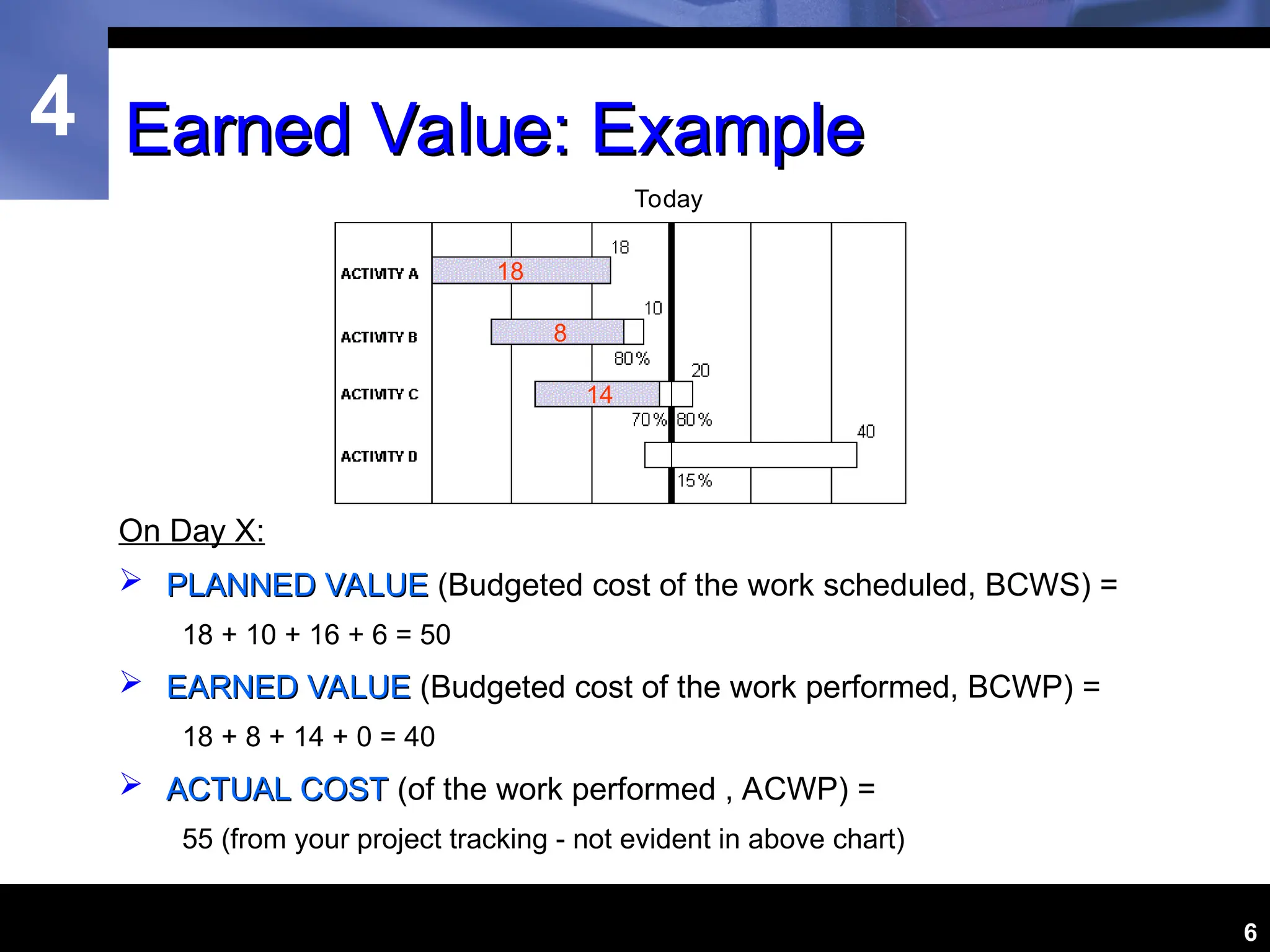
On Day X:
 PLANNED VALUE
PLANNED VALUE (Budgeted cost of the work scheduled, BCWS) =
18 + 10 + 16 + 6 = 50
 EARNED VALUE
EARNED VALUE (Budgeted cost of the work performed, BCWP) =
18 + 8 + 14 + 0 = 40
 ACTUAL COST
ACTUAL COST (of the work performed , ACWP) =
55 (from your project tracking - not evident in above chart)
18
8
14
Today
4
7
Earned Value: Example
Cost
(Person-Hours)
Time (Date)
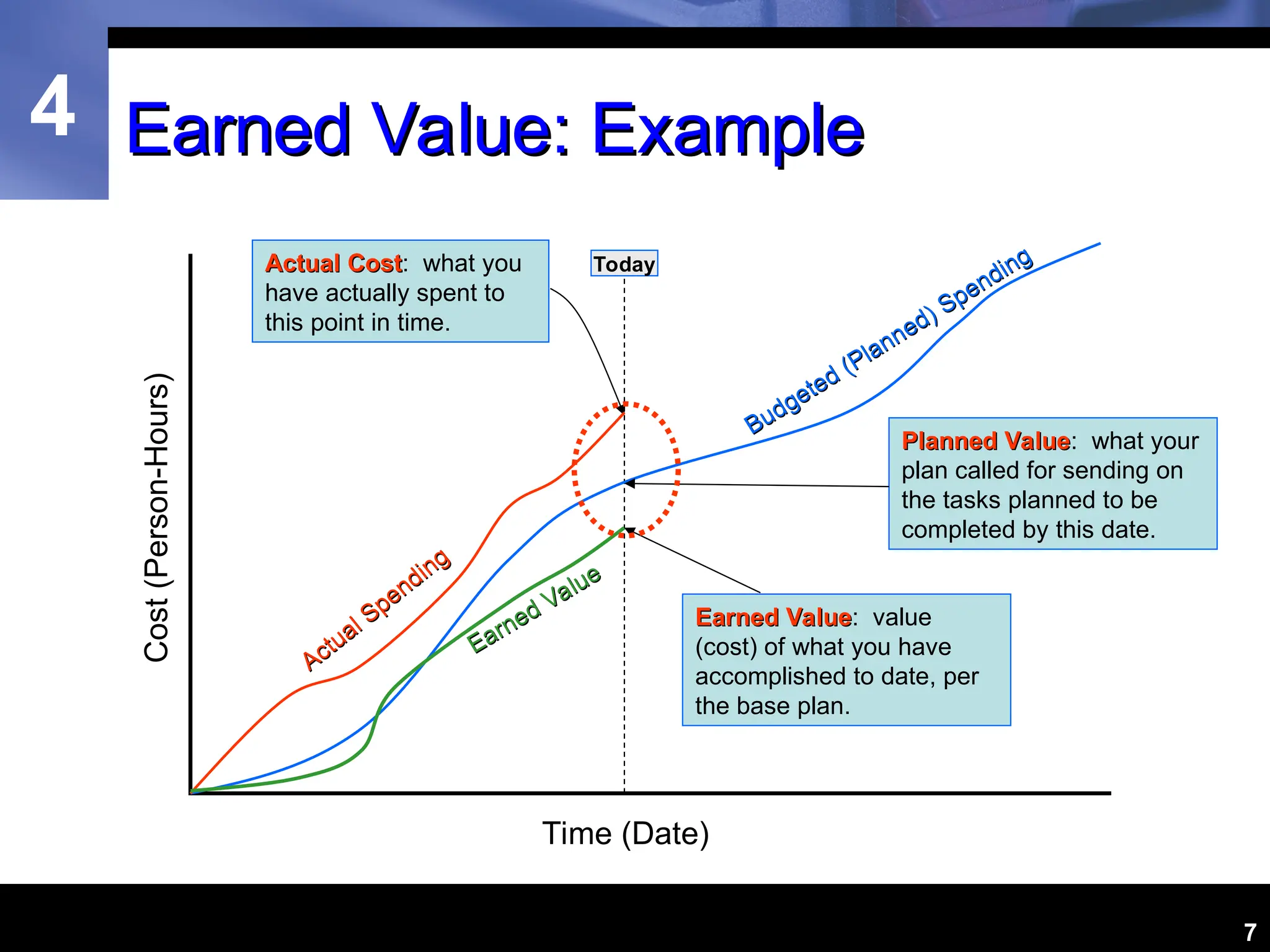
Planned Value
Planned Value: what your
plan called for sending on
the tasks planned to be
completed by this date.
Today
Earned Value
Earned Value: value
(cost) of what you have
accomplished to date, per
the base plan.
Actual Cost
Actual Cost: what you
have actually spent to
this point in time.
Budgeted (Planned) Spending
Actual Spending
Actual Spending
Earned Value
Earned Value
4
8
Earned Value: Example
Cost
(Person-Hours)
Time (Date)
Today
Budgeted (Planned) Spending
Actual Spending
Actual Spending
Earned Value
Earned Value
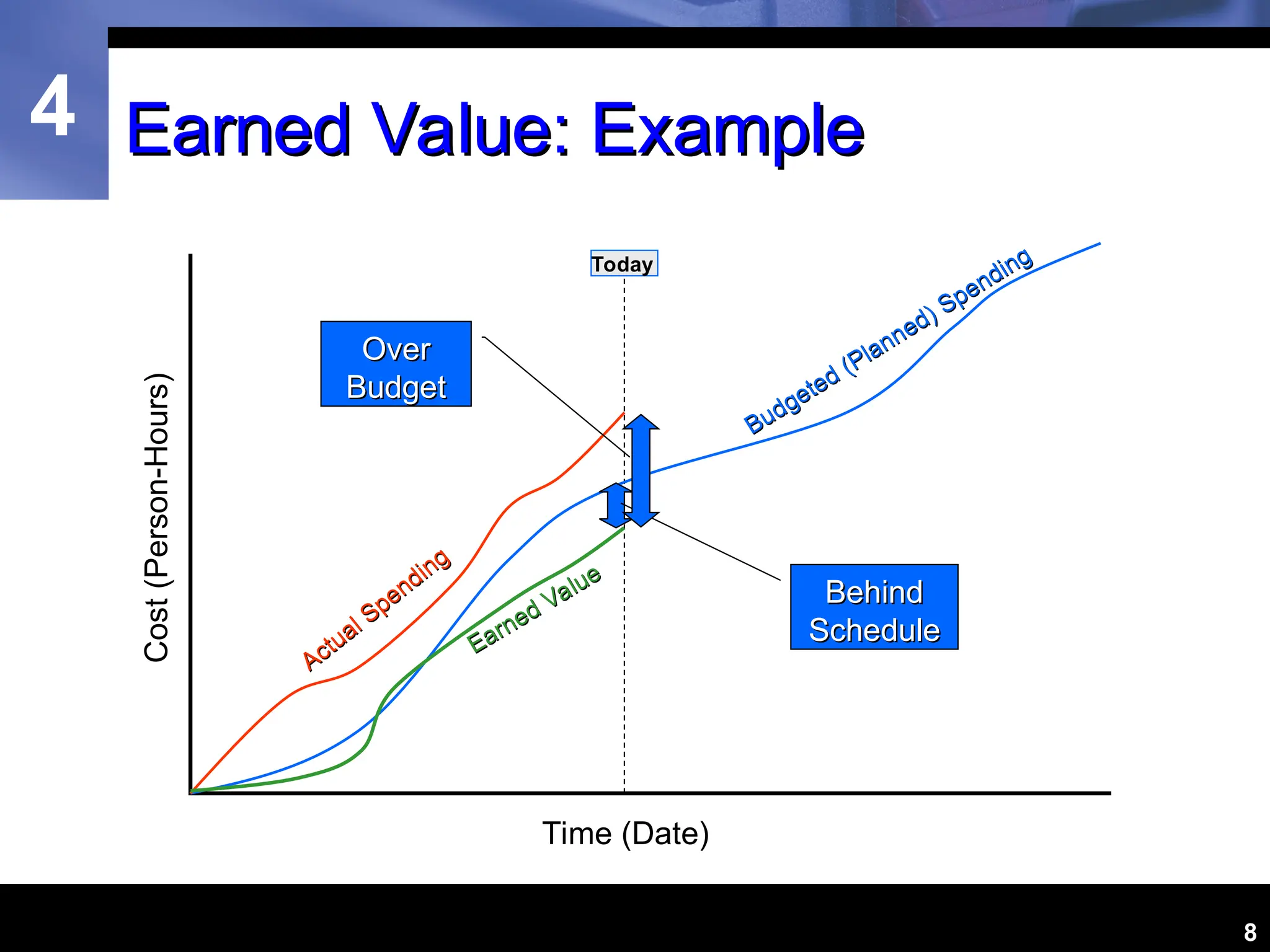
Behind
Behind
Schedule
Schedule
Over
Over
Budget
Budget
4
9
Variance
Variance
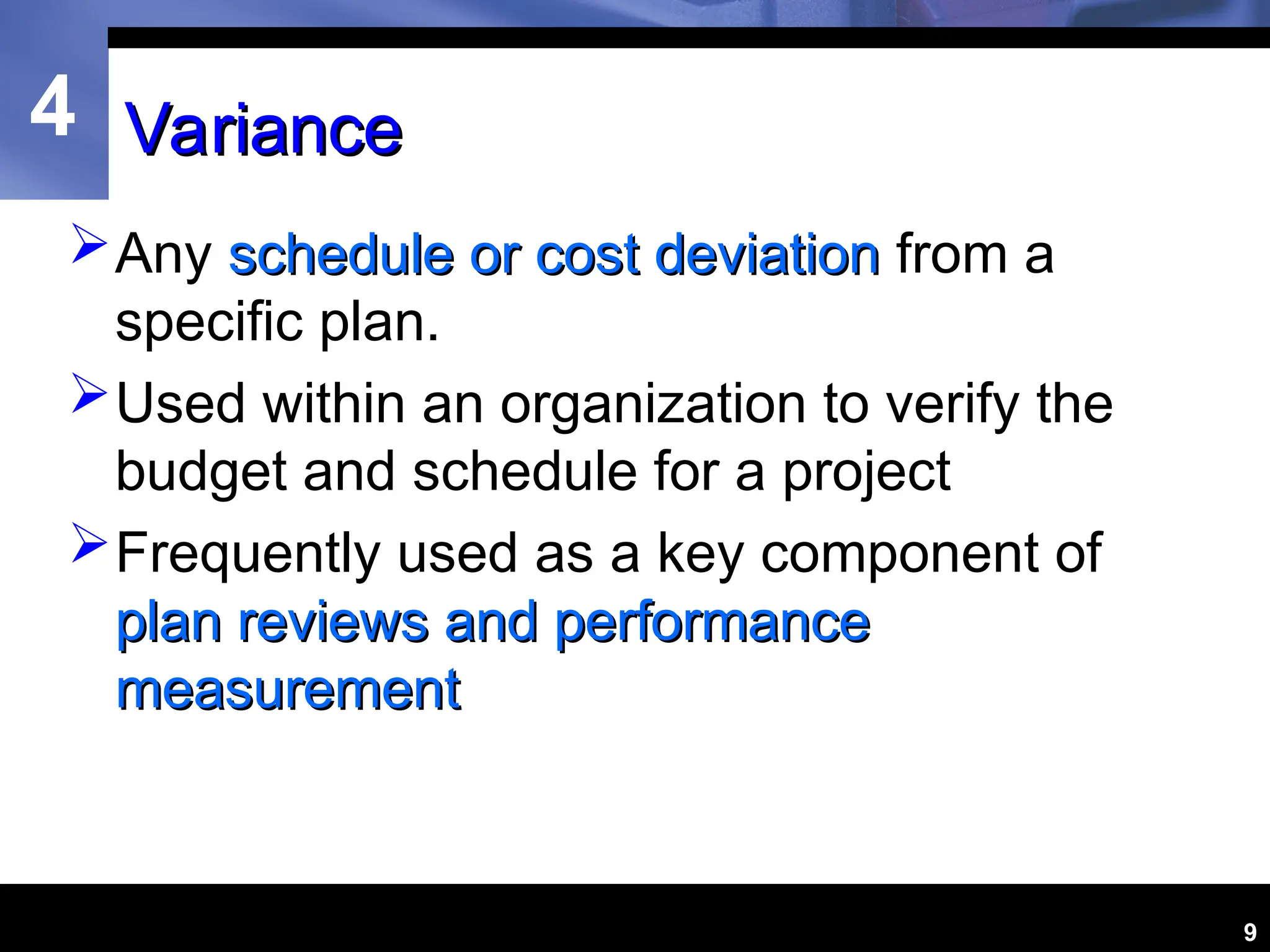
Any schedule or cost deviation
schedule or cost deviation from a
specific plan.
Used within an organization to verify the
budget and schedule for a project
Frequently used as a key component of
plan reviews and performance
measurement
measurement
4
10
Variance
Variance
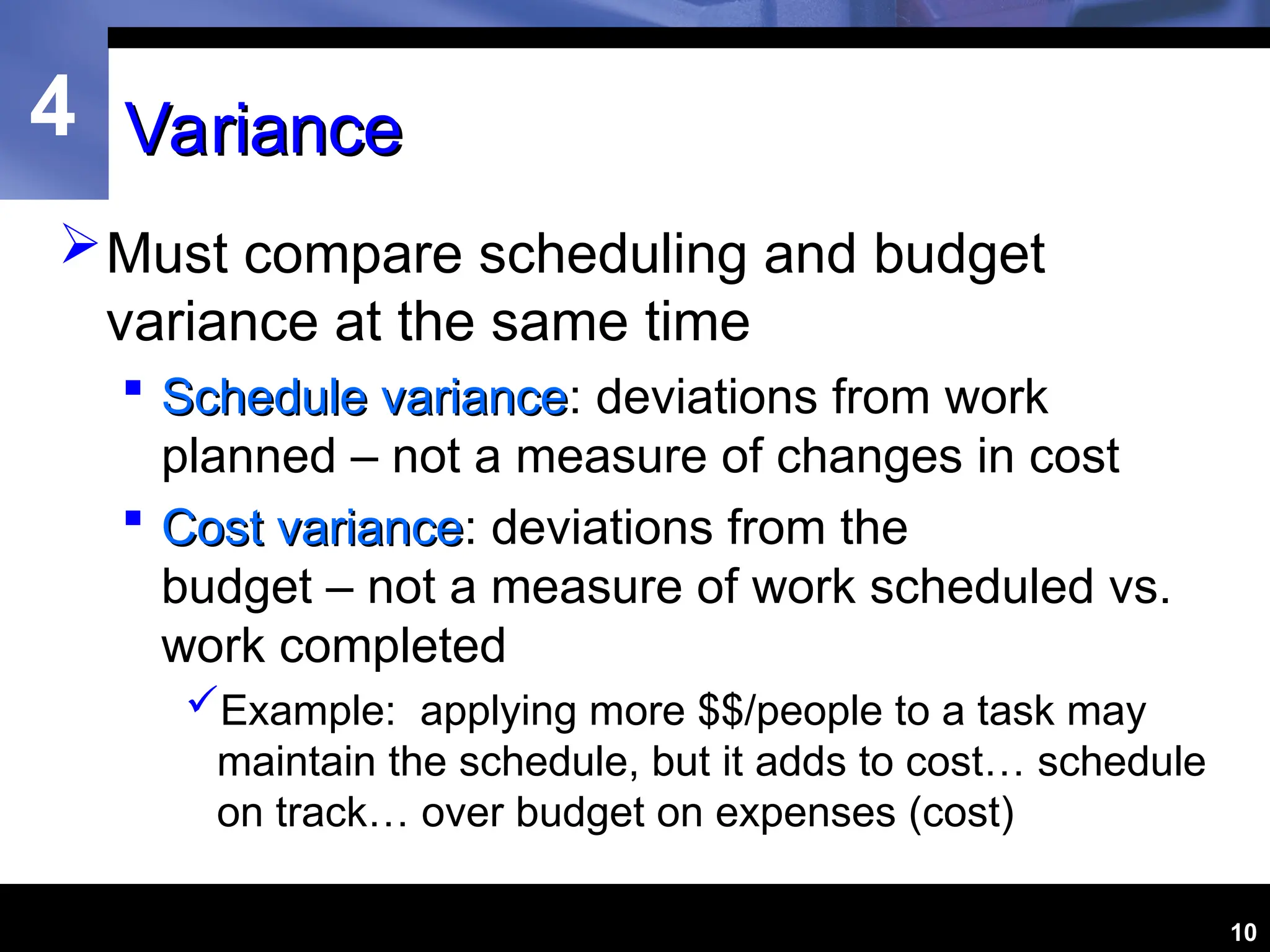
Must compare scheduling and budget
variance at the same time
 Schedule variance
Schedule variance: deviations from work
planned – not a measure of changes in cost
 Cost variance
Cost variance: deviations from the
budget – not a measure of work scheduled vs.
work completed
Example: applying more $$/people to a task may
maintain the schedule, but it adds to cost… schedule
on track… over budget on expenses (cost)
4
11
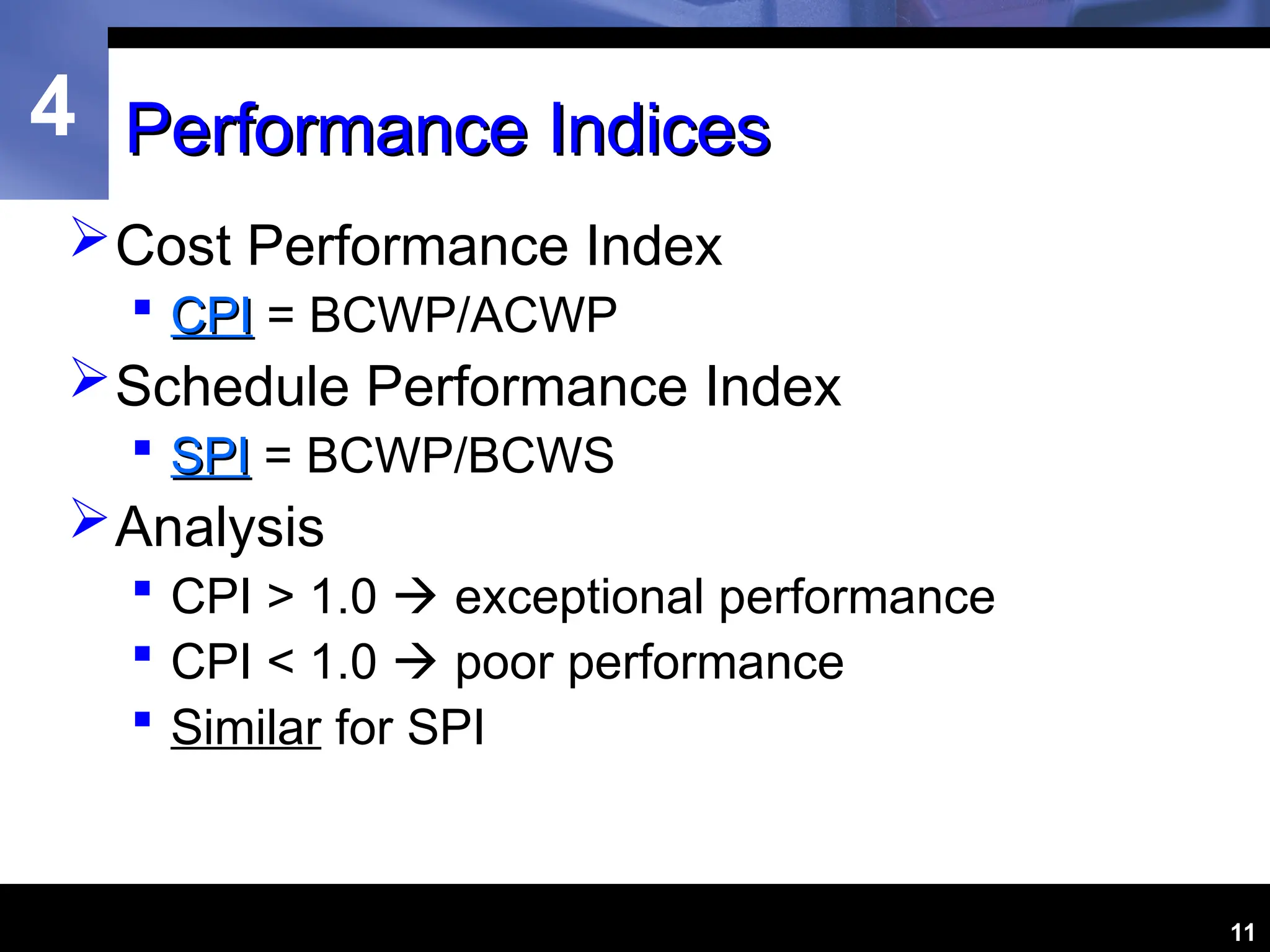
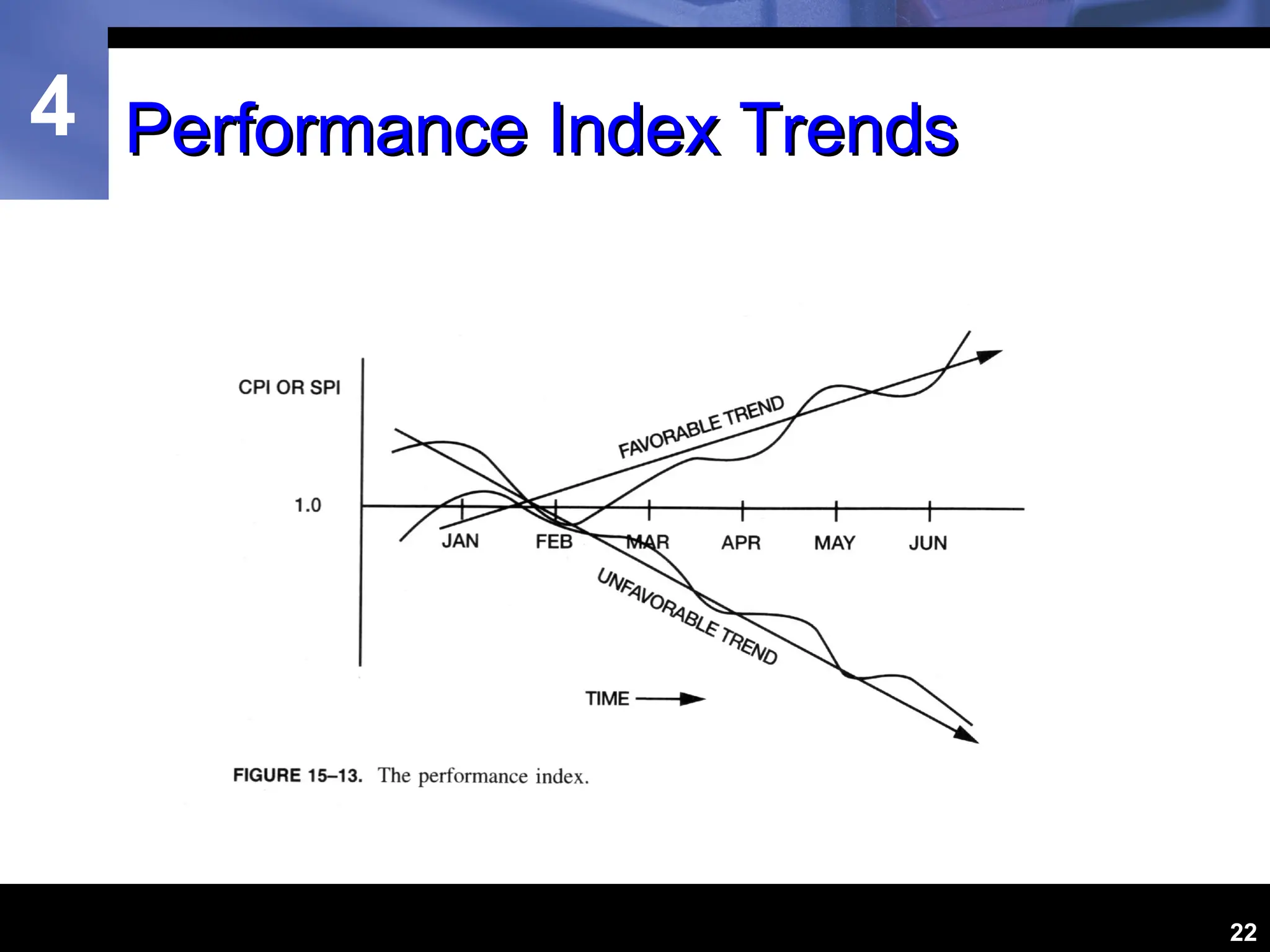
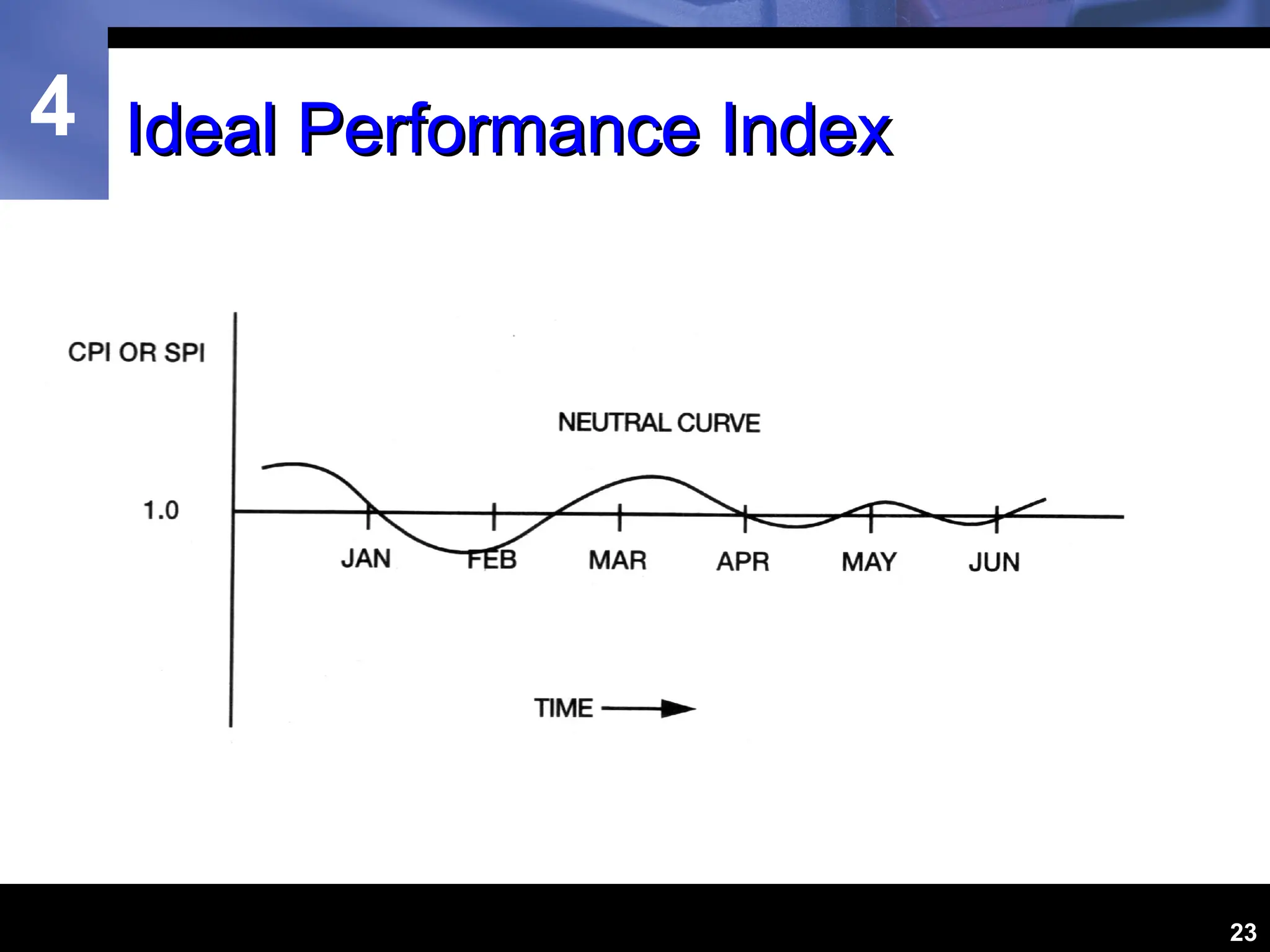
Performance Indices
Performance Indices
Cost Performance Index
 CPI
CPI = BCWP/ACWP
Schedule Performance Index
 SPI
SPI = BCWP/BCWS
Analysis
 CPI > 1.0  exceptional performance
 CPI < 1.0  poor performance
 Similar for SPI
4
14
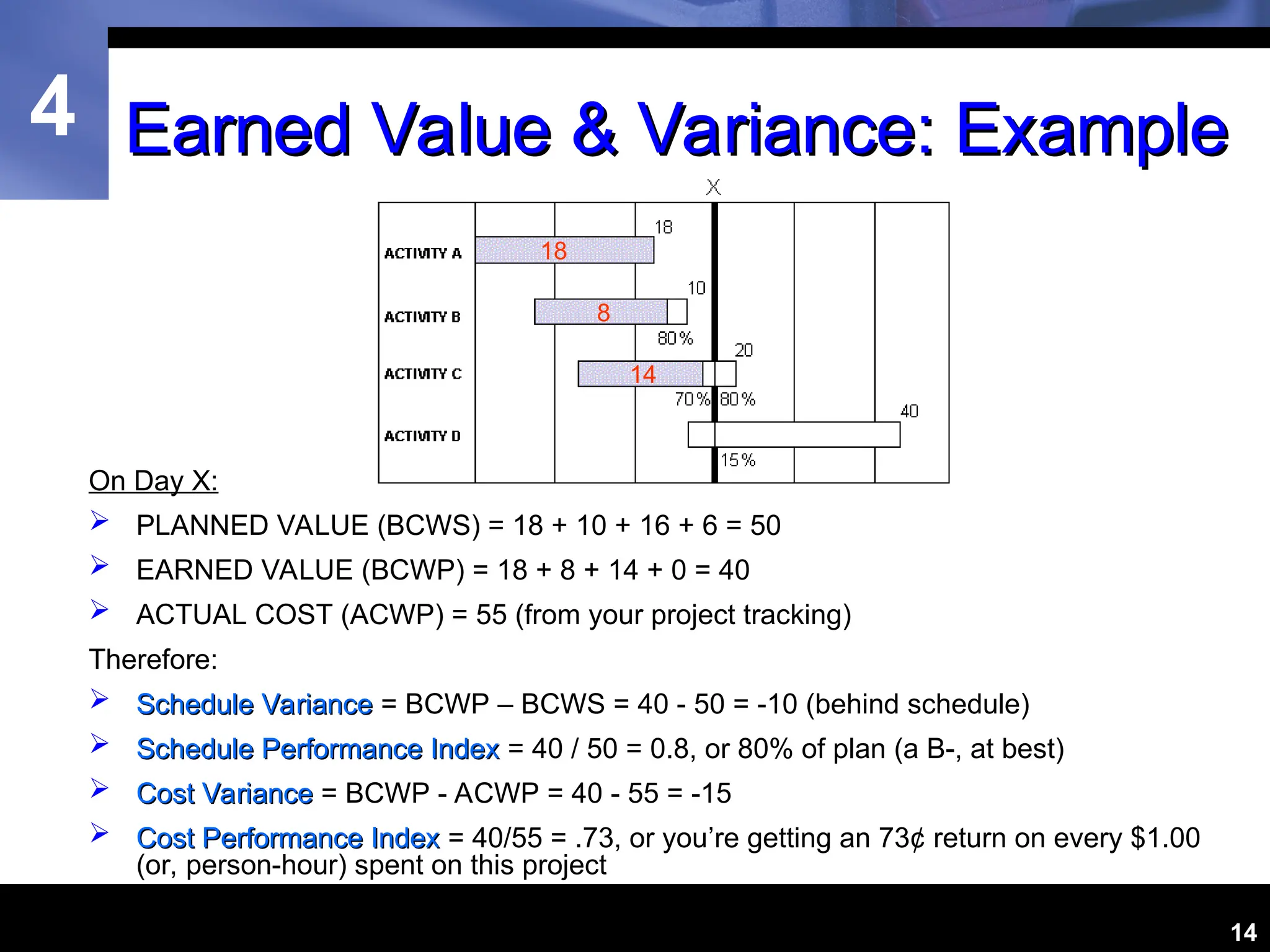
Earned Value & Variance: Example
On Day X:
 PLANNED VALUE (BCWS) = 18 + 10 + 16 + 6 = 50
 EARNED VALUE (BCWP) = 18 + 8 + 14 + 0 = 40
 ACTUAL COST (ACWP) = 55 (from your project tracking)
Therefore:
 Schedule Variance
Schedule Variance = BCWP – BCWS = 40 - 50 = -10 (behind schedule)
 Schedule Performance Index
Schedule Performance Index = 40 / 50 = 0.8, or 80% of plan (a B-, at best)
 Cost Variance
Cost Variance = BCWP - ACWP = 40 - 55 = -15
 Cost Performance Index
Cost Performance Index = 40/55 = .73, or you’re getting an 73¢ return on every $1.00
(or, person-hour) spent on this project
18
8
14
4
15
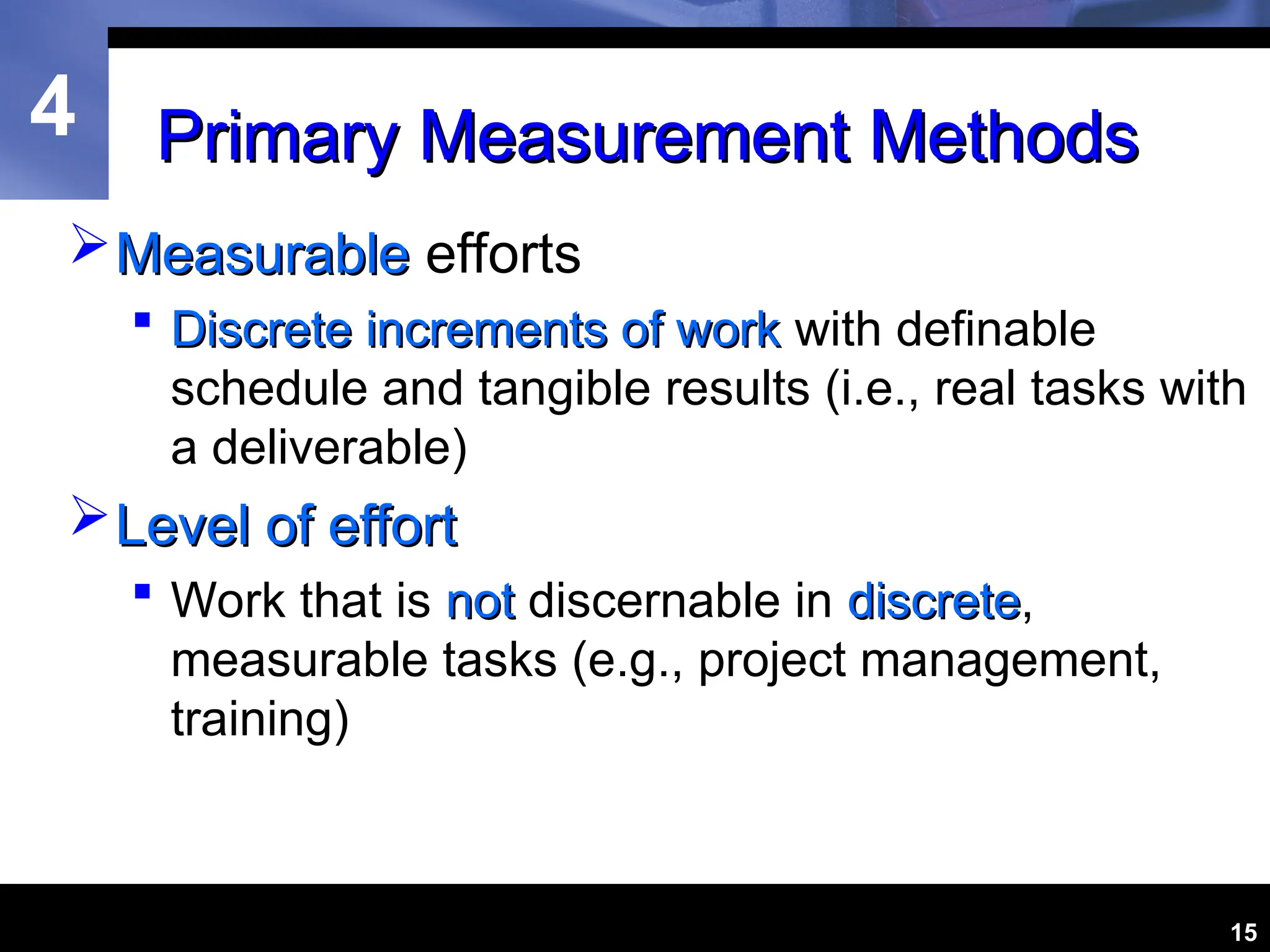
Primary Measurement Methods
Measurable
Measurable efforts
 Discrete increments of work
Discrete increments of work with definable
schedule and tangible results (i.e., real tasks with
a deliverable)
Level of effort
Level of effort
 Work that is not
not discernable in discrete
discrete,
measurable tasks (e.g., project management,
training)
4
16
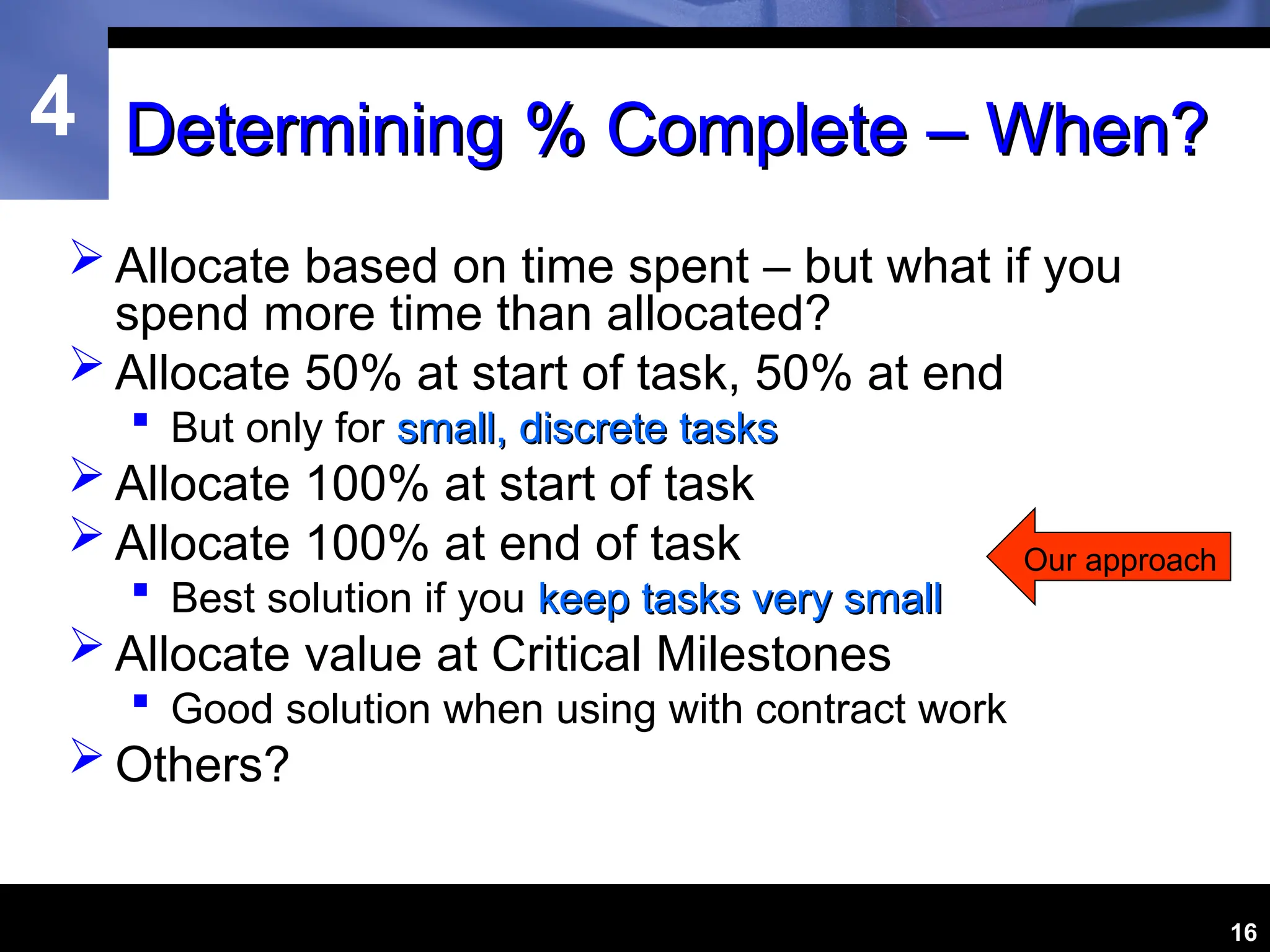
Determining % Complete – When?
 Allocate based on time spent – but what if you
spend more time than allocated?
 Allocate 50% at start of task, 50% at end
 But only for small, discrete tasks
small, discrete tasks
 Allocate 100% at start of task
 Allocate 100% at end of task
 Best solution if you keep tasks very small
keep tasks very small
 Allocate value at Critical Milestones
 Good solution when using with contract work
 Others?
Our approach
4
17
Another Example Project
 Plans to spend $100K in each of first 4 weeks
(baseline budget, per documented plan
per documented plan)
 Actuals, at end of week 4 show: $325K spent
 BCWS = $400K ($100K x 4)
 ACWP = $325K
 What conclusions can you draw?
 Under budget?
 Is project on schedule?
4
18
Another Example Project
Suppose BCWP is $300K
 How is this determined?
What conclusions now?
 SV = BCWP – BCWS
 SV = $300k - $400K = -$100K
Behind schedule
Behind schedule, but what does the $100K in variance
really mean?
 CV = BCWP – ACWP = $300K - $325K
Over budget
Over budget by $25K
4
19
Earned Value Management
 How can you use this information?
 Careful analysis of variance and trends
 Resetting schedule or budget, when appropriate
 Variance Analysis Questions
 What is the problem causing the variance?
 What is the impact on time, cost and performance?
 What is the impact on other efforts, if any?
 What corrective action is planned or under way?
 What are the expected results of the corrective action?
4
20
Earned Value Management
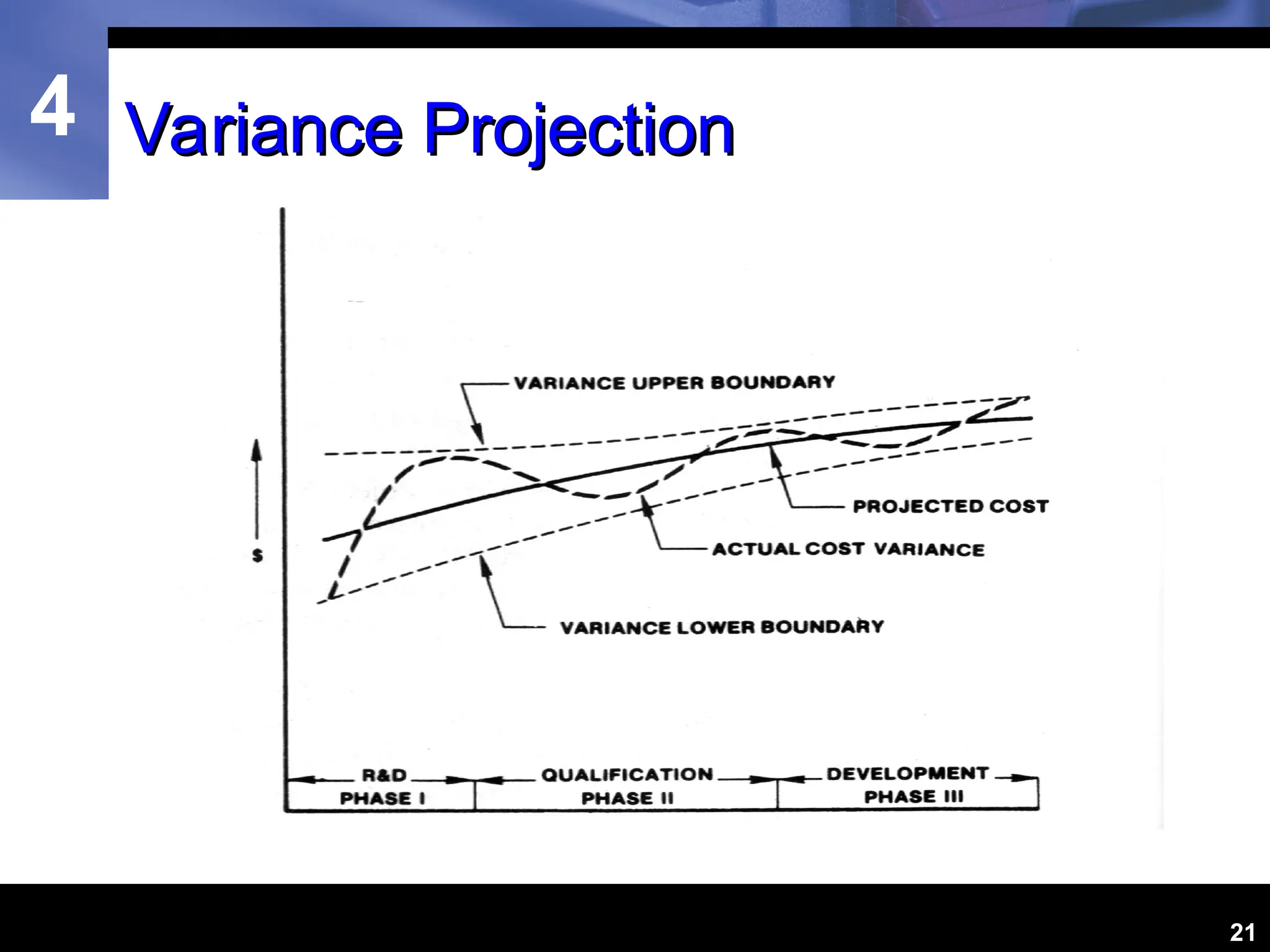
 Extraordinary variance or alarming trends may be
cause for reset or cancellation of
reset or cancellation of a project, but
where do you draw the line?
 How much variance to allow depends on a
number of factors:
 Life-cycle phase
 Length of life-cycle phase
 Length of project
 Type of estimate
 Accuracy of estimate
4
21
Variance Projection
Variance Projection
4
22
Performance Index Trends
4
23
Ideal Performance Index
4
24
Closing Thoughts: Management
Reserve
Reserve
The padding always added to a project for
unexpected costs that are within project
scope
 Not an allowance for changes to scope
 Not part of the cost estimate
Added by upper management, not the project
manager.
4
25
Closing Thoughts: Government
Requirements
Requirements
 U.S. government contract cost tracking often must
include:
 BCWS
 BCWP
 ACWP
 Estimated cost at completion
 Budgeted cost at completion
 Cost and schedule variances with explanations
 Traceability
4
26
Summary
Summary
Cost, in the form of Earned Value or BCWP,
can be used to analyze progress
analyze progress of a project
Using Earned Value data to make critical
project decisions must be based on careful
careful
analysis
analysis of data, variances and trends

Project Earned Value Management and principles

  • 1.
    CSE Senior DesignI CSE Senior Design I Earned Value Management Earned Value Management Partially adapted from Mike O’Dell. Some slides in this presentation were originally developed by Mr. Tom Rethard. Instructor: Manfred Huber Instructor: Manfred Huber
  • 2.
    4 2 Earned Value -What is it? Earned Value - What is it? Simply, it is a project monitoring and measurement system that: 1. establishes a clear relationship between planned planned accomplishments and actual actual accomplishments 2. 2. reinforces reinforces and rewards good planning good planning practices
  • 3.
    4 3 Earned Value -What is it? Earned Value - What is it? Basic concepts of Earned Value Management (EVM)  Each task in a project earns value as planned planned work work is completed For example (perhaps), if you were paid on this basis, you would earn earn $$ at key milestones based on the value of what you have completed (earned value)  Earned value can be compared to actual cost and budgeted cost to determine variance and predict future performance
  • 4.
    4 4 Earned Value -What is it? Earned Value - What is it?  The budgeted cost budgeted cost (e.g., dollars, person-hours, person-days, etc.) in terms of your baseline baseline plan/budget plan/budget of the work performed up to a specified point in time  Also known as Budgeted Cost of Work Performed (BCWP BCWP)  Each task in the Work Breakdown Structure (WBS) is assigned a BCWP based on its individual cost.  Project BCWP is total of BCWP for all tasks required to complete the project
  • 5.
    4 5 Earned Value Components EarnedValue Components  Planned Value (a.k.a. BCWS BCWS)  How much work (person-hours) you planned to have accomplished at a given point in time (this is from the WBS in your plan)  Actual Cost (a.k.a. ACWP ACWP)  How much work (person-hours) you have actually spent at a given point in time  Earned Value (a.k.a. BCWP BCWP)  The value (person-hours) in terms of your base budget of what you have accomplished at a given point in time (or, % complete X Planned Value)
  • 6.
    4 6 Earned Value: Example EarnedValue: Example On Day X:  PLANNED VALUE PLANNED VALUE (Budgeted cost of the work scheduled, BCWS) = 18 + 10 + 16 + 6 = 50  EARNED VALUE EARNED VALUE (Budgeted cost of the work performed, BCWP) = 18 + 8 + 14 + 0 = 40  ACTUAL COST ACTUAL COST (of the work performed , ACWP) = 55 (from your project tracking - not evident in above chart) 18 8 14 Today
  • 7.
    4 7 Earned Value: Example EarnedValue: Example Cost (Person-Hours) Time (Date) Planned Value Planned Value: what your plan called for sending on the tasks planned to be completed by this date. Today Earned Value Earned Value: value (cost) of what you have accomplished to date, per the base plan. Actual Cost Actual Cost: what you have actually spent to this point in time. Budgeted (Planned) Spending Budgeted (Planned) Spending Actual Spending Actual Spending Earned Value Earned Value
  • 8.
    4 8 Earned Value: Example EarnedValue: Example Cost (Person-Hours) Time (Date) Today Budgeted (Planned) Spending Budgeted (Planned) Spending Actual Spending Actual Spending Earned Value Earned Value Behind Behind Schedule Schedule Over Over Budget Budget
  • 9.
    4 9 Variance Variance Any schedule orcost deviation schedule or cost deviation from a specific plan. Used within an organization to verify the budget and schedule for a project Frequently used as a key component of plan reviews and performance plan reviews and performance measurement measurement
  • 10.
    4 10 Variance Variance Must compare schedulingand budget variance at the same time  Schedule variance Schedule variance: deviations from work planned – not a measure of changes in cost  Cost variance Cost variance: deviations from the budget – not a measure of work scheduled vs. work completed Example: applying more $$/people to a task may maintain the schedule, but it adds to cost… schedule on track… over budget on expenses (cost)
  • 11.
    4 11 Performance Indices Performance Indices CostPerformance Index  CPI CPI = BCWP/ACWP Schedule Performance Index  SPI SPI = BCWP/BCWS Analysis  CPI > 1.0  exceptional performance  CPI < 1.0  poor performance  Similar for SPI
  • 12.
    4 14 Earned Value &Variance: Example Earned Value & Variance: Example On Day X:  PLANNED VALUE (BCWS) = 18 + 10 + 16 + 6 = 50  EARNED VALUE (BCWP) = 18 + 8 + 14 + 0 = 40  ACTUAL COST (ACWP) = 55 (from your project tracking) Therefore:  Schedule Variance Schedule Variance = BCWP – BCWS = 40 - 50 = -10 (behind schedule)  Schedule Performance Index Schedule Performance Index = 40 / 50 = 0.8, or 80% of plan (a B-, at best)  Cost Variance Cost Variance = BCWP - ACWP = 40 - 55 = -15  Cost Performance Index Cost Performance Index = 40/55 = .73, or you’re getting an 73¢ return on every $1.00 (or, person-hour) spent on this project 18 8 14
  • 13.
    4 15 Primary Measurement Methods PrimaryMeasurement Methods Measurable Measurable efforts  Discrete increments of work Discrete increments of work with definable schedule and tangible results (i.e., real tasks with a deliverable) Level of effort Level of effort  Work that is not not discernable in discrete discrete, measurable tasks (e.g., project management, training)
  • 14.
    4 16 Determining % Complete– When? Determining % Complete – When?  Allocate based on time spent – but what if you spend more time than allocated?  Allocate 50% at start of task, 50% at end  But only for small, discrete tasks small, discrete tasks  Allocate 100% at start of task  Allocate 100% at end of task  Best solution if you keep tasks very small keep tasks very small  Allocate value at Critical Milestones  Good solution when using with contract work  Others? Our approach
  • 15.
    4 17 Another Example Project AnotherExample Project  Plans to spend $100K in each of first 4 weeks (baseline budget, per documented plan per documented plan)  Actuals, at end of week 4 show: $325K spent  BCWS = $400K ($100K x 4)  ACWP = $325K  What conclusions can you draw?  Under budget?  Is project on schedule?
  • 16.
    4 18 Another Example Project AnotherExample Project Suppose BCWP is $300K  How is this determined? What conclusions now?  SV = BCWP – BCWS  SV = $300k - $400K = -$100K Behind schedule Behind schedule, but what does the $100K in variance really mean?  CV = BCWP – ACWP = $300K - $325K Over budget Over budget by $25K
  • 17.
    4 19 Earned Value Management EarnedValue Management  How can you use this information?  Careful analysis of variance and trends  Resetting schedule or budget, when appropriate  Variance Analysis Questions  What is the problem causing the variance?  What is the impact on time, cost and performance?  What is the impact on other efforts, if any?  What corrective action is planned or under way?  What are the expected results of the corrective action?
  • 18.
    4 20 Earned Value Management EarnedValue Management  Extraordinary variance or alarming trends may be cause for reset or cancellation of reset or cancellation of a project, but where do you draw the line?  How much variance to allow depends on a number of factors:  Life-cycle phase  Length of life-cycle phase  Length of project  Type of estimate  Accuracy of estimate
  • 19.
  • 20.
  • 21.
  • 22.
    4 24 Closing Thoughts: Management ClosingThoughts: Management Reserve Reserve The padding always added to a project for unexpected costs that are within project scope  Not an allowance for changes to scope  Not part of the cost estimate Added by upper management, not the project manager.
  • 23.
    4 25 Closing Thoughts: Government ClosingThoughts: Government Requirements Requirements  U.S. government contract cost tracking often must include:  BCWS  BCWP  ACWP  Estimated cost at completion  Budgeted cost at completion  Cost and schedule variances with explanations  Traceability
  • 24.
    4 26 Summary Summary Cost, in theform of Earned Value or BCWP, can be used to analyze progress analyze progress of a project Using Earned Value data to make critical project decisions must be based on careful careful analysis analysis of data, variances and trends