1


PMSC Quarterly Meeting, February 1–2, 2011,
Fort Worth, Texas
Glen Alleman – Lewis & Fowler
Martin Radley – Carnegie Mellon Silicon Valley

SUCCESSFULLY
INTEGRATING AGILE
WITH EARNED VALUE
MANAGEMENT
Increasing the Probability Program of Success (PoPS) by “Connect the dots”
between Agile development methods and Earned Value Management.
An Opening Thought†
2


    † Integrating Risk Management with Earned Value Management, NDIA,
      http://www.ndia.org/Divisions/Divisions/Procurement/Documents/PMSCommittee/CommitteeDo
      cuments/WhitePapers/Integrating_RM_with_EVM.pdf
A Sobering Fact For Software Intensive
    Defense Programs†
3

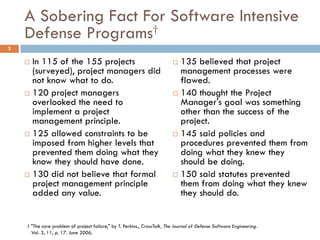
     In 115 of the 155 projects                                           135 believed that project
      (surveyed), project managers did                                      management processes were
      not know what to do.                                                  flawed.
     120 project managers                                                 140 thought the Project
      overlooked the need to                                                Manager's goal was something
      implement a project                                                   other than the success of the
      management principle.                                                 project.
     125 allowed constraints to be                                        145 said policies and
      imposed from higher levels that                                       procedures prevented them from
      prevented them doing what they                                        doing what they knew they
      know they should have done.                                           should be doing.
     130 did not believe that formal                                      150 said statutes prevented
      project management principle                                          them from doing what they knew
      added any value.                                                      they should do.


    † "The core problem of project failure," by T. Perkins., CrossTalk, The Journal of Defense Software Engineering.
      Vol. 3, 11, p. 17. June 2006.
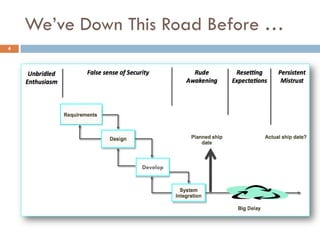
We’ve Down This Road Before …
4


                 Develop
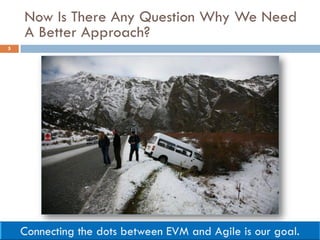
Now Is There Any Question Why We Need
    A Better Approach?
5
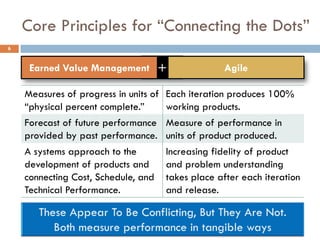
Core Principles for “Connecting the Dots”
6


     Earned Value Management         +              Agile

    Measures of progress in units of   Each iteration produces 100%
    “physical percent complete.”       working products.
    Forecast of future performance     Measure of performance in
    provided by past performance.      units of product produced.
    A systems approach to the          Increasing fidelity of product
    development of products and        and problem understanding
    connecting Cost, Schedule, and     takes place after each iteration
    Technical Performance.             and release.
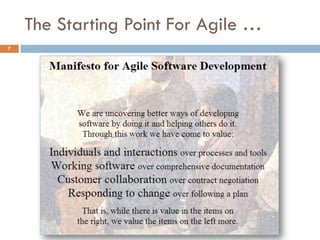
The Starting Point For Agile …
7
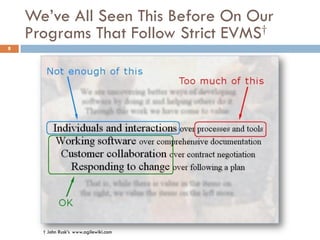
We’ve All Seen This Before On Our
    Programs That Follow Strict EVMS†
8


      † John Rusk’s www.agilewiki.com
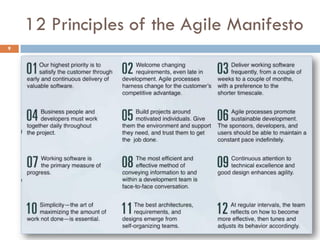
12 Principles of the Agile Manifesto
9
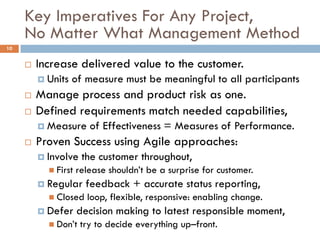
Key Imperatives For Any Project,
     No Matter What Management Method
10


        Increase delivered value to the customer.
          Units   of measure must be meaningful to all participants
        Manage process and product risk as one.
        Defined requirements match needed capabilities,
          Measure      of Effectiveness = Measures of Performance.
        Proven Success using Agile approaches:
          Involve    the customer throughout,
            First   release shouldn’t be a surprise for customer.
          Regular     feedback + accurate status reporting,
            Closed    loop, flexible, responsive: enabling change.
          Defer     decision making to latest responsible moment,
            Don’t    try to decide everything up–front.
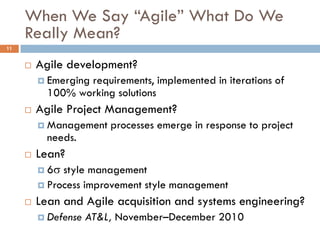
When We Say “Agile” What Do We
     Really Mean?
11


        Agile development?
          Emerging
                  requirements, implemented in iterations of
           100% working solutions
        Agile Project Management?
          Management    processes emerge in response to project
           needs.
        Lean?
          6 style management
          Process improvement style management

        Lean and Agile acquisition and systems engineering?
          Defense   AT&L, November–December 2010
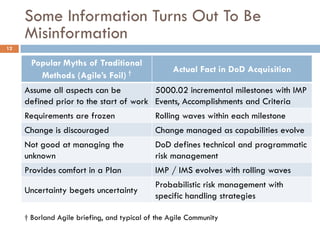
Some Information Turns Out To Be
     Misinformation
12

       Popular Myths of Traditional
                                                  Actual Fact in DoD Acquisition
         Methods (Agile’s Foil) †
     Assume all aspects can be          5000.02 incremental milestones with IMP
     defined prior to the start of work Events, Accomplishments and Criteria
     Requirements are frozen                 Rolling waves within each milestone
     Change is discouraged                   Change managed as capabilities evolve
     Not good at managing the                DoD defines technical and programmatic
     unknown                                 risk management
     Provides comfort in a Plan              IMP / IMS evolves with rolling waves
                                             Probabilistic risk management with
     Uncertainty begets uncertainty
                                             specific handling strategies

     † Borland Agile briefing, and typical of the Agile Community
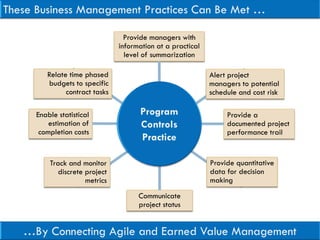
Provide managers with
                               information at a practical
                                 level of summarization

        Relate time phased                                  Alert project
        budgets to specific                                 managers to potential
              contract tasks                                schedule and cost risk

     Enable statistical                                          Provide a
         estimation of                                           documented project
      completion costs                                           performance trail


         Track and monitor                                  Provide quantitative
            discrete project                                data for decision
                     metrics                                making
                                     Communicate
                                     project status

13
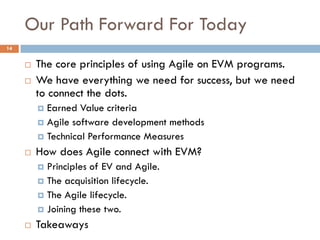
Our Path Forward For Today
14


        The core principles of using Agile on EVM programs.
        We have everything we need for success, but we need
         to connect the dots.
          Earned Value criteria
          Agile software development methods
          Technical Performance Measures

        How does Agile connect with EVM?
          Principles of EV and Agile.
          The acquisition lifecycle.
          The Agile lifecycle.
          Joining these two.

        Takeaways
What’s The Current State of EV?
15


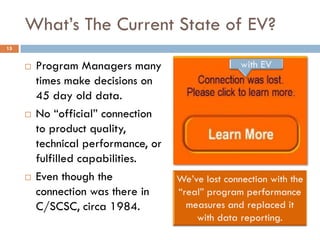
        Program Managers many
         times make decisions on
         45 day old data.
        No “official” connection
         to product quality,
         technical performance, or
         fulfilled capabilities.
        Even though the
         connection was there in
         C/SCSC, circa 1984.
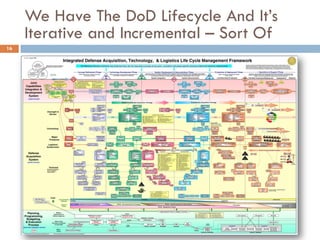
We Have The DoD Lifecycle And It’s
     Iterative and Incremental – Sort Of
16
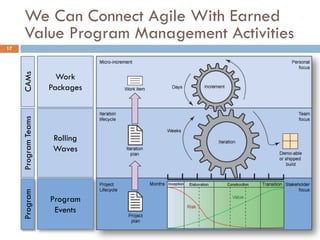
We Can Connect Agile With Earned
       Value Program Management Activities
17
     CAMs


                       Work
                     Packages
     Program Teams


                      Rolling
                      Waves
     Program


                     Program
                      Events
18   11 EVM Criteria and Agile
     Starting with the 32 criteria, let’s use the core 11
     criteria to connect with Agile.
     Let’s look at of the details of these 11 criteria.
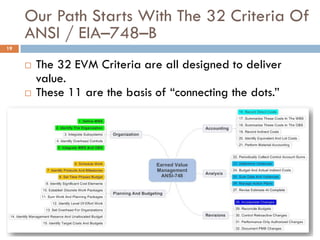
Our Path Starts With The 32 Criteria Of
     ANSI / EIA–748–B
19


        The 32 EVM Criteria are all designed to deliver
         value.
        These 11 are the basis of “connecting the dots.”
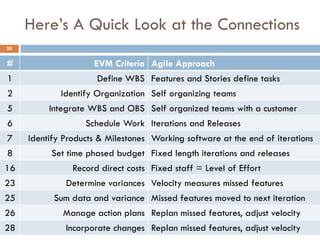
Here’s A Quick Look at the Connections
20


#                    EVM Criteria Agile Approach
1                     Define WBS Features and Stories define tasks
2            Identify Organization Self organizing teams
5         Integrate WBS and OBS Self organized teams with a customer
6                  Schedule Work Iterations and Releases
7    Identify Products & Milestones Working software at the end of iterations
8         Set time phased budget Fixed length iterations and releases
16              Record direct costs Fixed staff = Level of Effort
23            Determine variances Velocity measures missed features
25         Sum data and variance Missed features moved to next iteration
26           Manage action plans Replan missed features, adjust velocity
28            Incorporate changes Replan missed features, adjust velocity
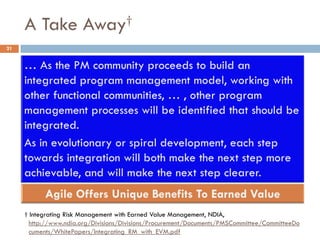
A Take Away†
21


     † Integrating Risk Management with Earned Value Management, NDIA,
       http://www.ndia.org/Divisions/Divisions/Procurement/Documents/PMSCommittee/CommitteeDo
       cuments/WhitePapers/Integrating_RM_with_EVM.pdf
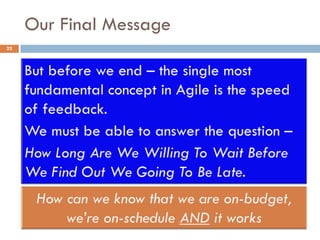
Our Final Message
22
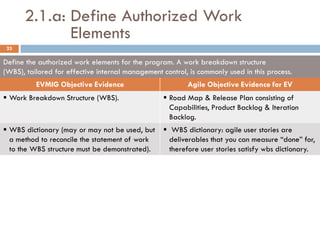
2.1.a: Define Authorized Work
             Elements
 23

Define the authorized work elements for the program. A work breakdown structure
(WBS), tailored for effective internal management control, is commonly used in this process.
          EVMIG Objective Evidence                        Agile Objective Evidence for EV
 Work Breakdown Structure (WBS).                  Road Map & Release Plan consisting of
                                                    Capabilities, Product Backlog & Iteration
                                                    Backlog.
 WBS dictionary (may or may not be used, but      WBS dictionary: agile user stories are
  a method to reconcile the statement of work       deliverables that you can measure “done” for,
  to the WBS structure must be demonstrated).       therefore user stories satisfy wbs dictionary.
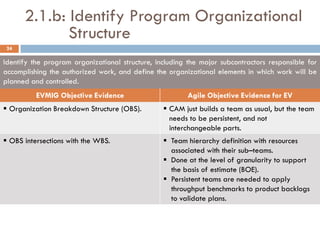
2.1.b: Identify Program Organizational
             Structure
 24

Identify the program organizational structure, including the major subcontractors responsible for
accomplishing the authorized work, and define the organizational elements in which work will be
planned and controlled.
          EVMIG Objective Evidence                       Agile Objective Evidence for EV
 Organization Breakdown Structure (OBS).         CAM just builds a team as usual, but the team
                                                   needs to be persistent, and not
                                                   interchangeable parts.
 OBS intersections with the WBS.                 Team hierarchy definition with resources
                                                   associated with their sub–teams.
                                                  Done at the level of granularity to support
                                                   the basis of estimate (BOE).
                                                  Persistent teams are needed to apply
                                                   throughput benchmarks to product backlogs
                                                   to validate plans.
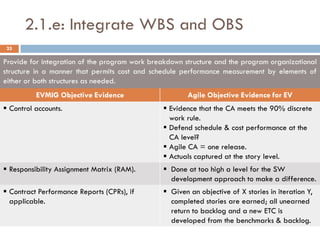
2.1.e: Integrate WBS and OBS
 25

Provide for integration of the program work breakdown structure and the program organizational
structure in a manner that permits cost and schedule performance measurement by elements of
either or both structures as needed.
          EVMIG Objective Evidence                     Agile Objective Evidence for EV
 Control accounts.                             Evidence that the CA meets the 90% discrete
                                                 work rule.
                                                Defend schedule & cost performance at the
                                                 CA level?
                                                Agile CA = one release.
                                                Actuals captured at the story level.
 Responsibility Assignment Matrix (RAM).       Done at too high a level for the SW
                                                 development approach to make a difference.
 Contract Performance Reports (CPRs), if       Given an objective of X stories in iteration Y,
  applicable.                                    completed stories are earned; all unearned
                                                 return to backlog and a new ETC is
                                                 developed from the benchmarks & backlog.
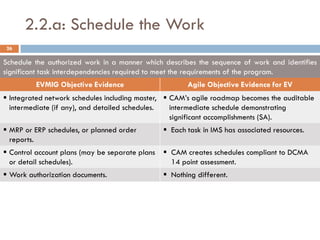
2.2.a: Schedule the Work
26

Schedule the authorized work in a manner which describes the sequence of work and identifies
significant task interdependencies required to meet the requirements of the program.
         EVMIG Objective Evidence                       Agile Objective Evidence for EV
 Integrated network schedules including master,  CAM’s agile roadmap becomes the auditable
  intermediate (if any), and detailed schedules.   intermediate schedule demonstrating
                                                   significant accomplishments (SA).
 MRP or ERP schedules, or planned order          Each task in IMS has associated resources.
  reports.
 Control account plans (may be separate plans    CAM creates schedules compliant to DCMA
  or detail schedules).                            14 point assessment.
 Work authorization documents.                   Nothing different.
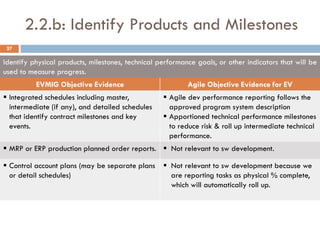
2.2.b: Identify Products and Milestones
 27

Identify physical products, milestones, technical performance goals, or other indicators that will be
used to measure progress.
          EVMIG Objective Evidence                         Agile Objective Evidence for EV
 Integrated schedules including master,            Agile dev performance reporting follows the
  intermediate (if any), and detailed schedules      approved program system description
  that identify contract milestones and key         Apportioned technical performance milestones
  events.                                            to reduce risk & roll up intermediate technical
                                                     performance.
 MRP or ERP production planned order reports.  Not relevant to sw development.

 Control account plans (may be separate plans      Not relevant to sw development because we
  or detail schedules)                               are reporting tasks as physical % complete,
                                                     which will automatically roll up.
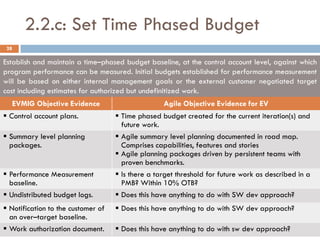
2.2.c: Set Time Phased Budget
 28

Establish and maintain a time–phased budget baseline, at the control account level, against which
program performance can be measured. Initial budgets established for performance measurement
will be based on either internal management goals or the external customer negotiated target
cost including estimates for authorized but undefinitized work.
  EVMIG Objective Evidence                         Agile Objective Evidence for EV
 Control account plans.             Time phased budget created for the current iteration(s) and
                                      future work.
 Summary level planning             Agile summary level planning documented in road map.
  packages.                           Comprises capabilities, features and stories
                                     Agile planning packages driven by persistent teams with
                                      proven benchmarks.
 Performance Measurement            Is there a target threshold for future work as described in a
  baseline.                           PMB? Within 10% OTB?
 Undistributed budget logs.         Does this have anything to do with SW dev approach?
 Notification to the customer of    Does this have anything to do with SW dev approach?
  an over–target baseline.
 Work authorization document.       Does this have anything to do with sw dev approach?
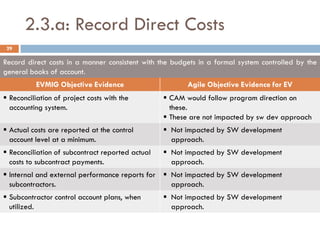
2.3.a: Record Direct Costs
 29

Record direct costs in a manner consistent with the budgets in a formal system controlled by the
general books of account.
           EVMIG Objective Evidence                      Agile Objective Evidence for EV
 Reconciliation of project costs with the         CAM would follow program direction on
  accounting system.                                these.
                                                   These are not impacted by sw dev approach
 Actual costs are reported at the control         Not impacted by SW development
  account level at a minimum.                       approach.
 Reconciliation of subcontract reported actual    Not impacted by SW development
  costs to subcontract payments.                    approach.
 Internal and external performance reports for  Not impacted by SW development
  subcontractors.                                 approach.
 Subcontractor control account plans, when        Not impacted by SW development
  utilized.                                         approach.
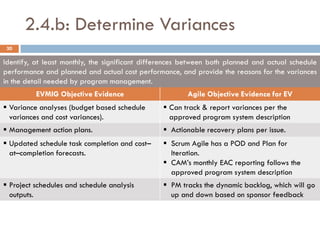
2.4.b: Determine Variances
 30

Identify, at least monthly, the significant differences between both planned and actual schedule
performance and planned and actual cost performance, and provide the reasons for the variances
in the detail needed by program management.
          EVMIG Objective Evidence                      Agile Objective Evidence for EV
 Variance analyses (budget based schedule       Can track & report variances per the
  variances and cost variances).                  approved program system description
 Management action plans.                       Actionable recovery plans per issue.
 Updated schedule task completion and cost–     Scrum Agile has a POD and Plan for
  at–completion forecasts.                        Iteration.
                                                 CAM’s monthly EAC reporting follows the
                                                  approved program system description
 Project schedules and schedule analysis        PM tracks the dynamic backlog, which will go
  outputs.                                        up and down based on sponsor feedback
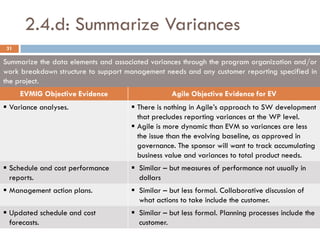
2.4.d: Summarize Variances
 31

Summarize the data elements and associated variances through the program organization and/or
work breakdown structure to support management needs and any customer reporting specified in
the project.
      EVMIG Objective Evidence                    Agile Objective Evidence for EV
 Variance analyses.                  There is nothing in Agile’s approach to SW development
                                       that precludes reporting variances at the WP level.
                                      Agile is more dynamic than EVM so variances are less
                                       the issue than the evolving baseline, as approved in
                                       governance. The sponsor will want to track accumulating
                                       business value and variances to total product needs.
 Schedule and cost performance       Similar – but measures of performance not usually in
  reports.                             dollars
 Management action plans.            Similar – but less formal. Collaborative discussion of
                                       what actions to take include the customer.
 Updated schedule and cost           Similar – but less formal. Planning processes include the
  forecasts.                           customer.
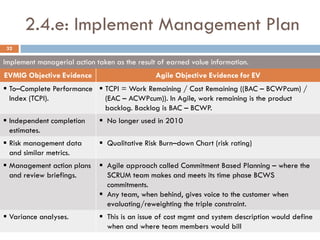
2.4.e: Implement Management Plan
 32

Implement managerial action taken as the result of earned value information.
EVMIG Objective Evidence                       Agile Objective Evidence for EV
 To–Complete Performance  TCPI = Work Remaining / Cost Remaining ((BAC – BCWPcum) /
  Index (TCPI).             (EAC – ACWPcum)). In Agile, work remaining is the product
                            backlog. Backlog is BAC – BCWP.
 Independent completion      No longer used in 2010
  estimates.
 Risk management data        Qualitative Risk Burn–down Chart (risk rating)
  and similar metrics.
 Management action plans     Agile approach called Commitment Based Planning – where the
  and review briefings.        SCRUM team makes and meets its time phase BCWS
                               commitments.
                              Any team, when behind, gives voice to the customer when
                               evaluating/reweighting the triple constraint.
 Variance analyses.          This is an issue of cost mgmt and system description would define
                               when and where team members would bill
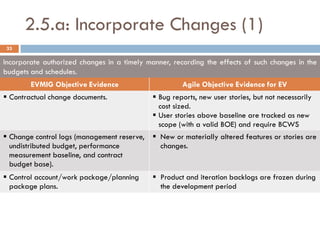
2.5.a: Incorporate Changes (1)
33

Incorporate authorized changes in a timely manner, recording the effects of such changes in the
budgets and schedules.
        EVMIG Objective Evidence                      Agile Objective Evidence for EV
 Contractual change documents.               Bug reports, new user stories, but not necessarily
                                               cost sized.
                                              User stories above baseline are tracked as new
                                               scope (with a valid BOE) and require BCWS
 Change control logs (management reserve,    New or materially altered features or stories are
  undistributed budget, performance            changes.
  measurement baseline, and contract
  budget base).
 Control account/work package/planning       Product and iteration backlogs are frozen during
  package plans.                               the development period
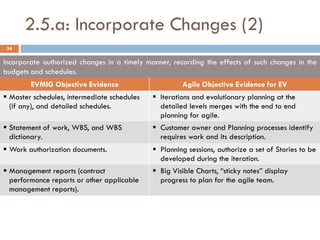
2.5.a: Incorporate Changes (2)
 34

Incorporate authorized changes in a timely manner, recording the effects of such changes in the
budgets and schedules.
        EVMIG Objective Evidence                      Agile Objective Evidence for EV
 Master schedules, intermediate schedules    Iterations and evolutionary planning at the
  (if any), and detailed schedules.            detailed levels merges with the end to end
                                               planning for agile.
 Statement of work, WBS, and WBS             Customer owner and Planning processes identify
  dictionary.                                  requires work and its description.
 Work authorization documents.               Planning sessions, authorize a set of Stories to be
                                               developed during the iteration.
 Management reports (contract                Big Visible Charts, “sticky notes” display
  performance reports or other applicable      progress to plan for the agile team.
  management reports).

Successfully Integrating Agile and Earned Value

  • 1.
    1 PMSC Quarterly Meeting,February 1–2, 2011, Fort Worth, Texas Glen Alleman – Lewis & Fowler Martin Radley – Carnegie Mellon Silicon Valley SUCCESSFULLY INTEGRATING AGILE WITH EARNED VALUE MANAGEMENT Increasing the Probability Program of Success (PoPS) by “Connect the dots” between Agile development methods and Earned Value Management.
  • 2.
    An Opening Thought† 2 † Integrating Risk Management with Earned Value Management, NDIA, http://www.ndia.org/Divisions/Divisions/Procurement/Documents/PMSCommittee/CommitteeDo cuments/WhitePapers/Integrating_RM_with_EVM.pdf
  • 3.
    A Sobering FactFor Software Intensive Defense Programs† 3  In 115 of the 155 projects  135 believed that project (surveyed), project managers did management processes were not know what to do. flawed.  120 project managers  140 thought the Project overlooked the need to Manager's goal was something implement a project other than the success of the management principle. project.  125 allowed constraints to be  145 said policies and imposed from higher levels that procedures prevented them from prevented them doing what they doing what they knew they know they should have done. should be doing.  130 did not believe that formal  150 said statutes prevented project management principle them from doing what they knew added any value. they should do. † "The core problem of project failure," by T. Perkins., CrossTalk, The Journal of Defense Software Engineering. Vol. 3, 11, p. 17. June 2006.
  • 4.
    We’ve Down ThisRoad Before … 4 Develop
  • 5.
    Now Is ThereAny Question Why We Need A Better Approach? 5
  • 6.
    Core Principles for“Connecting the Dots” 6 Earned Value Management + Agile Measures of progress in units of Each iteration produces 100% “physical percent complete.” working products. Forecast of future performance Measure of performance in provided by past performance. units of product produced. A systems approach to the Increasing fidelity of product development of products and and problem understanding connecting Cost, Schedule, and takes place after each iteration Technical Performance. and release.
  • 7.
    The Starting PointFor Agile … 7
  • 8.
    We’ve All SeenThis Before On Our Programs That Follow Strict EVMS† 8 † John Rusk’s www.agilewiki.com
  • 9.
    12 Principles ofthe Agile Manifesto 9
  • 10.
    Key Imperatives ForAny Project, No Matter What Management Method 10  Increase delivered value to the customer.  Units of measure must be meaningful to all participants  Manage process and product risk as one.  Defined requirements match needed capabilities,  Measure of Effectiveness = Measures of Performance.  Proven Success using Agile approaches:  Involve the customer throughout,  First release shouldn’t be a surprise for customer.  Regular feedback + accurate status reporting,  Closed loop, flexible, responsive: enabling change.  Defer decision making to latest responsible moment,  Don’t try to decide everything up–front.
  • 11.
    When We Say“Agile” What Do We Really Mean? 11  Agile development?  Emerging requirements, implemented in iterations of 100% working solutions  Agile Project Management?  Management processes emerge in response to project needs.  Lean?  6 style management  Process improvement style management  Lean and Agile acquisition and systems engineering?  Defense AT&L, November–December 2010
  • 12.
    Some Information TurnsOut To Be Misinformation 12 Popular Myths of Traditional Actual Fact in DoD Acquisition Methods (Agile’s Foil) † Assume all aspects can be 5000.02 incremental milestones with IMP defined prior to the start of work Events, Accomplishments and Criteria Requirements are frozen Rolling waves within each milestone Change is discouraged Change managed as capabilities evolve Not good at managing the DoD defines technical and programmatic unknown risk management Provides comfort in a Plan IMP / IMS evolves with rolling waves Probabilistic risk management with Uncertainty begets uncertainty specific handling strategies † Borland Agile briefing, and typical of the Agile Community
  • 13.
    Provide managers with information at a practical level of summarization Relate time phased Alert project budgets to specific managers to potential contract tasks schedule and cost risk Enable statistical Provide a estimation of documented project completion costs performance trail Track and monitor Provide quantitative discrete project data for decision metrics making Communicate project status 13
  • 14.
    Our Path ForwardFor Today 14  The core principles of using Agile on EVM programs.  We have everything we need for success, but we need to connect the dots.  Earned Value criteria  Agile software development methods  Technical Performance Measures  How does Agile connect with EVM?  Principles of EV and Agile.  The acquisition lifecycle.  The Agile lifecycle.  Joining these two.  Takeaways
  • 15.
    What’s The CurrentState of EV? 15  Program Managers many times make decisions on 45 day old data.  No “official” connection to product quality, technical performance, or fulfilled capabilities.  Even though the connection was there in C/SCSC, circa 1984.
  • 16.
    We Have TheDoD Lifecycle And It’s Iterative and Incremental – Sort Of 16
  • 17.
    We Can ConnectAgile With Earned Value Program Management Activities 17 CAMs Work Packages Program Teams Rolling Waves Program Program Events
  • 18.
    18 11 EVM Criteria and Agile Starting with the 32 criteria, let’s use the core 11 criteria to connect with Agile. Let’s look at of the details of these 11 criteria.
  • 19.
    Our Path StartsWith The 32 Criteria Of ANSI / EIA–748–B 19  The 32 EVM Criteria are all designed to deliver value.  These 11 are the basis of “connecting the dots.”
  • 20.
    Here’s A QuickLook at the Connections 20 # EVM Criteria Agile Approach 1 Define WBS Features and Stories define tasks 2 Identify Organization Self organizing teams 5 Integrate WBS and OBS Self organized teams with a customer 6 Schedule Work Iterations and Releases 7 Identify Products & Milestones Working software at the end of iterations 8 Set time phased budget Fixed length iterations and releases 16 Record direct costs Fixed staff = Level of Effort 23 Determine variances Velocity measures missed features 25 Sum data and variance Missed features moved to next iteration 26 Manage action plans Replan missed features, adjust velocity 28 Incorporate changes Replan missed features, adjust velocity
  • 21.
    A Take Away† 21 † Integrating Risk Management with Earned Value Management, NDIA, http://www.ndia.org/Divisions/Divisions/Procurement/Documents/PMSCommittee/CommitteeDo cuments/WhitePapers/Integrating_RM_with_EVM.pdf
  • 22.
  • 23.
    2.1.a: Define AuthorizedWork Elements 23 Define the authorized work elements for the program. A work breakdown structure (WBS), tailored for effective internal management control, is commonly used in this process. EVMIG Objective Evidence Agile Objective Evidence for EV  Work Breakdown Structure (WBS).  Road Map & Release Plan consisting of Capabilities, Product Backlog & Iteration Backlog.  WBS dictionary (may or may not be used, but  WBS dictionary: agile user stories are a method to reconcile the statement of work deliverables that you can measure “done” for, to the WBS structure must be demonstrated). therefore user stories satisfy wbs dictionary.
  • 24.
    2.1.b: Identify ProgramOrganizational Structure 24 Identify the program organizational structure, including the major subcontractors responsible for accomplishing the authorized work, and define the organizational elements in which work will be planned and controlled. EVMIG Objective Evidence Agile Objective Evidence for EV  Organization Breakdown Structure (OBS).  CAM just builds a team as usual, but the team needs to be persistent, and not interchangeable parts.  OBS intersections with the WBS.  Team hierarchy definition with resources associated with their sub–teams.  Done at the level of granularity to support the basis of estimate (BOE).  Persistent teams are needed to apply throughput benchmarks to product backlogs to validate plans.
  • 25.
    2.1.e: Integrate WBSand OBS 25 Provide for integration of the program work breakdown structure and the program organizational structure in a manner that permits cost and schedule performance measurement by elements of either or both structures as needed. EVMIG Objective Evidence Agile Objective Evidence for EV  Control accounts.  Evidence that the CA meets the 90% discrete work rule.  Defend schedule & cost performance at the CA level?  Agile CA = one release.  Actuals captured at the story level.  Responsibility Assignment Matrix (RAM).  Done at too high a level for the SW development approach to make a difference.  Contract Performance Reports (CPRs), if  Given an objective of X stories in iteration Y, applicable. completed stories are earned; all unearned return to backlog and a new ETC is developed from the benchmarks & backlog.
  • 26.
    2.2.a: Schedule theWork 26 Schedule the authorized work in a manner which describes the sequence of work and identifies significant task interdependencies required to meet the requirements of the program. EVMIG Objective Evidence Agile Objective Evidence for EV  Integrated network schedules including master,  CAM’s agile roadmap becomes the auditable intermediate (if any), and detailed schedules. intermediate schedule demonstrating significant accomplishments (SA).  MRP or ERP schedules, or planned order  Each task in IMS has associated resources. reports.  Control account plans (may be separate plans  CAM creates schedules compliant to DCMA or detail schedules). 14 point assessment.  Work authorization documents.  Nothing different.
  • 27.
    2.2.b: Identify Productsand Milestones 27 Identify physical products, milestones, technical performance goals, or other indicators that will be used to measure progress. EVMIG Objective Evidence Agile Objective Evidence for EV  Integrated schedules including master,  Agile dev performance reporting follows the intermediate (if any), and detailed schedules approved program system description that identify contract milestones and key  Apportioned technical performance milestones events. to reduce risk & roll up intermediate technical performance.  MRP or ERP production planned order reports.  Not relevant to sw development.  Control account plans (may be separate plans  Not relevant to sw development because we or detail schedules) are reporting tasks as physical % complete, which will automatically roll up.
  • 28.
    2.2.c: Set TimePhased Budget 28 Establish and maintain a time–phased budget baseline, at the control account level, against which program performance can be measured. Initial budgets established for performance measurement will be based on either internal management goals or the external customer negotiated target cost including estimates for authorized but undefinitized work. EVMIG Objective Evidence Agile Objective Evidence for EV  Control account plans.  Time phased budget created for the current iteration(s) and future work.  Summary level planning  Agile summary level planning documented in road map. packages. Comprises capabilities, features and stories  Agile planning packages driven by persistent teams with proven benchmarks.  Performance Measurement  Is there a target threshold for future work as described in a baseline. PMB? Within 10% OTB?  Undistributed budget logs.  Does this have anything to do with SW dev approach?  Notification to the customer of  Does this have anything to do with SW dev approach? an over–target baseline.  Work authorization document.  Does this have anything to do with sw dev approach?
  • 29.
    2.3.a: Record DirectCosts 29 Record direct costs in a manner consistent with the budgets in a formal system controlled by the general books of account. EVMIG Objective Evidence Agile Objective Evidence for EV  Reconciliation of project costs with the  CAM would follow program direction on accounting system. these.  These are not impacted by sw dev approach  Actual costs are reported at the control  Not impacted by SW development account level at a minimum. approach.  Reconciliation of subcontract reported actual  Not impacted by SW development costs to subcontract payments. approach.  Internal and external performance reports for  Not impacted by SW development subcontractors. approach.  Subcontractor control account plans, when  Not impacted by SW development utilized. approach.
  • 30.
    2.4.b: Determine Variances 30 Identify, at least monthly, the significant differences between both planned and actual schedule performance and planned and actual cost performance, and provide the reasons for the variances in the detail needed by program management. EVMIG Objective Evidence Agile Objective Evidence for EV  Variance analyses (budget based schedule  Can track & report variances per the variances and cost variances). approved program system description  Management action plans.  Actionable recovery plans per issue.  Updated schedule task completion and cost–  Scrum Agile has a POD and Plan for at–completion forecasts. Iteration.  CAM’s monthly EAC reporting follows the approved program system description  Project schedules and schedule analysis  PM tracks the dynamic backlog, which will go outputs. up and down based on sponsor feedback
  • 31.
    2.4.d: Summarize Variances 31 Summarize the data elements and associated variances through the program organization and/or work breakdown structure to support management needs and any customer reporting specified in the project. EVMIG Objective Evidence Agile Objective Evidence for EV  Variance analyses.  There is nothing in Agile’s approach to SW development that precludes reporting variances at the WP level.  Agile is more dynamic than EVM so variances are less the issue than the evolving baseline, as approved in governance. The sponsor will want to track accumulating business value and variances to total product needs.  Schedule and cost performance  Similar – but measures of performance not usually in reports. dollars  Management action plans.  Similar – but less formal. Collaborative discussion of what actions to take include the customer.  Updated schedule and cost  Similar – but less formal. Planning processes include the forecasts. customer.
  • 32.
    2.4.e: Implement ManagementPlan 32 Implement managerial action taken as the result of earned value information. EVMIG Objective Evidence Agile Objective Evidence for EV  To–Complete Performance  TCPI = Work Remaining / Cost Remaining ((BAC – BCWPcum) / Index (TCPI). (EAC – ACWPcum)). In Agile, work remaining is the product backlog. Backlog is BAC – BCWP.  Independent completion  No longer used in 2010 estimates.  Risk management data  Qualitative Risk Burn–down Chart (risk rating) and similar metrics.  Management action plans  Agile approach called Commitment Based Planning – where the and review briefings. SCRUM team makes and meets its time phase BCWS commitments.  Any team, when behind, gives voice to the customer when evaluating/reweighting the triple constraint.  Variance analyses.  This is an issue of cost mgmt and system description would define when and where team members would bill
  • 33.
    2.5.a: Incorporate Changes(1) 33 Incorporate authorized changes in a timely manner, recording the effects of such changes in the budgets and schedules. EVMIG Objective Evidence Agile Objective Evidence for EV  Contractual change documents.  Bug reports, new user stories, but not necessarily cost sized.  User stories above baseline are tracked as new scope (with a valid BOE) and require BCWS  Change control logs (management reserve,  New or materially altered features or stories are undistributed budget, performance changes. measurement baseline, and contract budget base).  Control account/work package/planning  Product and iteration backlogs are frozen during package plans. the development period
  • 34.
    2.5.a: Incorporate Changes(2) 34 Incorporate authorized changes in a timely manner, recording the effects of such changes in the budgets and schedules. EVMIG Objective Evidence Agile Objective Evidence for EV  Master schedules, intermediate schedules  Iterations and evolutionary planning at the (if any), and detailed schedules. detailed levels merges with the end to end planning for agile.  Statement of work, WBS, and WBS  Customer owner and Planning processes identify dictionary. requires work and its description.  Work authorization documents.  Planning sessions, authorize a set of Stories to be developed during the iteration.  Management reports (contract  Big Visible Charts, “sticky notes” display performance reports or other applicable progress to plan for the agile team. management reports).