DRY EYE
DR K HARIPRIYA
Definition
 Dry eye is a multifactorial disease of
the tears and ocular surface that
results in symptoms of discomfort,
visual disturbance and tear film
instability with potential damage to the
ocular surface.
 It is accompanied by increased
osmolarity of the tear film and
inflammation of the ocular surface.
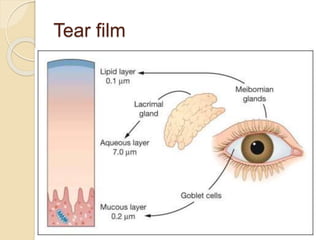
Tear film
Introduction
 Dry eye is recognized as a
disturbance of the Lacrimal Functional
Unit (LFU), an integrated system
comprising the lacrimal glands, ocular
surface (cornea, conjunctiva and
meibomian glands) and lids, and the
sensory and motor nerves that
connect them
 This functional unit controls the major
components of the tear film and
responds to environmental,
endocrinological
and cortical influences.
 Its overall function is to
-preserve the integrity of the tear film,
-transparency of the cornea,
-quality of the image projected onto the
retina
 Trigeminal sensory fibers arising from
the ocular surface run to the
superior salivary nucleus in the pons,
efferent fibers pass
nervus intermedius
pterygopalatine ganglion.
Here, postganglionic fibers arise, which
terminate in the lacrimal gland,
nasopharynx, and vessels of the orbit.
 Another neural pathway controls the
blink reflex, via trigeminal afferents
and the somatic efferent fibers of the
seventh cranial nerve.
SSWS
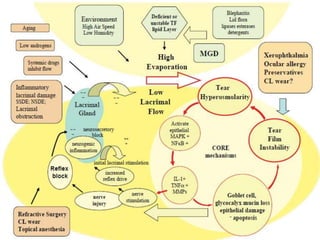
Effect of environment
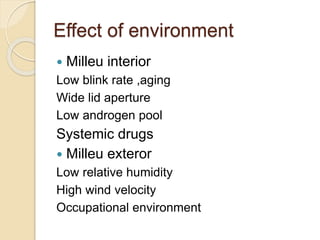
 Milleu interior
Low blink rate ,aging
Wide lid aperture
Low androgen pool
Systemic drugs
 Milleu exteror
Low relative humidity
High wind velocity
Occupational environment
Aqueous Tear-Deficient Dry Eye
(Tear Deficient Dry Eye; Lacrimal
Tear Deficiency)
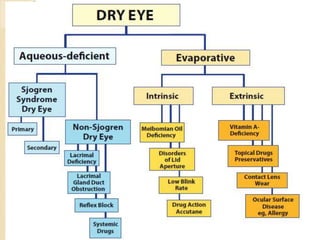
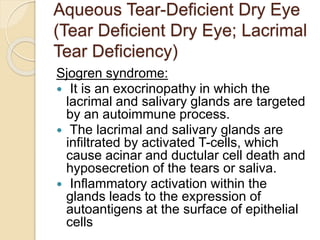
Sjogren syndrome:
 It is an exocrinopathy in which the
lacrimal and salivary glands are targeted
by an autoimmune process.
 The lacrimal and salivary glands are
infiltrated by activated T-cells, which
cause acinar and ductular cell death and
hyposecretion of the tears or saliva.
 Inflammatory activation within the
glands leads to the expression of
autoantigens at the surface of epithelial
cells
Sjogrens syndrome
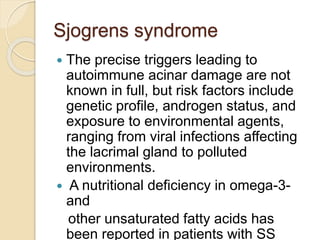
 The precise triggers leading to
autoimmune acinar damage are not
known in full, but risk factors include
genetic profile, androgen status, and
exposure to environmental agents,
ranging from viral infections affecting
the lacrimal gland to polluted
environments.
 A nutritional deficiency in omega-3-
and
other unsaturated fatty acids has
been reported in patients with SS
Sjogrens syndrome
Two types
 Primary SS consists of the occurrence
of ADDE in combination with
symptoms
of dry mouth
 Secondary SS consists of the features
of primary SS together with the
features
of an overt autoimmune connective
disease, such as rheumatoid arthritis,
Non-Sjogren Syndrome Dry
Eye
Primary lacrimal gland deficiencies:
Age-related dry eye
Congenital alacrima
Familial dysautonomia
Age-related dry eye
 Ductal pathology
Peri ductal, inter acinar fibrosis
Paraductal blood vessel loss
Acinar atrophy
 Low grade dacryoadenitis
Congenital Alacrima
 rare cause of dry eye in youth.
 It is also part of certain syndromes,
triple A syndrome
 Protien ALLADIN
Familial dysautonomia
 Developmental , progressive neuronal
abnormality of the cervical
sympathetic and parasympathetic
innervations of the lacrimal gland and
a defective sensory innervation of the
ocular surface
 Generalized insensitivity to pain is
accompanied by a marked lack of both
emotional and reflex tearing,
NSDE
Secondary lacrimal gland deficiencies
 Lacrimal gland infiltration
 Sarcoidosis
 Lymphoma
 AIDS
 Lacrimal gland ablation
 Lacrimal gland denervation
NSDE
Obstruction of the lacrimal gland ducts:
 Trachoma
 Cicatricial pemphigoid and mucous
membrane pemphigoid
 Erythema multiforme
 Chemical and thermal burns
NSDE
Reflex hyposecretion
 Reflex sensory block
Contact lens wear
Diabetes
Neurotrophic keratitis
 Reflex motor block
Cranial nerve damage
Multiple neuromatosis
Exposure to systemic drugs
Evoperative dry eye
 Intrinsic causes
 MGD
 Disorders of lid aperture
 Low blink rate
Extrinsic causes:
 Occular surface disorders
Vitamin A Deficiency
Topical Drugs and Preservatives
Allergic conjunctivitis
Inspection
 Signs of associaed systemic diseases
 Indications of personnel habits
 Ocular disease(lid malposition)
Evaluation of tear film
 Tear meniscus height
 TBUT
 Meniscometry : Tear meniscus radius,
height and cross sectional area
1MM, CONVEX-NORMAL
<0.3 MM IS abnormal
 Tear film lipid layer interferometry
color comparison table
kinetic analysis
TESTS OF TEAR
PRODUCTION
SCHIRMER TEST
 BASIC
 SCHIRMER 1
 SCHIRMER 11
 Inference - > 15 mm - normal, 6 to 10
mm - borderline dry, < 6 mm -
impaired secretion.
Tear composition assays
 Tear Osmolarity
 Rose Bengal staining – The dye has
an affinity for dead or devitalized
epithelial cells and for areas devoid of
mucus.
 Van Bijsterveld scoring system –
divide the ocular surface into three
zones:
 • Nasal bulbar conjunctiva, Cornea
Temporal bulbar conjunctiva.
 Each zone is then given a score of ‘0’
(no stain) to ‘3’ (confluent stain).
Scores in each eye is totaled. A score
of 3.5 or greater indicates positive for
keratoconjunctivitis
Newer technologies
 MEIBO METRY
Casual Lipid level (expressed as
arbitrary optical density units) is
calculated as (C-B), where C is the
casual reading, B is the reading from
the untouched tape
 MEIBO GRAPHY /MEIBO SCOPY
Finoff transilluminator
Most reliable test in patients with
ectodermal dysplasia syndrome
 Brush Cytology Technique
1) squamous metaplasia,
2) detecting inflammatory cells
3) expression of several surface
markers on the ocular surface
epithelium
 Flow cytometry in impression cytology
HLA DR expression by epithelial cells,
gold standard for inflammatory
assesment
 Ferning Test (TFT )
TO DIAGNOSE Quality of tears (electrolyte
concentration), KCS, Hyperosmolarity
The patterns of crystallization (ferning) are
classified in 4 classes:
Type 1: uniform large arborization,
Type 2: ferning abundant but of smaller size;
Type 3: partially present incomplete ferning;
Type 4: no ferning.
Types 1 & 2 are reported to be normal and
Types 3 & 4 reported to be abnormal
 Fluorophotometry (Fluorimetry)
 Tear Function Index
TFI is the quotient of the Schirmer test
value and the Tear clearance rate
(TCR).
A TFI of less than 40 is 100% sensitive
for patients with SS dry eye
MANAGEMENT
 A. Tear supplementation: lubricants
 B. Tear Retention
 C. Tear stimulation: secretagogues
 D. Biological tear substitutes
 E. Anti-inflammatory therapy
 F. Essential fatty acids
 G. Environmental strategies
A. Tear supplementation:
lubricants
 Hypotonic or isotonic buffered solutions
containing electrolytes, surfactants, and
various types of viscosity agents.
 Ideal artificial lubricant should be
preservative-free, contain potassium,
bicarbonate, and other electrolytes and
have a polymeric system to increase its
retention time.
 Physical properties
Neutral to slightly alkaline pH.
Osmolarities 181 to 354 mOsm/L.
Tear supplementation:
lubricants
 Electrolytes
potassium, bicarbonate
 Osmolarity
 Viscosity agents: prolong ocular
surface contact, increasing the
duration of action and penetration of
the drug
 Eye ointments and gels
B. Tear Retention
1. Punctal Occlusion
Types
 absorbable and nonabsorbable. The former
are made of collagen or polymers and last for
variable periods of time (3 days-6 mnths).
 The nonabsorbable “permanent” plugs
include silicon plugs, consists of a surface
collar resting on the punctal opening, a neck,
and a wider base
 Herrick plug is shaped like a golf tee and is
designed to reside within the canaliculus.
 cylindrical Smart plug: expands and
increases in diameter in situ, due to
thermodynamic properties of its hydrophilic
acrylic composition.
Punctal Occlusion
Indications
patients who are symptomatic of dry
eyes have a Schirmer test (with
anesthesia) result less than 5 mm at 5
minutes, and show evidence of ocular
surface dye staining
Contra indications
 Allergy to the materials used in the
plugs to be implanted,
 punctal ectropion,
 pre-existing nasolacrimal duct
obstruction,
 clinical ocular surface inflammation,
Complications
 Extrusion
 Internal migration of a plug,
 Biofilm formation
 Infection
 pyogenic granuloma formation
Tear Retention
 Moiature chamber spectacles
 Contact lenses
Tear Stimulation:
Secretogogues
 Diquafosol
 Rebamipide
 Gefarnate
 Ecabet sodium
D. Biological Tear Substitutes
 Serum
 Salivary Gland Autotransplantation:
 Indicated only in end-stage dry eye
disease with an absolute aqueous tear
deficiency (Schirmer-test wetting of 1
mm or less), a conjunctivalized
surface epithelium
 persistent severe pain despite punctal
occlusion and at least hourly
application of unpreserved tear
substitutes.
 Due to the hypoosmolarity of saliva,
compared to tears, excessive salivary
tearing can induce a microcystic
corneal edema, which is temporary,
but can lead to epithelial defects.
E. Anti-Inflammatory Therapy
 1. Cyclosporine
 2. Corticosteroids
 3. Tetracyclines
 a. Properties of tetracyclines and their
derivatives
 1) Antibacterial properties
 2) Anti-inflammatory
 3) Anti-angiogenic properties
 Essential fatty acids
 Environmental strategies:
Use of room humidifiers
Avoid extreme/harsh environmental
conditions.
Treatment recommendations by
severity level
Level 1:
 Education and environmental/dietary
modifications
 Elimination of offending systemic medications
 Artificial tear substitutes, gels/ointments
 Eye lid therapy
Level 2:
 Anti-inflammatories
 Tetracyclines (for meibomianitis, rosacea)
 Punctal plugs ,Secretogogues
 Moisture chamber spectacles
Treatment recommendations by
severity level
Level 3:
 Serum
 Contact lenses
 Permanent punctal occlusion
Level 4:
 Systemic anti-inflammatory agents
 Surgery (lid surgery, tarsorrhaphy;
mucus
 membrane, salivary gland, amniotic
 membrane transplantation)
THANKYOU

Dry eye

  • 1.
    DRY EYE DR KHARIPRIYA
  • 2.
    Definition  Dry eyeis a multifactorial disease of the tears and ocular surface that results in symptoms of discomfort, visual disturbance and tear film instability with potential damage to the ocular surface.  It is accompanied by increased osmolarity of the tear film and inflammation of the ocular surface.
  • 3.
  • 4.
    Introduction  Dry eyeis recognized as a disturbance of the Lacrimal Functional Unit (LFU), an integrated system comprising the lacrimal glands, ocular surface (cornea, conjunctiva and meibomian glands) and lids, and the sensory and motor nerves that connect them
  • 5.
     This functionalunit controls the major components of the tear film and responds to environmental, endocrinological and cortical influences.  Its overall function is to -preserve the integrity of the tear film, -transparency of the cornea, -quality of the image projected onto the retina
  • 6.
     Trigeminal sensoryfibers arising from the ocular surface run to the superior salivary nucleus in the pons, efferent fibers pass nervus intermedius pterygopalatine ganglion. Here, postganglionic fibers arise, which terminate in the lacrimal gland, nasopharynx, and vessels of the orbit.
  • 7.
     Another neuralpathway controls the blink reflex, via trigeminal afferents and the somatic efferent fibers of the seventh cranial nerve.
  • 9.
  • 10.
    Effect of environment Milleu interior Low blink rate ,aging Wide lid aperture Low androgen pool Systemic drugs  Milleu exteror Low relative humidity High wind velocity Occupational environment
  • 11.
    Aqueous Tear-Deficient DryEye (Tear Deficient Dry Eye; Lacrimal Tear Deficiency) Sjogren syndrome:  It is an exocrinopathy in which the lacrimal and salivary glands are targeted by an autoimmune process.  The lacrimal and salivary glands are infiltrated by activated T-cells, which cause acinar and ductular cell death and hyposecretion of the tears or saliva.  Inflammatory activation within the glands leads to the expression of autoantigens at the surface of epithelial cells
  • 12.
    Sjogrens syndrome  Theprecise triggers leading to autoimmune acinar damage are not known in full, but risk factors include genetic profile, androgen status, and exposure to environmental agents, ranging from viral infections affecting the lacrimal gland to polluted environments.  A nutritional deficiency in omega-3- and other unsaturated fatty acids has been reported in patients with SS
  • 13.
    Sjogrens syndrome Two types Primary SS consists of the occurrence of ADDE in combination with symptoms of dry mouth  Secondary SS consists of the features of primary SS together with the features of an overt autoimmune connective disease, such as rheumatoid arthritis,
  • 14.
    Non-Sjogren Syndrome Dry Eye Primarylacrimal gland deficiencies: Age-related dry eye Congenital alacrima Familial dysautonomia
  • 15.
    Age-related dry eye Ductal pathology Peri ductal, inter acinar fibrosis Paraductal blood vessel loss Acinar atrophy  Low grade dacryoadenitis
  • 16.
    Congenital Alacrima  rarecause of dry eye in youth.  It is also part of certain syndromes, triple A syndrome  Protien ALLADIN
  • 17.
    Familial dysautonomia  Developmental, progressive neuronal abnormality of the cervical sympathetic and parasympathetic innervations of the lacrimal gland and a defective sensory innervation of the ocular surface  Generalized insensitivity to pain is accompanied by a marked lack of both emotional and reflex tearing,
  • 18.
    NSDE Secondary lacrimal glanddeficiencies  Lacrimal gland infiltration  Sarcoidosis  Lymphoma  AIDS  Lacrimal gland ablation  Lacrimal gland denervation
  • 19.
    NSDE Obstruction of thelacrimal gland ducts:  Trachoma  Cicatricial pemphigoid and mucous membrane pemphigoid  Erythema multiforme  Chemical and thermal burns
  • 20.
    NSDE Reflex hyposecretion  Reflexsensory block Contact lens wear Diabetes Neurotrophic keratitis  Reflex motor block Cranial nerve damage Multiple neuromatosis Exposure to systemic drugs
  • 21.
    Evoperative dry eye Intrinsic causes  MGD  Disorders of lid aperture  Low blink rate
  • 22.
    Extrinsic causes:  Occularsurface disorders Vitamin A Deficiency Topical Drugs and Preservatives Allergic conjunctivitis
  • 24.
    Inspection  Signs ofassociaed systemic diseases  Indications of personnel habits  Ocular disease(lid malposition)
  • 25.
    Evaluation of tearfilm  Tear meniscus height  TBUT  Meniscometry : Tear meniscus radius, height and cross sectional area 1MM, CONVEX-NORMAL <0.3 MM IS abnormal  Tear film lipid layer interferometry color comparison table kinetic analysis
  • 26.
    TESTS OF TEAR PRODUCTION SCHIRMERTEST  BASIC  SCHIRMER 1  SCHIRMER 11  Inference - > 15 mm - normal, 6 to 10 mm - borderline dry, < 6 mm - impaired secretion.
  • 27.
  • 28.
     Rose Bengalstaining – The dye has an affinity for dead or devitalized epithelial cells and for areas devoid of mucus.  Van Bijsterveld scoring system – divide the ocular surface into three zones:  • Nasal bulbar conjunctiva, Cornea Temporal bulbar conjunctiva.  Each zone is then given a score of ‘0’ (no stain) to ‘3’ (confluent stain). Scores in each eye is totaled. A score of 3.5 or greater indicates positive for keratoconjunctivitis
  • 29.
    Newer technologies  MEIBOMETRY Casual Lipid level (expressed as arbitrary optical density units) is calculated as (C-B), where C is the casual reading, B is the reading from the untouched tape  MEIBO GRAPHY /MEIBO SCOPY Finoff transilluminator Most reliable test in patients with ectodermal dysplasia syndrome
  • 30.
     Brush CytologyTechnique 1) squamous metaplasia, 2) detecting inflammatory cells 3) expression of several surface markers on the ocular surface epithelium  Flow cytometry in impression cytology HLA DR expression by epithelial cells, gold standard for inflammatory assesment
  • 31.
     Ferning Test(TFT ) TO DIAGNOSE Quality of tears (electrolyte concentration), KCS, Hyperosmolarity The patterns of crystallization (ferning) are classified in 4 classes: Type 1: uniform large arborization, Type 2: ferning abundant but of smaller size; Type 3: partially present incomplete ferning; Type 4: no ferning. Types 1 & 2 are reported to be normal and Types 3 & 4 reported to be abnormal
  • 32.
     Fluorophotometry (Fluorimetry) Tear Function Index TFI is the quotient of the Schirmer test value and the Tear clearance rate (TCR). A TFI of less than 40 is 100% sensitive for patients with SS dry eye
  • 33.
    MANAGEMENT  A. Tearsupplementation: lubricants  B. Tear Retention  C. Tear stimulation: secretagogues  D. Biological tear substitutes  E. Anti-inflammatory therapy  F. Essential fatty acids  G. Environmental strategies
  • 34.
    A. Tear supplementation: lubricants Hypotonic or isotonic buffered solutions containing electrolytes, surfactants, and various types of viscosity agents.  Ideal artificial lubricant should be preservative-free, contain potassium, bicarbonate, and other electrolytes and have a polymeric system to increase its retention time.  Physical properties Neutral to slightly alkaline pH. Osmolarities 181 to 354 mOsm/L.
  • 35.
    Tear supplementation: lubricants  Electrolytes potassium,bicarbonate  Osmolarity  Viscosity agents: prolong ocular surface contact, increasing the duration of action and penetration of the drug  Eye ointments and gels
  • 36.
    B. Tear Retention 1.Punctal Occlusion Types  absorbable and nonabsorbable. The former are made of collagen or polymers and last for variable periods of time (3 days-6 mnths).  The nonabsorbable “permanent” plugs include silicon plugs, consists of a surface collar resting on the punctal opening, a neck, and a wider base  Herrick plug is shaped like a golf tee and is designed to reside within the canaliculus.  cylindrical Smart plug: expands and increases in diameter in situ, due to thermodynamic properties of its hydrophilic acrylic composition.
  • 37.
    Punctal Occlusion Indications patients whoare symptomatic of dry eyes have a Schirmer test (with anesthesia) result less than 5 mm at 5 minutes, and show evidence of ocular surface dye staining
  • 38.
    Contra indications  Allergyto the materials used in the plugs to be implanted,  punctal ectropion,  pre-existing nasolacrimal duct obstruction,  clinical ocular surface inflammation,
  • 39.
    Complications  Extrusion  Internalmigration of a plug,  Biofilm formation  Infection  pyogenic granuloma formation
  • 40.
    Tear Retention  Moiaturechamber spectacles  Contact lenses
  • 41.
    Tear Stimulation: Secretogogues  Diquafosol Rebamipide  Gefarnate  Ecabet sodium
  • 42.
    D. Biological TearSubstitutes  Serum  Salivary Gland Autotransplantation:  Indicated only in end-stage dry eye disease with an absolute aqueous tear deficiency (Schirmer-test wetting of 1 mm or less), a conjunctivalized surface epithelium  persistent severe pain despite punctal occlusion and at least hourly application of unpreserved tear substitutes.
  • 43.
     Due tothe hypoosmolarity of saliva, compared to tears, excessive salivary tearing can induce a microcystic corneal edema, which is temporary, but can lead to epithelial defects.
  • 44.
    E. Anti-Inflammatory Therapy 1. Cyclosporine  2. Corticosteroids  3. Tetracyclines  a. Properties of tetracyclines and their derivatives  1) Antibacterial properties  2) Anti-inflammatory  3) Anti-angiogenic properties
  • 45.
     Essential fattyacids  Environmental strategies: Use of room humidifiers Avoid extreme/harsh environmental conditions.
  • 46.
    Treatment recommendations by severitylevel Level 1:  Education and environmental/dietary modifications  Elimination of offending systemic medications  Artificial tear substitutes, gels/ointments  Eye lid therapy Level 2:  Anti-inflammatories  Tetracyclines (for meibomianitis, rosacea)  Punctal plugs ,Secretogogues  Moisture chamber spectacles
  • 47.
    Treatment recommendations by severitylevel Level 3:  Serum  Contact lenses  Permanent punctal occlusion Level 4:  Systemic anti-inflammatory agents  Surgery (lid surgery, tarsorrhaphy; mucus  membrane, salivary gland, amniotic  membrane transplantation)
  • 48.

Editor's Notes

  • #15 systemic autoimmune features characteristic of SSDE have been excluded.