DRY EYE ( INTRODUCTION , INVESTIGATIONS & BASIC )
DR. REENA
SCEH, LAHAN
CORNEA CONSULTANT
TEAR FILM : Structure of tear film
• Wolff was the first to describe the detailed structure of the fluid covering the
cornea & called it precorneal film.
• It consist of three layers, which from posterior to anterior are mucus layer,
aqueous layer & lipid or oily layer
• Normal thickness of tear film will be 7 to 9 um
Components & structure
Normally there are 3 layers of tear lilm
• 1. Mucus layer. It is the innermost & about 0.2 mm thick stratum of the tear film. It
consists of mucin secreting conjunctival goblet cells & glands of
Manz. It converts the hydrophobic corneal surface into hydrophilic one.
• 2. Aqueous layer. The bulk of tear film (7.0 mm) is formed by this intermediate
layer which consists of tears secreted by the main & accessory lacrimal glands.
The tears mainly comprise of water & small quantities of solutes such as sodium
chloride, sugar, urea & proteins. Therefore, it is alkaline & salty in taste. It also
contains antibacterial substances like lysozyme, betalysin & lactoferrin.
• 3. Lipid or oily layer.
• This is the outermost & thinnest (0.1 mm) layer of tear film formed at air-tear
interface from the secretions of meibomian, zeis & moll glands.
• This layer prevents the overflow of tears, retards their evaporation & lubricates
the eyelids as they slide over the surface of the globe
Function of the tear film
• 1. Keeps moist the cornea & conjunctiva.
• 2. Provides oxygen to the corneal epithelium.
• 3. Washes away debris & irritants.
• 4. Prevents infection due to presence of anti-bacterial substances.
• 5. Facilitates movements of the lids over the globe
Secretion of the tear ( basic mechanism )
• Tears are continuously secreted throughout the day by accessory (basal secretion)
& main (reflex secretion) lacrimal glands.
• Reflex secretion is in response to sensations from the cornea & conjunctiva.
• Hyperlacrimation occurs due to irritative sensations from the cornea & conjunctiva.
• Afferent pathway of this secretion is formed by fifth nerve & efferent by
parasympathetic (secretomotor) supply of lacrimal gland .
Elimination of tear & lacrimal pump mechanism ?
• About 70% tears is drained via inferior canaliculus & 30% via the superior
canaliculus by an active lacrimal pump mechanism….
• When the eyelids close with each blink there occurs:
• • Contraction of pretarsal orbicularis oculi which compresses the ampulla &
shortens the canaliculi. This movement expel the tear fluid present in the
ampulla & horizontal part of canaliculi towards the lacrimal sac.
lacrimal pump is for tear elimination & it occure with each blink
response
• • Contraction of preseptal fibers of orbicularis distends the lacrimal sac &
creates therein a negative pressure which draws the tear fluid from canaliculi
into the lacrimal sac .
Similarly other mechanism of lacrimal pump is due to relaxation of preseptal &
pretarsal orbicularis .( when eyelids open )
• When the eyelids open following events occur:
• • Relaxation of pretarsal orbicularis allows the canaliculi & ampulla to expand &
reopen, and to draw the tear fluid from the lacus lacrimalis and marginal tear
strips.
• • Relaxation of preseptal fibres (Horner’s muscle) results in collapse of sac, as a
consequence a positive pressure is created which forces the tears down the
nasolacrimal duct (NLD) into the nose. Gravity also helps in downward flow of tears
along the NLD.
DRY EYE (OSD) : The dry eye is not a disease entity, but a symptom complex
occurring as a sequelae to deficiency or abnormalities of the tear film.
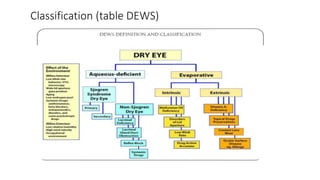
• According to International Dry Eye Workshop report (DEWS report 2007), the
causes of dry eye can be classified as :
• I. Aqueous deficiency dry eye
• II. Evaporative dry eye
Classification (table DEWS)
Etiology & causes of dry eyes
• I. Aqueous deficiency dry eye
• It is also known as keratoconjunctivitis sicca (KCS). Its causes include:
• a. Sjogren’s syndrome (Primary keratoconjunctivitis sicca).
• b. Non-Sjogren’s keratoconjunctivitis sicca. Causes are :
• 1. Primary age-related hyposecretion is the most common cause.
• 2. Lacrimal gland deficiencies as seen in congenital absence of gland , infiltrations of
lacrimal gland by e.g., tumours, post-radiation fibrosis of lacrimal gland & surgical
removal of gland .
OTHER CAUSES OF AQUEOUS DEFICINECY DRY EYES
• 3. Lacrimal gland duct obstruction as seen in old trachoma, chemical burns &
Stevens-Johnson syndrome. (SJS)
• 4. Reflex hyposecretion (neurogenic causes) as seen in Parkinson disease, reflex
sensory block, 7th cranial nerve damage, reduced corneal sensations after
refractive surgery & corneal lens wear.
II. Evaporative dry eye : caused by the conditions which decrease
tear film stability & thus increase evaporation.
• 1. Meibomian gland dysfunction as seen in chronic posterior blepharitis, rosacea,
& congenital absence of meibomian glands.
• 2. Lagophthalmos as seen in facial nerve palsy, severe proptosis & symblepharon
• 3. Defective blinking such as low blink rate as seen in prolonged computer users .
• 4. Vitamin A deficiency
Clinical features Symptoms suggestive of dry eye
• Irritation, foreign body (sandy) sensation, feeling of dryness, itching, nonspecific
ocular discomfort & chronically sore eyes not responding to a variety of eye drops .
Signs of dry eyes
• Tear film signs. :
• It may show presence of stingy mucous .
• Marginal tear strip is reduced or absent (normal height is 1 mm).
• Froth in the tears along the lid margin is a sign of meibomian gland dysfunction
(MGD)
• Conjunctival signs.
• It becomes lustureless, mildly congested, conjunctival xerosis & keratinization m ay
occur. Rose Bengal or Lisamin green staining may be positive .
• Corneal signs.
• It may show punctate epithelial erosions /spk , filaments & mucus plaques.
• Cornea may loose lusture.
• Vital stains, fluorescein, Rose Bengal or Lisamin green may diagnose this lesion .
• Signs of causative disease such as posterior blepharitis, conjunctival scarring
diseases (trachoma, Stevens-Johnson syndrome & chemical burns etc. ) &
lagophthalmos may be present .
TEAR FILM TEST
• These include tear film break-up time (BUT), Schirmer-I test, vital staining with Rose
Bengal, tear levels of lysozyme & lactoferrin, tear osmolarity & conjunctival
impression cytology.
• Out of these TFBUT, Schirmer-I test & Rose Bengal staining are important to
diagnose dry eyes ( OSD )
DIAGNOSTIC TESTS
The tests measure the following parameters:
• Stability of tear film as related to its break-up time (BUT)
• Tear production (schirmer, fluorescein clearance and tear osmolarity)
• Ocular surface disease (corneal stains)
diagnosis : clinical evaluation .
Tests For Tear Hyposecretions
Tear Film Break-up Time (TBUT)
• It is done to assess the stability of the precorneal tear film.
• It is abnormal in aqueous tear deficiency and Meibomian gland disorder.
Procedure:
• Fluorescein strip is moistened with non- preserved saline is instilled into the lower
fornix.
• At the slit lamp with a broad beam using cobalt blue filter tear film is examined
• After interval of time black spots or line indicating dry spots appear in the tear film.
• BUT is the time between the last blink and the appearance of the first randomly
appearance distributed dry spot.
• Normal value >10sec, marginal 5-10sec, severe <5sec
NON- INVASIVE TEAR BREAK-UPTIME
• Non- Invasive Technique
• Can Be Done By Using Placido Disc, Keratometer, Auto-refractometer, tearscope
Or Keratograph 5m.
• Procedure Same As TBUT
• Normal >20sec
• Marginal 10-20sec
• Abnormal <10sec
SCHIRMER TEST
SCHIRMER’S I TEST WITHOUT ANESTHESIA:
• The person is seated comfortably at rest
• The filter paper is folded at 5mm distance from one end and placed over the
lower lid margin taking care not to touch the cornea during the procedure
• Place it at the junction of medial 2/3rd and lateral 1/3rd of the lower lid for a
period of 5 minutes
• The wetting of the strip is recorded at the end of 5 minutes
type 2 Schirmer ….
SCHIRMER’S I TEST WITH ANESTHESIA
• Done 15 minutes after doing the test without anesthesia
• Proparacaine hydrochloride 0.5% is instilled into the lower conjunctival cul-de-
sac
• 1 drop, is instilled 1 minute apart for 2 times
• The excess anesthetic solution in the lower conjunctival cul-de-sac is gently
wiped off with a cotton tipped applicator 1 minute after instillation of the last
drop of proparacaine
• Filter paper is placed in the same manner as done for the procedure without
anesthesia for 5 minutes
• The wetting of the strip is recorded at the end of 5 minutes
• Without anesthesia: the basal tear secretion and the function of the main
lacrimal gland whose secretory activity is stimulated by the irritating nature of
the filter paper.
• After topical anesthesia: the function of the basal lacrimal secretion
• Normal schirmer test i values >10 mm in 2 minutes,
• Abnormal values without anesthesia: <10mm in 5 minutes
• With anesthesia: 10mm in 5min
TEAR MINISCUS HEIGHT
• Measures the tear meniscus formed on the amount of tears
resting at the
• junction of the bulbar conjunctiva and the lower eyelidmargin.
• Can be done with or without staining
• Thin Optic Section
• Primary Gaze
• Middle Of Lower Lid Margin
• Normal Blinking
• Normal meniscus height is 0.2–0.5 mm
• A value of <0.2mm suggests a tear insufficiency
PHENOL REDTHREAD TEST
A soft thread is touched to the lid and the results are obtained in 15 seconds per
eye
PROCEDURE:
• Remove the thread by peeling the film
• Bend 3mm end of the thread
• Pull lower eyelid slightly down & place 3mm folded thread on palpebral
conjunctival junction
• Patient is asked to look straight and blink normally
• After 15 second the thread is gently removed with an upward motion
• The entire length of the red portion of the thread is measured in mm from the
very tip regardless of the fold
• True dryness <10 mm wetting, borderline 10 to 20 mm wetting , and >20 mm
ROSEBENGALSTAINING
• Rose bengal is a fluorescein derivative
• It was thought to stain only devitalized epithelial cells but it also stains healthy
epithelial cells when they are not protected by a healthy layer of mucin
• It has the unique property of evaluating the protective status of the preocular tearfilm.
• It also stains dead or degenerating cells, lipid-contaminated mucous strands, and
corneal epithelial filaments
• Rose Bengal causes significant ocular discomfort
• It can be difficult differentiating its red stain in patients with inflamed red eyes
• The interpretation of rose Bengal staining in dry eyes is based on two factors, intensity
and location.
• A grading scale that evaluates the intensity based on a scale of 0 to 3 in three areas:
nasal conjunctiva, temporal conjunctiva and cornea, with a maximum possible score of 9
• May help to differentiate between ATD and lipid tear deficiency (LTD) by
studying the distribution of stain in the non-exposure zone
• Preferential staining has been observed in non exposure zones in the LTD
• In ATD the staining is seen in the exposed interpalpebral areas.
Rose Bengal stain
HOME WORK
1. What is dry eye ? Classification of dry eyes ?
2. What is tear film ? What are layers of tear film ?
3. What are the function of tear film ?
4. What are the signs & symptoms of dry eye ?
5. What are normal investigation done to diagnose dry eye syndrome ?
6. What are the causes of of dry eye ?
7. What is Schirmer test 1 & 2 ? What is procedure ?
8. What in normal tear meniscus ? What is the significane of that ?
9. Explain in brief rose Bengal test to diagnose dry eye ?
ThankYou

Dry eye ( investiigations &amp; basic )

  • 1.
    DRY EYE (INTRODUCTION , INVESTIGATIONS & BASIC ) DR. REENA SCEH, LAHAN CORNEA CONSULTANT
  • 2.
    TEAR FILM :Structure of tear film • Wolff was the first to describe the detailed structure of the fluid covering the cornea & called it precorneal film. • It consist of three layers, which from posterior to anterior are mucus layer, aqueous layer & lipid or oily layer • Normal thickness of tear film will be 7 to 9 um
  • 3.
  • 4.
    Normally there are3 layers of tear lilm • 1. Mucus layer. It is the innermost & about 0.2 mm thick stratum of the tear film. It consists of mucin secreting conjunctival goblet cells & glands of Manz. It converts the hydrophobic corneal surface into hydrophilic one.
  • 5.
    • 2. Aqueouslayer. The bulk of tear film (7.0 mm) is formed by this intermediate layer which consists of tears secreted by the main & accessory lacrimal glands. The tears mainly comprise of water & small quantities of solutes such as sodium chloride, sugar, urea & proteins. Therefore, it is alkaline & salty in taste. It also contains antibacterial substances like lysozyme, betalysin & lactoferrin.
  • 6.
    • 3. Lipidor oily layer. • This is the outermost & thinnest (0.1 mm) layer of tear film formed at air-tear interface from the secretions of meibomian, zeis & moll glands. • This layer prevents the overflow of tears, retards their evaporation & lubricates the eyelids as they slide over the surface of the globe
  • 7.
    Function of thetear film • 1. Keeps moist the cornea & conjunctiva. • 2. Provides oxygen to the corneal epithelium. • 3. Washes away debris & irritants. • 4. Prevents infection due to presence of anti-bacterial substances. • 5. Facilitates movements of the lids over the globe
  • 8.
    Secretion of thetear ( basic mechanism ) • Tears are continuously secreted throughout the day by accessory (basal secretion) & main (reflex secretion) lacrimal glands. • Reflex secretion is in response to sensations from the cornea & conjunctiva. • Hyperlacrimation occurs due to irritative sensations from the cornea & conjunctiva. • Afferent pathway of this secretion is formed by fifth nerve & efferent by parasympathetic (secretomotor) supply of lacrimal gland .
  • 9.
    Elimination of tear& lacrimal pump mechanism ? • About 70% tears is drained via inferior canaliculus & 30% via the superior canaliculus by an active lacrimal pump mechanism…. • When the eyelids close with each blink there occurs: • • Contraction of pretarsal orbicularis oculi which compresses the ampulla & shortens the canaliculi. This movement expel the tear fluid present in the ampulla & horizontal part of canaliculi towards the lacrimal sac.
  • 10.
    lacrimal pump isfor tear elimination & it occure with each blink response
  • 11.
    • • Contractionof preseptal fibers of orbicularis distends the lacrimal sac & creates therein a negative pressure which draws the tear fluid from canaliculi into the lacrimal sac . Similarly other mechanism of lacrimal pump is due to relaxation of preseptal & pretarsal orbicularis .( when eyelids open )
  • 12.
    • When theeyelids open following events occur: • • Relaxation of pretarsal orbicularis allows the canaliculi & ampulla to expand & reopen, and to draw the tear fluid from the lacus lacrimalis and marginal tear strips. • • Relaxation of preseptal fibres (Horner’s muscle) results in collapse of sac, as a consequence a positive pressure is created which forces the tears down the nasolacrimal duct (NLD) into the nose. Gravity also helps in downward flow of tears along the NLD.
  • 13.
    DRY EYE (OSD): The dry eye is not a disease entity, but a symptom complex occurring as a sequelae to deficiency or abnormalities of the tear film. • According to International Dry Eye Workshop report (DEWS report 2007), the causes of dry eye can be classified as : • I. Aqueous deficiency dry eye • II. Evaporative dry eye
  • 14.
  • 15.
    Etiology & causesof dry eyes • I. Aqueous deficiency dry eye • It is also known as keratoconjunctivitis sicca (KCS). Its causes include: • a. Sjogren’s syndrome (Primary keratoconjunctivitis sicca). • b. Non-Sjogren’s keratoconjunctivitis sicca. Causes are : • 1. Primary age-related hyposecretion is the most common cause. • 2. Lacrimal gland deficiencies as seen in congenital absence of gland , infiltrations of lacrimal gland by e.g., tumours, post-radiation fibrosis of lacrimal gland & surgical removal of gland .
  • 16.
    OTHER CAUSES OFAQUEOUS DEFICINECY DRY EYES • 3. Lacrimal gland duct obstruction as seen in old trachoma, chemical burns & Stevens-Johnson syndrome. (SJS) • 4. Reflex hyposecretion (neurogenic causes) as seen in Parkinson disease, reflex sensory block, 7th cranial nerve damage, reduced corneal sensations after refractive surgery & corneal lens wear.
  • 17.
    II. Evaporative dryeye : caused by the conditions which decrease tear film stability & thus increase evaporation. • 1. Meibomian gland dysfunction as seen in chronic posterior blepharitis, rosacea, & congenital absence of meibomian glands. • 2. Lagophthalmos as seen in facial nerve palsy, severe proptosis & symblepharon • 3. Defective blinking such as low blink rate as seen in prolonged computer users . • 4. Vitamin A deficiency
  • 18.
    Clinical features Symptomssuggestive of dry eye • Irritation, foreign body (sandy) sensation, feeling of dryness, itching, nonspecific ocular discomfort & chronically sore eyes not responding to a variety of eye drops .
  • 19.
    Signs of dryeyes • Tear film signs. : • It may show presence of stingy mucous . • Marginal tear strip is reduced or absent (normal height is 1 mm). • Froth in the tears along the lid margin is a sign of meibomian gland dysfunction (MGD)
  • 20.
    • Conjunctival signs. •It becomes lustureless, mildly congested, conjunctival xerosis & keratinization m ay occur. Rose Bengal or Lisamin green staining may be positive . • Corneal signs. • It may show punctate epithelial erosions /spk , filaments & mucus plaques. • Cornea may loose lusture. • Vital stains, fluorescein, Rose Bengal or Lisamin green may diagnose this lesion .
  • 21.
    • Signs ofcausative disease such as posterior blepharitis, conjunctival scarring diseases (trachoma, Stevens-Johnson syndrome & chemical burns etc. ) & lagophthalmos may be present .
  • 22.
    TEAR FILM TEST •These include tear film break-up time (BUT), Schirmer-I test, vital staining with Rose Bengal, tear levels of lysozyme & lactoferrin, tear osmolarity & conjunctival impression cytology. • Out of these TFBUT, Schirmer-I test & Rose Bengal staining are important to diagnose dry eyes ( OSD )
  • 23.
    DIAGNOSTIC TESTS The testsmeasure the following parameters: • Stability of tear film as related to its break-up time (BUT) • Tear production (schirmer, fluorescein clearance and tear osmolarity) • Ocular surface disease (corneal stains)
  • 24.
  • 25.
    Tests For TearHyposecretions Tear Film Break-up Time (TBUT) • It is done to assess the stability of the precorneal tear film. • It is abnormal in aqueous tear deficiency and Meibomian gland disorder. Procedure: • Fluorescein strip is moistened with non- preserved saline is instilled into the lower fornix. • At the slit lamp with a broad beam using cobalt blue filter tear film is examined • After interval of time black spots or line indicating dry spots appear in the tear film. • BUT is the time between the last blink and the appearance of the first randomly appearance distributed dry spot. • Normal value >10sec, marginal 5-10sec, severe <5sec
  • 27.
    NON- INVASIVE TEARBREAK-UPTIME • Non- Invasive Technique • Can Be Done By Using Placido Disc, Keratometer, Auto-refractometer, tearscope Or Keratograph 5m. • Procedure Same As TBUT • Normal >20sec • Marginal 10-20sec • Abnormal <10sec
  • 28.
    SCHIRMER TEST SCHIRMER’S ITEST WITHOUT ANESTHESIA: • The person is seated comfortably at rest • The filter paper is folded at 5mm distance from one end and placed over the lower lid margin taking care not to touch the cornea during the procedure • Place it at the junction of medial 2/3rd and lateral 1/3rd of the lower lid for a period of 5 minutes • The wetting of the strip is recorded at the end of 5 minutes
  • 29.
  • 30.
    SCHIRMER’S I TESTWITH ANESTHESIA • Done 15 minutes after doing the test without anesthesia • Proparacaine hydrochloride 0.5% is instilled into the lower conjunctival cul-de- sac • 1 drop, is instilled 1 minute apart for 2 times • The excess anesthetic solution in the lower conjunctival cul-de-sac is gently wiped off with a cotton tipped applicator 1 minute after instillation of the last drop of proparacaine • Filter paper is placed in the same manner as done for the procedure without anesthesia for 5 minutes • The wetting of the strip is recorded at the end of 5 minutes
  • 31.
    • Without anesthesia:the basal tear secretion and the function of the main lacrimal gland whose secretory activity is stimulated by the irritating nature of the filter paper. • After topical anesthesia: the function of the basal lacrimal secretion • Normal schirmer test i values >10 mm in 2 minutes, • Abnormal values without anesthesia: <10mm in 5 minutes • With anesthesia: 10mm in 5min
  • 34.
    TEAR MINISCUS HEIGHT •Measures the tear meniscus formed on the amount of tears resting at the • junction of the bulbar conjunctiva and the lower eyelidmargin. • Can be done with or without staining • Thin Optic Section • Primary Gaze • Middle Of Lower Lid Margin • Normal Blinking • Normal meniscus height is 0.2–0.5 mm • A value of <0.2mm suggests a tear insufficiency
  • 35.
    PHENOL REDTHREAD TEST Asoft thread is touched to the lid and the results are obtained in 15 seconds per eye PROCEDURE: • Remove the thread by peeling the film • Bend 3mm end of the thread • Pull lower eyelid slightly down & place 3mm folded thread on palpebral conjunctival junction • Patient is asked to look straight and blink normally • After 15 second the thread is gently removed with an upward motion • The entire length of the red portion of the thread is measured in mm from the very tip regardless of the fold • True dryness <10 mm wetting, borderline 10 to 20 mm wetting , and >20 mm
  • 36.
    ROSEBENGALSTAINING • Rose bengalis a fluorescein derivative • It was thought to stain only devitalized epithelial cells but it also stains healthy epithelial cells when they are not protected by a healthy layer of mucin • It has the unique property of evaluating the protective status of the preocular tearfilm. • It also stains dead or degenerating cells, lipid-contaminated mucous strands, and corneal epithelial filaments • Rose Bengal causes significant ocular discomfort • It can be difficult differentiating its red stain in patients with inflamed red eyes • The interpretation of rose Bengal staining in dry eyes is based on two factors, intensity and location. • A grading scale that evaluates the intensity based on a scale of 0 to 3 in three areas: nasal conjunctiva, temporal conjunctiva and cornea, with a maximum possible score of 9
  • 37.
    • May helpto differentiate between ATD and lipid tear deficiency (LTD) by studying the distribution of stain in the non-exposure zone • Preferential staining has been observed in non exposure zones in the LTD • In ATD the staining is seen in the exposed interpalpebral areas.
  • 39.
  • 40.
    HOME WORK 1. Whatis dry eye ? Classification of dry eyes ? 2. What is tear film ? What are layers of tear film ? 3. What are the function of tear film ? 4. What are the signs & symptoms of dry eye ? 5. What are normal investigation done to diagnose dry eye syndrome ? 6. What are the causes of of dry eye ? 7. What is Schirmer test 1 & 2 ? What is procedure ? 8. What in normal tear meniscus ? What is the significane of that ? 9. Explain in brief rose Bengal test to diagnose dry eye ?
  • 41.