1
Dry Eye Disease
DR SARANSH JAIN
24/06/2015
Outline of presentation
INTRODUCTION
LACRIMAL FUNCTION UNIT PATHOPHYSIOLOGY
EPIDEMIOLOGY
CLASSIFICATION/GRADING
CLINICAL FEATURES AND EVALUATION
MANAGEMENT
INTRODUCTION
• Dry eye is a multifactorial disease of the tears
and the ocular surface that results in symptoms
of discomfort, visual disturbance, and tear film
instability with potential damage to then ocular
surface.
• accompanied by increased osmolarity of the tear
film and inflammation of the ocular surface
*2007 Report of the Dry Eye Work Shop (Ocul Surf 2007;5[2]:65-204)
• Ocular surface- entire sheet of epithelium
which extends from grey line back over the
lid margin onto the back of eyelids, inferior
fornix up over the globe and onto cornea
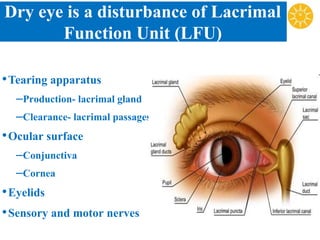
Dry eye is a disturbance of Lacrimal
Function Unit (LFU)
•Tearing apparatus
–Production- lacrimal gland
–Clearance- lacrimal passages
•Ocular surface
–Conjunctiva
–Cornea
•Eyelids
•Sensory and motor nerves
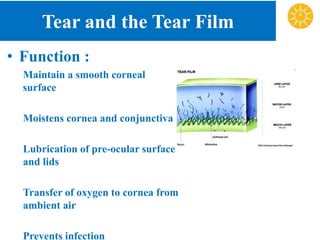
Tear and the Tear Film
• Function :
Maintain a smooth corneal
surface
Moistens cornea and conjunctiva
Lubrication of pre-ocular surface
and lids
Transfer of oxygen to cornea from
ambient air
Prevents infection
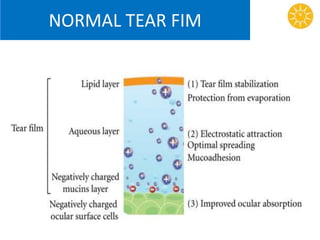
NORMAL TEAR FIM
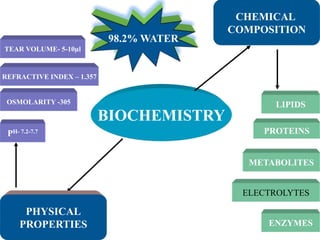
BIOCHEMISTRY
PHYSICAL
PROPERTIES
CHEMICAL
COMPOSITION
PH- 7.2-7.7
OSMOLARITY -305
REFRACTIVE INDEX – 1.357
TEAR VOLUME- 5-10µl
LIPIDS
PROTEINS
METABOLITES
ELECTROLYTES
ENZYMES
98.2% WATER
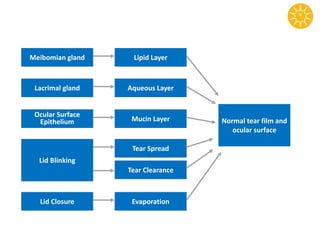
Meibomian gland
Lacrimal gland
Ocular Surface
Epithelium
Lid Blinking
Lid Closure
Lipid Layer
Aqueous Layer
Mucin Layer
Tear Spread
Evaporation
Tear Clearance
Normal tear film and
ocular surface
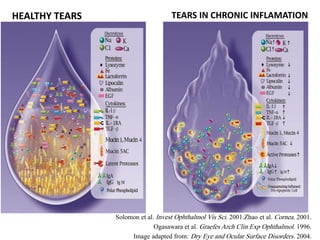
HEALTHY TEARS TEARS IN CHRONIC INFLAMATION
Solomon et al. Invest Ophthalmol Vis Sci. 2001.Zhao et al. Cornea. 2001.
Ogasawara et al. Graefes Arch Clin Exp Ophthalmol. 1996.
Image adapted from: Dry Eye and Ocular Surface Disorders. 2004.
*2007 Report of the Dry Eye Work Shop (Ocul Surf 2007;5[2]:65-204)
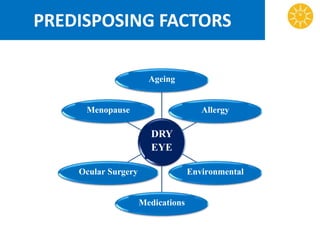
PREDISPOSING FACTORS
DRY
EYE
Ageing
Allergy
Environmental
Medications
Ocular Surgery
Menopause
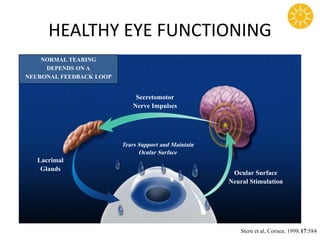
HEALTHY EYE FUNCTIONING
Stern et al, Cornea. 1998:17:584
NORMAL TEARING
DEPENDS ON A
NEURONAL FEEDBACK LOOP
Secretomotor
Nerve Impulses
Tears Support and Maintain
Ocular Surface
Lacrimal
Glands Ocular Surface
Neural Stimulation
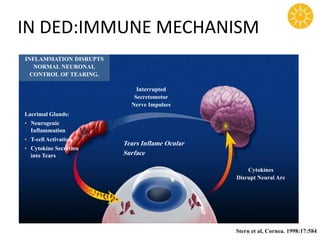
IN DED:IMMUNE MECHANISM
INFLAMMATION DISRUPTS
NORMAL NEURONAL
CONTROL OF TEARING.
Lacrimal Glands:
• Neurogenic
Inflammation
• T-cell Activation
• Cytokine Secretion
into Tears
Interrupted
Secretomotor
Nerve Impulses
Tears Inflame Ocular
Surface
Cytokines
Disrupt Neural Arc
Stern et al, Cornea. 1998:17:584
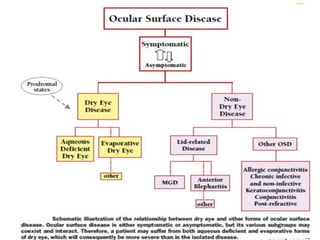
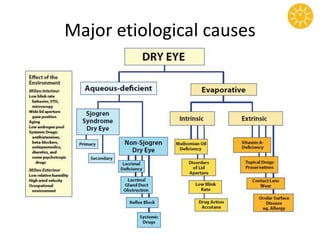
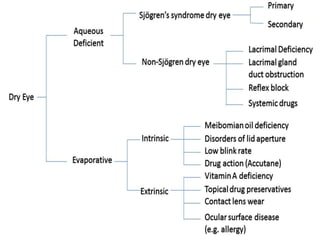
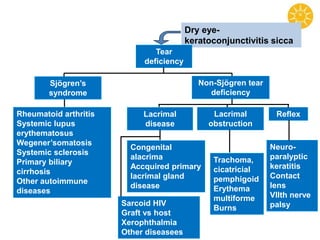
Major etiological causes
Dry eye-
keratoconjunctivitis sicca
Tear
deficiency
Sjögren’s
syndrome
Non-Sjögren tear
deficiency
Rheumatoid arthritis
Systemic lupus
erythematosus
Wegener’somatosis
Systemic sclerosis
Primary biliary
cirrhosis
Other autoimmune
diseases
Lacrimal
disease
Lacrimal
obstruction
Reflex
Congenital
alacrima
Accquired primary
lacrimal gland
disease
Trachoma,
cicatricial
pemphigoid
Erythema
multiforme
Burns
Neuro-
paralyptic
keratitis
Contact
lens
VIIth nerve
palsySarcoid HIV
Graft vs host
Xerophthalmia
Other diseasees
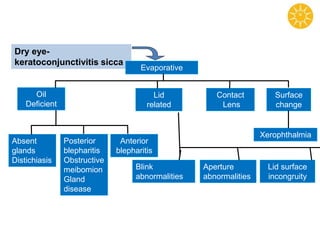
Dry eye-
keratoconjunctivitis sicca
Evaporative
Oil
Deficient
Lid
related
Contact
Lens
Surface
change
Absent
glands
Distichiasis
Posterior
blepharitis
Obstructive
meibomion
Gland
disease
Anterior
blepharitis
Blink
abnormalities
Lid surface
incongruity
Aperture
abnormalities
Xerophthalmia
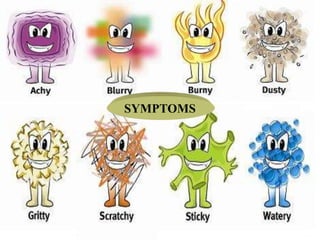
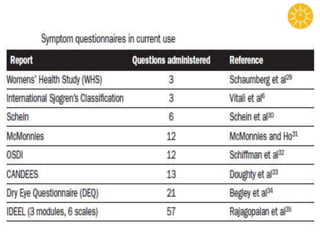
SYMPTOMS
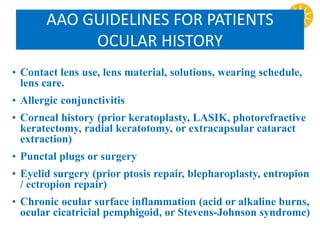
AAO GUIDELINES FOR PATIENTS
OCULAR HISTORY
• Contact lens use, lens material, solutions, wearing schedule,
lens care.
• Allergic conjunctivitis
• Corneal history (prior keratoplasty, LASIK, photorefractive
keratectomy, radial keratotomy, or extracapsular cataract
extraction)
• Punctal plugs or surgery
• Eyelid surgery (prior ptosis repair, blepharoplasty, entropion
/ ectropion repair)
• Chronic ocular surface inflammation (acid or alkaline burns,
ocular cicatricial pemphigoid, or Stevens-Johnson syndrome)
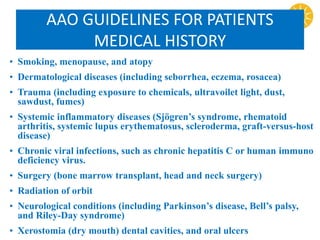
AAO GUIDELINES FOR PATIENTS
MEDICAL HISTORY
• Smoking, menopause, and atopy
• Dermatological diseases (including seborrhea, eczema, rosacea)
• Trauma (including exposure to chemicals, ultravoilet light, dust,
sawdust, fumes)
• Systemic inflammatory diseases (Sjögren’s syndrome, rhematoid
arthritis, systemic lupus erythematosus, scleroderma, graft-versus-host
disease)
• Chronic viral infections, such as chronic hepatitis C or human immuno
deficiency virus.
• Surgery (bone marrow transplant, head and neck surgery)
• Radiation of orbit
• Neurological conditions (including Parkinson’s disease, Bell’s palsy,
and Riley-Day syndrome)
• Xerostomia (dry mouth) dental cavities, and oral ulcers
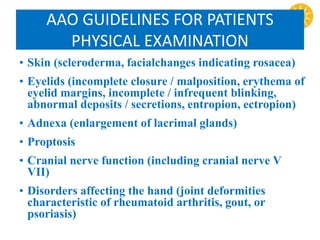
AAO GUIDELINES FOR PATIENTS
PHYSICAL EXAMINATION
• Skin (scleroderma, facialchanges indicating rosacea)
• Eyelids (incomplete closure / malposition, erythema of
eyelid margins, incomplete / infrequent blinking,
abnormal deposits / secretions, entropion, ectropion)
• Adnexa (enlargement of lacrimal glands)
• Proptosis
• Cranial nerve function (including cranial nerve V
VII)
• Disorders affecting the hand (joint deformities
characteristic of rheumatoid arthritis, gout, or
psoriasis)
AAO GUIDELINES FOR PATIENTS SLIT
LAMP EXAMINATION
• Tear film (height of meniscus, debris, foam)
• Eyelashes (trichiasis, distichiasis, madrosis, deposits)
• Anterior / posterior eyelid margins and character of
meibomian gland secretions
• Vascularisation crossing the mucocutaneous junction,
ketatini-zation, and scarring
• Puncta (patency and position)
• Conjunctiva (inferior formix and tarsal conjunctiva and bulbar
conjunctiva)
• Cornea (localized interpalpebral drying, punctuate epithelial
erosions, filaments, microepitrlial defects, punctate staining
with rose bengal or fluorescein dyes, mucous plaques,
keratinization, pannusformation, thinning, infiltrates,
ulceration, neovascularisation, and scarring)
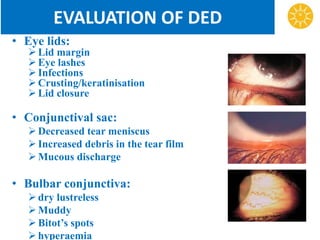
EVALUATION OF DED
• Eye lids:
Lid margin
Eye lashes
Infections
Crusting/keratinisation
Lid closure
• Conjunctival sac:
Decreased tear meniscus
Increased debris in the tear film
Mucous discharge
• Bulbar conjunctiva:
dry lustreless
Muddy
Bitot’s spots
hyperaemia
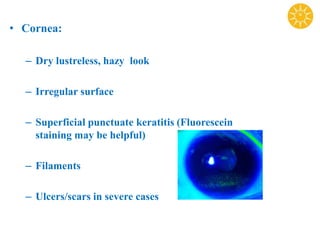
• Cornea:
– Dry lustreless, hazy look
– Irregular surface
– Superficial punctuate keratitis (Fluorescein
staining may be helpful)
– Filaments
– Ulcers/scars in severe cases
DIAGNOSTIC TESTS
• Aims :
– Tear secretion assessment
– Tear volume assessment
– Tear clearance assessment
– Evaluation of tear film stability
– Ocular surface damage assessment
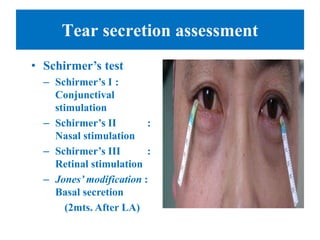
Tear secretion assessment
• Schirmer’s test
– Schirmer’s I :
Conjunctival
stimulation
– Schirmer’s II :
Nasal stimulation
– Schirmer’s III :
Retinal stimulation
– Jones’ modification :
Basal secretion
(2mts. After LA)
Tear clearance assessment
• Fluorescein clearance test
• Basal tear secretion
• Reflex tear secretion
• Tear clearance
• Fluorophotometry
• Tear function index
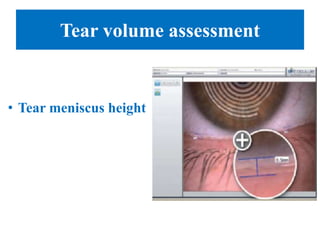
Tear volume assessment
• Tear meniscus height
Evaluation of tear film stability
• Tear film break-up
time (TBUT)
• Fluorescein TBUT
• Non-invasive TBUT
• Lipid layer
assessment
NIBUT
• Corneal Topography
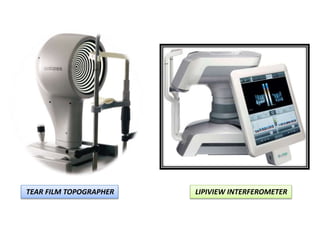
• Interferometry
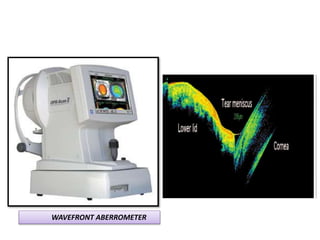
• Aberrometry
• Functional visual acuity assessment
• Confocal microscopy
LIPIVIEW INTERFEROMETERTEAR FILM TOPOGRAPHER
WAVEFRONT ABERROMETER
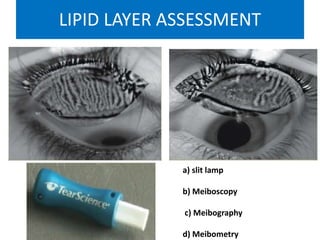
LIPID LAYER ASSESSMENT
a) slit lamp
b) Meiboscopy
c) Meibography
d) Meibometry
Ocular surface damage assessment
• Staining
• Corneal sensitivity
• Impression cytology
• Tear osmolarity
• Tear protein assays
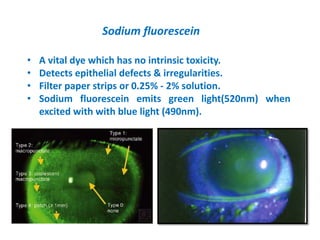
• A vital dye which has no intrinsic toxicity.
• Detects epithelial defects & irregularities.
• Filter paper strips or 0.25% - 2% solution.
• Sodium fluorescein emits green light(520nm) when
excited with with blue light (490nm).
Sodium fluorescein
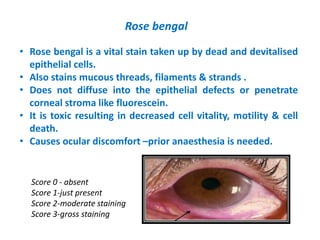
Rose bengal
• Rose bengal is a vital stain taken up by dead and devitalised
epithelial cells.
• Also stains mucous threads, filaments & strands .
• Does not diffuse into the epithelial defects or penetrate
corneal stroma like fluorescein.
• It is toxic resulting in decreased cell vitality, motility & cell
death.
• Causes ocular discomfort –prior anaesthesia is needed.
Score 0 - absent
Score 1-just present
Score 2-moderate staining
Score 3-gross staining
• Dark green, water soluble
• Degenerated cells, mucus, dead cells
• Less irritating
Lissamine green
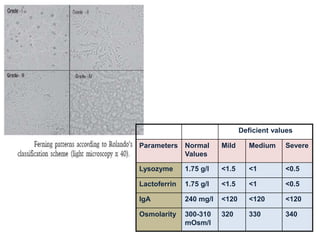
Deficient values
Parameters Normal
Values
Mild Medium Severe
Lysozyme 1.75 g/l <1.5 <1 <0.5
Lactoferrin 1.75 g/l <1.5 <1 <0.5
IgA 240 mg/l <120 <120 <120
Osmolarity 300-310
mOsm/l
320 330 340
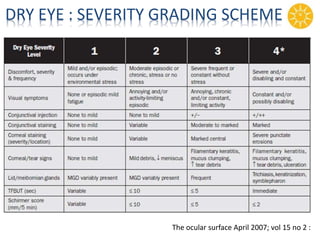
DRY EYE : SEVERITY GRADING SCHEME
The ocular surface April 2007; vol 15 no 2 :
MANAGEMENT
• Goals of management:
– Establish the diagnosis.
– Differentiate from other causes of similar symptoms.
– Establish presence/absence of limbal cell deficiency.
– Decide appropriate therapy.
• To relieve symptoms
• To prevent complications
– Educate patient / relatives about nature of disease and its
management.
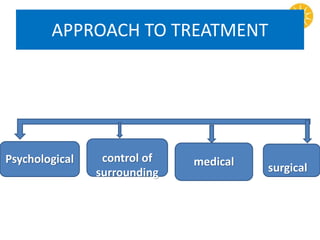
Psychological control of
surrounding
medical surgical
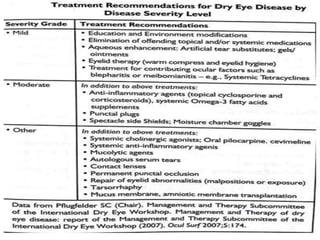
APPROACH TO TREATMENT
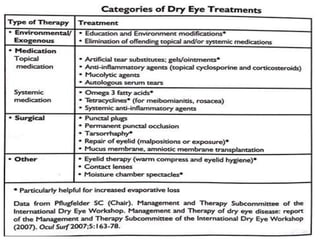
• Elimination/avoidance of exacerbating factors
which
• Decrease tear production
• Increase tear evaporation
– Humidification of rooms
– Avoidance of dusty/smoky rooms
– Breaks between prolonged computer use
– Lowering the computer monitor below eye level
– Low water content contact lenses for Shorter
duration at a time.
– Blinking exercises*
*Wolkoff P et al. Occup Environ Med 2005;62:4-12
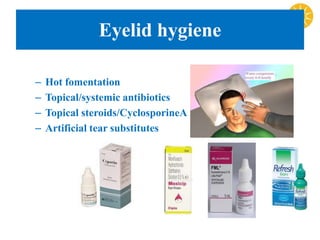
Eyelid hygiene
– Hot fomentation
– Topical/systemic antibiotics
– Topical steroids/CyclosporineA
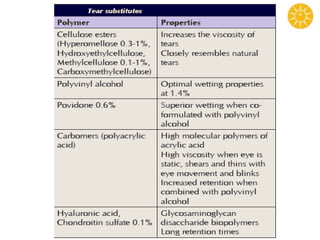
– Artificial tear substitutes
1.Tear supplementation
• Be preservative free
• Contain K+, HCO3
- and other electrolytes
• Have a polymeric system to increase its viscosity, hence retention time
• Have neutral to slightly alkaline Ph
• Have osmolarity- 181-354 mOsm/L
• Gels (carbomers) require less frequent
application than drops.
• Ointments using petrolatum, lanolin and
mineral oil base, dissolve at the temperature
of ocular tissue, retained in the cul-de-sac for
long - used mainly at night time.
Anti-inflammatory therapy
• Topical cyclosporine(0.05%-0.1% - two to four times a day)
• Only pharmacological agent approved by FDA for treatment of dry eye
• Reduces conjunctival IL-6 levels, activated lymphocytes, inflammatory
and apoptotic markers
• Increases conjunctival goblet cell number
• Corticosteroids
• Recommended only for short-term use
• Systemic medications
• Oral tetracyclines (used for anti-inflammatory action)
– Decrease matrix metalloproteinase activity and production of cytokines such as IL-1
and TNF-ɑ
A stagnant and
unstable tear film
who continue to
have symptoms that
are not relieved by
artificial tears
AND/OR corneal
epithelial disease.
Newer treatment modalities
• Ocular inserts6-
• Cylindrical rod containing
5mg Hydroxypropyl
methyl cellulose (HPMC)
placed in the lower cul-
de-sac.
• Imbibes fluid and swells
• Lasts for 12 -24 hrs
• Secretagogues
• Stimulate endogenous
tear production
• Oral pilocarpine
(Salagen) 5mg four times
a day7 – cholinergic side
effects.
• Cevilemine – Fewer side
effects
Newer treatment modalities
• Mucolytic agents as
acetylcysteine 5% drops
used in patients with
corneal filaments and
mucous plaques.
• Autologous serum
drops [diluted 1:3 with
saline] have reported to
reduce ocular irritation
and conjuntival and
corneal dye staining in
Sjogren’s syndrome
associated aqueous tear
deficiency.
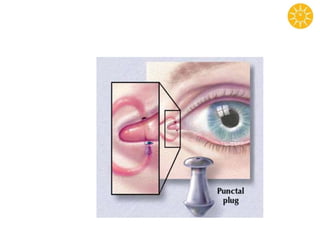
• Tear retention
–Punctal occlusion: Temporary and Permanent.
• Absorbable
– collagen or polymers
– Duration- 1 week- 6 months
• Nonabsorbable
– Silicone or acrylic
–Moisture chamber spectacles
–Contact lenses
• Severe dry eye
– Retain tear film
– Promote ocular surface healing
–Tarsorrhaphy
Surgical options
• Reserved for severe-very severe dry eyes
• Tarsorrhaphy
• Mucous membrane grafting
• Salivary gland transposition
• Amniotic membrane transplantation
NEWER DRUGS ON THE BLOCK
– Tear stimulation: secretogogues
• Diquafosol (P2y2 receptor agonist)
• Ecabet sodium (mucous secretion stimulant)
• Rebamipide
• Gefarnate
– N-acetyl-cystine eye drops.
– Chloroquine Phosphate eye drops (0.3mg/ml).
– Lacriserts, collagen shields.
– Androgen ointment.
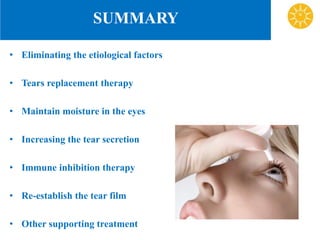
SUMMARY
• Eliminating the etiological factors
• Tears replacement therapy
• Maintain moisture in the eyes
• Increasing the tear secretion
• Immune inhibition therapy
• Re-establish the tear film
• Other supporting treatment
CARRY HOME MESSAGE…
• Methodical approach to diagnosis.
• Do not miss subtle clinical signs.
• Carefully plan the line of treatment.
• Irrespective of cause of dry eye- immunomodulation
+ tear replacement.
• Educate the patient and family members about the
dilemmas in management.

Dry eyes

  • 1.
    1 Dry Eye Disease DRSARANSH JAIN 24/06/2015
  • 2.
    Outline of presentation INTRODUCTION LACRIMALFUNCTION UNIT PATHOPHYSIOLOGY EPIDEMIOLOGY CLASSIFICATION/GRADING CLINICAL FEATURES AND EVALUATION MANAGEMENT
  • 3.
    INTRODUCTION • Dry eyeis a multifactorial disease of the tears and the ocular surface that results in symptoms of discomfort, visual disturbance, and tear film instability with potential damage to then ocular surface. • accompanied by increased osmolarity of the tear film and inflammation of the ocular surface *2007 Report of the Dry Eye Work Shop (Ocul Surf 2007;5[2]:65-204)
  • 4.
    • Ocular surface-entire sheet of epithelium which extends from grey line back over the lid margin onto the back of eyelids, inferior fornix up over the globe and onto cornea
  • 6.
    Dry eye isa disturbance of Lacrimal Function Unit (LFU) •Tearing apparatus –Production- lacrimal gland –Clearance- lacrimal passages •Ocular surface –Conjunctiva –Cornea •Eyelids •Sensory and motor nerves
  • 7.
    Tear and theTear Film • Function : Maintain a smooth corneal surface Moistens cornea and conjunctiva Lubrication of pre-ocular surface and lids Transfer of oxygen to cornea from ambient air Prevents infection
  • 8.
  • 9.
    BIOCHEMISTRY PHYSICAL PROPERTIES CHEMICAL COMPOSITION PH- 7.2-7.7 OSMOLARITY -305 REFRACTIVEINDEX – 1.357 TEAR VOLUME- 5-10µl LIPIDS PROTEINS METABOLITES ELECTROLYTES ENZYMES 98.2% WATER
  • 10.
    Meibomian gland Lacrimal gland OcularSurface Epithelium Lid Blinking Lid Closure Lipid Layer Aqueous Layer Mucin Layer Tear Spread Evaporation Tear Clearance Normal tear film and ocular surface
  • 11.
    HEALTHY TEARS TEARSIN CHRONIC INFLAMATION Solomon et al. Invest Ophthalmol Vis Sci. 2001.Zhao et al. Cornea. 2001. Ogasawara et al. Graefes Arch Clin Exp Ophthalmol. 1996. Image adapted from: Dry Eye and Ocular Surface Disorders. 2004.
  • 12.
    *2007 Report ofthe Dry Eye Work Shop (Ocul Surf 2007;5[2]:65-204)
  • 13.
  • 14.
    HEALTHY EYE FUNCTIONING Sternet al, Cornea. 1998:17:584 NORMAL TEARING DEPENDS ON A NEURONAL FEEDBACK LOOP Secretomotor Nerve Impulses Tears Support and Maintain Ocular Surface Lacrimal Glands Ocular Surface Neural Stimulation
  • 15.
    IN DED:IMMUNE MECHANISM INFLAMMATIONDISRUPTS NORMAL NEURONAL CONTROL OF TEARING. Lacrimal Glands: • Neurogenic Inflammation • T-cell Activation • Cytokine Secretion into Tears Interrupted Secretomotor Nerve Impulses Tears Inflame Ocular Surface Cytokines Disrupt Neural Arc Stern et al, Cornea. 1998:17:584
  • 18.
  • 20.
    Dry eye- keratoconjunctivitis sicca Tear deficiency Sjögren’s syndrome Non-Sjögrentear deficiency Rheumatoid arthritis Systemic lupus erythematosus Wegener’somatosis Systemic sclerosis Primary biliary cirrhosis Other autoimmune diseases Lacrimal disease Lacrimal obstruction Reflex Congenital alacrima Accquired primary lacrimal gland disease Trachoma, cicatricial pemphigoid Erythema multiforme Burns Neuro- paralyptic keratitis Contact lens VIIth nerve palsySarcoid HIV Graft vs host Xerophthalmia Other diseasees
  • 21.
  • 22.
  • 23.
    AAO GUIDELINES FORPATIENTS OCULAR HISTORY • Contact lens use, lens material, solutions, wearing schedule, lens care. • Allergic conjunctivitis • Corneal history (prior keratoplasty, LASIK, photorefractive keratectomy, radial keratotomy, or extracapsular cataract extraction) • Punctal plugs or surgery • Eyelid surgery (prior ptosis repair, blepharoplasty, entropion / ectropion repair) • Chronic ocular surface inflammation (acid or alkaline burns, ocular cicatricial pemphigoid, or Stevens-Johnson syndrome)
  • 24.
    AAO GUIDELINES FORPATIENTS MEDICAL HISTORY • Smoking, menopause, and atopy • Dermatological diseases (including seborrhea, eczema, rosacea) • Trauma (including exposure to chemicals, ultravoilet light, dust, sawdust, fumes) • Systemic inflammatory diseases (Sjögren’s syndrome, rhematoid arthritis, systemic lupus erythematosus, scleroderma, graft-versus-host disease) • Chronic viral infections, such as chronic hepatitis C or human immuno deficiency virus. • Surgery (bone marrow transplant, head and neck surgery) • Radiation of orbit • Neurological conditions (including Parkinson’s disease, Bell’s palsy, and Riley-Day syndrome) • Xerostomia (dry mouth) dental cavities, and oral ulcers
  • 26.
    AAO GUIDELINES FORPATIENTS PHYSICAL EXAMINATION • Skin (scleroderma, facialchanges indicating rosacea) • Eyelids (incomplete closure / malposition, erythema of eyelid margins, incomplete / infrequent blinking, abnormal deposits / secretions, entropion, ectropion) • Adnexa (enlargement of lacrimal glands) • Proptosis • Cranial nerve function (including cranial nerve V VII) • Disorders affecting the hand (joint deformities characteristic of rheumatoid arthritis, gout, or psoriasis)
  • 27.
    AAO GUIDELINES FORPATIENTS SLIT LAMP EXAMINATION • Tear film (height of meniscus, debris, foam) • Eyelashes (trichiasis, distichiasis, madrosis, deposits) • Anterior / posterior eyelid margins and character of meibomian gland secretions • Vascularisation crossing the mucocutaneous junction, ketatini-zation, and scarring • Puncta (patency and position) • Conjunctiva (inferior formix and tarsal conjunctiva and bulbar conjunctiva) • Cornea (localized interpalpebral drying, punctuate epithelial erosions, filaments, microepitrlial defects, punctate staining with rose bengal or fluorescein dyes, mucous plaques, keratinization, pannusformation, thinning, infiltrates, ulceration, neovascularisation, and scarring)
  • 28.
    EVALUATION OF DED •Eye lids: Lid margin Eye lashes Infections Crusting/keratinisation Lid closure • Conjunctival sac: Decreased tear meniscus Increased debris in the tear film Mucous discharge • Bulbar conjunctiva: dry lustreless Muddy Bitot’s spots hyperaemia
  • 29.
    • Cornea: – Drylustreless, hazy look – Irregular surface – Superficial punctuate keratitis (Fluorescein staining may be helpful) – Filaments – Ulcers/scars in severe cases
  • 30.
    DIAGNOSTIC TESTS • Aims: – Tear secretion assessment – Tear volume assessment – Tear clearance assessment – Evaluation of tear film stability – Ocular surface damage assessment
  • 31.
    Tear secretion assessment •Schirmer’s test – Schirmer’s I : Conjunctival stimulation – Schirmer’s II : Nasal stimulation – Schirmer’s III : Retinal stimulation – Jones’ modification : Basal secretion (2mts. After LA)
  • 32.
    Tear clearance assessment •Fluorescein clearance test • Basal tear secretion • Reflex tear secretion • Tear clearance • Fluorophotometry • Tear function index
  • 33.
    Tear volume assessment •Tear meniscus height
  • 34.
    Evaluation of tearfilm stability • Tear film break-up time (TBUT) • Fluorescein TBUT • Non-invasive TBUT • Lipid layer assessment
  • 35.
    NIBUT • Corneal Topography •Interferometry • Aberrometry • Functional visual acuity assessment • Confocal microscopy
  • 36.
  • 37.
  • 38.
    LIPID LAYER ASSESSMENT a)slit lamp b) Meiboscopy c) Meibography d) Meibometry
  • 39.
    Ocular surface damageassessment • Staining • Corneal sensitivity • Impression cytology • Tear osmolarity • Tear protein assays
  • 40.
    • A vitaldye which has no intrinsic toxicity. • Detects epithelial defects & irregularities. • Filter paper strips or 0.25% - 2% solution. • Sodium fluorescein emits green light(520nm) when excited with with blue light (490nm). Sodium fluorescein
  • 41.
    Rose bengal • Rosebengal is a vital stain taken up by dead and devitalised epithelial cells. • Also stains mucous threads, filaments & strands . • Does not diffuse into the epithelial defects or penetrate corneal stroma like fluorescein. • It is toxic resulting in decreased cell vitality, motility & cell death. • Causes ocular discomfort –prior anaesthesia is needed. Score 0 - absent Score 1-just present Score 2-moderate staining Score 3-gross staining
  • 42.
    • Dark green,water soluble • Degenerated cells, mucus, dead cells • Less irritating Lissamine green
  • 43.
    Deficient values Parameters Normal Values MildMedium Severe Lysozyme 1.75 g/l <1.5 <1 <0.5 Lactoferrin 1.75 g/l <1.5 <1 <0.5 IgA 240 mg/l <120 <120 <120 Osmolarity 300-310 mOsm/l 320 330 340
  • 44.
    DRY EYE :SEVERITY GRADING SCHEME The ocular surface April 2007; vol 15 no 2 :
  • 47.
    MANAGEMENT • Goals ofmanagement: – Establish the diagnosis. – Differentiate from other causes of similar symptoms. – Establish presence/absence of limbal cell deficiency. – Decide appropriate therapy. • To relieve symptoms • To prevent complications – Educate patient / relatives about nature of disease and its management.
  • 49.
    Psychological control of surrounding medicalsurgical APPROACH TO TREATMENT
  • 50.
    • Elimination/avoidance ofexacerbating factors which • Decrease tear production • Increase tear evaporation – Humidification of rooms – Avoidance of dusty/smoky rooms – Breaks between prolonged computer use – Lowering the computer monitor below eye level – Low water content contact lenses for Shorter duration at a time. – Blinking exercises* *Wolkoff P et al. Occup Environ Med 2005;62:4-12
  • 52.
    Eyelid hygiene – Hotfomentation – Topical/systemic antibiotics – Topical steroids/CyclosporineA – Artificial tear substitutes
  • 53.
    1.Tear supplementation • Bepreservative free • Contain K+, HCO3 - and other electrolytes • Have a polymeric system to increase its viscosity, hence retention time • Have neutral to slightly alkaline Ph • Have osmolarity- 181-354 mOsm/L
  • 55.
    • Gels (carbomers)require less frequent application than drops. • Ointments using petrolatum, lanolin and mineral oil base, dissolve at the temperature of ocular tissue, retained in the cul-de-sac for long - used mainly at night time.
  • 56.
    Anti-inflammatory therapy • Topicalcyclosporine(0.05%-0.1% - two to four times a day) • Only pharmacological agent approved by FDA for treatment of dry eye • Reduces conjunctival IL-6 levels, activated lymphocytes, inflammatory and apoptotic markers • Increases conjunctival goblet cell number • Corticosteroids • Recommended only for short-term use • Systemic medications • Oral tetracyclines (used for anti-inflammatory action) – Decrease matrix metalloproteinase activity and production of cytokines such as IL-1 and TNF-ɑ A stagnant and unstable tear film who continue to have symptoms that are not relieved by artificial tears AND/OR corneal epithelial disease.
  • 57.
    Newer treatment modalities •Ocular inserts6- • Cylindrical rod containing 5mg Hydroxypropyl methyl cellulose (HPMC) placed in the lower cul- de-sac. • Imbibes fluid and swells • Lasts for 12 -24 hrs • Secretagogues • Stimulate endogenous tear production • Oral pilocarpine (Salagen) 5mg four times a day7 – cholinergic side effects. • Cevilemine – Fewer side effects
  • 58.
    Newer treatment modalities •Mucolytic agents as acetylcysteine 5% drops used in patients with corneal filaments and mucous plaques. • Autologous serum drops [diluted 1:3 with saline] have reported to reduce ocular irritation and conjuntival and corneal dye staining in Sjogren’s syndrome associated aqueous tear deficiency.
  • 59.
    • Tear retention –Punctalocclusion: Temporary and Permanent. • Absorbable – collagen or polymers – Duration- 1 week- 6 months • Nonabsorbable – Silicone or acrylic –Moisture chamber spectacles –Contact lenses • Severe dry eye – Retain tear film – Promote ocular surface healing –Tarsorrhaphy
  • 61.
    Surgical options • Reservedfor severe-very severe dry eyes • Tarsorrhaphy • Mucous membrane grafting • Salivary gland transposition • Amniotic membrane transplantation
  • 62.
    NEWER DRUGS ONTHE BLOCK – Tear stimulation: secretogogues • Diquafosol (P2y2 receptor agonist) • Ecabet sodium (mucous secretion stimulant) • Rebamipide • Gefarnate – N-acetyl-cystine eye drops. – Chloroquine Phosphate eye drops (0.3mg/ml). – Lacriserts, collagen shields. – Androgen ointment.
  • 64.
    SUMMARY • Eliminating theetiological factors • Tears replacement therapy • Maintain moisture in the eyes • Increasing the tear secretion • Immune inhibition therapy • Re-establish the tear film • Other supporting treatment
  • 65.
    CARRY HOME MESSAGE… •Methodical approach to diagnosis. • Do not miss subtle clinical signs. • Carefully plan the line of treatment. • Irrespective of cause of dry eye- immunomodulation + tear replacement. • Educate the patient and family members about the dilemmas in management.