

Dry Eye
Dr. Karan Bhatia
Aravind Eye Hospital, Pondicherry
What is Dry Eye Disease?
Dry eye disease (DED) is a condition
caused by many factors that result in
inflammation of the eye and the tear-
producing glands.
Inflammation can decrease the eye’s
ability to produce normal tears that protect
the surface of the eye and keep it moist
and lubricated.
Dry eye is not a trivial complaint. It can cause
significant discomfort and affect the quality of
life significantly.
 In 1995 the National eye Institute defined dry
eye disease (DED) as “ a disorder of the tear
film due to tear deficiency or excessive tear
evaporation which causes damage to the
interpalpebral ocular surface and is
associated with symptoms of ocular
discomfort”.
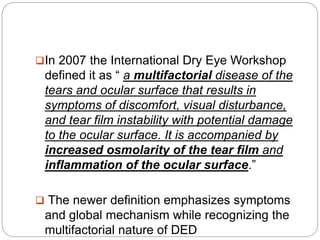
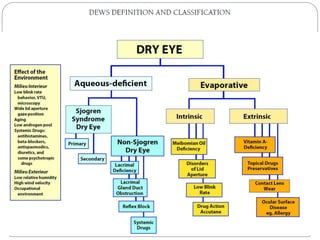
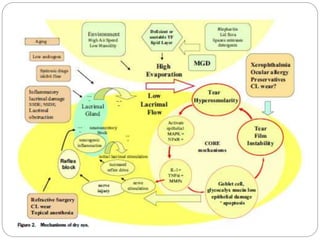
In 2007 the International Dry Eye Workshop
defined it as “ a multifactorial disease of the
tears and ocular surface that results in
symptoms of discomfort, visual disturbance,
and tear film instability with potential damage
to the ocular surface. It is accompanied by
increased osmolarity of the tear film and
inflammation of the ocular surface.”
 The newer definition emphasizes symptoms
and global mechanism while recognizing the
multifactorial nature of DED
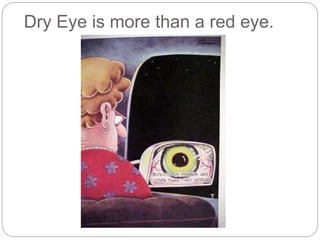
Dry Eye is more than a red eye.
Dry Eye
Affects Quality of Life
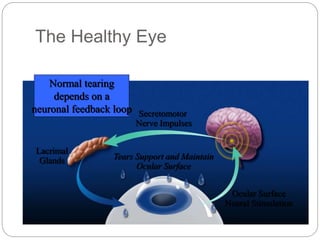
Lacrimal
Glands
Secretomotor
Nerve Impulses
Tears Support and Maintain
Ocular Surface
Ocular Surface
Neural Stimulation
The Healthy Eye
Normal tearing
depends on a
neuronal feedback loop
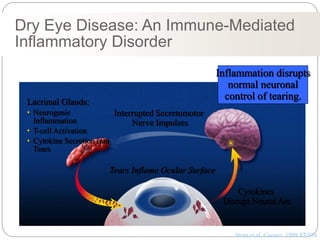
Lacrimal Glands:
• Neurogenic
Inflammation
• T-cell Activation
• Cytokine Secretion into
Tears
Interrupted Secretomotor
Nerve Impulses
Tears Inflame Ocular Surface
Cytokines
Disrupt Neural Arc
Inflammation disrupts
normal neuronal
control of tearing.
Stern et al, Cornea. 1998:17:584
Dry Eye Disease: An Immune-Mediated
Inflammatory Disorder
Dry Eye Disease Continuum
 Continuum of severity
ranges from mild to
severe
 Chronic dry eye is the
result of disease
progression
1Pflugfelder. Am J Ophthalmol. 2004.
Multiple Factors in Dry Eye
 Transient discomfort
 May be stimulated by
environmental
conditions
 Inflammation and
ocular surface
damage
 Altered tear film
composition
1de Paiva and Pflugfelder. In: Dry Eye and Ocular Surface Disorders. 2004;
2Pflugfelder et al. In: Dry Eye and Ocular Surface Disorders. 2004.
Role of Inflammation
in Chronic Dry Eye
 Inflammation may be present but not clinically
apparent
 Cycle of inflammation and dysfunction
 If untreated, inflammation can damage the
lacrimal gland and ocular surface
 Consequences:
 Lower tear production
 Altered corneal barrier function
Pflugfelder. Am J Ophthalmol. 2004.
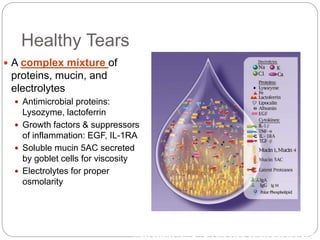
Healthy Tears
 A complex mixture of
proteins, mucin, and
electrolytes
 Antimicrobial proteins:
Lysozyme, lactoferrin
 Growth factors & suppressors
of inflammation: EGF, IL-1RA
 Soluble mucin 5AC secreted
by goblet cells for viscosity
 Electrolytes for proper
osmolarity
Image adapted from: Dry Eye and Ocular Surface Disorders. 2004.
Stern et al. In: Dry Eye and Ocular Surface Disorders. 2004.
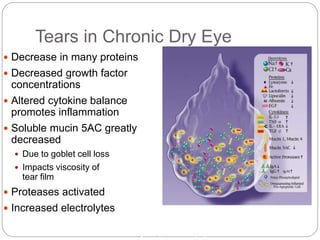
Tears in Chronic Dry Eye
 Decrease in many proteins
 Decreased growth factor
concentrations
 Altered cytokine balance
promotes inflammation
 Soluble mucin 5AC greatly
decreased
 Due to goblet cell loss
 Impacts viscosity of
tear film
 Proteases activated
 Increased electrolytes Solomon et al. Invest Ophthalmol Vis Sci. 2001.
Zhao et al. Cornea. 2001.
Ogasawara et al. Graefes Arch Clin Exp Ophthalmol. 1996.
Image adapted from: Dry Eye and Ocular Surface Disorders. 2004.
Who Is Likely to Have Dry Eye?
How Do We Diagnose It?
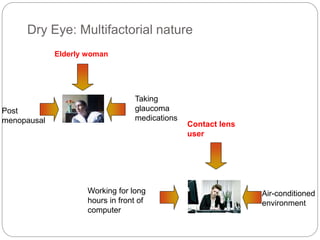
Dry Eye: Multifactorial nature
Elderly woman
Contact lens
user
Post
menopausal
Taking
glaucoma
medications
Working for long
hours in front of
computer
Air-conditioned
environment
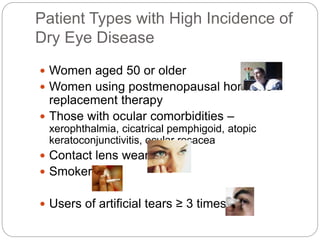
Patient Types with High Incidence of
Dry Eye Disease
 Women aged 50 or older
 Women using postmenopausal hormone
replacement therapy
 Those with ocular comorbidities –
xerophthalmia, cicatrical pemphigoid, atopic
keratoconjunctivitis, ocular rosacea
 Contact lens wearers
 Smokers
 Users of artificial tears ≥ 3 times/day
Dry Eye Disease: Predisposing
Factors
 Aging
 Menopause - Decreased Androgens
 Allergy Response
 Environmental Stresses
 Contact Lens Wear
 Wind
 Air Pollution
 Ocular Surgery (LASIK, Corneal
Transplant)
 Medications
– Low Humidity: Heating/Air Co
– Lack of Sleep
– Use of Computer Terminals
Medications That May Contribute
to Dry Eye Disease
 Systemic
 Antihypertensives
 Antiandrogens
 Anticholinergics
 Antidepressants
 Cardiac Antiarrhythmic Drugs
 Parkinson’s Disease Agents
 Antihistamines
• Topical
– Preservatives in
Tears
Dry Eye Disease:
Autoimmune Triggers
 Systemic Autoimmunity
 Rheumatoid Arthritis
 Lupus
 Sjögren’s Syndrome
 Graft vs. Host Disease
 All can result in immune-mediated
inflammation in the eye.
 Inflammatory mediators secreted into tears.
 Promote inflammation of ocular surface.
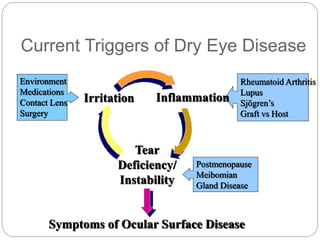
Environment
Medications
Contact Lens
Surgery
Rheumatoid Arthritis
Lupus
Sjögren’s
Graft vs Host
Postmenopause
Meibomian
Gland Disease
Symptoms of Ocular Surface Disease
Inflammation
Tear
Deficiency/
Instability
Irritation
Current Triggers of Dry Eye Disease
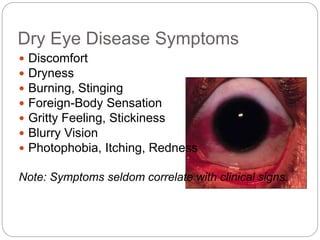
Dry Eye Disease Symptoms
 Discomfort
 Dryness
 Burning, Stinging
 Foreign-Body Sensation
 Gritty Feeling, Stickiness
 Blurry Vision
 Photophobia, Itching, Redness
Note: Symptoms seldom correlate with clinical signs.
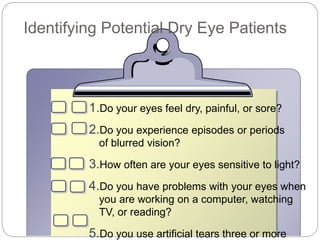
Identifying Potential Dry Eye Patients
1.Do your eyes feel dry, painful, or sore?
2.Do you experience episodes or periods
of blurred vision?
3.How often are your eyes sensitive to light?
4.Do you have problems with your eyes when
you are working on a computer, watching
TV, or reading?
5.Do you use artificial tears three or more
Diagnosing Dry Eye Disease
 Patients who answer “yes” to any one of the previous
questions should be evaluated for dry eye disease
 Many clinicians use clinical tests plus symptoms and
patient history to diagnose.
1Nichols et al. Cornea. 2000.
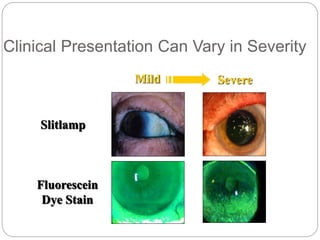
Slitlamp
Fluorescein
Dye Stain
Mild Severe
Clinical Presentation Can Vary in Severity
Slit lamp examination
 Increased debris/mucin strands in tear
film
 Inspection of tear meniscus at lid
margin.
Normal thickness – 1mm, convex.
 < 0.5mm – tear deficiency.
In severe cases – Marginal tear
meniscus is concave, small & absent.
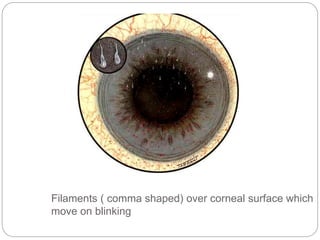
Filaments ( comma shaped) over corneal surface which
move on blinking
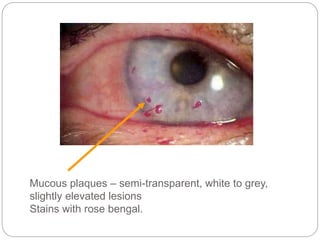
Mucous plaques – semi-transparent, white to grey,
slightly elevated lesions
Stains with rose bengal.
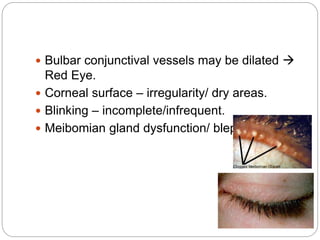
 Bulbar conjunctival vessels may be dilated 
Red Eye.
 Corneal surface – irregularity/ dry areas.
 Blinking – incomplete/infrequent.
 Meibomian gland dysfunction/ blepharitis.
Diagnostic Tests
 Appropriate choice of test helps the clinician to
arrive at an accurate diagnosis as well as for
individualization of therapy.
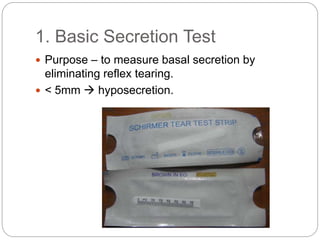
1. Basic Secretion Test
 Purpose – to measure basal secretion by
eliminating reflex tearing.
 < 5mm  hyposecretion.
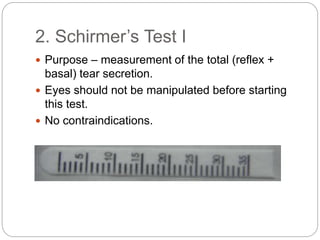
2. Schirmer’s Test I
 Purpose – measurement of the total (reflex +
basal) tear secretion.
 Eyes should not be manipulated before starting
this test.
 No contraindications.
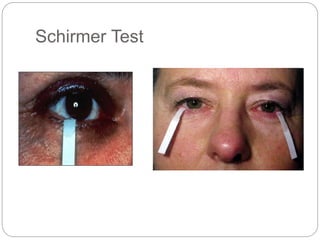
Schirmer Test
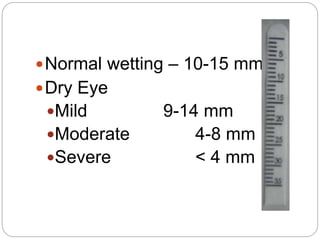
Normal wetting – 10-15 mm
Dry Eye
Mild 9-14 mm
Moderate 4-8 mm
Severe < 4 mm
Schirmer Test II
 Purpose – to ascertain reflex secretion.
 Measured after 2 minutes.
 After Strips are installed  unanaeasthetized
nasal mucossa is irritated.
 Less than 15 mm failure of reflex secretion.
Rose Bengal staining
 Purpose - to ascertain indirectly, the presence of
reduced tear volume by the detection of damaged
epithelial cells.
 Useful in early stages of conjunctivitis sicca and
keratoconjunctivitis sicca syndrome.
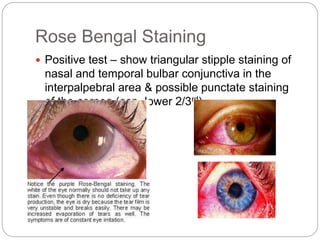
Rose Bengal Staining
 Positive test – show triangular stipple staining of
nasal and temporal bulbar conjunctiva in the
interpalpebral area & possible punctate staining
of the cornea (esp. lower 2/3rd).
Rose Bengal Staining
 False positive –
 Chronic conjunctivitis
 Acute chemical conjunctivitis, secondary to hair
spray use and drugs such as tetracine & cocaine
 Exposure keratitis
 Superficial punctate keratitis, secondary to toxic or
idiopathic phenomena.
 Foreign bodies in conjunctiva.
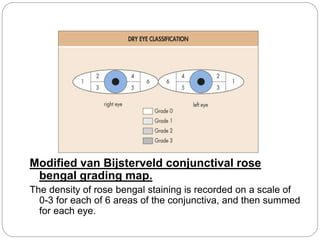
Modified van Bijsterveld conjunctival rose
bengal grading map.
The density of rose bengal staining is recorded on a scale of
0-3 for each of 6 areas of the conjunctiva, and then summed
for each eye.
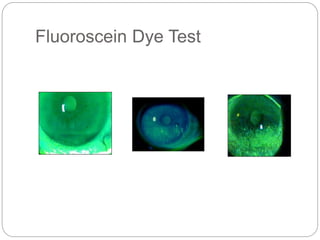
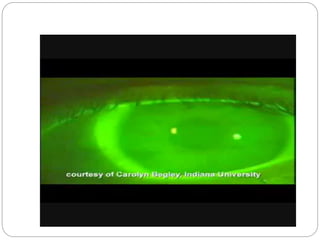
Fluoroscein Dye Test
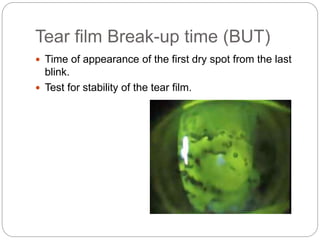
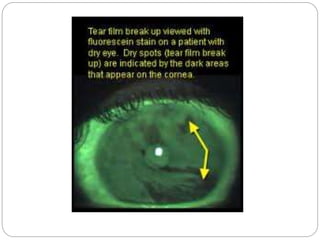
Tear film Break-up time (BUT)
 Time of appearance of the first dry spot from the last
blink.
 Test for stability of the tear film.
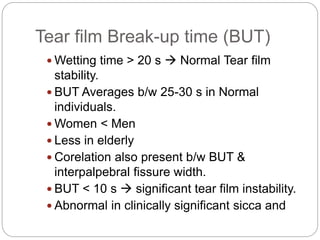
Tear film Break-up time (BUT)
 Wetting time > 20 s  Normal Tear film
stability.
 BUT Averages b/w 25-30 s in Normal
individuals.
 Women < Men
 Less in elderly
 Corelation also present b/w BUT &
interpalpebral fissure width.
 BUT < 10 s  significant tear film instability.
 Abnormal in clinically significant sicca and
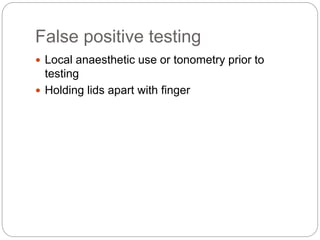
False positive testing
 Local anaesthetic use or tonometry prior to
testing
 Holding lids apart with finger
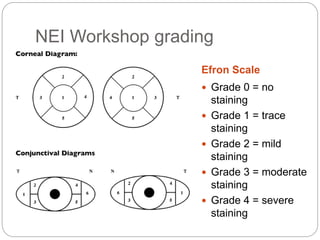
NEI Workshop grading
Efron Scale
 Grade 0 = no
staining
 Grade 1 = trace
staining
 Grade 2 = mild
staining
 Grade 3 = moderate
staining
 Grade 4 = severe
staining
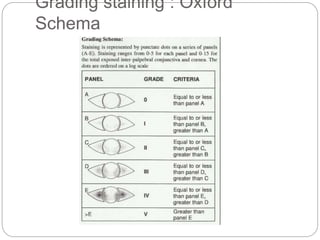
Grading staining : Oxford
Schema
Other tests
 Practical Double Vital Staining for Ocular Examination
 Corneal Residence Time Test or Tear Clearance Rate
(TCR)
 Tear Function Index
 Tear Film Osmolarity Test
 Tear Lactoferrin Test
 Tear Lysozyme Test
 A Qualitative Mucous Assay
 A Conjunctival Biopsy
 Impression Cytology
 Biopsy of Labial Accessory Salivary Glands
 Ocular Ferning Test
Corneal Residence Time Test or Tear
Clearance Rate (TCR)
 5 µl of Fluoroscein instilled
 Residual dye measured in a Schirmer’s strip
at intevals of 1, 10, 20 and 30 minutes.
 Presence of fluoroscein in each strip is
examined under blue light and compared to a
standard scale/ fluorometry.
 Normal eyes – 0 after 20 minutes.
 Dry Eyes – delayed clearance(↓ turnover of
tears).
Tear Function Index ( 3 mins)
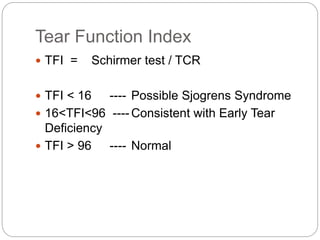
Tear Function Index
 TFI = Schirmer test / TCR
 TFI < 16 ---- Possible Sjogrens Syndrome
 16<TFI<96 ---- Consistent with Early Tear
Deficiency
 TFI > 96 ---- Normal
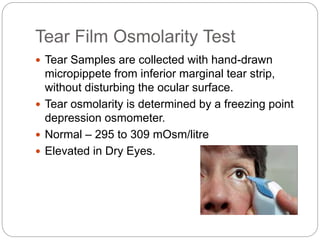
Tear Film Osmolarity Test
 Tear Samples are collected with hand-drawn
micropippete from inferior marginal tear strip,
without disturbing the ocular surface.
 Tear osmolarity is determined by a freezing point
depression osmometer.
 Normal – 295 to 309 mOsm/litre
 Elevated in Dry Eyes.
Impression Cytology
 To determine the goblet cell density of bulbar &
palpebral conjunctiva.
 A strip of filter paper is gently pressed against the
bulbar & palpebral conjunctiva with a glass end.
 Staining with Schiff’s agent & counter staining
with haemotoxylin  graded with microscope.
 Dry Eyes  ↓ goblet cell counts.
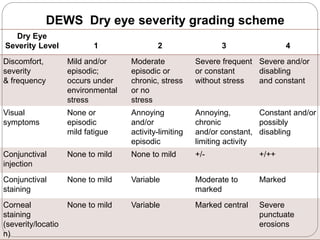
DEWS Dry eye severity grading scheme
Dry Eye
Severity Level 1 2 3 4
Discomfort,
severity
& frequency
Mild and/or
episodic;
occurs under
environmental
stress
Moderate
episodic or
chronic, stress
or no
stress
Severe frequent
or constant
without stress
Severe and/or
disabling
and constant
Visual
symptoms
None or
episodic
mild fatigue
Annoying
and/or
activity-limiting
episodic
Annoying,
chronic
and/or constant,
limiting activity
Constant and/or
possibly
disabling
Conjunctival
injection
None to mild None to mild +/- +/++
Conjunctival
staining
None to mild Variable Moderate to
marked
Marked
Corneal
staining
(severity/locatio
n)
None to mild Variable Marked central Severe
punctuate
erosions
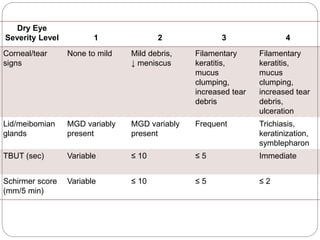
Dry Eye
Severity Level 1 2 3 4
Corneal/tear
signs
None to mild Mild debris,
↓ meniscus
Filamentary
keratitis,
mucus
clumping,
increased tear
debris
Filamentary
keratitis,
mucus
clumping,
increased tear
debris,
ulceration
Lid/meibomian
glands
MGD variably
present
MGD variably
present
Frequent Trichiasis,
keratinization,
symblepharon
TBUT (sec) Variable ≤ 10 ≤ 5 Immediate
Schirmer score
(mm/5 min)
Variable ≤ 10 ≤ 5 ≤ 2
Left Untreated, Chronic Dry Eye
May Become a Progressive Disorder
 Patients suffering from dry eye disease may move
between severity levels and can become worse, if
untreated.
 Disease management options can be adjusted for
individual patients depending on disease severity
1Nelson et al. Adv Ther. 2000.
Management
Aims of Treatment
 Relieve discomfort
 Provide smooth optical surface
 Prevent structural ocular surface damage
Modalities of treatment
 Preservation of existing tears
 Reduction of tear drainage
 Tear substitutes
 Treat any other associated eye disease which
predisposes to dry eye
 Other options
Preservation of existing tears
 Environmental modifications such as humidification,
avoidance of wind/dusty or smoky environment, avoid
central heating
 Lifestyle/workplace modifications
 taking regular breaks from reading or computer use
 lowering computer monitor below eye level
 increasing blink/fast blinking exercise
 discontinuing medications that exacerbate DED
 A small lateral tarsorrhaphy – useful in incomplete
lid closure.
Reduction of tear drainage
Done by punctual occlusion
• Preserves natural tears & prolongs
effect of artificial tears
• Greatest value in sever KCS who
have not responded to frequent use
of topical treatment.
• May be –
o Short term occlusion
oPermanent occlusion
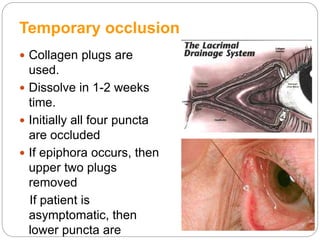
Temporary occlusion
 Collagen plugs are
used.
 Dissolve in 1-2 weeks
time.
 Initially all four puncta
are occluded
 If epiphora occurs, then
upper two plugs
removed
If patient is
asymptomatic, then
lower puncta are
Reversible occlusion
 Reversible prolonged occlusion with silicone/ long
acting collagen plugs (that dissolve in 2-6 wks).
 Problems –
 Extrusion
 Granuloma formation
 Distal migration.
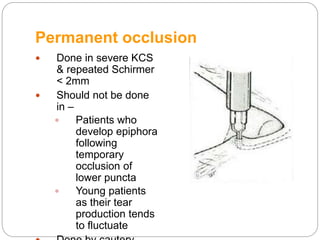
Permanent occlusion
 Done in severe KCS
& repeated Schirmer
< 2mm
 Should not be done
in –
 Patients who
develop epiphora
following
temporary
occlusion of
lower puncta
 Young patients
as their tear
production tends
to fluctuate
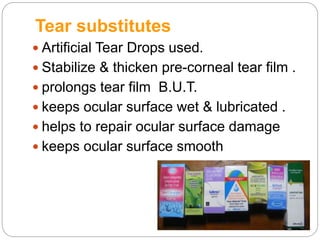
Tear substitutes
 Artificial Tear Drops used.
 Stabilize & thicken pre-corneal tear film .
 prolongs tear film B.U.T.
 keeps ocular surface wet & lubricated .
 helps to repair ocular surface damage
 keeps ocular surface smooth
Tear substitutes
 Drops - Frequent instillation is required
Preservative free drops are better
 Gels – Consists of carbomers
Less frequent instillation required
 Ointments – Contains petroleum mineral oil &
used at bedtime
Mucolytic agents – 5 % acetylcysteine drops QID
to disperse corneal filaments & mucous
plaques.
Drops
 Cellulose derivatives –
o Hydroxypropyl methylcellulose
o Carboxymethylcellulose [more useful in lipid or
mucous deficiency]
o Appropriate for mild cases.
 Polyvinyl alcohol – Better in aqueous deficiency
o Dose
 QID in mild cases
 ½ hrly – 2 hrly in severe cases
 Sodium hyaluronate
 Povidone
 Sodium chloride
 Hypromellose
Preservatives used in tear drops
 Benzalkanium chloride (0.01% for eye-drops , 0/02% for
C.L. solutions & 1% as disinfectant )
 Chlorbutanol .
 Chlorhexidine (0.002- 0.005%)
 Thimerosal & mercuric oxides (0.002- 0.005% )
 EDTA .
 Methylparaben .
 Propylparaben .
 Polyquad ( SPK)
 Purite .
 Potasium sorbate .
 Sodium perborate (air touch changes to H2O2,then H2O &
O2)
 Sorbic acid (less toxic)
Ocular complications of
preservatives
 Pigmentation (mercury deposits in lids –conj. –
cornea & lens )
 Irritation(redness – photophobia– lacrimation–burning)
 Allergic
 Dermatitis, urticaria & eczema
 blepharitis
 papillary & follicular conjunctivitis
 pemphigoid
 symblepharon
 SPK – corneal edema – pannus –corneal opacityocular
surface mal-function & inflammation
 Toxic
 Epith. Cell exfoliation
 SPK
 long term decreased tear
 Due to side effects of preservatives , now
preservative – free artificial tears are made
 But most of them are in unit dose form (chance of
contamination)
 Also they are expensive.
 Eg Tears natural free
Treatment of associated
diseases
 Meibomian gland disease/ Blepharitis –
 Lid hygiene – warm compresses, lid massage.
 Lid scurbs with dilute detergents
 Systemic Doxycycline/ Azithromycin/ Roxitromycin/
Tetracycline.
 Correction of eyelid abnormalities – ptosis,
lagophthalmos
Other options
 Topical cyclosporine [0.05%, 0.1%]
 Reduces cell-mediated inflammation of lacrimal tissue 
increase in goblet cells, reversal of squamous metaplasia of
conjunctiva.
 Oral cholinergic agents (M3) like pilocarpine ,
cevimeline
 Effective in xerostomia & about 40% of KCS patients also
obtain relief
 Botulinum toxin injection to orbicularis muscle –
controls blepharospasm in severe dry eye.
 Sub-mandibular gland transplantation – for
extreme dry eye.
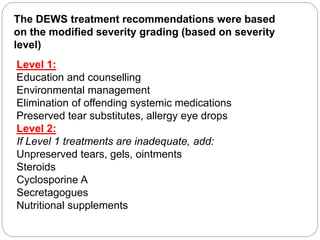
Level 1:
Education and counselling
Environmental management
Elimination of offending systemic medications
Preserved tear substitutes, allergy eye drops
Level 2:
If Level 1 treatments are inadequate, add:
Unpreserved tears, gels, ointments
Steroids
Cyclosporine A
Secretagogues
Nutritional supplements
The DEWS treatment recommendations were based
on the modified severity grading (based on severity
level)
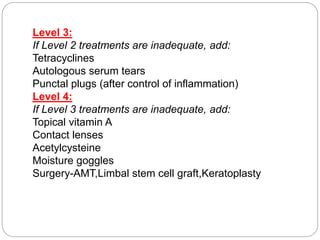
Level 3:
If Level 2 treatments are inadequate, add:
Tetracyclines
Autologous serum tears
Punctal plugs (after control of inflammation)
Level 4:
If Level 3 treatments are inadequate, add:
Topical vitamin A
Contact lenses
Acetylcysteine
Moisture goggles
Surgery-AMT,Limbal stem cell graft,Keratoplasty
 Thankyou.
Summary
 Dry eye is a prevalent yet underdiagnosed disease
ranging from mild to severe, episodic or chronic
 Episodic dry eye can be due to external factors
 Chronic dry eye can be a progressive disease with
underlying pathophysiology of inflammation and altered
tear composition
 Certain patient types have a high incidence of dry eye
and should be diagnosed with a combination of signs and
symptoms
 A continuum of care is available to treat both episodic
and chronic dry eye across the range of severity levels
Contact lenses
 Low water content HEMA lenses may increase
tear film evaporation -- moderately dry eyes.
 Silicone rubber lenses contain no water and
readily transmit oxygen – effective in extreme tear
film deficiency.
 Occlusive gas permeable scleral contact lenses
provide reservoir of saline over cornea.
 Can be worn on extremely dry eye with exposure.

Dry Eye Disease

  • 1.
    Dry Eye Dr. KaranBhatia Aravind Eye Hospital, Pondicherry
  • 2.
    What is DryEye Disease? Dry eye disease (DED) is a condition caused by many factors that result in inflammation of the eye and the tear- producing glands. Inflammation can decrease the eye’s ability to produce normal tears that protect the surface of the eye and keep it moist and lubricated.
  • 3.
    Dry eye isnot a trivial complaint. It can cause significant discomfort and affect the quality of life significantly.  In 1995 the National eye Institute defined dry eye disease (DED) as “ a disorder of the tear film due to tear deficiency or excessive tear evaporation which causes damage to the interpalpebral ocular surface and is associated with symptoms of ocular discomfort”.
  • 4.
    In 2007 theInternational Dry Eye Workshop defined it as “ a multifactorial disease of the tears and ocular surface that results in symptoms of discomfort, visual disturbance, and tear film instability with potential damage to the ocular surface. It is accompanied by increased osmolarity of the tear film and inflammation of the ocular surface.”  The newer definition emphasizes symptoms and global mechanism while recognizing the multifactorial nature of DED
  • 5.
    Dry Eye ismore than a red eye.
  • 6.
  • 7.
    Lacrimal Glands Secretomotor Nerve Impulses Tears Supportand Maintain Ocular Surface Ocular Surface Neural Stimulation The Healthy Eye Normal tearing depends on a neuronal feedback loop
  • 8.
    Lacrimal Glands: • Neurogenic Inflammation •T-cell Activation • Cytokine Secretion into Tears Interrupted Secretomotor Nerve Impulses Tears Inflame Ocular Surface Cytokines Disrupt Neural Arc Inflammation disrupts normal neuronal control of tearing. Stern et al, Cornea. 1998:17:584 Dry Eye Disease: An Immune-Mediated Inflammatory Disorder
  • 9.
    Dry Eye DiseaseContinuum  Continuum of severity ranges from mild to severe  Chronic dry eye is the result of disease progression 1Pflugfelder. Am J Ophthalmol. 2004.
  • 10.
    Multiple Factors inDry Eye  Transient discomfort  May be stimulated by environmental conditions  Inflammation and ocular surface damage  Altered tear film composition 1de Paiva and Pflugfelder. In: Dry Eye and Ocular Surface Disorders. 2004; 2Pflugfelder et al. In: Dry Eye and Ocular Surface Disorders. 2004.
  • 11.
    Role of Inflammation inChronic Dry Eye  Inflammation may be present but not clinically apparent  Cycle of inflammation and dysfunction  If untreated, inflammation can damage the lacrimal gland and ocular surface  Consequences:  Lower tear production  Altered corneal barrier function Pflugfelder. Am J Ophthalmol. 2004.
  • 12.
    Healthy Tears  Acomplex mixture of proteins, mucin, and electrolytes  Antimicrobial proteins: Lysozyme, lactoferrin  Growth factors & suppressors of inflammation: EGF, IL-1RA  Soluble mucin 5AC secreted by goblet cells for viscosity  Electrolytes for proper osmolarity Image adapted from: Dry Eye and Ocular Surface Disorders. 2004. Stern et al. In: Dry Eye and Ocular Surface Disorders. 2004.
  • 13.
    Tears in ChronicDry Eye  Decrease in many proteins  Decreased growth factor concentrations  Altered cytokine balance promotes inflammation  Soluble mucin 5AC greatly decreased  Due to goblet cell loss  Impacts viscosity of tear film  Proteases activated  Increased electrolytes Solomon et al. Invest Ophthalmol Vis Sci. 2001. Zhao et al. Cornea. 2001. Ogasawara et al. Graefes Arch Clin Exp Ophthalmol. 1996. Image adapted from: Dry Eye and Ocular Surface Disorders. 2004.
  • 14.
    Who Is Likelyto Have Dry Eye? How Do We Diagnose It?
  • 15.
    Dry Eye: Multifactorialnature Elderly woman Contact lens user Post menopausal Taking glaucoma medications Working for long hours in front of computer Air-conditioned environment
  • 16.
    Patient Types withHigh Incidence of Dry Eye Disease  Women aged 50 or older  Women using postmenopausal hormone replacement therapy  Those with ocular comorbidities – xerophthalmia, cicatrical pemphigoid, atopic keratoconjunctivitis, ocular rosacea  Contact lens wearers  Smokers  Users of artificial tears ≥ 3 times/day
  • 17.
    Dry Eye Disease:Predisposing Factors  Aging  Menopause - Decreased Androgens  Allergy Response  Environmental Stresses  Contact Lens Wear  Wind  Air Pollution  Ocular Surgery (LASIK, Corneal Transplant)  Medications – Low Humidity: Heating/Air Co – Lack of Sleep – Use of Computer Terminals
  • 18.
    Medications That MayContribute to Dry Eye Disease  Systemic  Antihypertensives  Antiandrogens  Anticholinergics  Antidepressants  Cardiac Antiarrhythmic Drugs  Parkinson’s Disease Agents  Antihistamines • Topical – Preservatives in Tears
  • 19.
    Dry Eye Disease: AutoimmuneTriggers  Systemic Autoimmunity  Rheumatoid Arthritis  Lupus  Sjögren’s Syndrome  Graft vs. Host Disease  All can result in immune-mediated inflammation in the eye.  Inflammatory mediators secreted into tears.  Promote inflammation of ocular surface.
  • 20.
    Environment Medications Contact Lens Surgery Rheumatoid Arthritis Lupus Sjögren’s Graftvs Host Postmenopause Meibomian Gland Disease Symptoms of Ocular Surface Disease Inflammation Tear Deficiency/ Instability Irritation Current Triggers of Dry Eye Disease
  • 23.
    Dry Eye DiseaseSymptoms  Discomfort  Dryness  Burning, Stinging  Foreign-Body Sensation  Gritty Feeling, Stickiness  Blurry Vision  Photophobia, Itching, Redness Note: Symptoms seldom correlate with clinical signs.
  • 24.
    Identifying Potential DryEye Patients 1.Do your eyes feel dry, painful, or sore? 2.Do you experience episodes or periods of blurred vision? 3.How often are your eyes sensitive to light? 4.Do you have problems with your eyes when you are working on a computer, watching TV, or reading? 5.Do you use artificial tears three or more
  • 25.
    Diagnosing Dry EyeDisease  Patients who answer “yes” to any one of the previous questions should be evaluated for dry eye disease  Many clinicians use clinical tests plus symptoms and patient history to diagnose. 1Nichols et al. Cornea. 2000.
  • 26.
    Slitlamp Fluorescein Dye Stain Mild Severe ClinicalPresentation Can Vary in Severity
  • 27.
    Slit lamp examination Increased debris/mucin strands in tear film  Inspection of tear meniscus at lid margin. Normal thickness – 1mm, convex.  < 0.5mm – tear deficiency. In severe cases – Marginal tear meniscus is concave, small & absent.
  • 28.
    Filaments ( commashaped) over corneal surface which move on blinking
  • 29.
    Mucous plaques –semi-transparent, white to grey, slightly elevated lesions Stains with rose bengal.
  • 30.
     Bulbar conjunctivalvessels may be dilated  Red Eye.  Corneal surface – irregularity/ dry areas.  Blinking – incomplete/infrequent.  Meibomian gland dysfunction/ blepharitis.
  • 31.
    Diagnostic Tests  Appropriatechoice of test helps the clinician to arrive at an accurate diagnosis as well as for individualization of therapy.
  • 33.
    1. Basic SecretionTest  Purpose – to measure basal secretion by eliminating reflex tearing.  < 5mm  hyposecretion.
  • 34.
    2. Schirmer’s TestI  Purpose – measurement of the total (reflex + basal) tear secretion.  Eyes should not be manipulated before starting this test.  No contraindications.
  • 36.
  • 37.
    Normal wetting –10-15 mm Dry Eye Mild 9-14 mm Moderate 4-8 mm Severe < 4 mm
  • 38.
    Schirmer Test II Purpose – to ascertain reflex secretion.  Measured after 2 minutes.  After Strips are installed  unanaeasthetized nasal mucossa is irritated.  Less than 15 mm failure of reflex secretion.
  • 39.
    Rose Bengal staining Purpose - to ascertain indirectly, the presence of reduced tear volume by the detection of damaged epithelial cells.  Useful in early stages of conjunctivitis sicca and keratoconjunctivitis sicca syndrome.
  • 40.
    Rose Bengal Staining Positive test – show triangular stipple staining of nasal and temporal bulbar conjunctiva in the interpalpebral area & possible punctate staining of the cornea (esp. lower 2/3rd).
  • 41.
    Rose Bengal Staining False positive –  Chronic conjunctivitis  Acute chemical conjunctivitis, secondary to hair spray use and drugs such as tetracine & cocaine  Exposure keratitis  Superficial punctate keratitis, secondary to toxic or idiopathic phenomena.  Foreign bodies in conjunctiva.
  • 42.
    Modified van Bijsterveldconjunctival rose bengal grading map. The density of rose bengal staining is recorded on a scale of 0-3 for each of 6 areas of the conjunctiva, and then summed for each eye.
  • 43.
  • 44.
    Tear film Break-uptime (BUT)  Time of appearance of the first dry spot from the last blink.  Test for stability of the tear film.
  • 47.
    Tear film Break-uptime (BUT)  Wetting time > 20 s  Normal Tear film stability.  BUT Averages b/w 25-30 s in Normal individuals.  Women < Men  Less in elderly  Corelation also present b/w BUT & interpalpebral fissure width.  BUT < 10 s  significant tear film instability.  Abnormal in clinically significant sicca and
  • 48.
    False positive testing Local anaesthetic use or tonometry prior to testing  Holding lids apart with finger
  • 49.
    NEI Workshop grading EfronScale  Grade 0 = no staining  Grade 1 = trace staining  Grade 2 = mild staining  Grade 3 = moderate staining  Grade 4 = severe staining
  • 50.
    Grading staining :Oxford Schema
  • 51.
    Other tests  PracticalDouble Vital Staining for Ocular Examination  Corneal Residence Time Test or Tear Clearance Rate (TCR)  Tear Function Index  Tear Film Osmolarity Test  Tear Lactoferrin Test  Tear Lysozyme Test  A Qualitative Mucous Assay  A Conjunctival Biopsy  Impression Cytology  Biopsy of Labial Accessory Salivary Glands  Ocular Ferning Test
  • 52.
    Corneal Residence TimeTest or Tear Clearance Rate (TCR)  5 µl of Fluoroscein instilled  Residual dye measured in a Schirmer’s strip at intevals of 1, 10, 20 and 30 minutes.  Presence of fluoroscein in each strip is examined under blue light and compared to a standard scale/ fluorometry.  Normal eyes – 0 after 20 minutes.  Dry Eyes – delayed clearance(↓ turnover of tears).
  • 53.
  • 54.
    Tear Function Index TFI = Schirmer test / TCR  TFI < 16 ---- Possible Sjogrens Syndrome  16<TFI<96 ---- Consistent with Early Tear Deficiency  TFI > 96 ---- Normal
  • 55.
    Tear Film OsmolarityTest  Tear Samples are collected with hand-drawn micropippete from inferior marginal tear strip, without disturbing the ocular surface.  Tear osmolarity is determined by a freezing point depression osmometer.  Normal – 295 to 309 mOsm/litre  Elevated in Dry Eyes.
  • 56.
    Impression Cytology  Todetermine the goblet cell density of bulbar & palpebral conjunctiva.  A strip of filter paper is gently pressed against the bulbar & palpebral conjunctiva with a glass end.  Staining with Schiff’s agent & counter staining with haemotoxylin  graded with microscope.  Dry Eyes  ↓ goblet cell counts.
  • 57.
    DEWS Dry eyeseverity grading scheme Dry Eye Severity Level 1 2 3 4 Discomfort, severity & frequency Mild and/or episodic; occurs under environmental stress Moderate episodic or chronic, stress or no stress Severe frequent or constant without stress Severe and/or disabling and constant Visual symptoms None or episodic mild fatigue Annoying and/or activity-limiting episodic Annoying, chronic and/or constant, limiting activity Constant and/or possibly disabling Conjunctival injection None to mild None to mild +/- +/++ Conjunctival staining None to mild Variable Moderate to marked Marked Corneal staining (severity/locatio n) None to mild Variable Marked central Severe punctuate erosions
  • 58.
    Dry Eye Severity Level1 2 3 4 Corneal/tear signs None to mild Mild debris, ↓ meniscus Filamentary keratitis, mucus clumping, increased tear debris Filamentary keratitis, mucus clumping, increased tear debris, ulceration Lid/meibomian glands MGD variably present MGD variably present Frequent Trichiasis, keratinization, symblepharon TBUT (sec) Variable ≤ 10 ≤ 5 Immediate Schirmer score (mm/5 min) Variable ≤ 10 ≤ 5 ≤ 2
  • 59.
    Left Untreated, ChronicDry Eye May Become a Progressive Disorder  Patients suffering from dry eye disease may move between severity levels and can become worse, if untreated.  Disease management options can be adjusted for individual patients depending on disease severity 1Nelson et al. Adv Ther. 2000.
  • 60.
  • 61.
    Aims of Treatment Relieve discomfort  Provide smooth optical surface  Prevent structural ocular surface damage
  • 62.
    Modalities of treatment Preservation of existing tears  Reduction of tear drainage  Tear substitutes  Treat any other associated eye disease which predisposes to dry eye  Other options
  • 63.
    Preservation of existingtears  Environmental modifications such as humidification, avoidance of wind/dusty or smoky environment, avoid central heating  Lifestyle/workplace modifications  taking regular breaks from reading or computer use  lowering computer monitor below eye level  increasing blink/fast blinking exercise  discontinuing medications that exacerbate DED  A small lateral tarsorrhaphy – useful in incomplete lid closure.
  • 64.
    Reduction of teardrainage Done by punctual occlusion • Preserves natural tears & prolongs effect of artificial tears • Greatest value in sever KCS who have not responded to frequent use of topical treatment. • May be – o Short term occlusion oPermanent occlusion
  • 65.
    Temporary occlusion  Collagenplugs are used.  Dissolve in 1-2 weeks time.  Initially all four puncta are occluded  If epiphora occurs, then upper two plugs removed If patient is asymptomatic, then lower puncta are
  • 66.
    Reversible occlusion  Reversibleprolonged occlusion with silicone/ long acting collagen plugs (that dissolve in 2-6 wks).  Problems –  Extrusion  Granuloma formation  Distal migration.
  • 67.
    Permanent occlusion  Donein severe KCS & repeated Schirmer < 2mm  Should not be done in –  Patients who develop epiphora following temporary occlusion of lower puncta  Young patients as their tear production tends to fluctuate
  • 68.
    Tear substitutes  ArtificialTear Drops used.  Stabilize & thicken pre-corneal tear film .  prolongs tear film B.U.T.  keeps ocular surface wet & lubricated .  helps to repair ocular surface damage  keeps ocular surface smooth
  • 69.
    Tear substitutes  Drops- Frequent instillation is required Preservative free drops are better  Gels – Consists of carbomers Less frequent instillation required  Ointments – Contains petroleum mineral oil & used at bedtime Mucolytic agents – 5 % acetylcysteine drops QID to disperse corneal filaments & mucous plaques.
  • 70.
    Drops  Cellulose derivatives– o Hydroxypropyl methylcellulose o Carboxymethylcellulose [more useful in lipid or mucous deficiency] o Appropriate for mild cases.  Polyvinyl alcohol – Better in aqueous deficiency o Dose  QID in mild cases  ½ hrly – 2 hrly in severe cases  Sodium hyaluronate  Povidone  Sodium chloride  Hypromellose
  • 71.
    Preservatives used intear drops  Benzalkanium chloride (0.01% for eye-drops , 0/02% for C.L. solutions & 1% as disinfectant )  Chlorbutanol .  Chlorhexidine (0.002- 0.005%)  Thimerosal & mercuric oxides (0.002- 0.005% )  EDTA .  Methylparaben .  Propylparaben .  Polyquad ( SPK)  Purite .  Potasium sorbate .  Sodium perborate (air touch changes to H2O2,then H2O & O2)  Sorbic acid (less toxic)
  • 72.
    Ocular complications of preservatives Pigmentation (mercury deposits in lids –conj. – cornea & lens )  Irritation(redness – photophobia– lacrimation–burning)  Allergic  Dermatitis, urticaria & eczema  blepharitis  papillary & follicular conjunctivitis  pemphigoid  symblepharon  SPK – corneal edema – pannus –corneal opacityocular surface mal-function & inflammation  Toxic  Epith. Cell exfoliation  SPK  long term decreased tear
  • 73.
     Due toside effects of preservatives , now preservative – free artificial tears are made  But most of them are in unit dose form (chance of contamination)  Also they are expensive.  Eg Tears natural free
  • 74.
    Treatment of associated diseases Meibomian gland disease/ Blepharitis –  Lid hygiene – warm compresses, lid massage.  Lid scurbs with dilute detergents  Systemic Doxycycline/ Azithromycin/ Roxitromycin/ Tetracycline.  Correction of eyelid abnormalities – ptosis, lagophthalmos
  • 75.
    Other options  Topicalcyclosporine [0.05%, 0.1%]  Reduces cell-mediated inflammation of lacrimal tissue  increase in goblet cells, reversal of squamous metaplasia of conjunctiva.  Oral cholinergic agents (M3) like pilocarpine , cevimeline  Effective in xerostomia & about 40% of KCS patients also obtain relief  Botulinum toxin injection to orbicularis muscle – controls blepharospasm in severe dry eye.  Sub-mandibular gland transplantation – for extreme dry eye.
  • 76.
    Level 1: Education andcounselling Environmental management Elimination of offending systemic medications Preserved tear substitutes, allergy eye drops Level 2: If Level 1 treatments are inadequate, add: Unpreserved tears, gels, ointments Steroids Cyclosporine A Secretagogues Nutritional supplements The DEWS treatment recommendations were based on the modified severity grading (based on severity level)
  • 77.
    Level 3: If Level2 treatments are inadequate, add: Tetracyclines Autologous serum tears Punctal plugs (after control of inflammation) Level 4: If Level 3 treatments are inadequate, add: Topical vitamin A Contact lenses Acetylcysteine Moisture goggles Surgery-AMT,Limbal stem cell graft,Keratoplasty
  • 78.
  • 79.
    Summary  Dry eyeis a prevalent yet underdiagnosed disease ranging from mild to severe, episodic or chronic  Episodic dry eye can be due to external factors  Chronic dry eye can be a progressive disease with underlying pathophysiology of inflammation and altered tear composition  Certain patient types have a high incidence of dry eye and should be diagnosed with a combination of signs and symptoms  A continuum of care is available to treat both episodic and chronic dry eye across the range of severity levels
  • 80.
    Contact lenses  Lowwater content HEMA lenses may increase tear film evaporation -- moderately dry eyes.  Silicone rubber lenses contain no water and readily transmit oxygen – effective in extreme tear film deficiency.  Occlusive gas permeable scleral contact lenses provide reservoir of saline over cornea.  Can be worn on extremely dry eye with exposure.