DRY EYE:
AN OVERVIEW
                 Dr.Gayatree Mohanty
       Dept. of Ophthalmology, KIMS
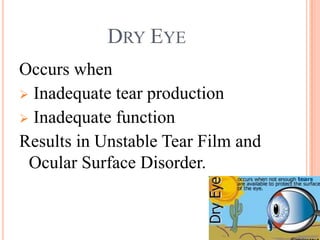
DRY EYE
Occurs when
 Inadequate tear production
 Inadequate function
Results in Unstable Tear Film and
 Ocular Surface Disorder.
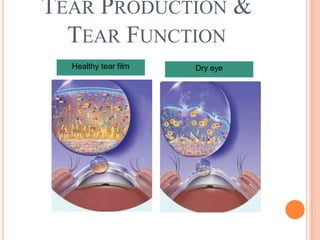
TEAR PRODUCTION &
  TEAR FUNCTION
  Healthy tear film   Dry eye
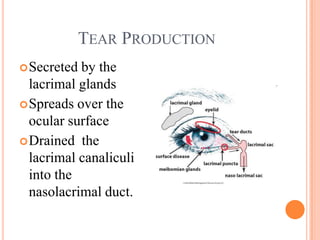
TEAR PRODUCTION
 Secreted by the
  lacrimal glands
 Spreads over the
  ocular surface
 Drained the
  lacrimal canaliculi
  into the
  nasolacrimal duct.
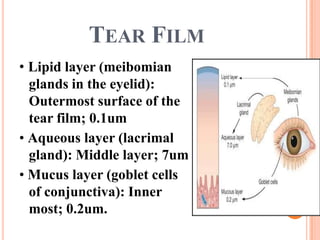
TEAR FILM
• Lipid layer (meibomian
  glands in the eyelid):
  Outermost surface of the
  tear film; 0.1um
• Aqueous layer (lacrimal
  gland): Middle layer; 7um
• Mucus layer (goblet cells
  of conjunctiva): Inner
  most; 0.2um.
FUNCTIONS OF THE TEAR
           FILM
• Lipid layer: Prevents evaporation of tears and acts as an
  surfactant allowing spread of the tear film.

• Aqueous middle layer: Provide atmospheric O2 to the
  corneal epithelium; Antibacterial
  activity(Interleukins, lysozymes, IgA & lactoferrin);
  Cleanses the eye and washes away foreign particles or
  irritants; Provide a smooth optical surface to cornea by
  abolishing the irregularities.

• Mucus layer: Allows the watery layer to spread evenly over
  the surface of the eye and helps the eye remain moist.
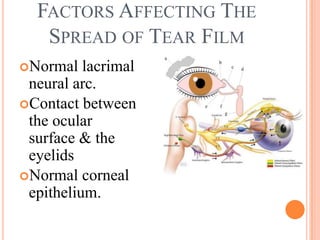
FACTORS AFFECTING THE
   SPREAD OF TEAR FILM
Normal   lacrimal
 neural arc.
Contact between
 the ocular
 surface & the
 eyelids
Normal corneal
 epithelium.
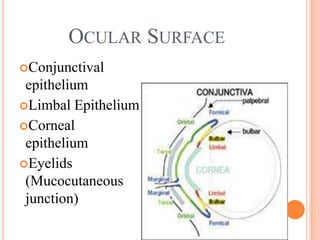
OCULAR SURFACE
Conjunctival
 epithelium
Limbal Epithelium
Corneal
 epithelium
Eyelids
 (Mucocutaneous
 junction)
ETIOPATHOGENESIS
Aqueous   tear deficiency
Sjogren’s Dieseases

Non-Sjogren’s Diseases

Lipid tear deficiency

Mucin deficiency

Kinetic disorders of lacrimal fluid
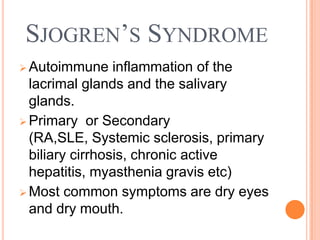
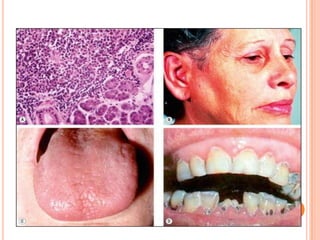
SJOGREN’S SYNDROME
 Autoimmune     inflammation of the
  lacrimal glands and the salivary
  glands.
 Primary or Secondary
  (RA,SLE, Systemic sclerosis, primary
  biliary cirrhosis, chronic active
  hepatitis, myasthenia gravis etc)
 Most common symptoms are dry eyes
  and dry mouth.
COMMON NON-SJOGREN’S CAUSES
 Vitamin A deficiency,
 Stevens Johnson syndrome and

 Ocular Cicatricial Pemphigoid (OCP).

Affects the inner mucous layer of the tear film and
  prevents the natural tear film from adhering to the
  eye.

   Prolonged computer hours: Evaporative dry eye

   Allergic conjunctivitis: Altered tear function due to
    conjunctival & limbal inflammation.
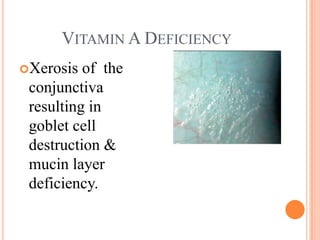
VITAMIN A DEFICIENCY
Xerosis  of the
 conjunctiva
 resulting in
 goblet cell
 destruction &
 mucin layer
 deficiency.
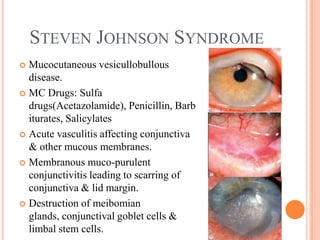
STEVEN JOHNSON SYNDROME
 Mucocutaneous vesicullobullous
  disease.
 MC Drugs: Sulfa
  drugs(Acetazolamide), Penicillin, Barb
  iturates, Salicylates
 Acute vasculitis affecting conjunctiva
  & other mucous membranes.
 Membranous muco-purulent
  conjunctivitis leading to scarring of
  conjunctiva & lid margin.
 Destruction of meibomian
  glands, conjunctival goblet cells &
  limbal stem cells.
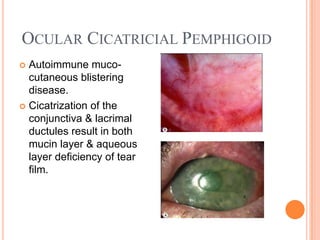
OCULAR CICATRICIAL PEMPHIGOID
 Autoimmune muco-
  cutaneous blistering
  disease.
 Cicatrization of the
  conjunctiva & lacrimal
  ductules result in both
  mucin layer & aqueous
  layer deficiency of tear
  film.
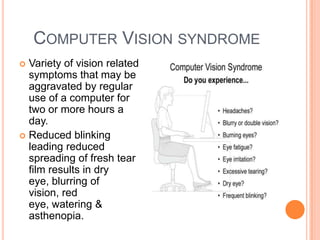
COMPUTER VISION SYNDROME
 Variety of vision related
  symptoms that may be
  aggravated by regular
  use of a computer for
  two or more hours a
  day.
 Reduced blinking
  leading reduced
  spreading of fresh tear
  film results in dry
  eye, blurring of
  vision, red
  eye, watering &
  asthenopia.
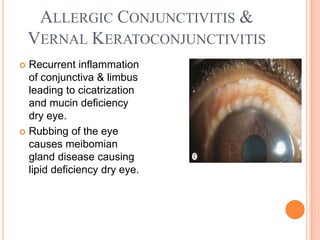
ALLERGIC CONJUNCTIVITIS &
    VERNAL KERATOCONJUNCTIVITIS
 Recurrent inflammation
  of conjunctiva & limbus
  leading to cicatrization
  and mucin deficiency
  dry eye.
 Rubbing of the eye
  causes meibomian
  gland disease causing
  lipid deficiency dry eye.
MEDICATIONS CAUSING
         DRY EYE
•Diuretics
• Beta-blockers
• Antihistamines
• Sedatives
• Anti-Anxiety medications
• Analgesics
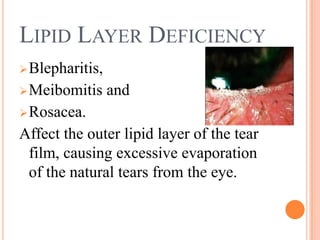
LIPID LAYER DEFICIENCY
 Blepharitis,
 Meibomitis     and
 Rosacea.
Affect the outer lipid layer of the tear
 film, causing excessive evaporation
 of the natural tears from the eye.
CLINICAL FEATURE:
          SYMPTOMS
 Burning  sensation
 Foreign body sensation (exaggerates
  over the day)
 Stringy mucus discharge
 Transient blurring of vision
 Redness
 Difficulty wearing contact lenses
 Crusting of the lids
CLINICAL MANIFESTATION:
             SIGNS
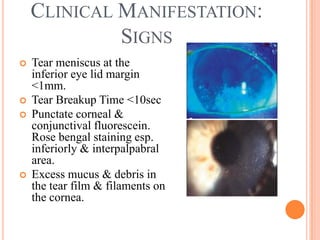
   Tear meniscus at the
    inferior eye lid margin
    <1mm.
   Tear Breakup Time <10sec
   Punctate corneal &
    conjunctival fluorescein.
    Rose bengal staining esp.
    inferiorly & interpalpabral
    area.
   Excess mucus & debris in
    the tear film & filaments on
    the cornea.
WORK-UP
 History with external examination
 Slit lamp examination with Fluorescein stain to
  examine TBUT, Conjunctive & Cornea.
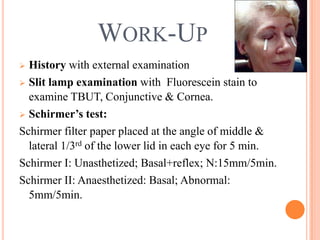
 Schirmer’s test:

Schirmer filter paper placed at the angle of middle &
  lateral 1/3rd of the lower lid in each eye for 5 min.
Schirmer I: Unasthetized; Basal+reflex; N:15mm/5min.
Schirmer II: Anaesthetized: Basal; Abnormal:
  5mm/5min.
TREATMENT
Increase    tear film volume:
 Artificial tears(Carboxymethyl
  Cellulose/ Hypromellose)
 Temporary insertion of punctal plugs
Improve Lubrication:
 Artificial Tear Substitutes
To break the sticky mucin:
 Acetylcysteine
TEAR SUBSTITUTES
Cellulose derivatives: Carboxymethyl
 cellulose 1%, Hypromellose 0.5%
Carbomers(Polyacrylic acid)
Polyvinyl alcolhol, Povidone, sodium
 Hylauronate
Lipids & Oil:
Acetylcysteine 5% with
 Hypromellose.
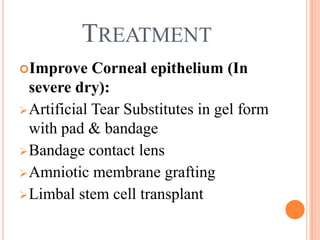
TREATMENT
Improve     Corneal epithelium (In
  severe dry):
 Artificial Tear Substitutes in gel form
  with pad & bandage
 Bandage contact lens
 Amniotic membrane grafting
 Limbal stem cell transplant
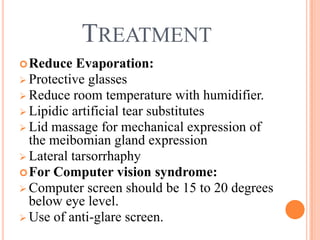
TREATMENT
 Reduce   Evaporation:
 Protective glasses
 Reduce room temperature with humidifier.
 Lipidic artificial tear substitutes
 Lid massage for mechanical expression of
  the meibomian gland expression
 Lateral tarsorrhaphy
 For Computer vision syndrome:
 Computer screen should be 15 to 20 degrees
  below eye level.
 Use of anti-glare screen.
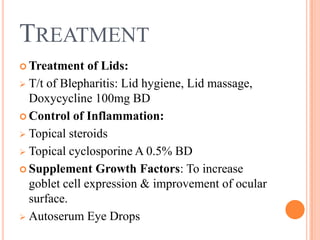
TREATMENT
 Treatment    of Lids:
 T/t of Blepharitis: Lid hygiene, Lid massage,
  Doxycycline 100mg BD
 Control of Inflammation:

 Topical steroids

 Topical cyclosporine A 0.5% BD

 Supplement Growth Factors: To increase
  goblet cell expression & improvement of ocular
  surface.
 Autoserum Eye Drops
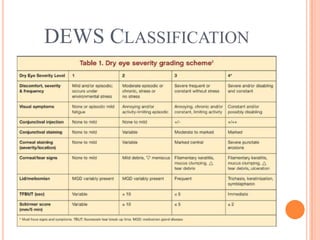
DEWS CLASSIFICATION
DEWS RECOMMENDATION OF
            TREATMENT
Level 1 treatment consists of the following:
 Education and environmental or dietary
  modifications
 Elimination of offending systemic medications

 Preserved artificial tear substitutes, gels, and
  ointments
 Eyelid therapy
.
DEWS RECOMMENDATION OF
         TREATMENT
If level 1 treatment is inadequate, level 2
  measures are added, including the following:
 Nonpreserved artificial tear substitutes

 Anti-inflammatory agents

 Tetracyclines (for meibomitis or rosacea)

 Punctal plugs (after inflammation has been
  controlled)
 Secretagogues

 Moisture chamber spectacles
DEWS RECOMMENDATION OF
         TREATMENT
If level 2 treatment is inadequate, level 3
  measures are added, including the following:
 Autologous serum or umbilical cord serum

 Contact lenses

 Permanent punctal occlusion

 If level 3 treatment is inadequate, level 4
  treatment, consisting of the administration of
  systemic anti-inflammatory agents, is added.
CONCLUSION
 Dry  eye complaints are a frequent
  presentation at Ophthalmic OPD due our
  current environment, pollution & life style.
 Prevalence(DEWS):35%
 The management of Dry Eye is simple if
  diagnosed early but tedious and difficult as
  the severity of the dry eye increases.
 Any patient with C/o red eye, grittiness, FB
  sensation & photophobia along with
  predisposing factors should be referred to the
  Eye clinic for further management.
REFERENCE;
 2007 Report of the International Dry Eye Workshop
  (DEWS). The OcularSurface. 2007;5:65-204.
 Systemic Approach to Clinical Ophthalmology.
  Kanski. 6th edition,2008.

Dry eye: An Overview

  • 1.
    DRY EYE: AN OVERVIEW Dr.Gayatree Mohanty Dept. of Ophthalmology, KIMS
  • 2.
    DRY EYE Occurs when Inadequate tear production  Inadequate function Results in Unstable Tear Film and Ocular Surface Disorder.
  • 3.
    TEAR PRODUCTION & TEAR FUNCTION Healthy tear film Dry eye
  • 4.
    TEAR PRODUCTION  Secretedby the lacrimal glands  Spreads over the ocular surface  Drained the lacrimal canaliculi into the nasolacrimal duct.
  • 5.
    TEAR FILM • Lipidlayer (meibomian glands in the eyelid): Outermost surface of the tear film; 0.1um • Aqueous layer (lacrimal gland): Middle layer; 7um • Mucus layer (goblet cells of conjunctiva): Inner most; 0.2um.
  • 6.
    FUNCTIONS OF THETEAR FILM • Lipid layer: Prevents evaporation of tears and acts as an surfactant allowing spread of the tear film. • Aqueous middle layer: Provide atmospheric O2 to the corneal epithelium; Antibacterial activity(Interleukins, lysozymes, IgA & lactoferrin); Cleanses the eye and washes away foreign particles or irritants; Provide a smooth optical surface to cornea by abolishing the irregularities. • Mucus layer: Allows the watery layer to spread evenly over the surface of the eye and helps the eye remain moist.
  • 7.
    FACTORS AFFECTING THE SPREAD OF TEAR FILM Normal lacrimal neural arc. Contact between the ocular surface & the eyelids Normal corneal epithelium.
  • 8.
    OCULAR SURFACE Conjunctival epithelium LimbalEpithelium Corneal epithelium Eyelids (Mucocutaneous junction)
  • 9.
    ETIOPATHOGENESIS Aqueous tear deficiency Sjogren’s Dieseases Non-Sjogren’s Diseases Lipid tear deficiency Mucin deficiency Kinetic disorders of lacrimal fluid
  • 10.
    SJOGREN’S SYNDROME  Autoimmune inflammation of the lacrimal glands and the salivary glands.  Primary or Secondary (RA,SLE, Systemic sclerosis, primary biliary cirrhosis, chronic active hepatitis, myasthenia gravis etc)  Most common symptoms are dry eyes and dry mouth.
  • 12.
    COMMON NON-SJOGREN’S CAUSES Vitamin A deficiency,  Stevens Johnson syndrome and  Ocular Cicatricial Pemphigoid (OCP). Affects the inner mucous layer of the tear film and prevents the natural tear film from adhering to the eye.  Prolonged computer hours: Evaporative dry eye  Allergic conjunctivitis: Altered tear function due to conjunctival & limbal inflammation.
  • 13.
    VITAMIN A DEFICIENCY Xerosis of the conjunctiva resulting in goblet cell destruction & mucin layer deficiency.
  • 14.
    STEVEN JOHNSON SYNDROME Mucocutaneous vesicullobullous disease.  MC Drugs: Sulfa drugs(Acetazolamide), Penicillin, Barb iturates, Salicylates  Acute vasculitis affecting conjunctiva & other mucous membranes.  Membranous muco-purulent conjunctivitis leading to scarring of conjunctiva & lid margin.  Destruction of meibomian glands, conjunctival goblet cells & limbal stem cells.
  • 15.
    OCULAR CICATRICIAL PEMPHIGOID Autoimmune muco- cutaneous blistering disease.  Cicatrization of the conjunctiva & lacrimal ductules result in both mucin layer & aqueous layer deficiency of tear film.
  • 16.
    COMPUTER VISION SYNDROME Variety of vision related symptoms that may be aggravated by regular use of a computer for two or more hours a day.  Reduced blinking leading reduced spreading of fresh tear film results in dry eye, blurring of vision, red eye, watering & asthenopia.
  • 17.
    ALLERGIC CONJUNCTIVITIS & VERNAL KERATOCONJUNCTIVITIS  Recurrent inflammation of conjunctiva & limbus leading to cicatrization and mucin deficiency dry eye.  Rubbing of the eye causes meibomian gland disease causing lipid deficiency dry eye.
  • 18.
    MEDICATIONS CAUSING DRY EYE •Diuretics • Beta-blockers • Antihistamines • Sedatives • Anti-Anxiety medications • Analgesics
  • 19.
    LIPID LAYER DEFICIENCY Blepharitis,  Meibomitis and  Rosacea. Affect the outer lipid layer of the tear film, causing excessive evaporation of the natural tears from the eye.
  • 20.
    CLINICAL FEATURE: SYMPTOMS  Burning sensation  Foreign body sensation (exaggerates over the day)  Stringy mucus discharge  Transient blurring of vision  Redness  Difficulty wearing contact lenses  Crusting of the lids
  • 21.
    CLINICAL MANIFESTATION: SIGNS  Tear meniscus at the inferior eye lid margin <1mm.  Tear Breakup Time <10sec  Punctate corneal & conjunctival fluorescein. Rose bengal staining esp. inferiorly & interpalpabral area.  Excess mucus & debris in the tear film & filaments on the cornea.
  • 22.
    WORK-UP  History withexternal examination  Slit lamp examination with Fluorescein stain to examine TBUT, Conjunctive & Cornea.  Schirmer’s test: Schirmer filter paper placed at the angle of middle & lateral 1/3rd of the lower lid in each eye for 5 min. Schirmer I: Unasthetized; Basal+reflex; N:15mm/5min. Schirmer II: Anaesthetized: Basal; Abnormal: 5mm/5min.
  • 23.
    TREATMENT Increase tear film volume:  Artificial tears(Carboxymethyl Cellulose/ Hypromellose)  Temporary insertion of punctal plugs Improve Lubrication:  Artificial Tear Substitutes To break the sticky mucin:  Acetylcysteine
  • 24.
    TEAR SUBSTITUTES Cellulose derivatives:Carboxymethyl cellulose 1%, Hypromellose 0.5% Carbomers(Polyacrylic acid) Polyvinyl alcolhol, Povidone, sodium Hylauronate Lipids & Oil: Acetylcysteine 5% with Hypromellose.
  • 25.
    TREATMENT Improve Corneal epithelium (In severe dry):  Artificial Tear Substitutes in gel form with pad & bandage  Bandage contact lens  Amniotic membrane grafting  Limbal stem cell transplant
  • 26.
    TREATMENT  Reduce Evaporation:  Protective glasses  Reduce room temperature with humidifier.  Lipidic artificial tear substitutes  Lid massage for mechanical expression of the meibomian gland expression  Lateral tarsorrhaphy  For Computer vision syndrome:  Computer screen should be 15 to 20 degrees below eye level.  Use of anti-glare screen.
  • 27.
    TREATMENT  Treatment of Lids:  T/t of Blepharitis: Lid hygiene, Lid massage, Doxycycline 100mg BD  Control of Inflammation:  Topical steroids  Topical cyclosporine A 0.5% BD  Supplement Growth Factors: To increase goblet cell expression & improvement of ocular surface.  Autoserum Eye Drops
  • 28.
  • 29.
    DEWS RECOMMENDATION OF TREATMENT Level 1 treatment consists of the following:  Education and environmental or dietary modifications  Elimination of offending systemic medications  Preserved artificial tear substitutes, gels, and ointments  Eyelid therapy .
  • 30.
    DEWS RECOMMENDATION OF TREATMENT If level 1 treatment is inadequate, level 2 measures are added, including the following:  Nonpreserved artificial tear substitutes  Anti-inflammatory agents  Tetracyclines (for meibomitis or rosacea)  Punctal plugs (after inflammation has been controlled)  Secretagogues  Moisture chamber spectacles
  • 31.
    DEWS RECOMMENDATION OF TREATMENT If level 2 treatment is inadequate, level 3 measures are added, including the following:  Autologous serum or umbilical cord serum  Contact lenses  Permanent punctal occlusion  If level 3 treatment is inadequate, level 4 treatment, consisting of the administration of systemic anti-inflammatory agents, is added.
  • 32.
    CONCLUSION  Dry eye complaints are a frequent presentation at Ophthalmic OPD due our current environment, pollution & life style.  Prevalence(DEWS):35%  The management of Dry Eye is simple if diagnosed early but tedious and difficult as the severity of the dry eye increases.  Any patient with C/o red eye, grittiness, FB sensation & photophobia along with predisposing factors should be referred to the Eye clinic for further management.
  • 33.
    REFERENCE;  2007 Reportof the International Dry Eye Workshop (DEWS). The OcularSurface. 2007;5:65-204.  Systemic Approach to Clinical Ophthalmology. Kanski. 6th edition,2008.