DRY EYE &
EPIPHORA
INTRODUCTION
• Dry eye is a multifactorial disease of the tears
and ocular surface that results in symptoms of
discomfort, visual disturbance and tear film
instability with potential damage to the ocular
surface.
• It is accompanied by increased osmolarity of
the tear filmand inflammation of the ocular
surface.
ETIOLOGIGAL CLASSIFICATION
• Aqueous deficiency dry eye(keratoconjunctivitis sicca).
a) Sjogrens syndrome
b) Non-Sjogrens keratoconjunctivitis sicca.
 Lacrimal deficiency: Primary age-related hyposecretion & other causes like congenital alacrima,
infiltrations of lacrimal gland.
 Lacrimal gland duct obstruction: old trachoma, chemical burns, Steven-Johnson syndrome.
 Hypersecretory states: Parkinson disease, reflex sensory block, reflex nerve blade, 7th CN
damage.
 Other disorders include: Meige syndrome, diabetes mellitus, pseudoexfoliation.
• Evaporative dry disease
Meibomian gland diseases-related evaporative dry eye
 Meibomian gland dysfunction
 Age-related charges
 Chronic posterior blepharitis
 Rosacea
 Congenital absence of meibomian glands
Evaporative any eye in disorders of lid aperture congruity and blind dynamics
 Lagophthalmos
 Defective blinking
Ocular surface-related evaporative dry eye
CLINICAL FEATURES
• Symptoms: Irritation, Foreign body sensation, Feeling of dryness,
Itching, Nonspecific ocular discomfort chronically sore eyes not
responsponding to a variety of drops instilled earlier.
• Signs:
 Tear film signs: Stingy mucous & particulate matter.
 Conjunctival signs: Lustreless, mildly congested, conjunctival
xerosis & keratinization.
 Corneal signs: Punctate epithelial erosions, filaments & mucus
plaques.
 Signs of causative disease: Posterior blepharitis, conjunctival
scarring diseases & lagophthalmos
COMPLICATIONS
• Can be vision threatening and include epithelial breakdown, corneal ulcer,
melting and even perforation.
TEAR FILM TESTS
1) Tear film break-up (BUT): Interval between a complete blink and appearance
of first randomly distributed dry spot on the cornea. Noted after instilling a
drop of fluorescein and examining in a cobalt-blue light of a slit lamp.
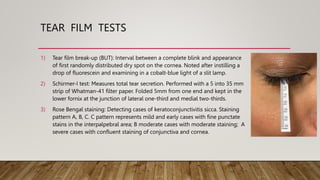
2) Schirmer-I test: Measures total tear secretion. Performed with a 5 into 35 mm
strip of Whatman-41 filter paper. Folded 5mm from one end and kept in the
lower fornix at the junction of lateral one-third and medial two-thirds.
3) Rose Bengal staining: Detecting cases of keratoconjunctivitis sicca. Staining
pattern A, B, C. C pattern represents mild and early cases with fine punctate
stains in the interpalpebral area; B moderate cases with moderate staining; A
severe cases with confluent staining of conjunctiva and cornea.
TREATMENT
• Supplementation with tear substitutes: Artificial tears are available as drops, ointments and
slow-release inserts.
• Anti-inflammatory agents:
 Low potency topical steroids like fluorometholone.
 Topical cyclosporine
 Chloroquine eye drops
 Omega fatty acid supplements.
• Secretagogues: Pilocarpine and cevimeline.
• Mucolytics like acetylcysteine.
SJOGRENS SYNDROME
• Etiology: Autoimmune chronic inflammatory disease with multisystem
involvement.
• Characteristic features: is an aqueous deficiency dry eye with symptoms and signs
of dry eye.
• In primay ss, patients presents with kcs xerostomia.
• In secondary ss, dry eye and dry mouth are associated with autoimmune disease,
commonly rheumatoid arthritis.
• Pathological features: focal accumulation and infiltrations with destruction of
lacrimal glandular tissues.
THE WATERING EYE
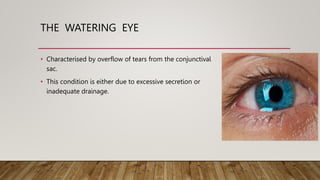
• Characterised by overflow of tears from the conjunctival
sac.
• This condition is either due to excessive secretion or
inadequate drainage.
ETIOLOGY
• Causes of hyperlacrimation
a) Primary hyperlacrimation: due to direct stimulation of lacrimal gland.
b) Reflex hyperlacrimation: due to stimulation of sensory branches of fifth nerve
due to irritation of cornea or conjunctiva.
c) Central lacrimation: seen in emotional states, voluntary lacrimation and
hysterical lacrimation.
• Causes of epiphora
a) Physiological cause: lacrimal pump failure due lower lid laxity.
b) Mechanical obstruction:
 Punctal causes – eversion of lower punctum Or punctal obstruction.
 Causes of the canaliculi – congenital or acquired due to foreign body, trauma, idiopathic fibrosis
and canaliculitis.
 Causes in the lacrimal sac – congenital mucous membrane fold, traumatic strictures,
dacryocystitis, specific infections like tuberculosis and syphilis.
 Causes of nasolacrimal duct – noncanalization, partial canalization, or imperforated
membranous valves. Diseases of surrounding bones, inflammatory strictures, tumours.
CLINICAL EVALUATION
• Ocular examination with diffuse illumination using magnification:
to rule out any cause of reflex hypersecretion located in lids,
conjunctiva, cornea, sclera, anterior chamber, uveal tract.
• Regurgitation test: Steady pressure with index finger is applied
over the lacrimal sac above the medial palpebral ligament. Reflux
of mucopurulent discharge indicates chronic dacryocystasis with
obstruction at lower end of the sac or mechanical obstruction.
• Fluorescein dye disappearance test (FDDT): 2 drops of fluorescein
dye are instilled in both conjunctival sac and are observed after 2
mins. Prolonged retention of dye in the conjunctival sac indicates
inadequate drainage which may be due to atonia of sac or
mechanical obstruction.
• Lacrimal syringing test: is performed after topical anaesthesia with 4% xylocaine. Normal saline
is pushed into the lacrimal sac from lower punctum with the help of a syringe and lacrimal
cannula. With free passage, indicates no mechanical obstruction. If pressure needed to be
applied on the syringe, indicates presence of partial obstruction. In the presence of obstruction,
it may reflux back through the same or through opposite punctum.
• Jones dye tests: they are perforformed when partial obstruction is suspected.
a) Jones dye test 1, is performed to differentiate between watering due to partial obstruction of
lacrimal passages from that due to primary hypersecretion of tears.
b) Jones dye test II, when the first is negative, the cotton bud is again placed in the inferior
meatus and lacrimal syringing is performed. Positive test indicates partial obstruction,
negative test indicates lacrimal pump failure.
• Dacryocystography: Use for patients with
mechanical obstruction. Tells the exact
site, nature and extent of block. Also
gives information about mucosa of the
sac, presence of fistulae, diverticulae,
stone or tumour in the sac.
THANK YOU…

Dry eye & epiphora.pptx

  • 1.
  • 2.
    INTRODUCTION • Dry eyeis a multifactorial disease of the tears and ocular surface that results in symptoms of discomfort, visual disturbance and tear film instability with potential damage to the ocular surface. • It is accompanied by increased osmolarity of the tear filmand inflammation of the ocular surface.
  • 3.
    ETIOLOGIGAL CLASSIFICATION • Aqueousdeficiency dry eye(keratoconjunctivitis sicca). a) Sjogrens syndrome b) Non-Sjogrens keratoconjunctivitis sicca.  Lacrimal deficiency: Primary age-related hyposecretion & other causes like congenital alacrima, infiltrations of lacrimal gland.  Lacrimal gland duct obstruction: old trachoma, chemical burns, Steven-Johnson syndrome.  Hypersecretory states: Parkinson disease, reflex sensory block, reflex nerve blade, 7th CN damage.  Other disorders include: Meige syndrome, diabetes mellitus, pseudoexfoliation.
  • 4.
    • Evaporative drydisease Meibomian gland diseases-related evaporative dry eye  Meibomian gland dysfunction  Age-related charges  Chronic posterior blepharitis  Rosacea  Congenital absence of meibomian glands Evaporative any eye in disorders of lid aperture congruity and blind dynamics  Lagophthalmos  Defective blinking Ocular surface-related evaporative dry eye
  • 5.
    CLINICAL FEATURES • Symptoms:Irritation, Foreign body sensation, Feeling of dryness, Itching, Nonspecific ocular discomfort chronically sore eyes not responsponding to a variety of drops instilled earlier. • Signs:  Tear film signs: Stingy mucous & particulate matter.  Conjunctival signs: Lustreless, mildly congested, conjunctival xerosis & keratinization.  Corneal signs: Punctate epithelial erosions, filaments & mucus plaques.  Signs of causative disease: Posterior blepharitis, conjunctival scarring diseases & lagophthalmos
  • 6.
    COMPLICATIONS • Can bevision threatening and include epithelial breakdown, corneal ulcer, melting and even perforation.
  • 7.
    TEAR FILM TESTS 1)Tear film break-up (BUT): Interval between a complete blink and appearance of first randomly distributed dry spot on the cornea. Noted after instilling a drop of fluorescein and examining in a cobalt-blue light of a slit lamp. 2) Schirmer-I test: Measures total tear secretion. Performed with a 5 into 35 mm strip of Whatman-41 filter paper. Folded 5mm from one end and kept in the lower fornix at the junction of lateral one-third and medial two-thirds. 3) Rose Bengal staining: Detecting cases of keratoconjunctivitis sicca. Staining pattern A, B, C. C pattern represents mild and early cases with fine punctate stains in the interpalpebral area; B moderate cases with moderate staining; A severe cases with confluent staining of conjunctiva and cornea.
  • 8.
    TREATMENT • Supplementation withtear substitutes: Artificial tears are available as drops, ointments and slow-release inserts. • Anti-inflammatory agents:  Low potency topical steroids like fluorometholone.  Topical cyclosporine  Chloroquine eye drops  Omega fatty acid supplements. • Secretagogues: Pilocarpine and cevimeline. • Mucolytics like acetylcysteine.
  • 9.
    SJOGRENS SYNDROME • Etiology:Autoimmune chronic inflammatory disease with multisystem involvement. • Characteristic features: is an aqueous deficiency dry eye with symptoms and signs of dry eye. • In primay ss, patients presents with kcs xerostomia. • In secondary ss, dry eye and dry mouth are associated with autoimmune disease, commonly rheumatoid arthritis. • Pathological features: focal accumulation and infiltrations with destruction of lacrimal glandular tissues.
  • 10.
    THE WATERING EYE •Characterised by overflow of tears from the conjunctival sac. • This condition is either due to excessive secretion or inadequate drainage.
  • 11.
    ETIOLOGY • Causes ofhyperlacrimation a) Primary hyperlacrimation: due to direct stimulation of lacrimal gland. b) Reflex hyperlacrimation: due to stimulation of sensory branches of fifth nerve due to irritation of cornea or conjunctiva. c) Central lacrimation: seen in emotional states, voluntary lacrimation and hysterical lacrimation.
  • 12.
    • Causes ofepiphora a) Physiological cause: lacrimal pump failure due lower lid laxity. b) Mechanical obstruction:  Punctal causes – eversion of lower punctum Or punctal obstruction.  Causes of the canaliculi – congenital or acquired due to foreign body, trauma, idiopathic fibrosis and canaliculitis.  Causes in the lacrimal sac – congenital mucous membrane fold, traumatic strictures, dacryocystitis, specific infections like tuberculosis and syphilis.  Causes of nasolacrimal duct – noncanalization, partial canalization, or imperforated membranous valves. Diseases of surrounding bones, inflammatory strictures, tumours.
  • 13.
    CLINICAL EVALUATION • Ocularexamination with diffuse illumination using magnification: to rule out any cause of reflex hypersecretion located in lids, conjunctiva, cornea, sclera, anterior chamber, uveal tract. • Regurgitation test: Steady pressure with index finger is applied over the lacrimal sac above the medial palpebral ligament. Reflux of mucopurulent discharge indicates chronic dacryocystasis with obstruction at lower end of the sac or mechanical obstruction. • Fluorescein dye disappearance test (FDDT): 2 drops of fluorescein dye are instilled in both conjunctival sac and are observed after 2 mins. Prolonged retention of dye in the conjunctival sac indicates inadequate drainage which may be due to atonia of sac or mechanical obstruction.
  • 14.
    • Lacrimal syringingtest: is performed after topical anaesthesia with 4% xylocaine. Normal saline is pushed into the lacrimal sac from lower punctum with the help of a syringe and lacrimal cannula. With free passage, indicates no mechanical obstruction. If pressure needed to be applied on the syringe, indicates presence of partial obstruction. In the presence of obstruction, it may reflux back through the same or through opposite punctum. • Jones dye tests: they are perforformed when partial obstruction is suspected. a) Jones dye test 1, is performed to differentiate between watering due to partial obstruction of lacrimal passages from that due to primary hypersecretion of tears. b) Jones dye test II, when the first is negative, the cotton bud is again placed in the inferior meatus and lacrimal syringing is performed. Positive test indicates partial obstruction, negative test indicates lacrimal pump failure.
  • 15.
    • Dacryocystography: Usefor patients with mechanical obstruction. Tells the exact site, nature and extent of block. Also gives information about mucosa of the sac, presence of fistulae, diverticulae, stone or tumour in the sac.
  • 16.