

Arthshastra
• Concerned with the acquisition and protection of
means of livelihood.
• Also a means to ensure the well-being of men in
general
• Two fold aims
– Palana: administration and protection of the state
– Labha: conquest and acquisition of territory
• Hence it is a science dealing with internal as well as
external spheres.
• Concentrated on the practical aspects of administration
Origin of the state
Anarchy
• Might is right
• Matsyanyaya: Law of the fish
• Hence they chose Manu as the king
• Gave him taxes in return for protection
• No explicit theory of social contract in the book
Monarchy
• Attaches an element of divinity to the king
• Monarchy seems to have been the accepted
norm
• Other forms:
– Dvairajya: joint rule of the kingdom by the males
of the same family
– Vairajya: rule by a foreign ruler
• Disapproves of Vairajya
Qualities of the ruler
• Should be a native of the territory
• Follow the teachings of the shastra
• Strong and of noble birth etc
• Trained in philosophy, economics and political
science (dandaniti)
• Difference between Kautilya’s king and Plato’s
philosopher king
– Kautilya doesn’t mean that the king should lead
the life of a saint or an ascetic.
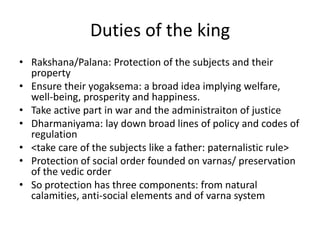
Duties of the king
• Rakshana/Palana: Protection of the subjects and their
property
• Ensure their yogaksema: a broad idea implying welfare,
well-being, prosperity and happiness.
• Take active part in war and the administraiton of justice
• Dharmaniyama: lay down broad lines of policy and codes of
regulation
• <take care of the subjects like a father: paternalistic rule>
• Protection of social order founded on varnas/ preservation
of the vedic order
• So protection has three components: from natural
calamities, anti-social elements and of varna system
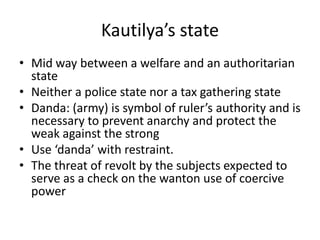
Kautilya’s state
• Mid way between a welfare and an authoritarian
state
• Neither a police state nor a tax gathering state
• Danda: (army) is symbol of ruler’s authority and is
necessary to prevent anarchy and protect the
weak against the strong
• Use ‘danda’ with restraint.
• The threat of revolt by the subjects expected to
serve as a check on the wanton use of coercive
power
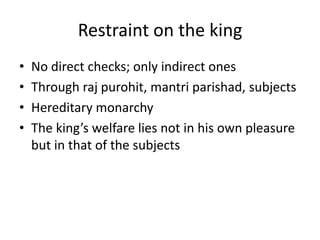
Restraint on the king
• No direct checks; only indirect ones
• Through raj purohit, mantri parishad, subjects
• Hereditary monarchy
• The king’s welfare lies not in his own pleasure
but in that of the subjects
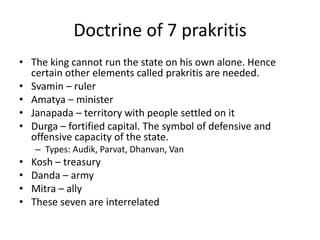
Doctrine of 7 prakritis
• The king cannot run the state on his own alone. Hence
certain other elements called prakritis are needed.
• Svamin – ruler
• Amatya – minister
• Janapada – territory with people settled on it
• Durga – fortified capital. The symbol of defensive and
offensive capacity of the state.
– Types: Audik, Parvat, Dhanvan, Van
• Kosh – treasury
• Danda – army
• Mitra – ally
• These seven are interrelated
• Mantris and Mantri parishad is not analogous to
the modern day cabinet
– The king was not mandated to consult them
– He could consult some or none
• Qualities of the officers of the state
– Sattva (energy)
– Prajna (intelligence)
– Vakyashakti (power of expression)
• Recommends few tests to test them
• 18 tirthas (officers)
Revenue Administraiton
• Kosa is one of the 7 prakritas
• Three principal means of livelihood
– Agriculture
– Cattle tending
– Trade
• Samahartrs were revenue officers
• Total control by the state of the ecomic activities of the
state to earn maximum possible revenue
• Trade routes should be under strict control of the state
• Guidelines on prices administration
Personnel Administration
• Personnels who man the organisation are as important as the organisation itself.
• Recruitment
– Prescribes qualifications for each post
– All important appointments made by the king
– Tests such as Dharmopadha, Arthopadha, Bhayopadha and Kamopadha
• Training
– Extended discussion on the training of the prince but little on the training of the personnel
• Pay: prescribes the salaries
– Salaries given on a fairly liberal scale to prevent discontent and ensure efficiency.
– Talked about pension as well
• Promotion
– No definite rules
– Who increase revenue may be promoted
– Transfer to prevent misapproriation of funds
• Tenure and removal
– On the will of the king
Pub Ad Principles in Arthshastra
• Unity of command
– King as the sole source of authority
• Public accountability
– Makes the king partly responsible to the public
– King has a duty to protect the subjects
• Rule of business
– Departmentalisation
• Coordination
– Because there was division of labour
• Job Classification
– Speical tests prescribed for holding special types of jobs
• Hierarcy
– Because job classification exists
• Planning and Budgeting
• Dencentralisation
– Janapada was also further divided
Elements of welfare state in Arth.
• Though one man rule, yet it was a benevolent
monarchy. Seeds of the idea of welfare state.
• King’s mission: Yogakshema
• Paternalistic rule
• Duty of the king to maintain the minors, the aged
and those in distress
• Guidelines on crisis administration
• A newly settled village was initially given some
concessions
Appraisal
• Arthshastra shifted attention from political
philosophy to political science
– Plato and Aristotle gave political philosophy
– Kautilya had a very practical approach in the sense
he wanted to give guidelines to show how a state
ought to be ruled.
– Speaks in terms of a highly materialistic world
keeping the moral values aside
Kautilya vs Weber
• Spatial and temporal differences between the two significant
– India was ‘traditional’ while Germany had acquired some aspects of
‘legal rational’ authority
• Kautilya never made a serious attempt at theory building. Was
normative and perscriptive in his treatment
– Normativism was not prominent in Weber’s model
• Both were keen on the efficiency and rationality aspects of
administration
• Weberian bureaucratic model is based on ‘authority’ while
Kautilya’s analysis focuses on the concept of control.
– Hence, Kautilya and Weber differ on the basis of legitimacy of
authority.
• We can also see characters like hierarchy, competence, selection by
merit, promotion by seniority, written orders etc

Kautilya

  • 2.
    Arthshastra • Concerned withthe acquisition and protection of means of livelihood. • Also a means to ensure the well-being of men in general • Two fold aims – Palana: administration and protection of the state – Labha: conquest and acquisition of territory • Hence it is a science dealing with internal as well as external spheres. • Concentrated on the practical aspects of administration
  • 3.
    Origin of thestate Anarchy • Might is right • Matsyanyaya: Law of the fish • Hence they chose Manu as the king • Gave him taxes in return for protection • No explicit theory of social contract in the book
  • 4.
    Monarchy • Attaches anelement of divinity to the king • Monarchy seems to have been the accepted norm • Other forms: – Dvairajya: joint rule of the kingdom by the males of the same family – Vairajya: rule by a foreign ruler • Disapproves of Vairajya
  • 5.
    Qualities of theruler • Should be a native of the territory • Follow the teachings of the shastra • Strong and of noble birth etc • Trained in philosophy, economics and political science (dandaniti) • Difference between Kautilya’s king and Plato’s philosopher king – Kautilya doesn’t mean that the king should lead the life of a saint or an ascetic.
  • 6.
    Duties of theking • Rakshana/Palana: Protection of the subjects and their property • Ensure their yogaksema: a broad idea implying welfare, well-being, prosperity and happiness. • Take active part in war and the administraiton of justice • Dharmaniyama: lay down broad lines of policy and codes of regulation • <take care of the subjects like a father: paternalistic rule> • Protection of social order founded on varnas/ preservation of the vedic order • So protection has three components: from natural calamities, anti-social elements and of varna system
  • 7.
    Kautilya’s state • Midway between a welfare and an authoritarian state • Neither a police state nor a tax gathering state • Danda: (army) is symbol of ruler’s authority and is necessary to prevent anarchy and protect the weak against the strong • Use ‘danda’ with restraint. • The threat of revolt by the subjects expected to serve as a check on the wanton use of coercive power
  • 8.
    Restraint on theking • No direct checks; only indirect ones • Through raj purohit, mantri parishad, subjects • Hereditary monarchy • The king’s welfare lies not in his own pleasure but in that of the subjects
  • 9.
    Doctrine of 7prakritis • The king cannot run the state on his own alone. Hence certain other elements called prakritis are needed. • Svamin – ruler • Amatya – minister • Janapada – territory with people settled on it • Durga – fortified capital. The symbol of defensive and offensive capacity of the state. – Types: Audik, Parvat, Dhanvan, Van • Kosh – treasury • Danda – army • Mitra – ally • These seven are interrelated
  • 10.
    • Mantris andMantri parishad is not analogous to the modern day cabinet – The king was not mandated to consult them – He could consult some or none • Qualities of the officers of the state – Sattva (energy) – Prajna (intelligence) – Vakyashakti (power of expression) • Recommends few tests to test them • 18 tirthas (officers)
  • 11.
    Revenue Administraiton • Kosais one of the 7 prakritas • Three principal means of livelihood – Agriculture – Cattle tending – Trade • Samahartrs were revenue officers • Total control by the state of the ecomic activities of the state to earn maximum possible revenue • Trade routes should be under strict control of the state • Guidelines on prices administration
  • 12.
    Personnel Administration • Personnelswho man the organisation are as important as the organisation itself. • Recruitment – Prescribes qualifications for each post – All important appointments made by the king – Tests such as Dharmopadha, Arthopadha, Bhayopadha and Kamopadha • Training – Extended discussion on the training of the prince but little on the training of the personnel • Pay: prescribes the salaries – Salaries given on a fairly liberal scale to prevent discontent and ensure efficiency. – Talked about pension as well • Promotion – No definite rules – Who increase revenue may be promoted – Transfer to prevent misapproriation of funds • Tenure and removal – On the will of the king
  • 13.
    Pub Ad Principlesin Arthshastra • Unity of command – King as the sole source of authority • Public accountability – Makes the king partly responsible to the public – King has a duty to protect the subjects • Rule of business – Departmentalisation • Coordination – Because there was division of labour • Job Classification – Speical tests prescribed for holding special types of jobs • Hierarcy – Because job classification exists • Planning and Budgeting • Dencentralisation – Janapada was also further divided
  • 14.
    Elements of welfarestate in Arth. • Though one man rule, yet it was a benevolent monarchy. Seeds of the idea of welfare state. • King’s mission: Yogakshema • Paternalistic rule • Duty of the king to maintain the minors, the aged and those in distress • Guidelines on crisis administration • A newly settled village was initially given some concessions
  • 15.
    Appraisal • Arthshastra shiftedattention from political philosophy to political science – Plato and Aristotle gave political philosophy – Kautilya had a very practical approach in the sense he wanted to give guidelines to show how a state ought to be ruled. – Speaks in terms of a highly materialistic world keeping the moral values aside
  • 16.
    Kautilya vs Weber •Spatial and temporal differences between the two significant – India was ‘traditional’ while Germany had acquired some aspects of ‘legal rational’ authority • Kautilya never made a serious attempt at theory building. Was normative and perscriptive in his treatment – Normativism was not prominent in Weber’s model • Both were keen on the efficiency and rationality aspects of administration • Weberian bureaucratic model is based on ‘authority’ while Kautilya’s analysis focuses on the concept of control. – Hence, Kautilya and Weber differ on the basis of legitimacy of authority. • We can also see characters like hierarchy, competence, selection by merit, promotion by seniority, written orders etc