STRUCTURE OF NUCLEIC ACIDS :
DNA (DE-OXY RIBO NUCLEIC
ACID )
By
Dr. Ichha Purak
University Professor
Department of Botany
Ranchi Women’s College,Ranchi
http://www.dripurak.com/
Discovery of DNA
Friedrick Miescher (1869) , a Swiss chemist first identified
nuclein from nuclei of human white blood cells which was
later on renamed as Nucleic acid . It was rich in phosphorus
having no sulphur so was different than protein.
Russian Biochemist Phobebus Levene (1910) is credited to
discover Phosphate-Sugar-Base as three components of
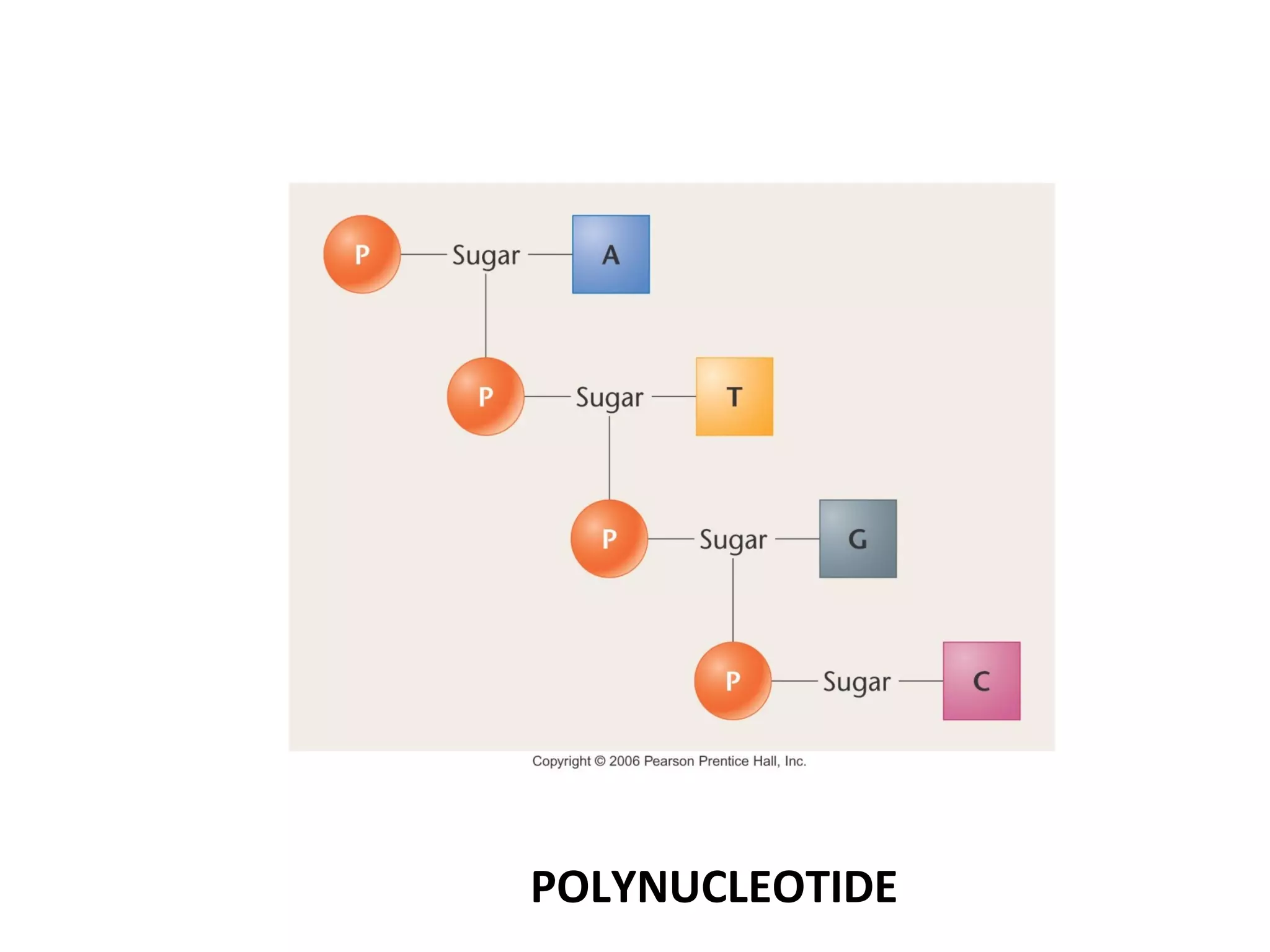
Nucleotide . He also mentioned DNA as polynucleotide (Any
one of four adenine,Cytocine,Thymine /Guanine ).
He also stated difference between Ribose and Deoxyribose
Sugar
HISTORY OF DNAHISTORY OF DNA
William Astbury (1938) detected a periodicity of 3.4
angstroms
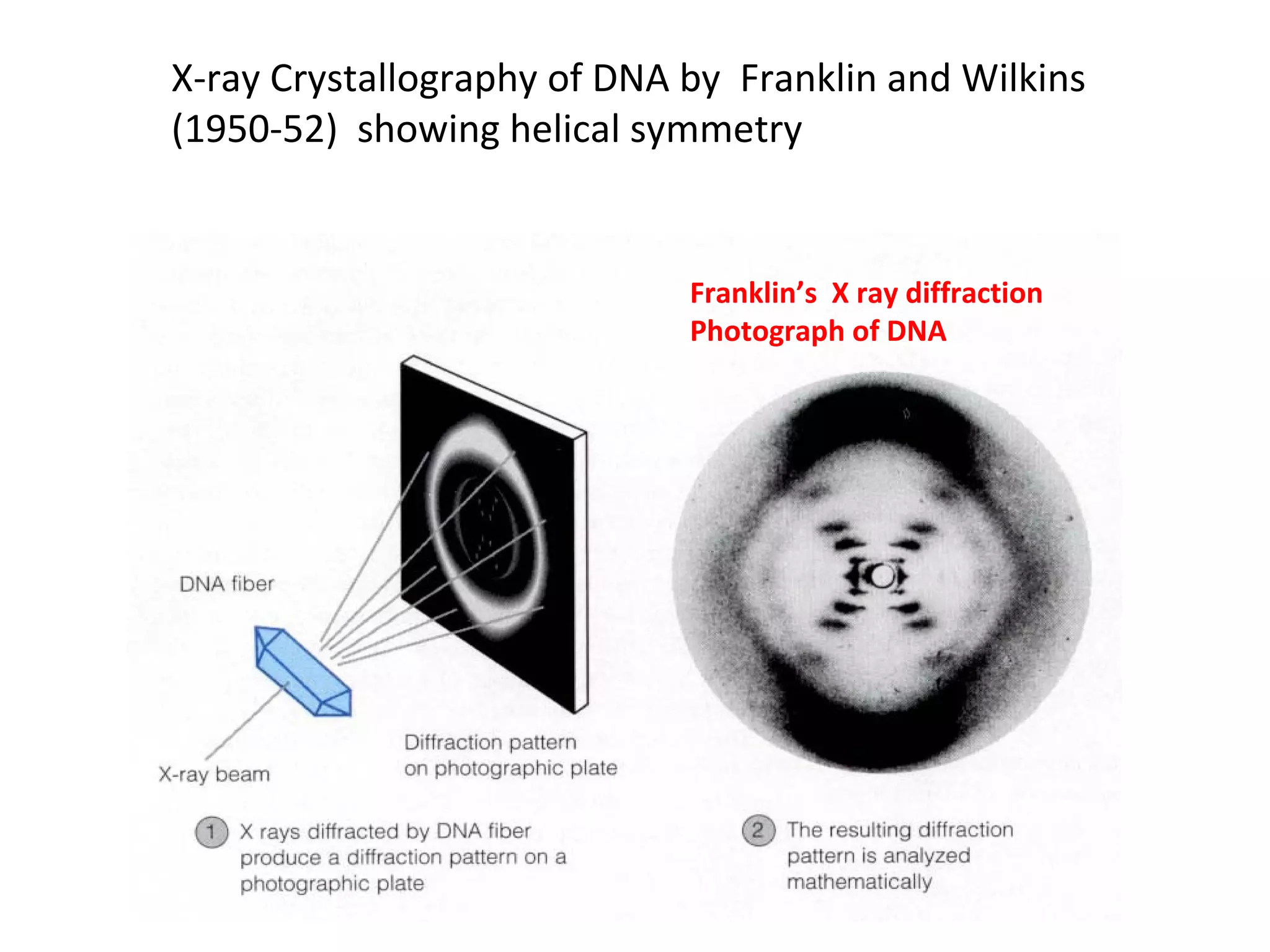
Rosalind Franklin (1952) performed - X- ray diffraction
analysis of DNA crystal
Franklin and Wilkins (1950-1953) confirmed 3.4 periodicity
and noted uniform diameter of 20A○
(2nm)
The images of DNA taken by Franklin gave clue to Watson and
Crick about the width of double helix and spacing of N-bases
Watson and Crick (1953 ) proposed the DNA double helical
model based on Franklin’s X-ray crystallography Analysis
and other evidences
1962: Nobel Prize in Physiology
and Medicine
James D.
Watson
Francis H.
Crick
Maurice H. F.
Wilkins Rosalind Franklin
X-ray Crystallography of DNA by Franklin and Wilkins
(1950-52) showing helical symmetry
Franklin’s X ray diffraction
Photograph of DNA
•DNA is one of the two nucleic acids ( RNA and DNA )
•DNA is long, unbranched and spirally coiled in
Eukaryotes and circular in prokaryotes as well as
mitochondria and plastids
• In Prokayotes DNA is present only in Nucleoid and is
Monocistronic, but in Eukaryotes DNA is present in
Nucleus, Mitochondria and Plastids and is
Polycistronic.
•DNA is genetic material ,carries heredity characters
over generations through DNA Replication ( DNA 
DNA )and Transcription ( DNA RNA ) followed by
Translation
•Nucleic Acids are fibre like molecules ( Length is
many times the breadth )
•Nucleic Acids are polymers of Nucleotides.
•DNA is a macromolecule of high Molecular Weight
•Nucleotides consists of sugar, Phosphoric Acid and
bases ( Purine /Pyrimidine)
•
POLYNUCLEOTIDE
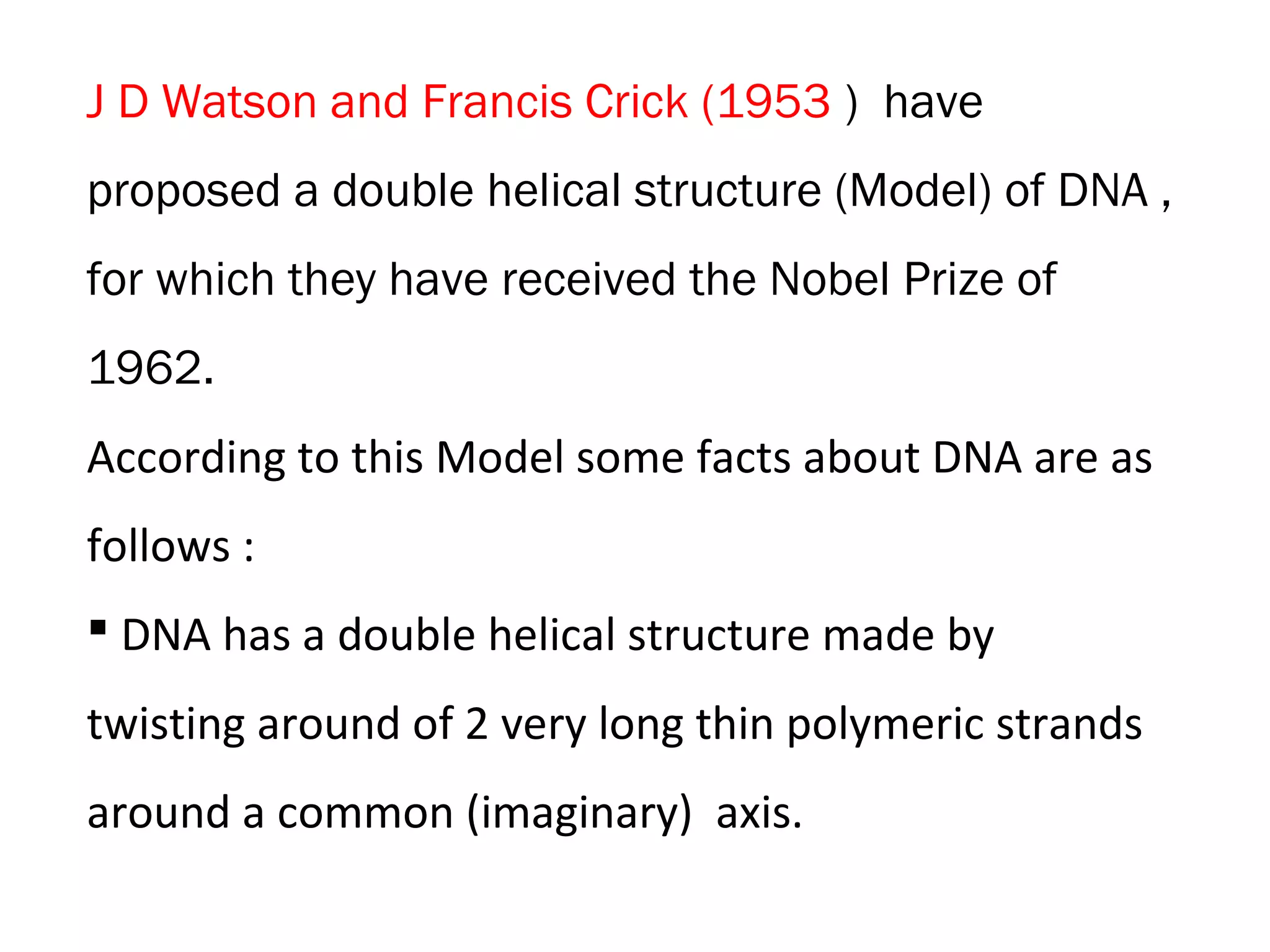
J D Watson and Francis Crick (1953 ) have
proposed a double helical structure (Model) of DNA ,
for which they have received the Nobel Prize of
1962.
According to this Model some facts about DNA are as
follows :
 DNA has a double helical structure made by
twisting around of 2 very long thin polymeric strands
around a common (imaginary) axis.
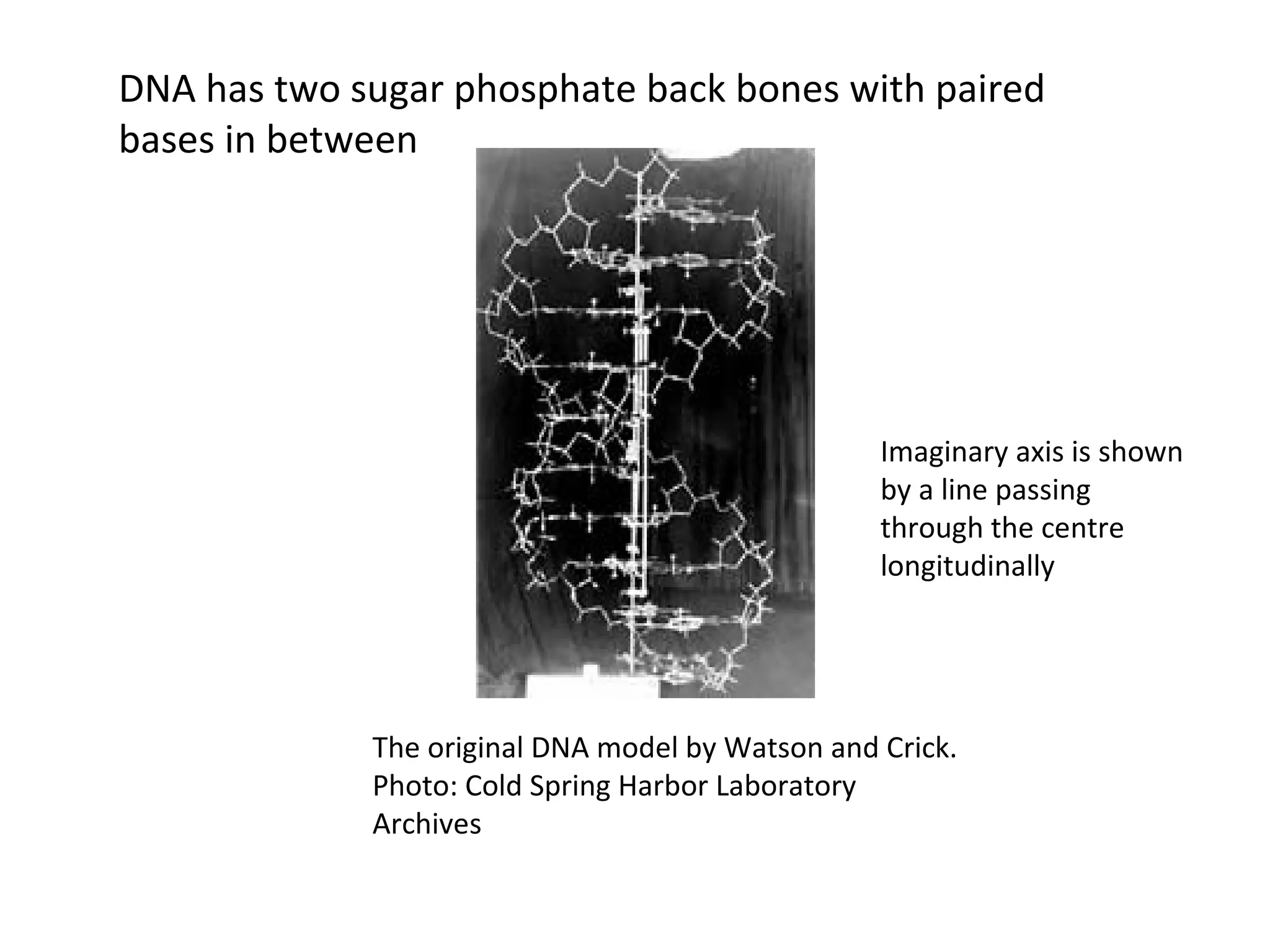
The original DNA model by Watson and Crick.
Photo: Cold Spring Harbor Laboratory
Archives
Imaginary axis is shown
by a line passing
through the centre
longitudinally
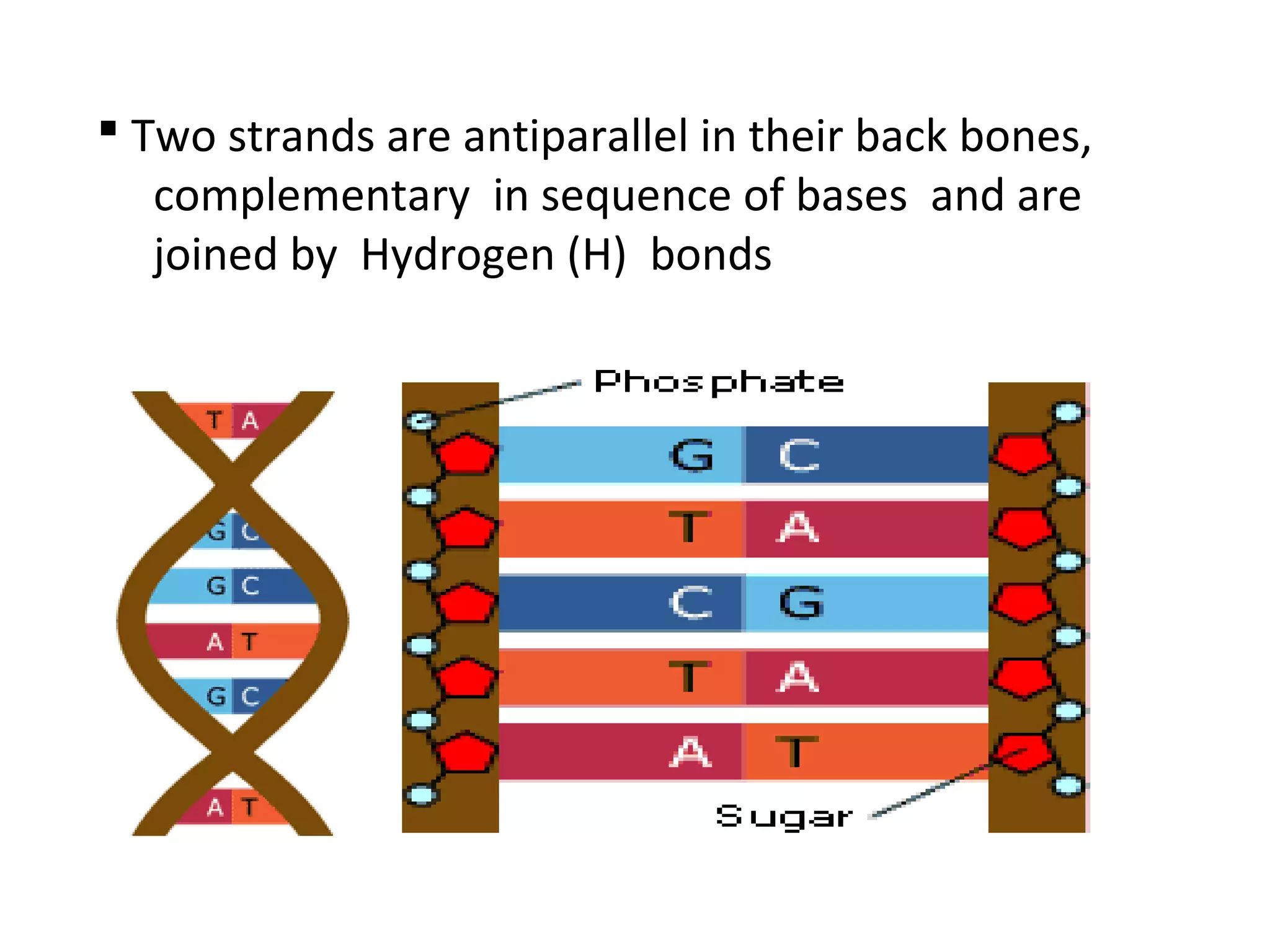
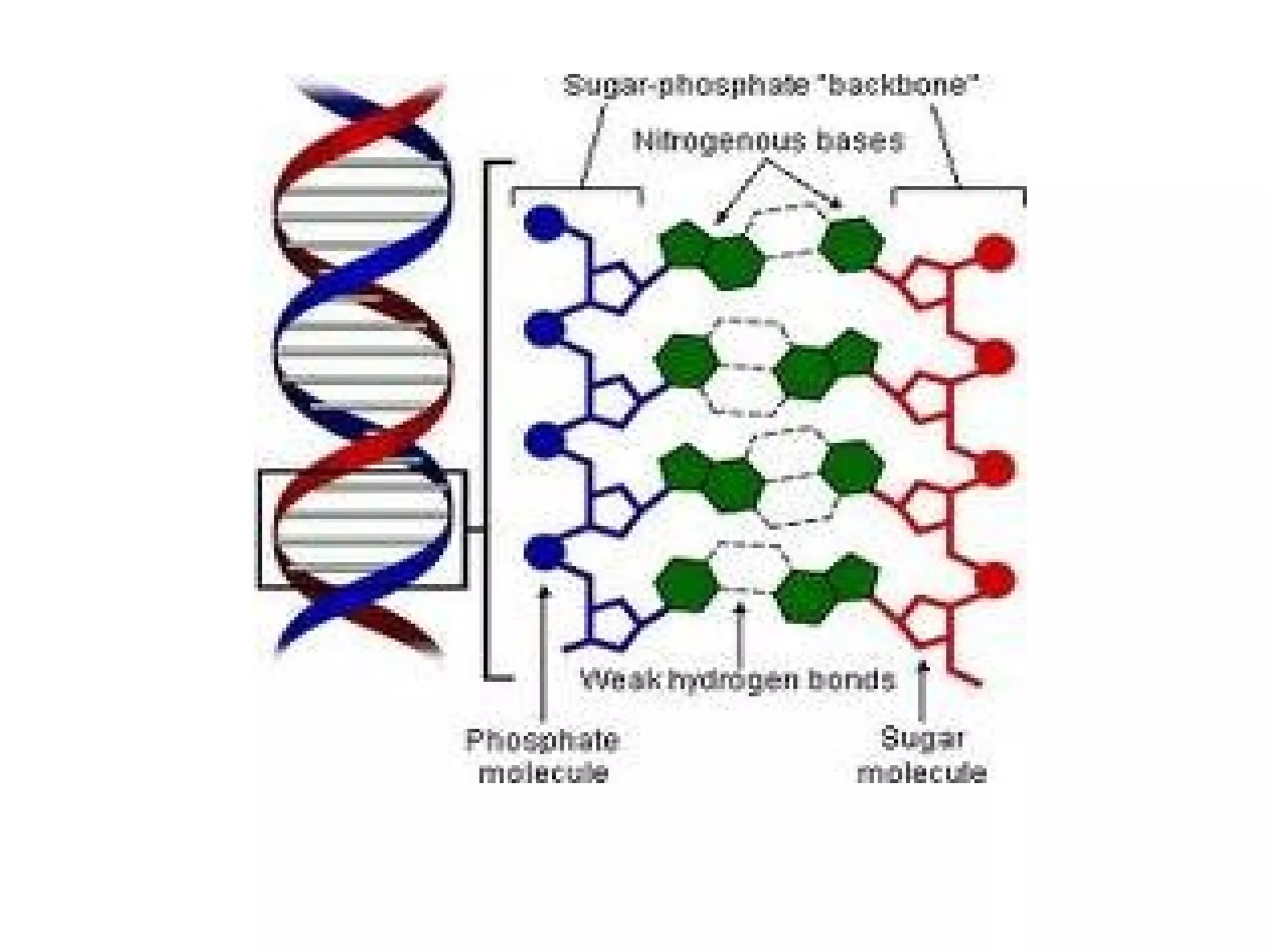
DNA has two sugar phosphate back bones with paired
bases in between
DNA Double
Helix
 Two strands are antiparallel in their back bones,
complementary in sequence of bases and are
joined by Hydrogen (H) bonds
O
O=P-O
O
PhosphatePhosphate
GroupGroup
N
Nitrogenous baseNitrogenous base
(A, G, C, or T)(A, G, C, or T)
CH2
O
C1
C4
C3
C2
5
SugarSugar
(deoxyribose)(deoxyribose)
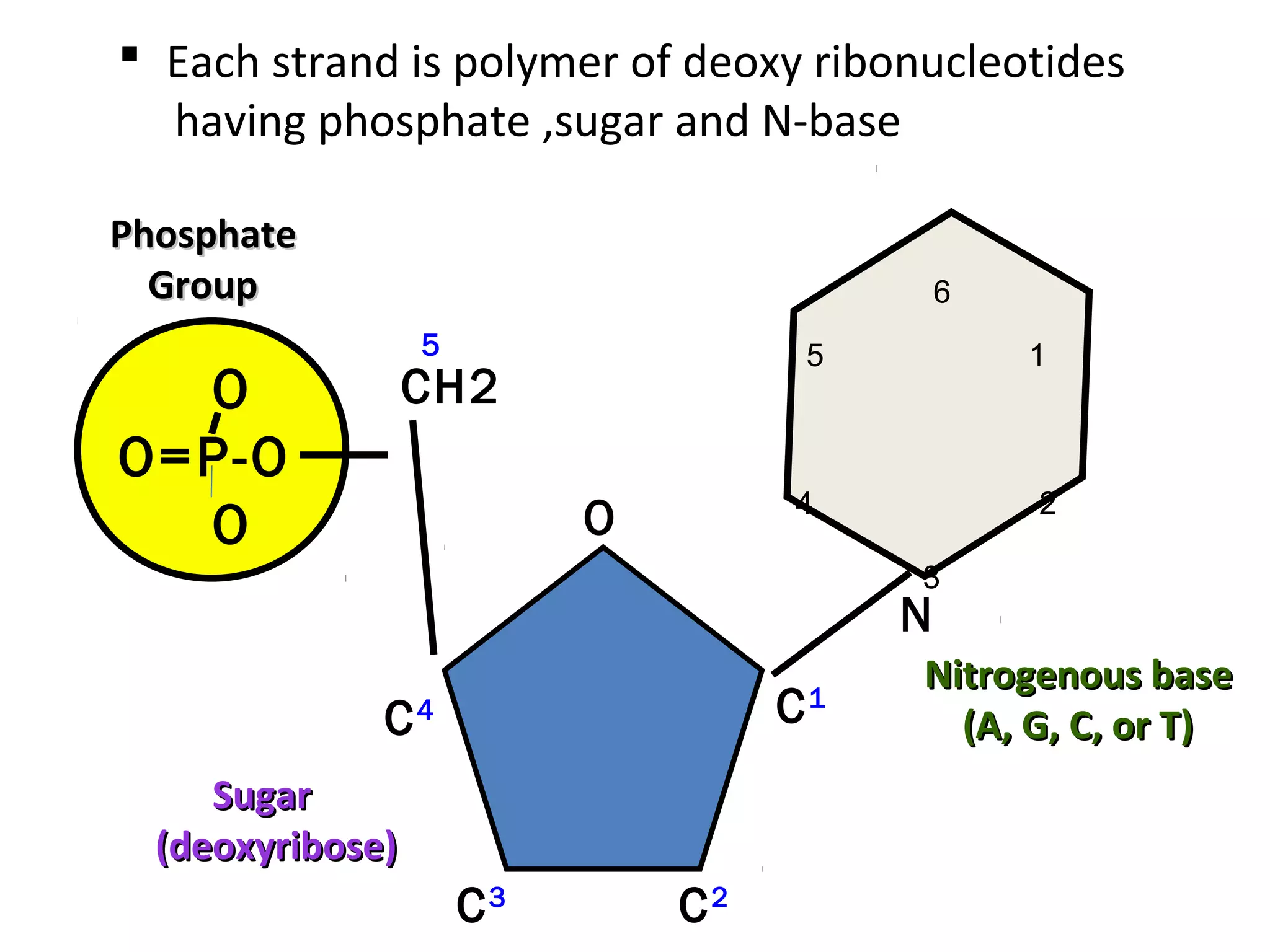
 Each strand is polymer of deoxy ribonucleotides
having phosphate ,sugar and N-base
1
2
3
4
5
6
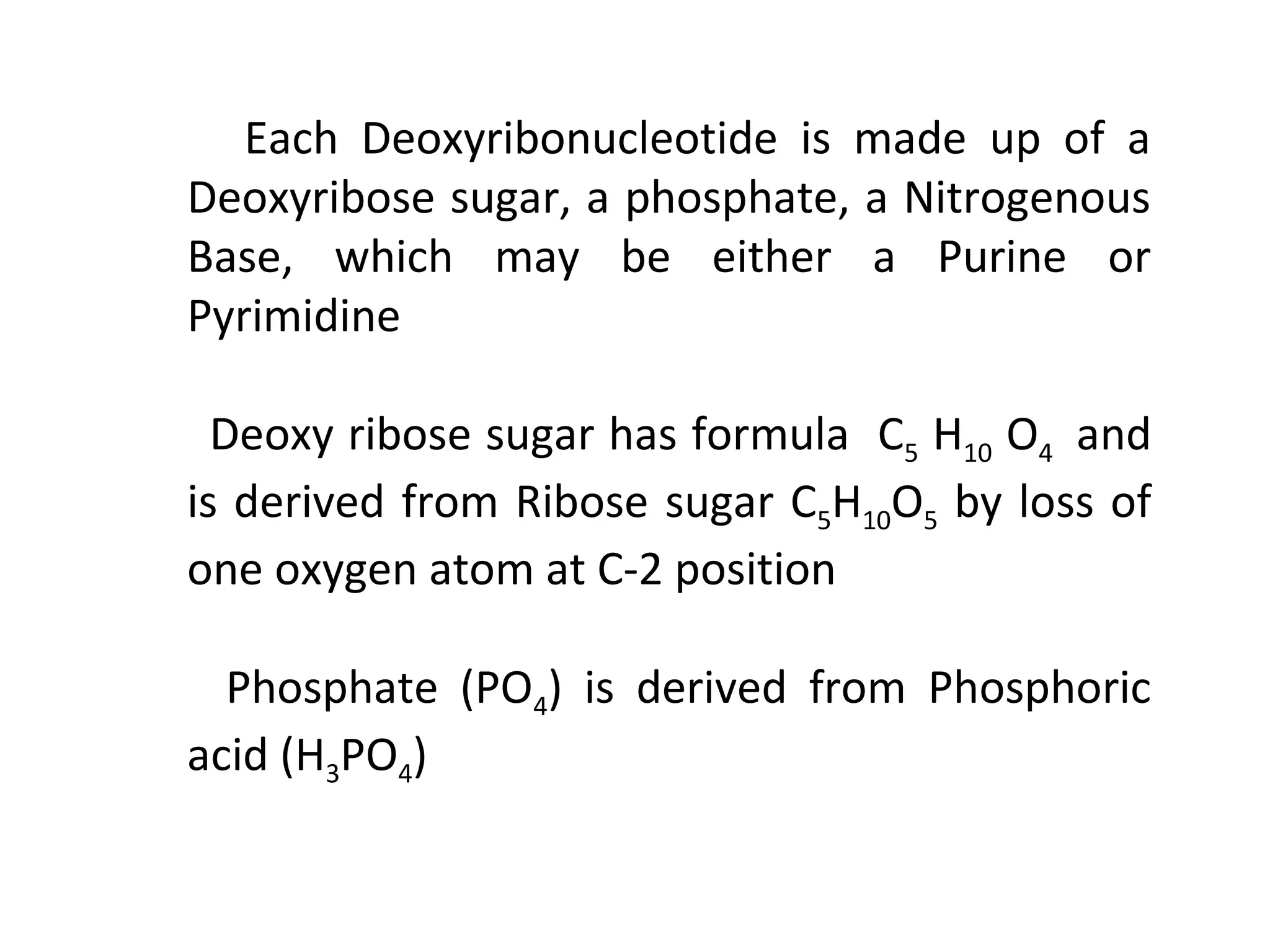
Each Deoxyribonucleotide is made up of a
Deoxyribose sugar, a phosphate, a Nitrogenous
Base, which may be either a Purine or
Pyrimidine
Deoxy ribose sugar has formula C5 H10 O4 and
is derived from Ribose sugar C5H10O5 by loss of
one oxygen atom at C-2 position
Phosphate (PO4) is derived from Phosphoric
acid (H3PO4)
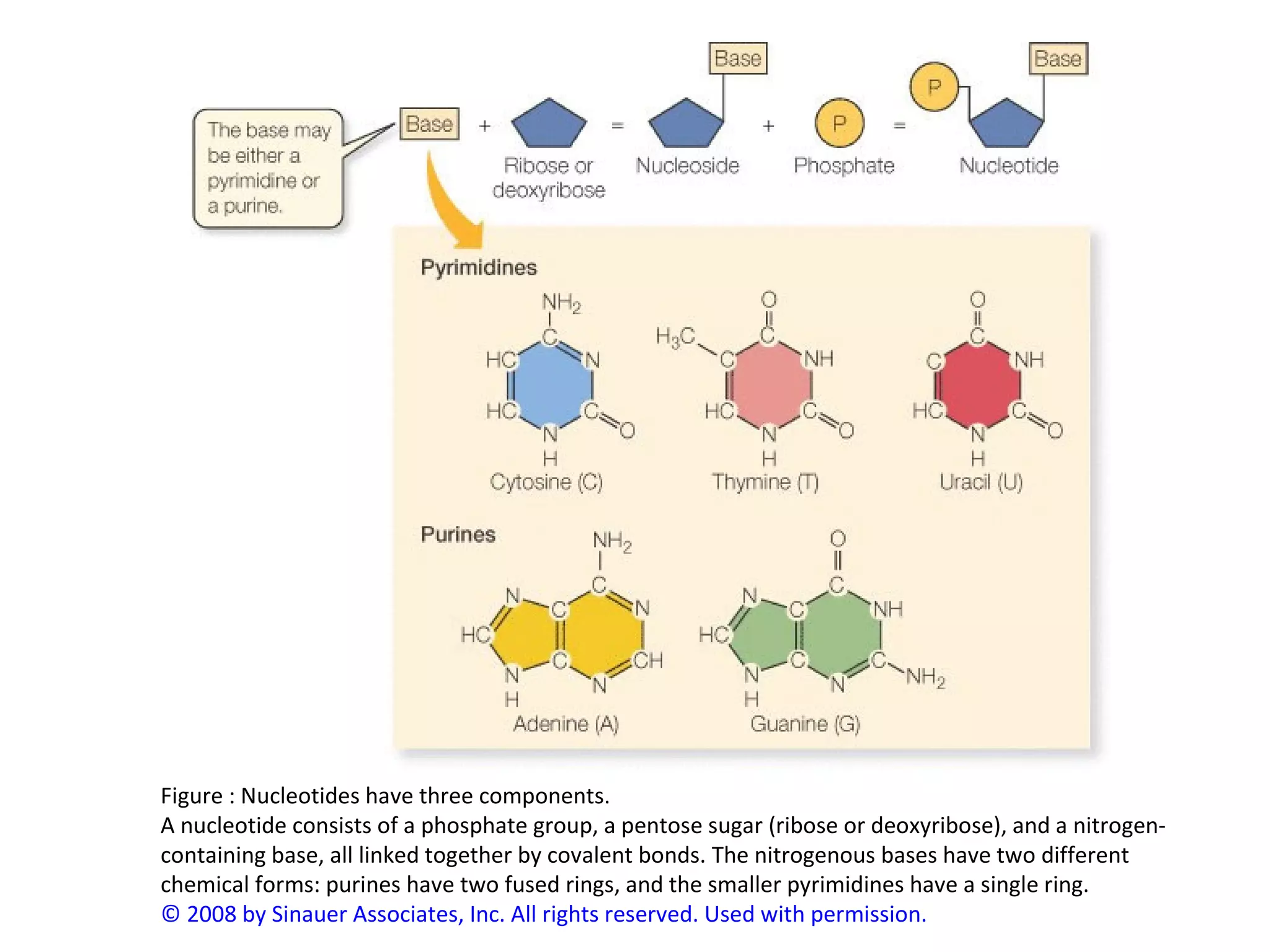
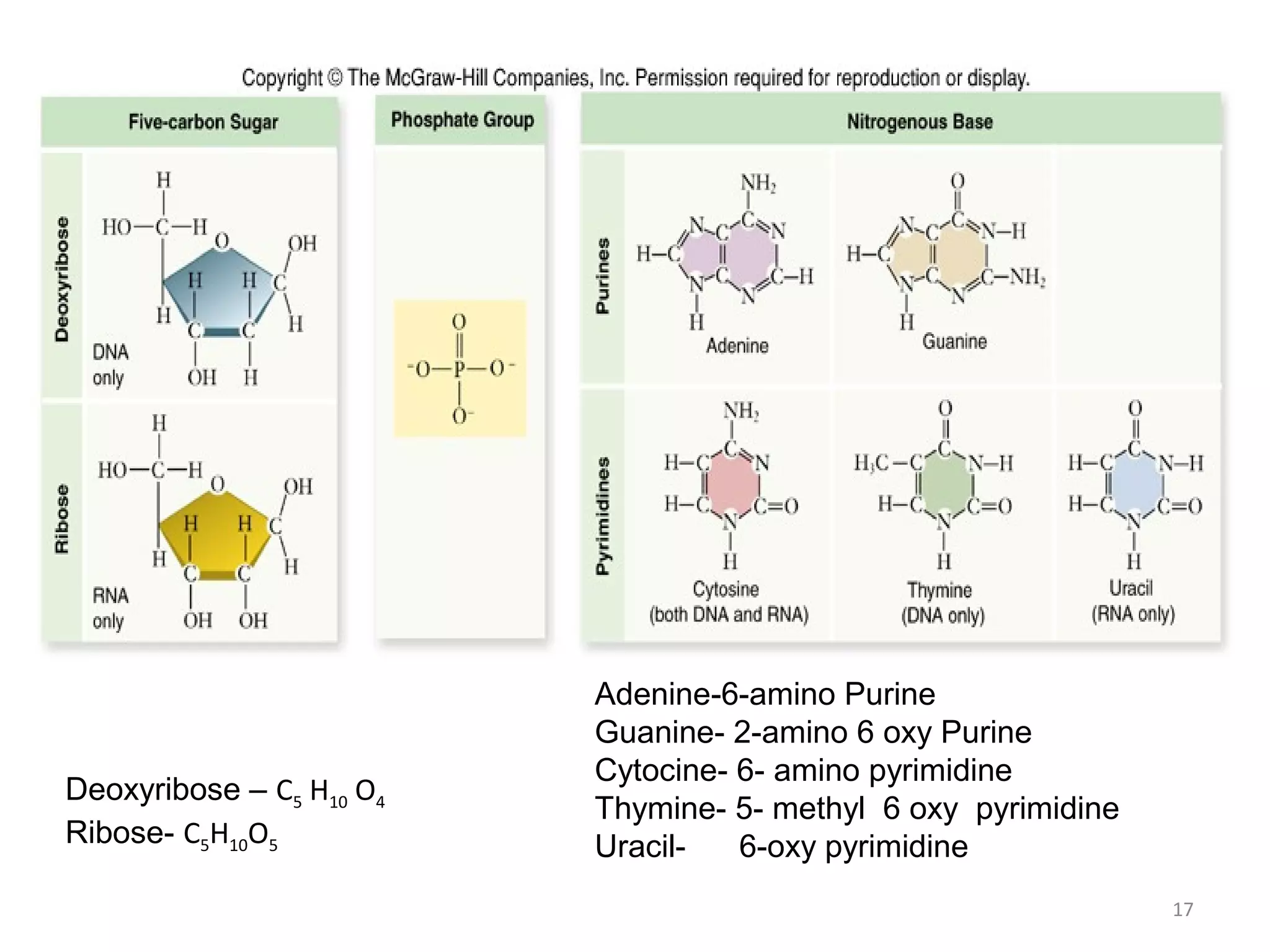
Figure : Nucleotides have three components.
A nucleotide consists of a phosphate group, a pentose sugar (ribose or deoxyribose), and a nitrogen-
containing base, all linked together by covalent bonds. The nitrogenous bases have two different
chemical forms: purines have two fused rings, and the smaller pyrimidines have a single ring.
© 2008 by Sinauer Associates, Inc. All rights reserved. Used with permission.
17
Deoxyribose – C5 H10 O4
Ribose- C5H10O5
Adenine-6-amino Purine
Guanine- 2-amino 6 oxy Purine
Cytocine- 6- amino pyrimidine
Thymine- 5- methyl 6 oxy pyrimidine
Uracil- 6-oxy pyrimidine
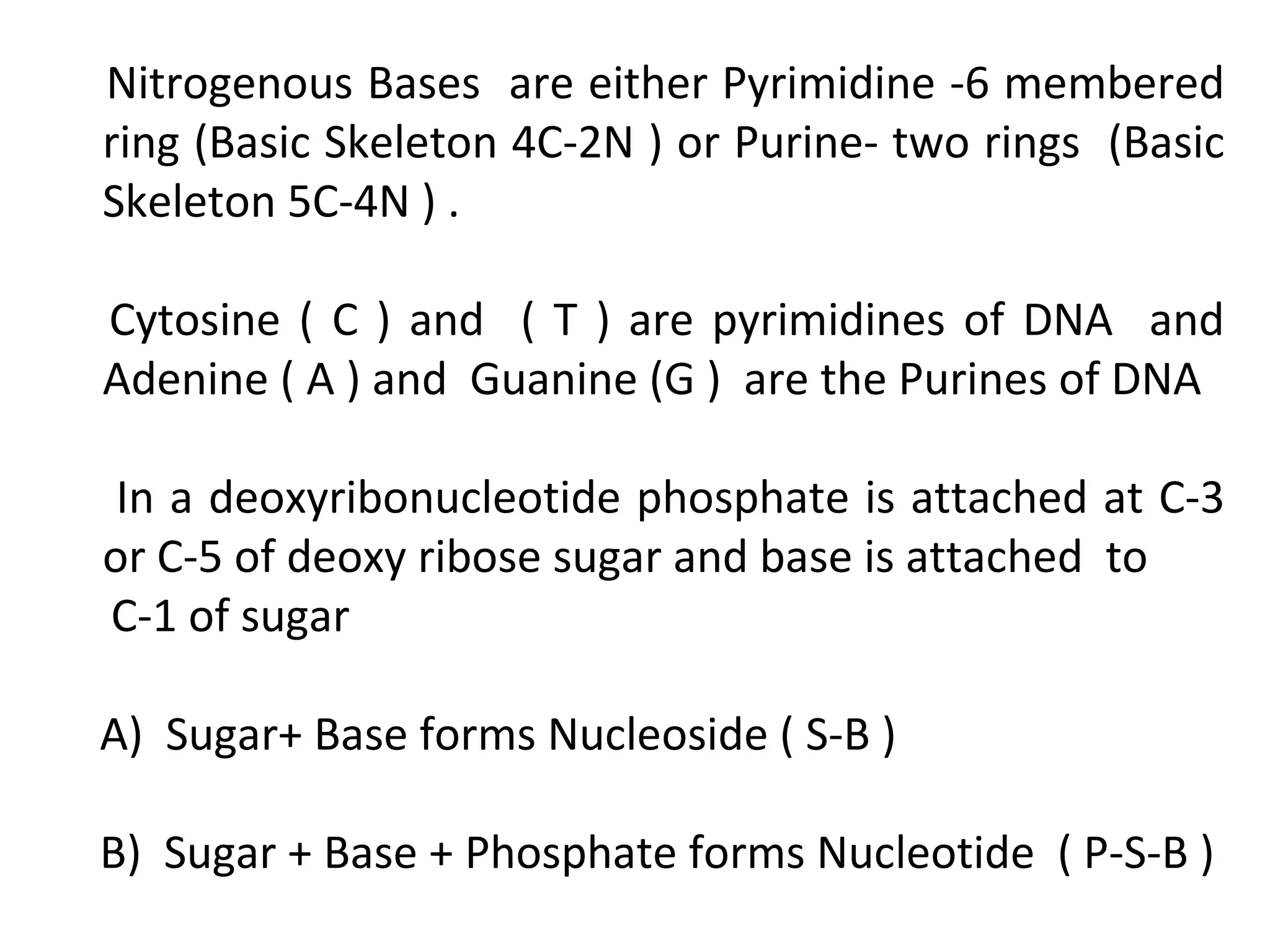
Nitrogenous Bases are either Pyrimidine -6 membered
ring (Basic Skeleton 4C-2N ) or Purine- two rings (Basic
Skeleton 5C-4N ) .
Cytosine ( C ) and ( T ) are pyrimidines of DNA and
Adenine ( A ) and Guanine (G ) are the Purines of DNA
In a deoxyribonucleotide phosphate is attached at C-3
or C-5 of deoxy ribose sugar and base is attached to
C-1 of sugar
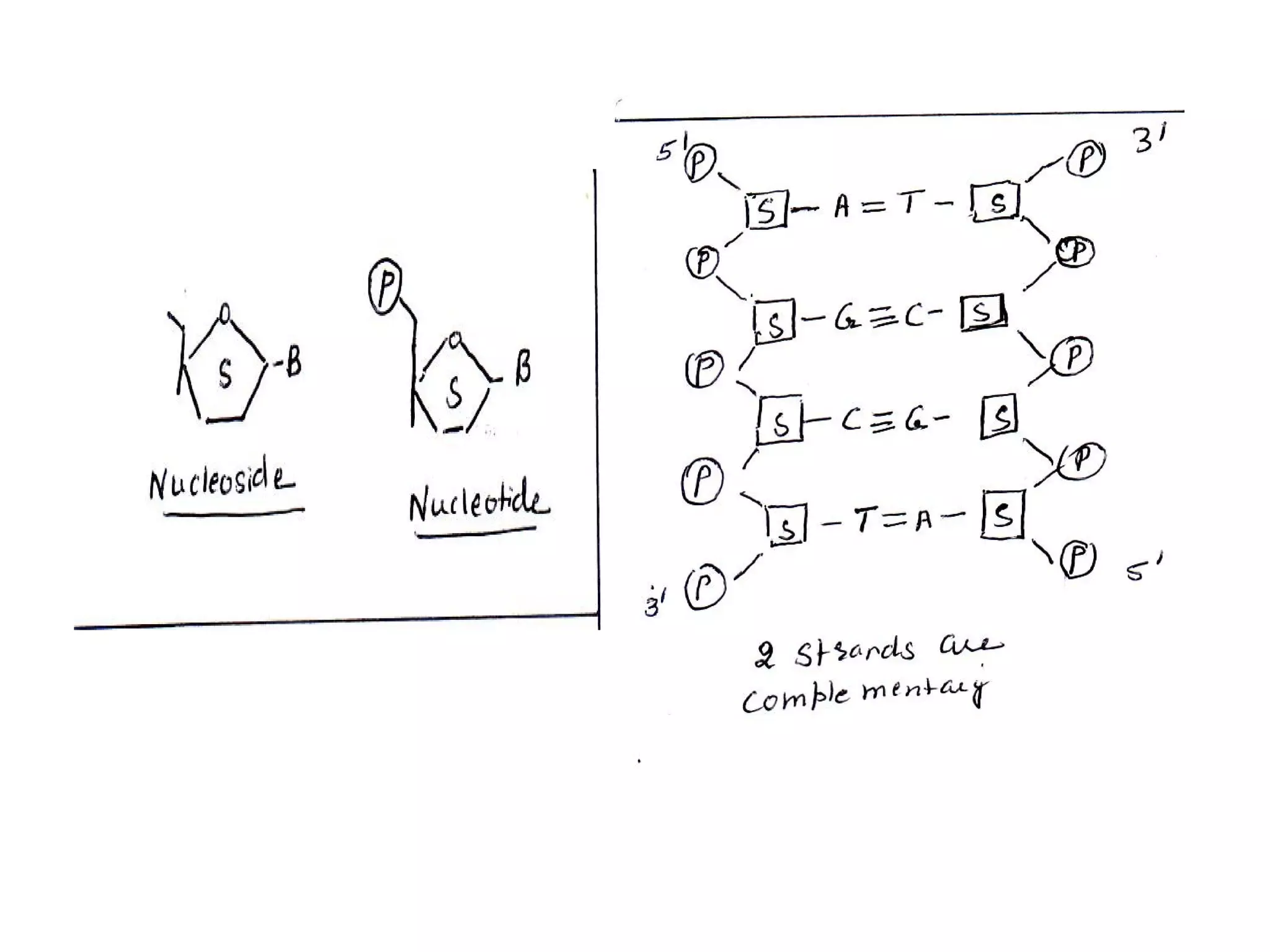
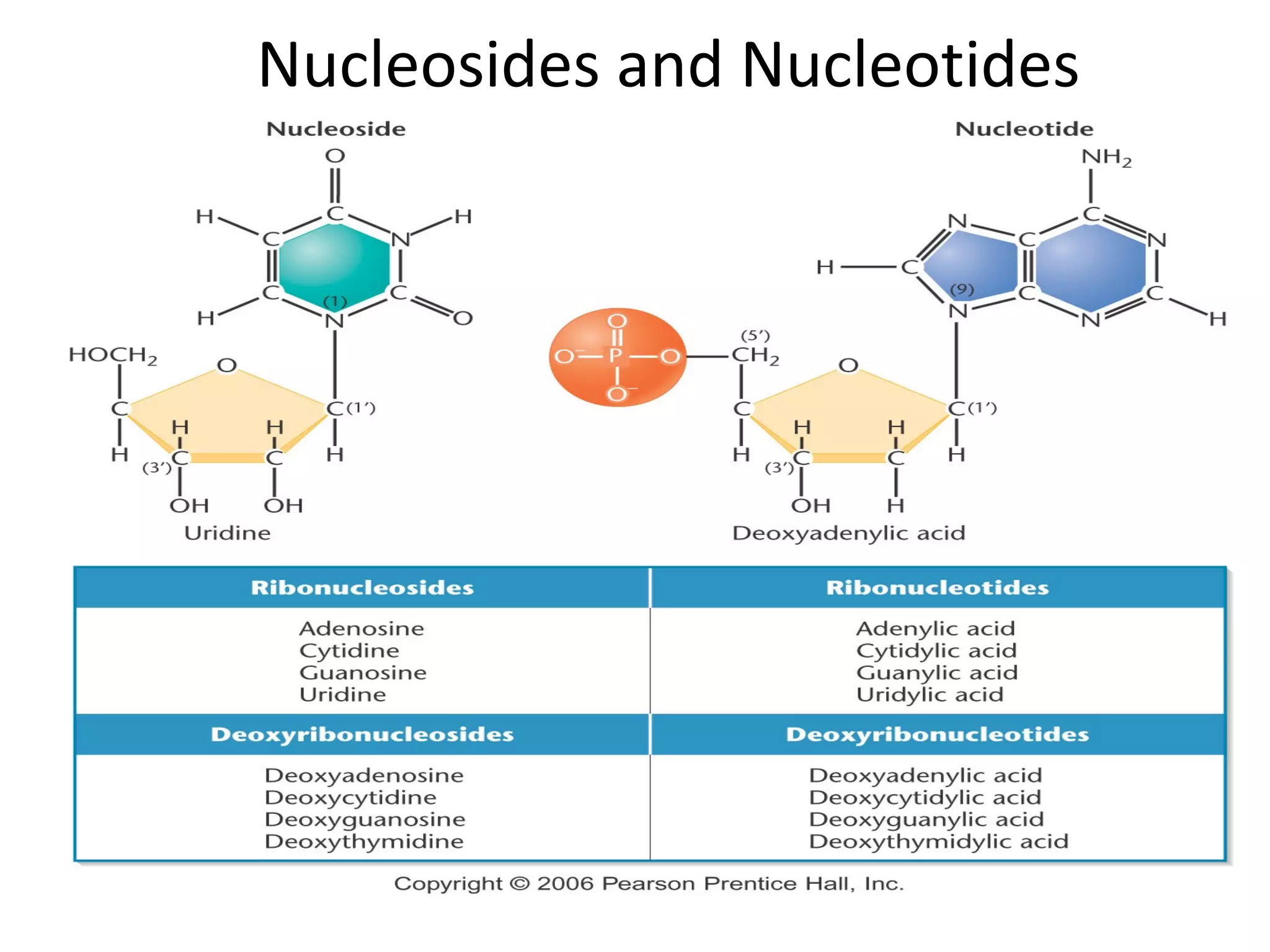
A) Sugar+ Base forms Nucleoside ( S-B )
B) Sugar + Base + Phosphate forms Nucleotide ( P-S-B )
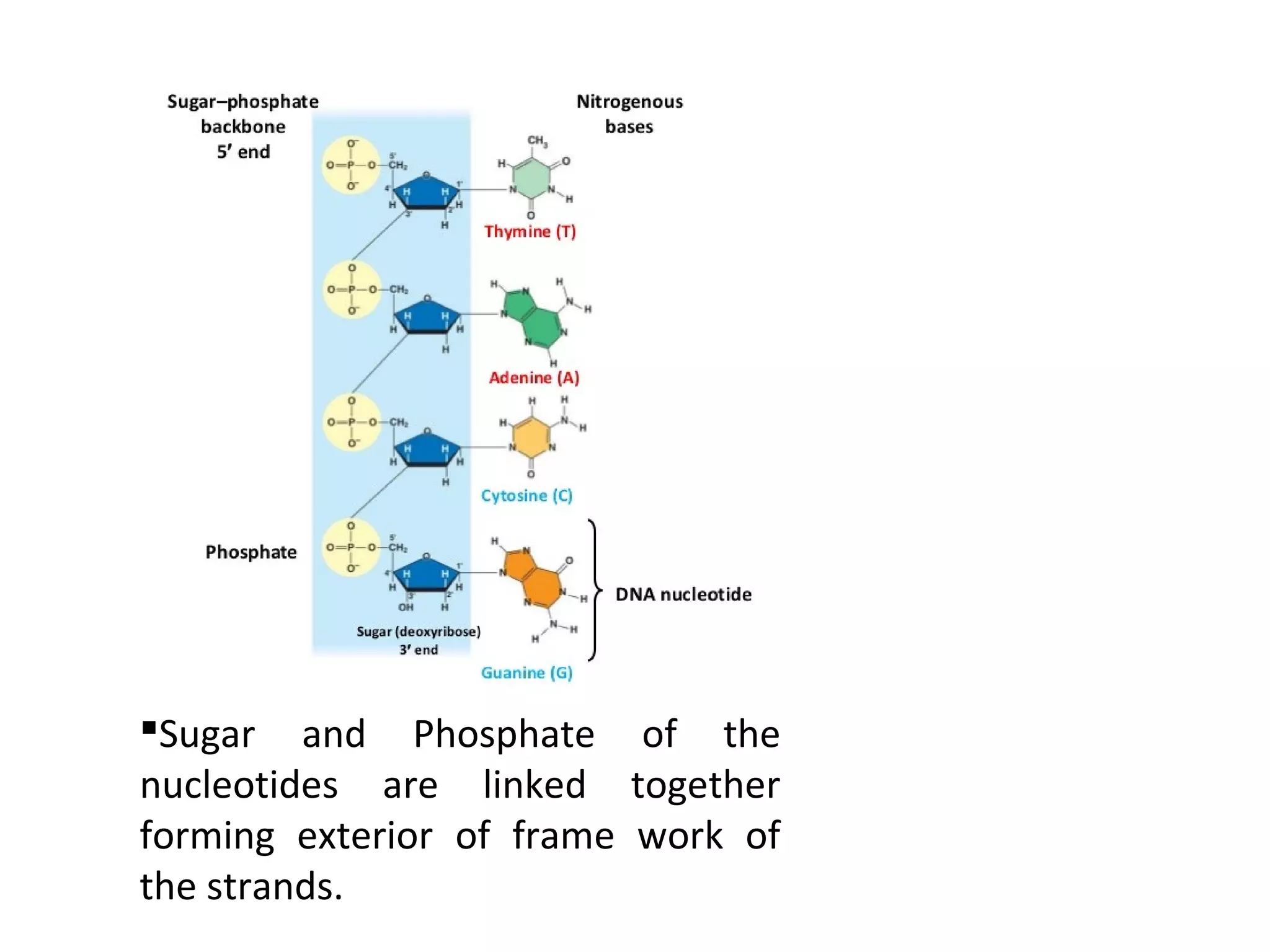
Sugar and Phosphate of the
nucleotides are linked together
forming exterior of frame work of
the strands.
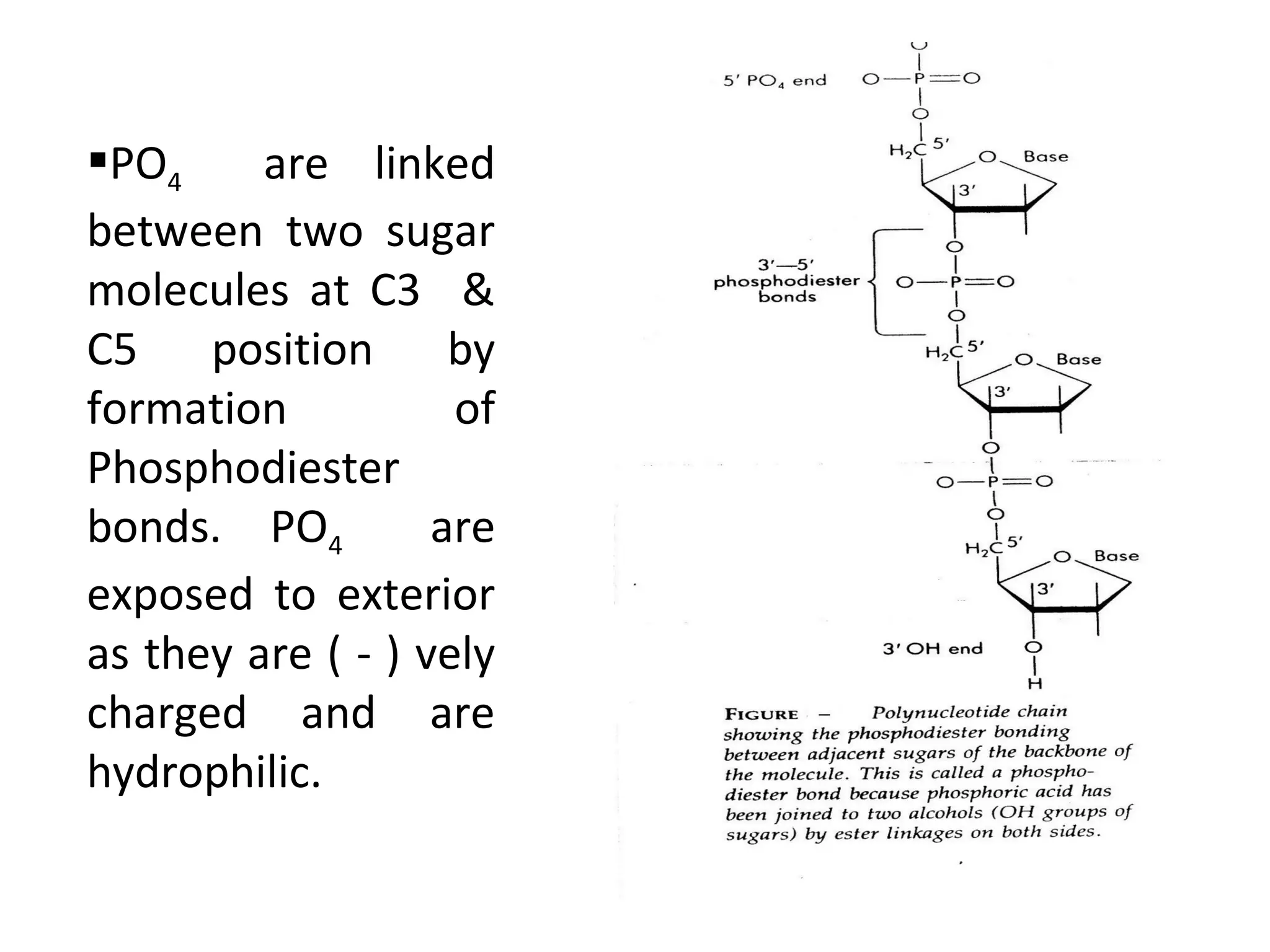
PO4 are linked
between two sugar
molecules at C3 &
C5 position by
formation of
Phosphodiester
bonds. PO4 are
exposed to exterior
as they are ( - ) vely
charged and are
hydrophilic.
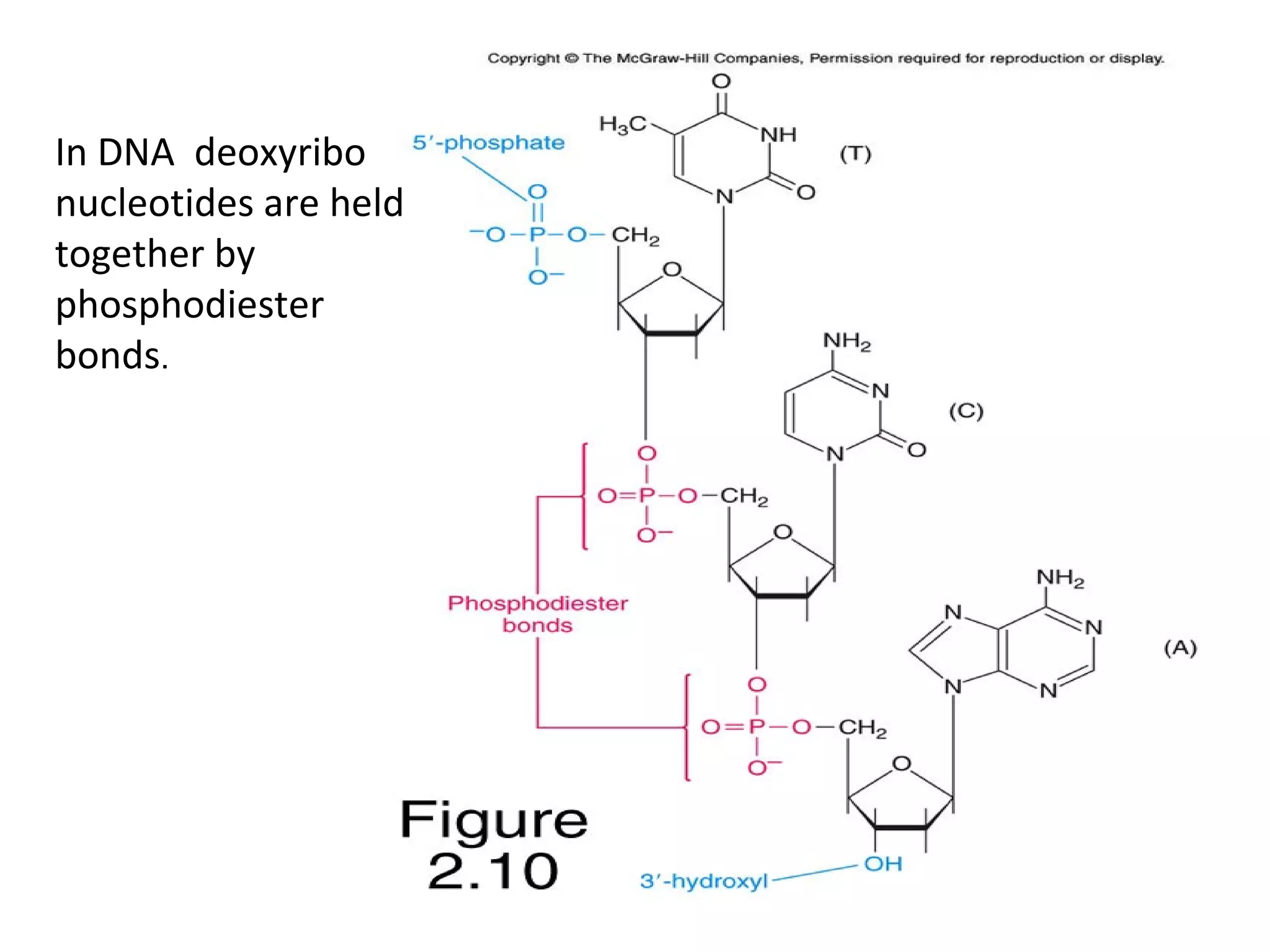
In DNA deoxyribo
nucleotides are held
together by
phosphodiester
bonds.
What chemical forces hold the two
DNA strands together?
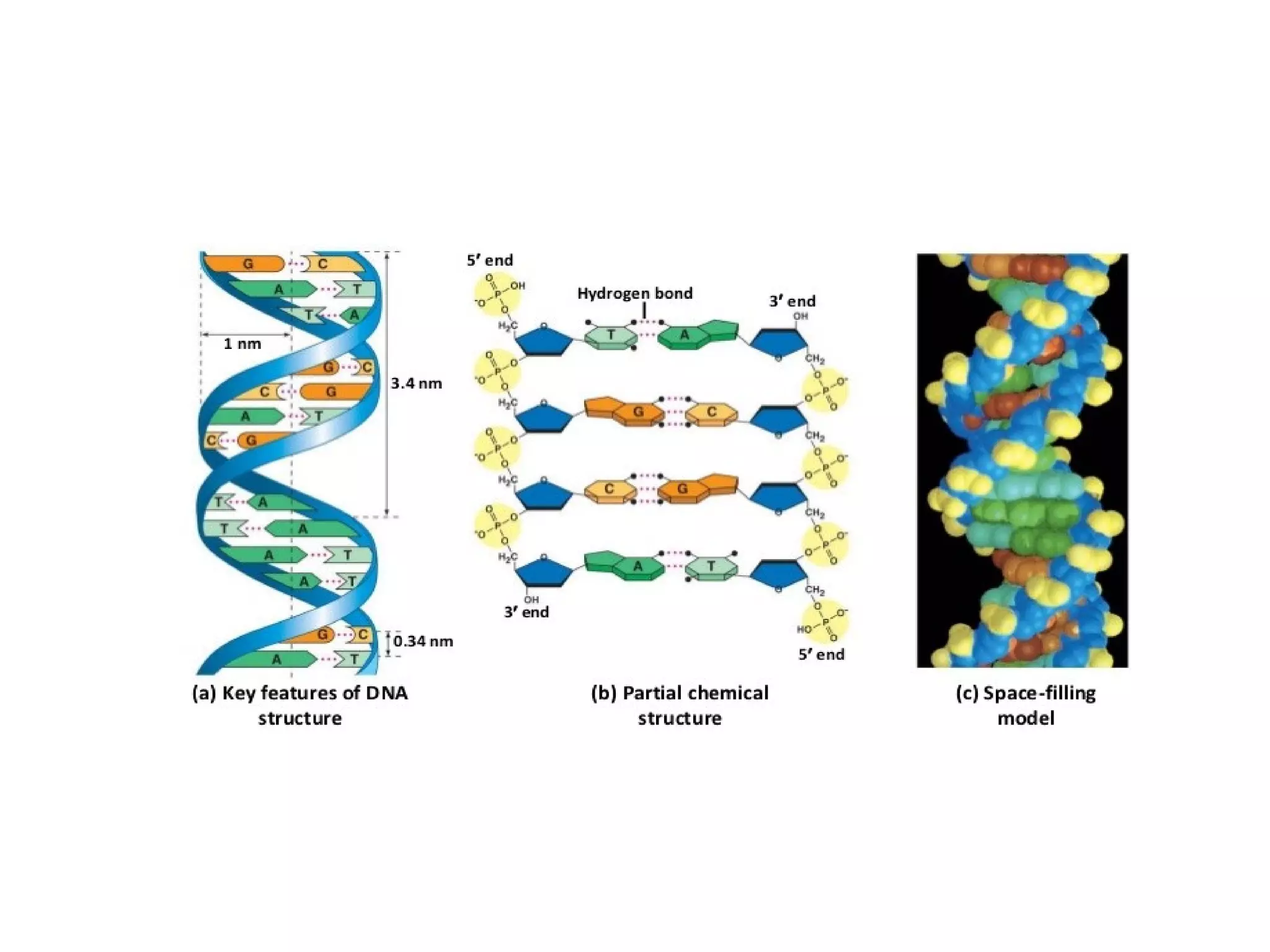
 Two strands are connected to each other by means
of base pairing which comprise the steps of the
ladder. Base pairing takes place between one purine
and one pyrimidine by H bonds. Although H bonds
are weak but many H bonds give stability to the
double helical structure.
The two strands of DNA are oriented in opposite
directions. One strand runs in 3’-5’ direction and the
other in 5’-3’ direction. This antiparallel orientation
also supports the double helical nature of DNA
molecule.
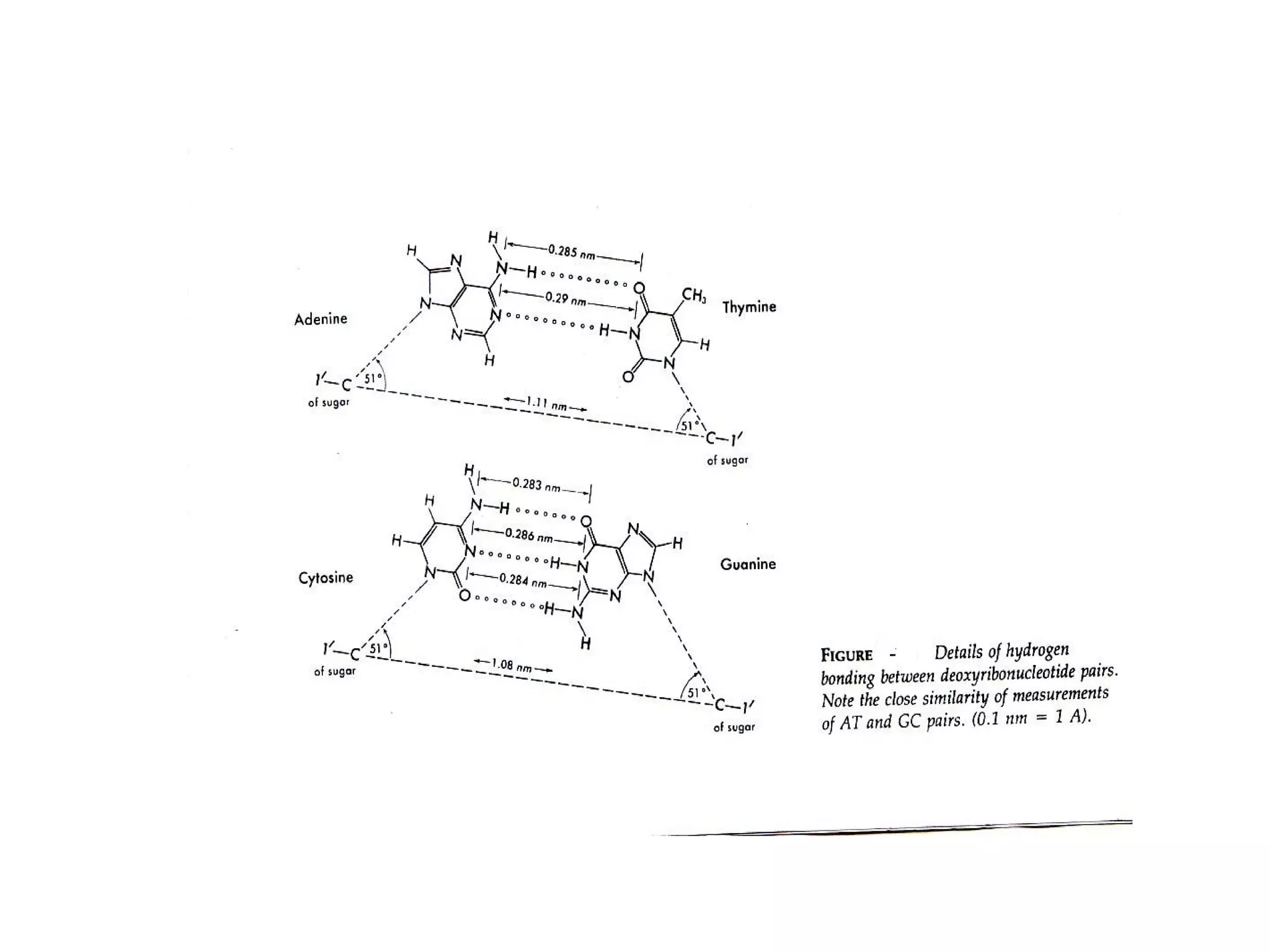
There lies close similarity of measurements of AT and
GC pairs, distance of A-T is about 1.11 nm and that of
G-C is 1.08nm. The angle between C-1 of deoxyribose
sugar and N of base is about 51°.
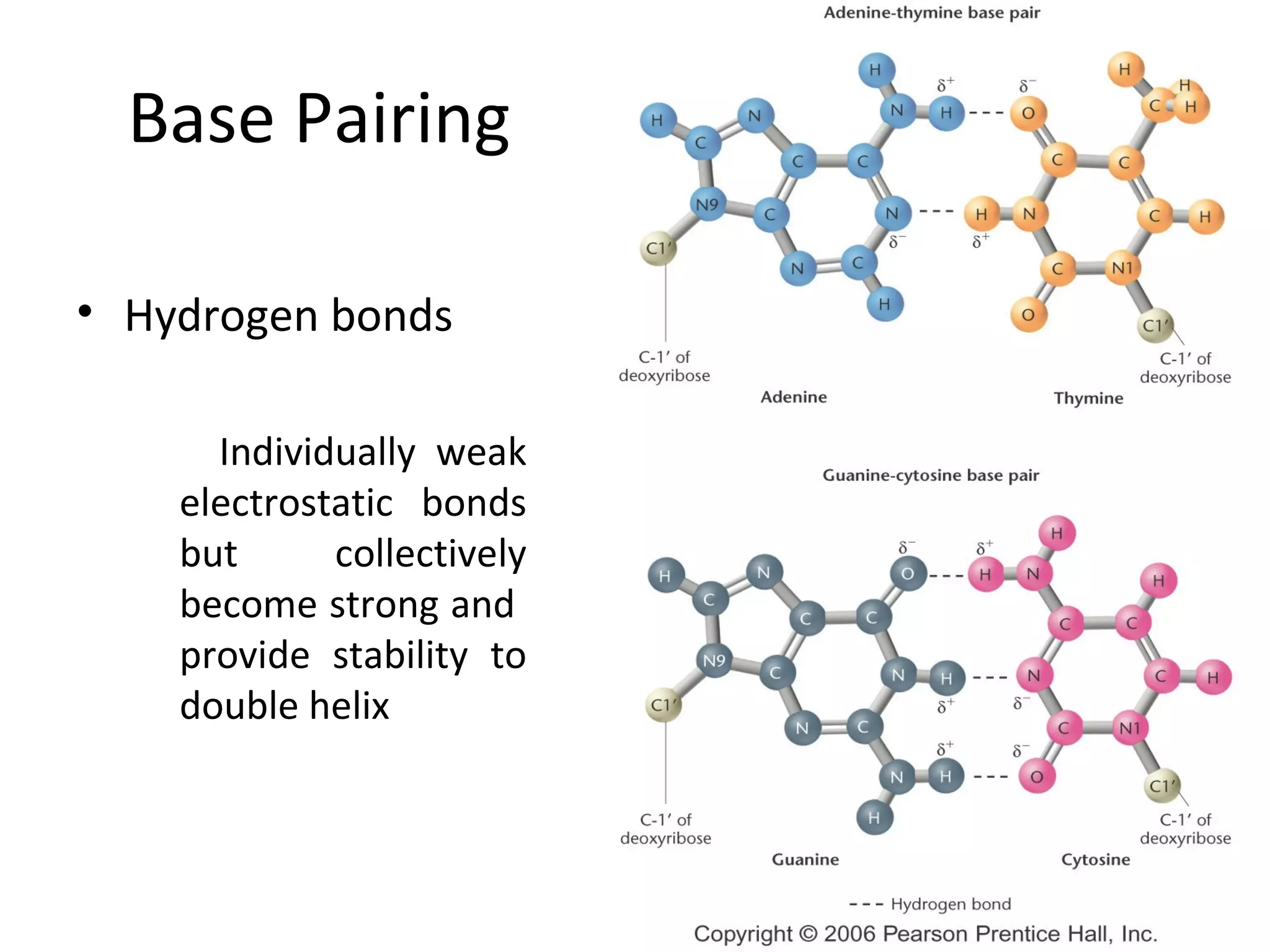
Base Pairing
• Hydrogen bonds
Individually weak
electrostatic bonds
but collectively
become strong and
provide stability to
double helix
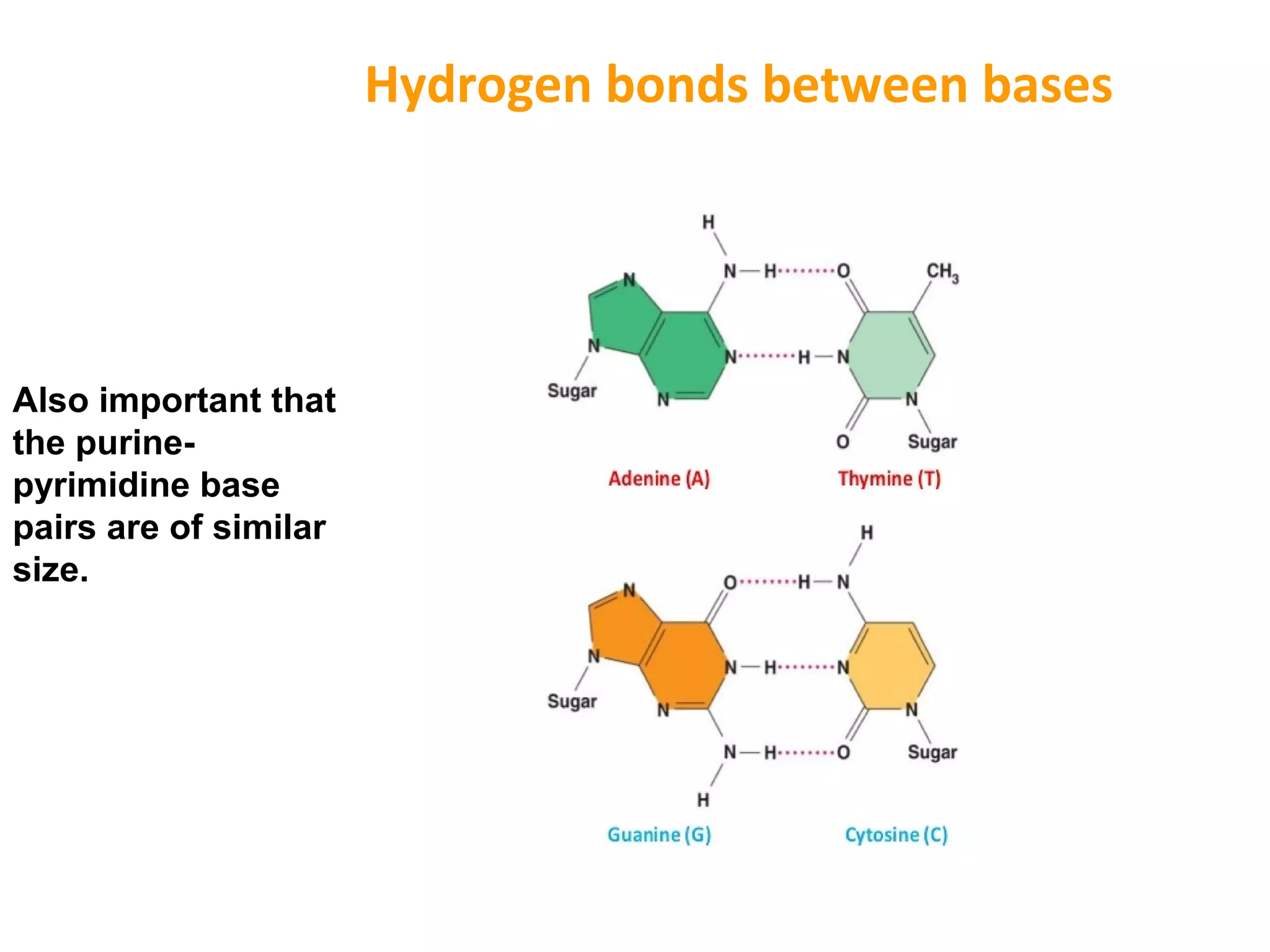
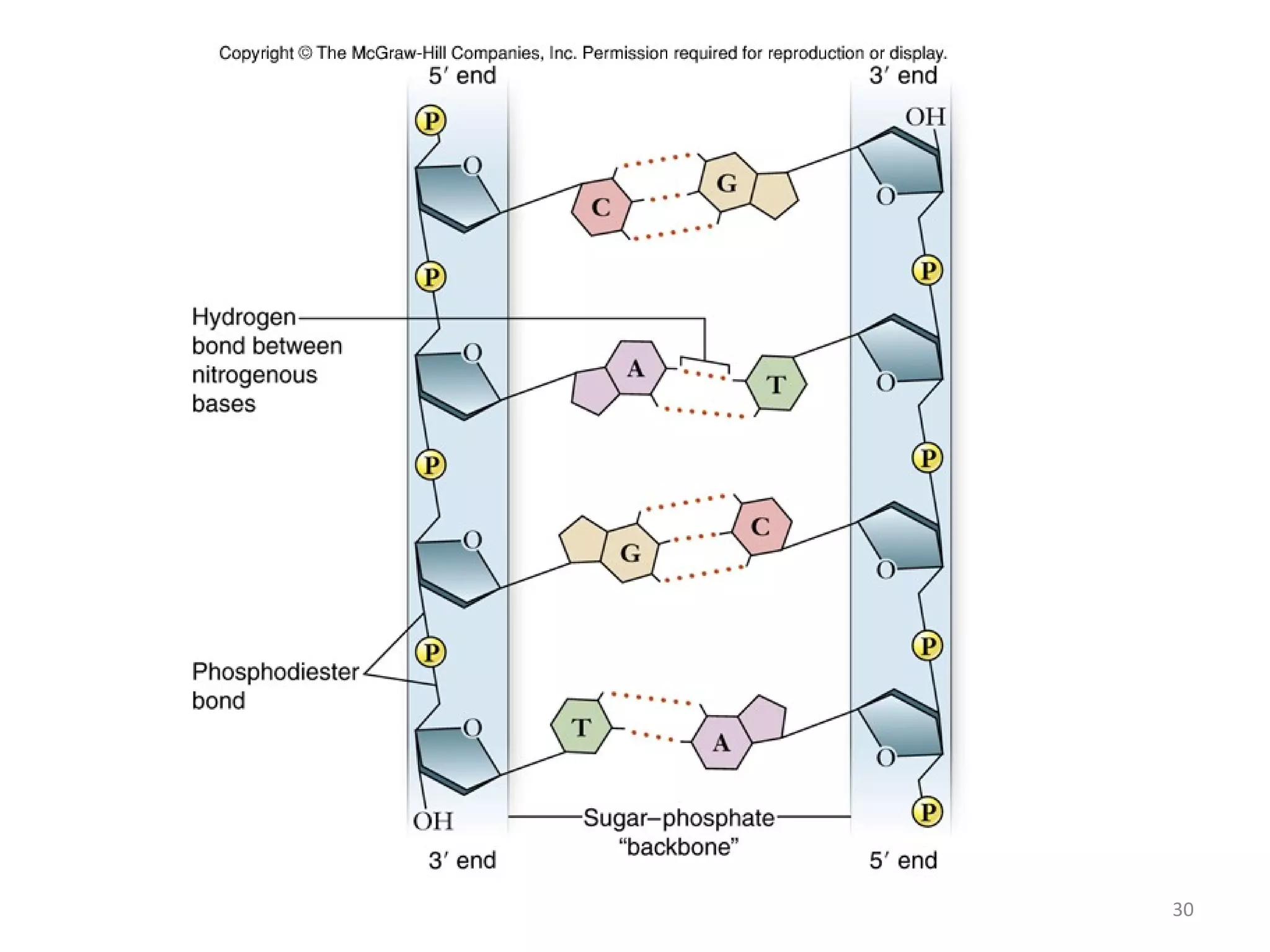
Hydrogen bonds between bases
Also important that
the purine-
pyrimidine base
pairs are of similar
size.
DNA strands also held together by base stacking:
Van der Waals interactions with neighboring base
pairs
The evidence for this opinion is based on interference
by urea and foramide ,are unable to separate double
strand themselves but require heat in addition
Double stranded helix structure is also promoted by
having phosphates on outside ,interact with water and
K+
and Mg+ +
ions
30
 Bases are projected inwards and lie perpendicular
to the long sugar & phosphate chains.
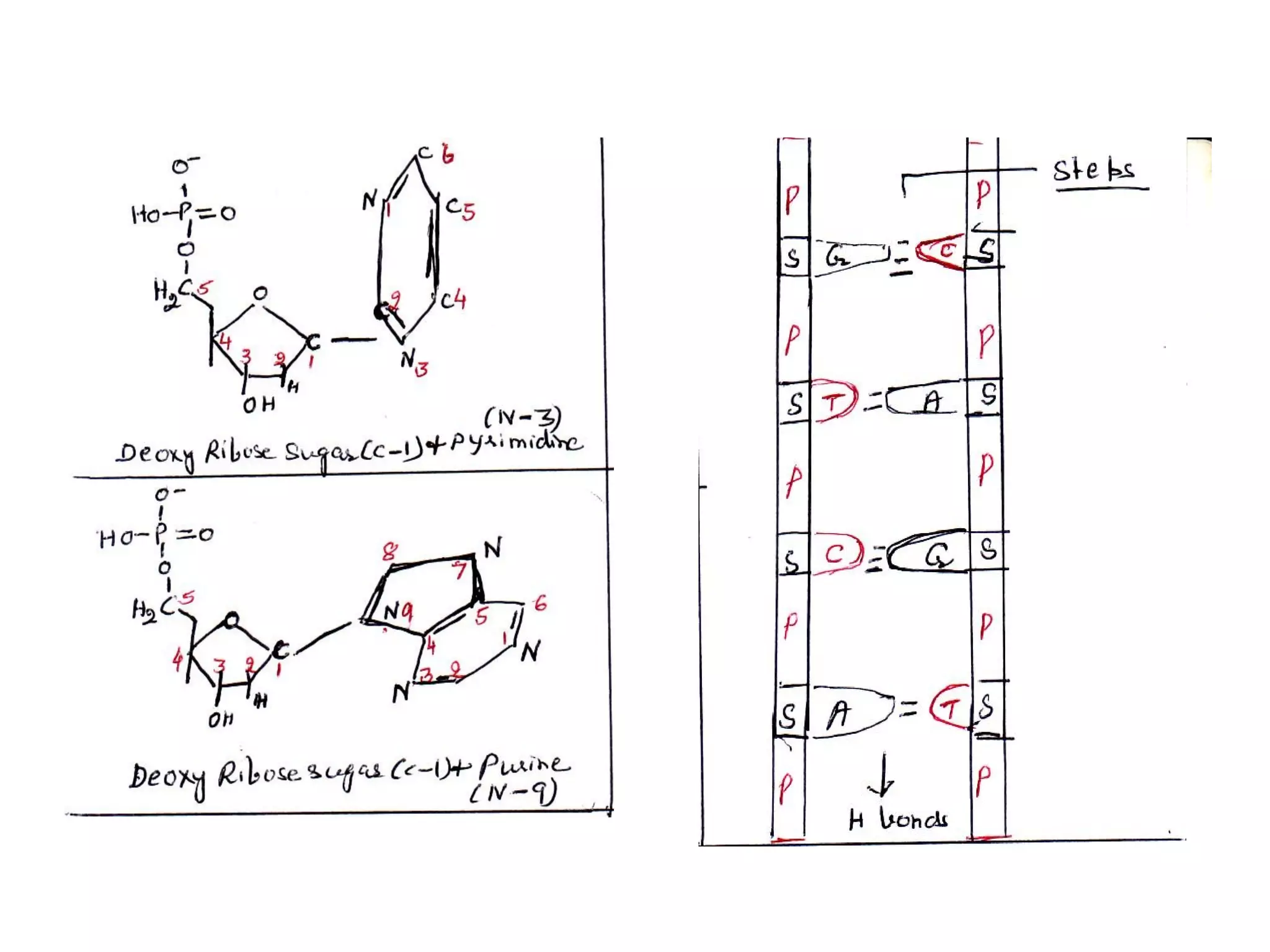
 Bases are attached to C -1 of sugar and for
attachment N at 3 position of pyrimidine and N at 9
position of Purine is used.
 During base pairing Adenine always pairs with
Thymine by 2 H bonds and Guanine pairs with
Cytosine b y 3 H bonds.
A=T G Ξ C
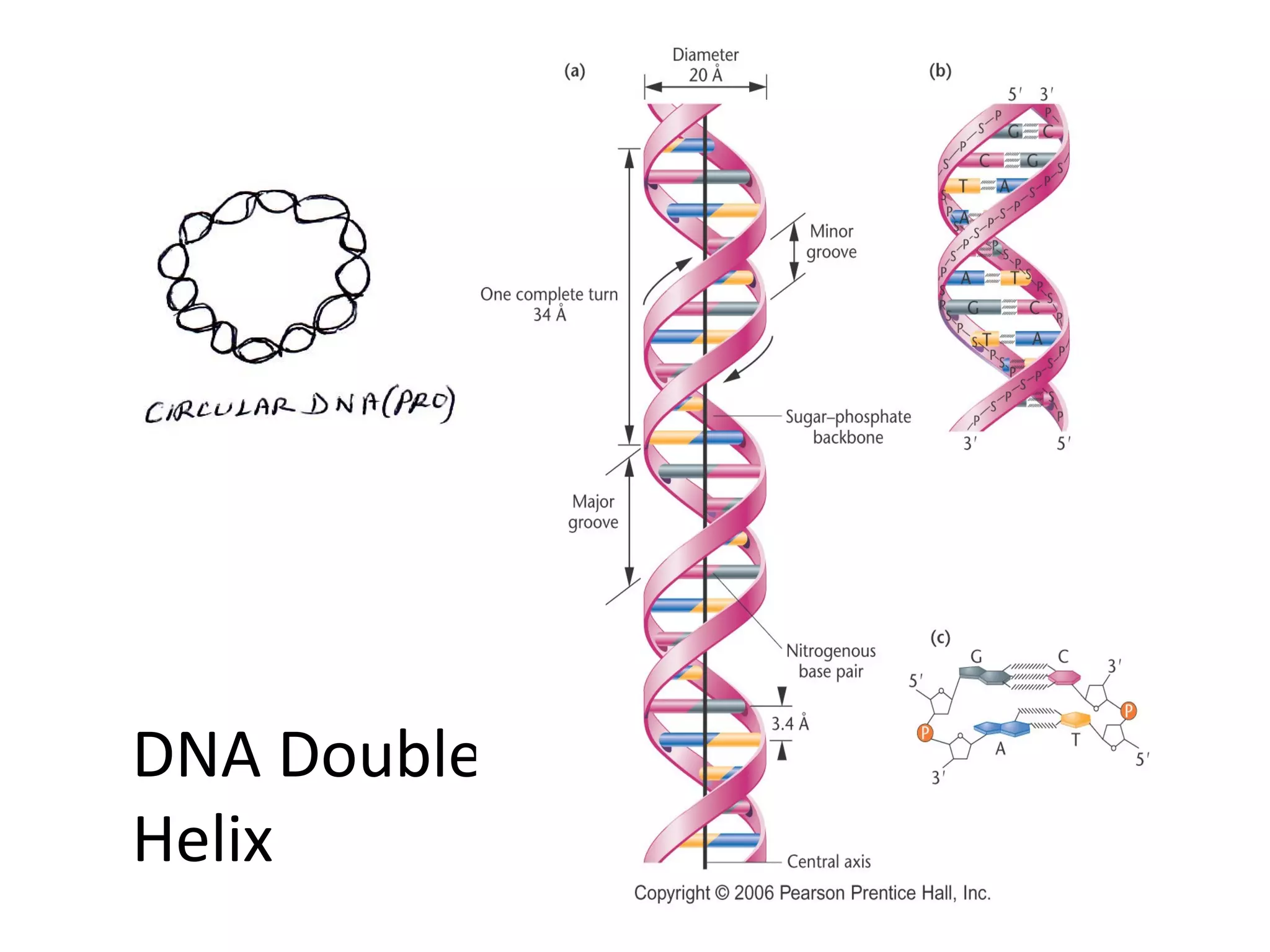
 Diameter of double helical structure is constant
because of strict pyrimidine (small ) and Purine (large )
base pairing. Diameter of B- DNA is 20 A ° (2 nm)
For one complete turn 34 A° space is required and
10 bp (base pairs ) are present in each complete turn.
Each base pair lies at an angle of 36 ° from next base
pair
Two strands of DNA run in antiparallel direction. One
in 3’ →5’ direction and other in 5’ →3’ direction. The
direction depends on attachment of first PO4 group to
C3 or C5 of deoxyribose sugar.
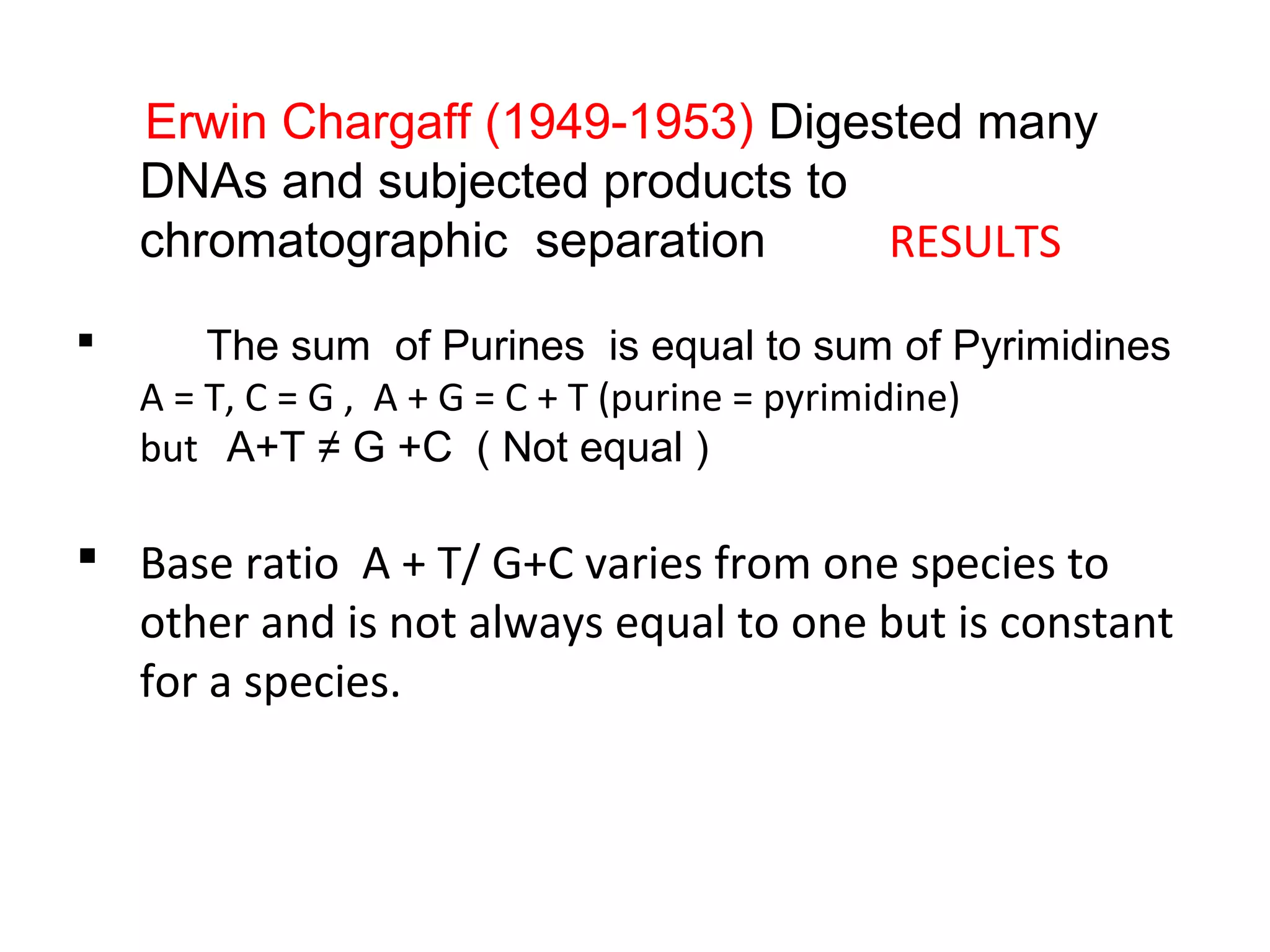
Two strands are coiled around a common axis in such
a way ( like a rope ) that deep (major ) and shallow
(Minor) grooves are resulted. Proteins can bind with
DNA at these locations. Major grooves are 22A° and
Minor grooves are 12 A°
34 Å
3.4 Å
20 Å
Minor
Groove
Major
Groove
GC
CG
AT
TA
CG
GC
AT
TA
TA
AT
GC
CG
GC
Strands are
antiparallel
 Two strands are coiled around each other in such
a way that they can not be separated unless ends
are permitted to revolve ( just like a rope ) Such
coiling is known as Plectonic coiling.
 Due to strict base pairing rules , two strands are
complementary to each other in sequence of
bases. This feature helps in determining heredity
through DNA Replication and Transcription.
• DNA code consists of only 4 symbols A T G C
Erwin Chargaff (1949-1953) Digested many
DNAs and subjected products to
chromatographic separation RESULTS
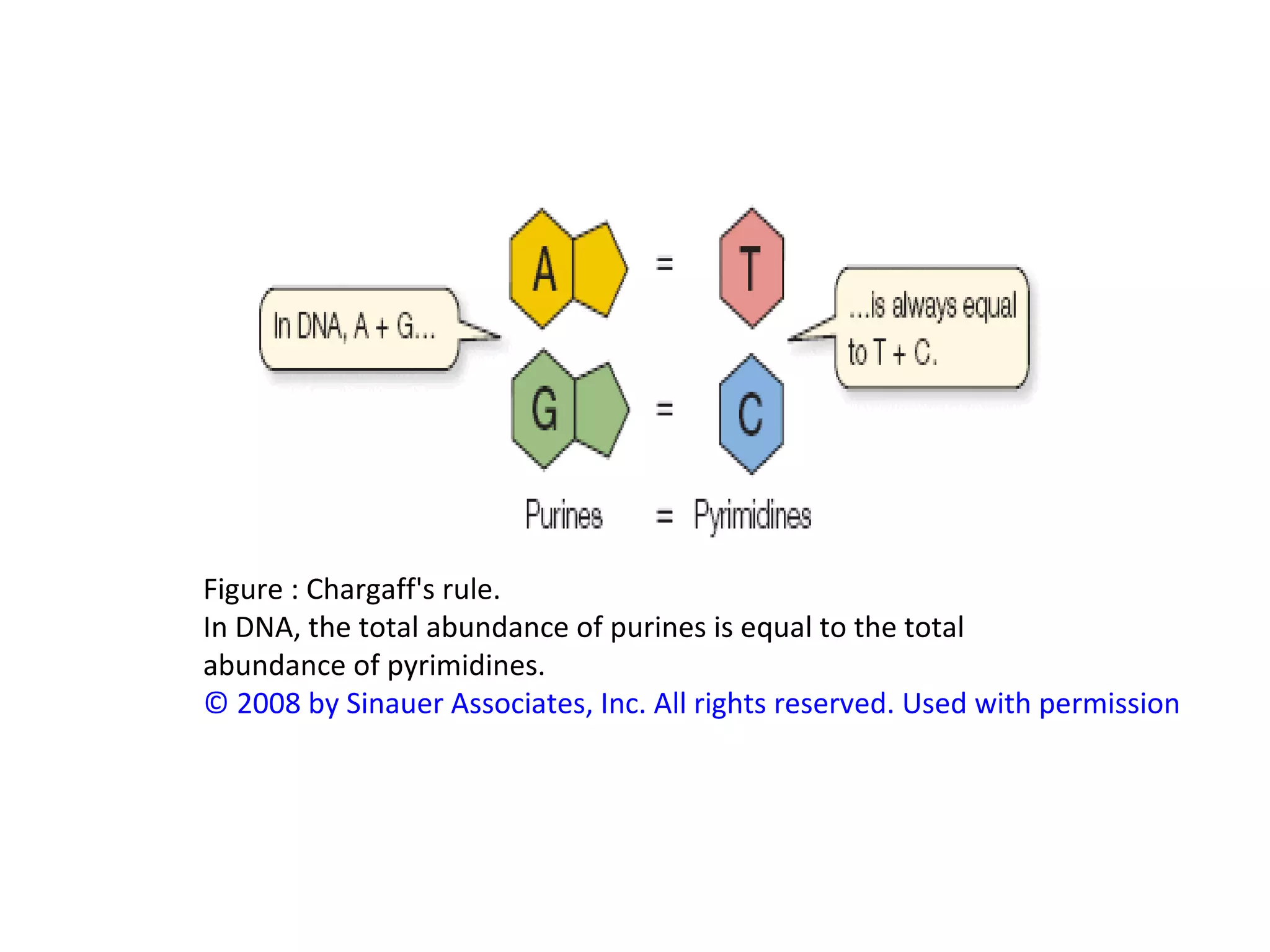
 The sum of Purines is equal to sum of Pyrimidines
A = T, C = G , A + G = C + T (purine = pyrimidine)
but A+T ≠ G +C ( Not equal )
 Base ratio A + T/ G+C varies from one species to
other and is not always equal to one but is constant
for a species.
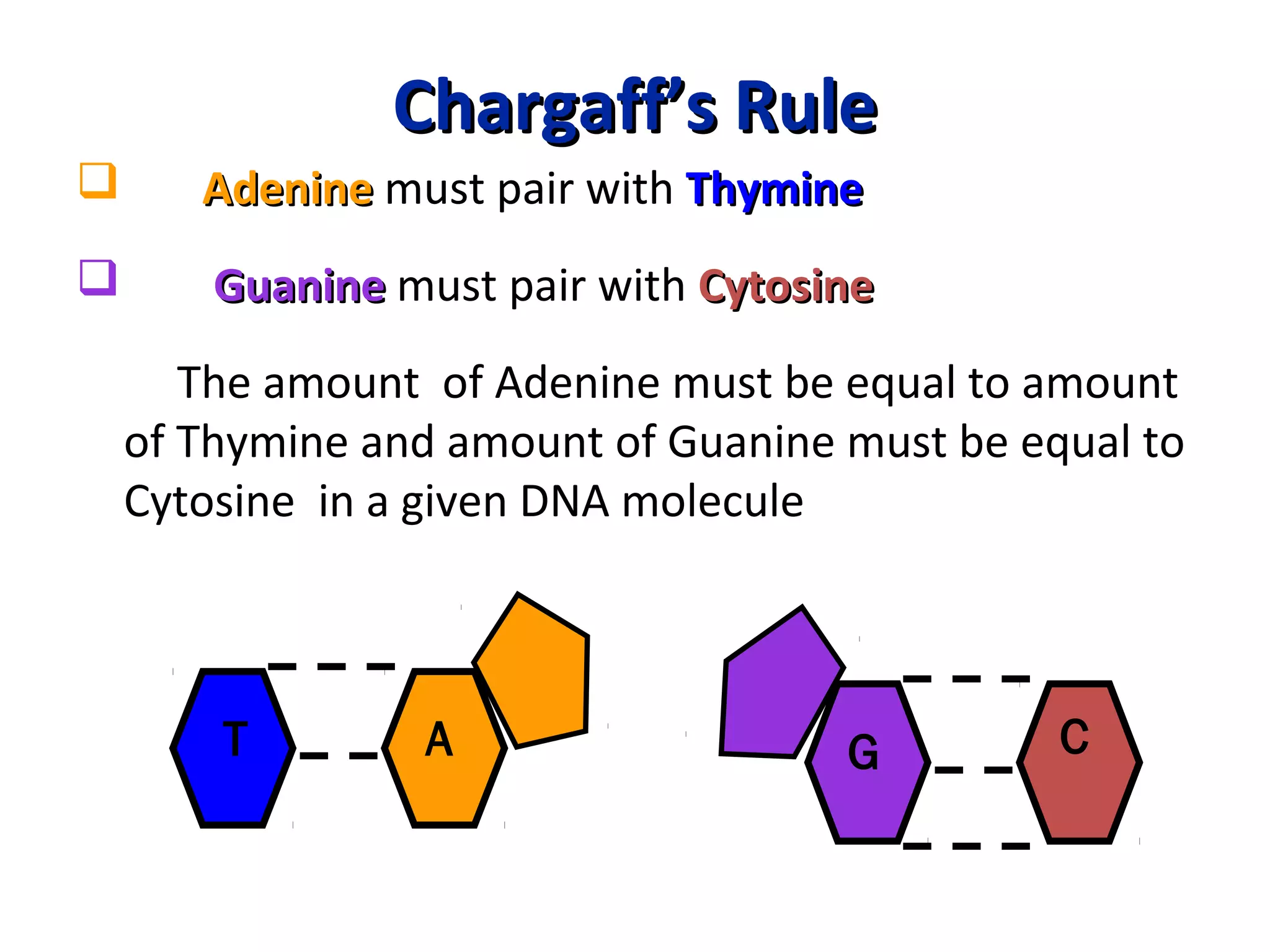
Chargaff’s RuleChargaff’s Rule
 AdenineAdenine must pair with ThymineThymine
 GuanineGuanine must pair with CytosineCytosine
The amount of Adenine must be equal to amount
of Thymine and amount of Guanine must be equal to
Cytosine in a given DNA molecule
G CT A
Figure : Chargaff's rule.
In DNA, the total abundance of purines is equal to the total
abundance of pyrimidines.
© 2008 by Sinauer Associates, Inc. All rights reserved. Used with permission
 DNA with high percentage of G ≡ C pairing
( Mitochondrial DNA ) have more density than those
with high A = T pairing. (Nuclear DNA )
Upon heating upto 80-90 º C or more 2 strands of
DNA uncoil and separate
( DNA Denaturation ). On cooling the strands come
closer and are held together ( DNA Renaturation or
Annealing ) The two separated strands can act as
template for synthesis of new complementary
strand.This property is used in PCR ( Polymerase
Chain Reaction) which is in vitro process for DNA
amplification
 DNA is generally double stranded, but is single
stranded exceptionally in some Viruses viz.
- 174 & S-13ȹ
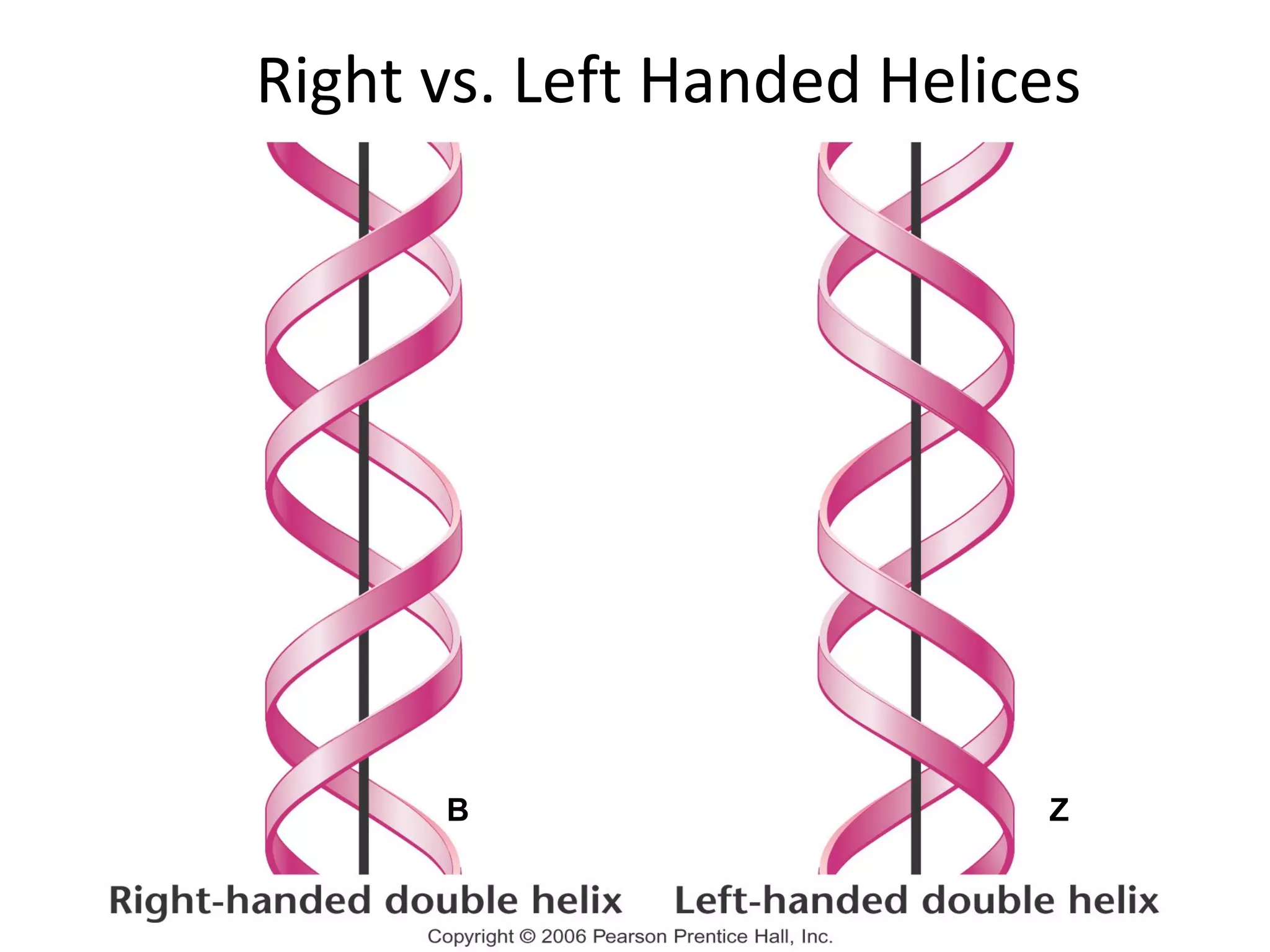
 Both strands of DNA are right handed spirals
except Z DNA ( Left handed spiral )
Alternative Forms of DNA
DNA can exist in several conformational isomers
B form is the “normal” conformation
A form is found in high salt conc
Z form Left-handed helix and 12 bp/turn (Z for zigzag)
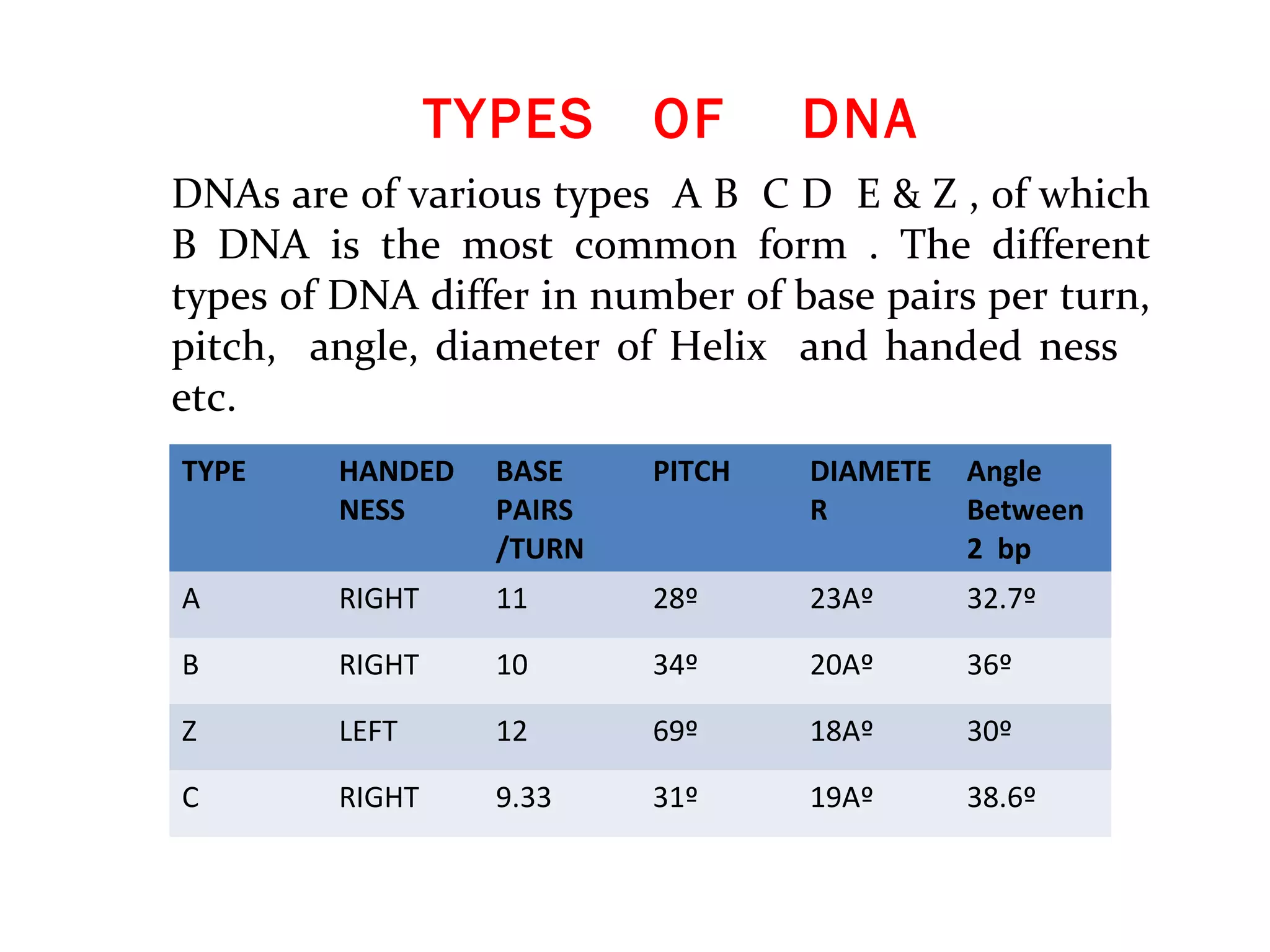
DNAs are of various types A B C D E & Z , of which
B DNA is the most common form . The different
types of DNA differ in number of base pairs per turn,
pitch, angle, diameter of Helix and handed ness
etc.
TYPE HANDED
NESS
BASE
PAIRS
/TURN
PITCH DIAMETE
R
Angle
Between
2 bp
A RIGHT 11 28º 23Aº 32.7º
B RIGHT 10 34º 20Aº 36º
Z LEFT 12 69º 18Aº 30º
C RIGHT 9.33 31º 19Aº 38.6º
TYPES OF DNA
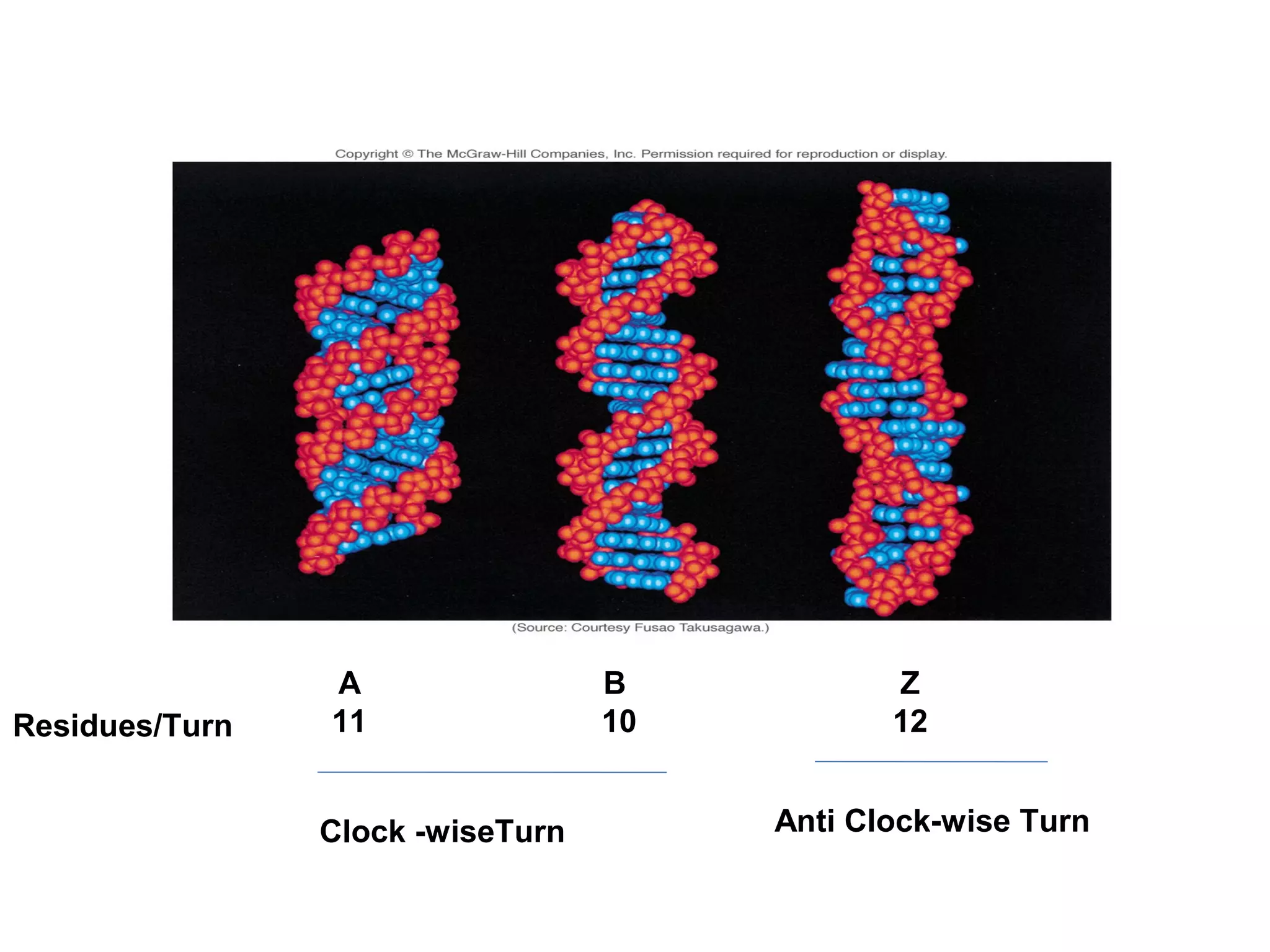
A
11
B
10
Z
12Residues/Turn
Clock -wiseTurn Anti Clock-wise Turn
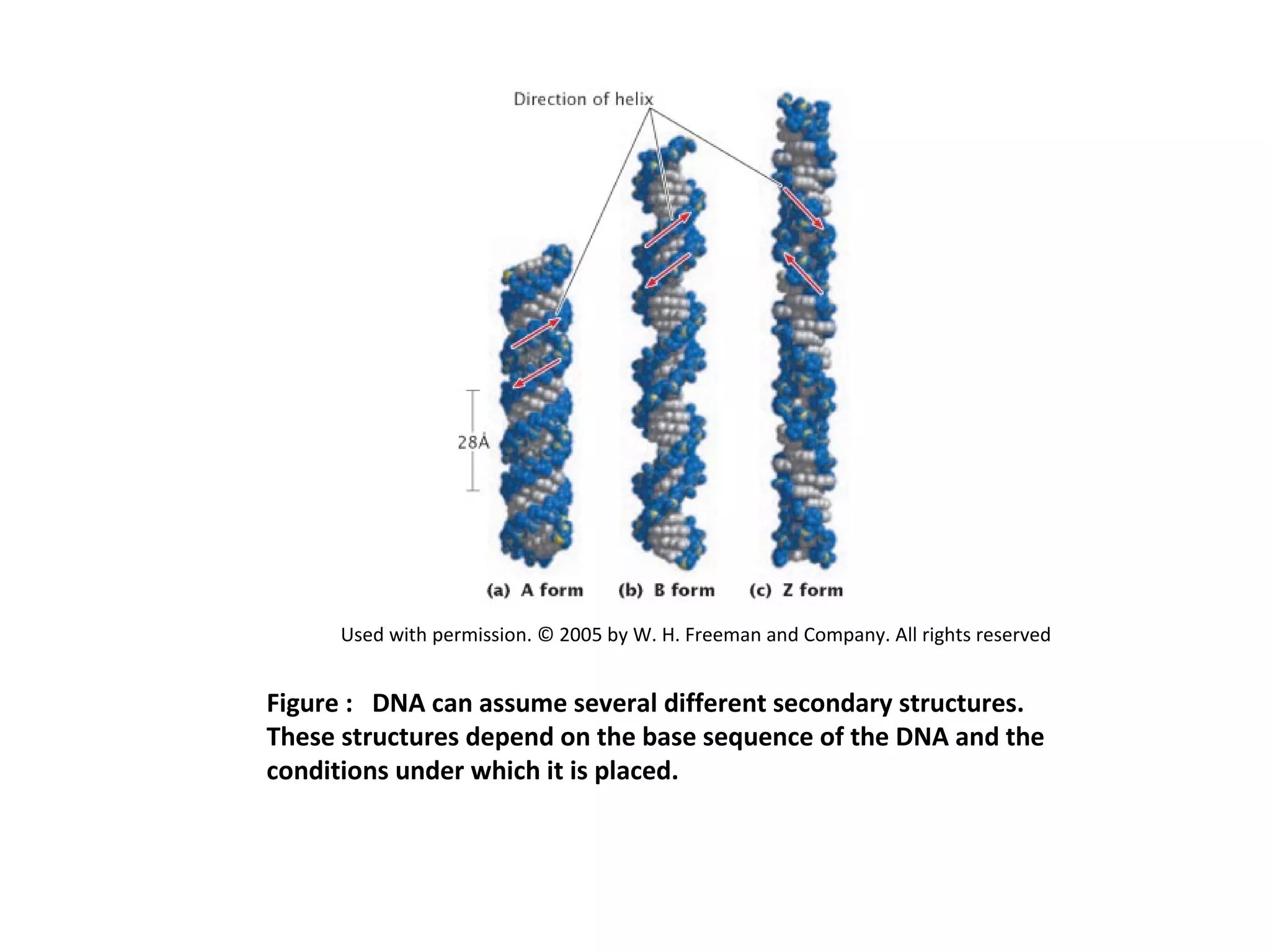
Figure : DNA can assume several different secondary structures.
These structures depend on the base sequence of the DNA and the
conditions under which it is placed.
Used with permission. © 2005 by W. H. Freeman and Company. All rights reserved
Right vs. Left Handed Helices
B Z
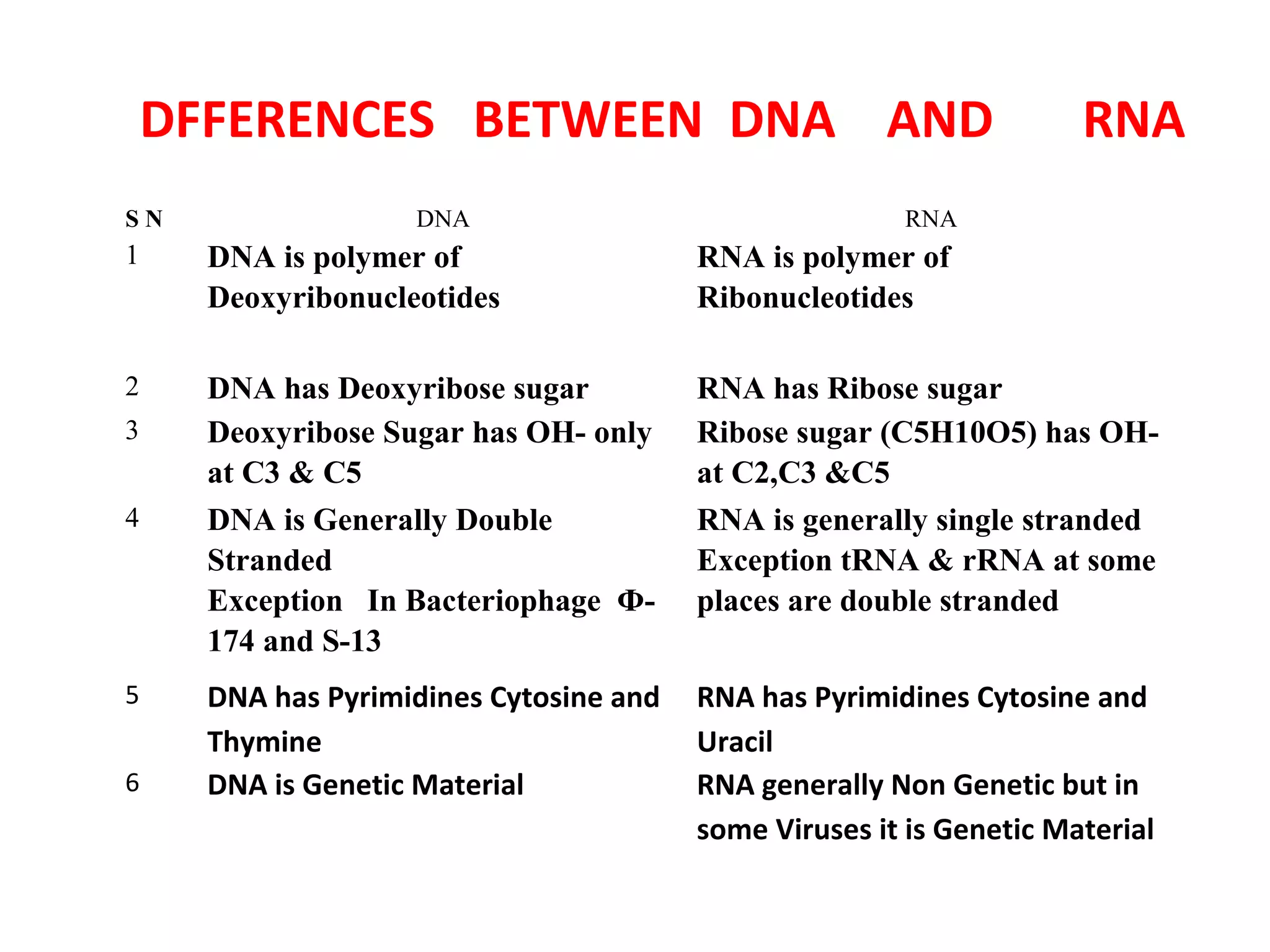
DFFERENCES BETWEEN DNA AND RNA
S N DNA RNA
1 DNA is polymer of
Deoxyribonucleotides
RNA is polymer of
Ribonucleotides
2 DNA has Deoxyribose sugar RNA has Ribose sugar
3 Deoxyribose Sugar has OH- only
at C3 & C5
Ribose sugar (C5H10O5) has OH-
at C2,C3 &C5
4 DNA is Generally Double
Stranded
Exception In Bacteriophage Ф-
174 and S-13
RNA is generally single stranded
Exception tRNA & rRNA at some
places are double stranded
5 DNA has Pyrimidines Cytosine and
Thymine
RNA has Pyrimidines Cytosine and
Uracil
6 DNA is Genetic Material RNA generally Non Genetic but in
some Viruses it is Genetic Material
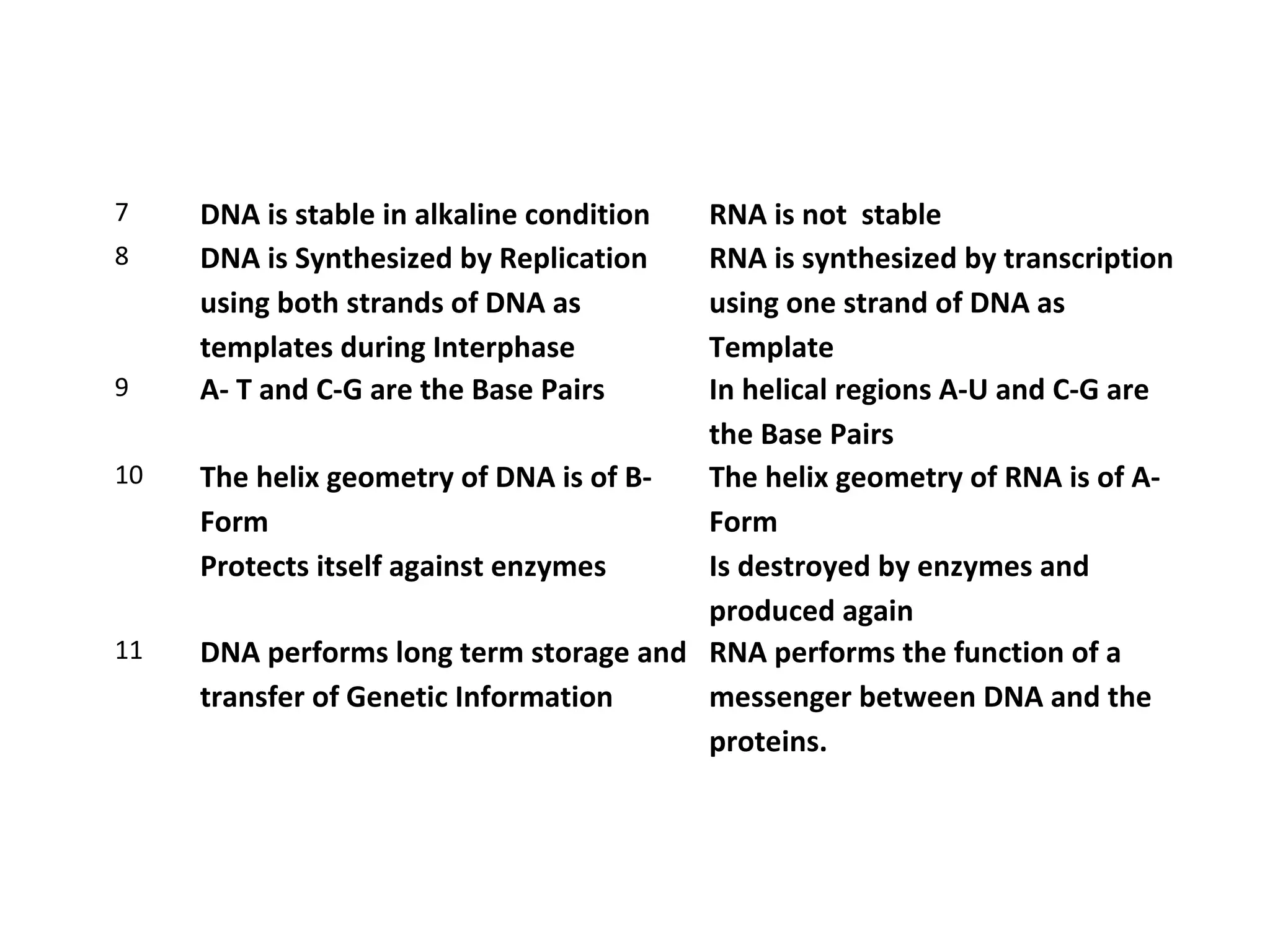
7 DNA is stable in alkaline condition RNA is not stable
8 DNA is Synthesized by Replication
using both strands of DNA as
templates during Interphase
RNA is synthesized by transcription
using one strand of DNA as
Template
9 A- T and C-G are the Base Pairs In helical regions A-U and C-G are
the Base Pairs
10 The helix geometry of DNA is of B-
Form
Protects itself against enzymes
The helix geometry of RNA is of A-
Form
Is destroyed by enzymes and
produced again
11 DNA performs long term storage and
transfer of Genetic Information
RNA performs the function of a
messenger between DNA and the
proteins.
RIBOSE
1
OHOCH2
H
H
OH
H
OH
H
OH
23
4
5
OHOCH2
H
H
OH
H
OH
H
H
1
23
4
5
2-DEOXY-RIBOSE
O
N
H N
O
H
CH3
THYMINE
O
N
HN
O
H
URACIL
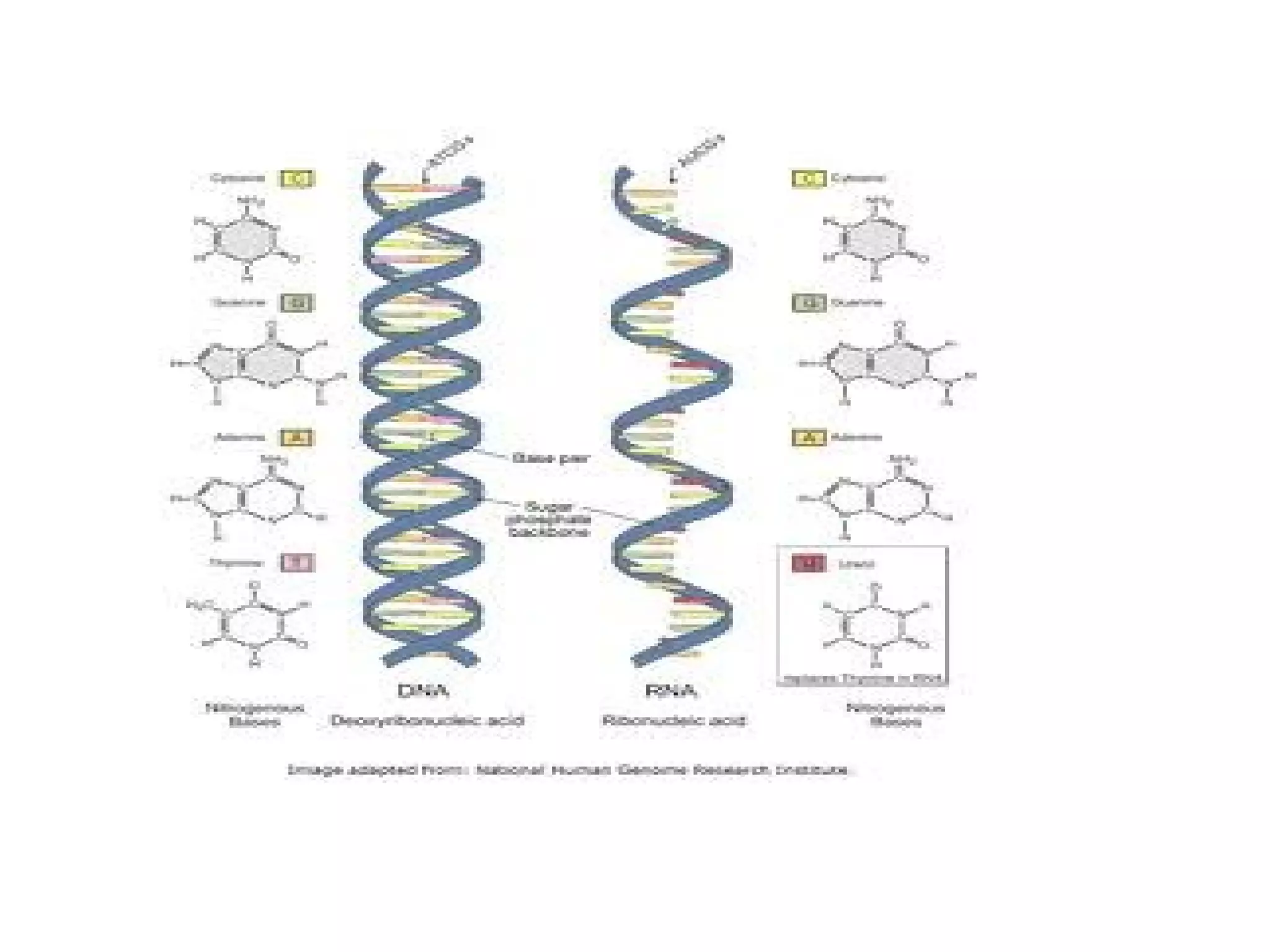
RNA DNA
Molecular Differences between Ribonucleic Acid (RNA)
& 2-deoxy-ribonucleic acid (DNA).
Ribose replaces deoxyribose; uracil replaces thymine
RNA
Nucleosides and Nucleotides
SUMMARY OF THE PRESENTATION
DNA STRUCTURE
 DNA ( De oxy Ribo Nucleic Acid ) is one of the two
Nucleic Acid
 The Repeating Units of DNA are De-oxy Ribonucleotides
 Each Deoxy Ribonucleotide has 3 components Deoxy
Ribose Sugar, Phosphate and Any one N Base ( A/G/T/C)
 DNA is double helical in Nature , two strands are coiled
around a common imaginary axis
Double helical structure is like a ladder having steps
made by base pairs which are projected inwards
Successive De oxy ribonucleotides are linked with
each other by Phospho diester bond which is formed
by linkage of phosphate with two OH groups of two
sugar residues
Amount of Purines is always equal to amount of
Pyrimidines(Charguff’s Rule)
Adenine always pairs with Thymine by two Hydrogen
bonds and Guanine always pairs with Cytosine by three
Hydrogen bonds
Two strands run in opposite directions.
 Two strands are complementary to each other in
sequence of bases because of strict base pairing rules ,
A=T, G Ξ C. This feature helps in maintaining the
diameter of double helix constant ( Pyrimidine→Purine
Pairing) and also making DNA as Genetic Material
through Replication and Transcription.
DNA with high percentage of G ≡ C pairing ( Mitochondrial DNA )
have more density than those with high A = T pairing. (Nuclear DNA )
DNA with high percentage of G ≡ C pairing ( Mitochondrial DNA )
have more density than those with high A = T pairing. (Nuclear DNA )
DNA may have millions of Nucleotides
PART OF DNA DOUBLE
THANK YOU

Dna structure slide share

  • 1.
    STRUCTURE OF NUCLEICACIDS : DNA (DE-OXY RIBO NUCLEIC ACID ) By Dr. Ichha Purak University Professor Department of Botany Ranchi Women’s College,Ranchi http://www.dripurak.com/
  • 2.
    Discovery of DNA FriedrickMiescher (1869) , a Swiss chemist first identified nuclein from nuclei of human white blood cells which was later on renamed as Nucleic acid . It was rich in phosphorus having no sulphur so was different than protein. Russian Biochemist Phobebus Levene (1910) is credited to discover Phosphate-Sugar-Base as three components of Nucleotide . He also mentioned DNA as polynucleotide (Any one of four adenine,Cytocine,Thymine /Guanine ). He also stated difference between Ribose and Deoxyribose Sugar
  • 3.
    HISTORY OF DNAHISTORYOF DNA William Astbury (1938) detected a periodicity of 3.4 angstroms Rosalind Franklin (1952) performed - X- ray diffraction analysis of DNA crystal Franklin and Wilkins (1950-1953) confirmed 3.4 periodicity and noted uniform diameter of 20A○ (2nm) The images of DNA taken by Franklin gave clue to Watson and Crick about the width of double helix and spacing of N-bases Watson and Crick (1953 ) proposed the DNA double helical model based on Franklin’s X-ray crystallography Analysis and other evidences
  • 4.
    1962: Nobel Prizein Physiology and Medicine James D. Watson Francis H. Crick Maurice H. F. Wilkins Rosalind Franklin
  • 5.
    X-ray Crystallography ofDNA by Franklin and Wilkins (1950-52) showing helical symmetry Franklin’s X ray diffraction Photograph of DNA
  • 6.
    •DNA is oneof the two nucleic acids ( RNA and DNA ) •DNA is long, unbranched and spirally coiled in Eukaryotes and circular in prokaryotes as well as mitochondria and plastids • In Prokayotes DNA is present only in Nucleoid and is Monocistronic, but in Eukaryotes DNA is present in Nucleus, Mitochondria and Plastids and is Polycistronic. •DNA is genetic material ,carries heredity characters over generations through DNA Replication ( DNA  DNA )and Transcription ( DNA RNA ) followed by Translation
  • 7.
    •Nucleic Acids arefibre like molecules ( Length is many times the breadth ) •Nucleic Acids are polymers of Nucleotides. •DNA is a macromolecule of high Molecular Weight •Nucleotides consists of sugar, Phosphoric Acid and bases ( Purine /Pyrimidine) •
  • 8.
  • 9.
    J D Watsonand Francis Crick (1953 ) have proposed a double helical structure (Model) of DNA , for which they have received the Nobel Prize of 1962. According to this Model some facts about DNA are as follows :  DNA has a double helical structure made by twisting around of 2 very long thin polymeric strands around a common (imaginary) axis.
  • 10.
    The original DNAmodel by Watson and Crick. Photo: Cold Spring Harbor Laboratory Archives Imaginary axis is shown by a line passing through the centre longitudinally DNA has two sugar phosphate back bones with paired bases in between
  • 12.
  • 13.
     Two strandsare antiparallel in their back bones, complementary in sequence of bases and are joined by Hydrogen (H) bonds
  • 14.
    O O=P-O O PhosphatePhosphate GroupGroup N Nitrogenous baseNitrogenous base (A,G, C, or T)(A, G, C, or T) CH2 O C1 C4 C3 C2 5 SugarSugar (deoxyribose)(deoxyribose)  Each strand is polymer of deoxy ribonucleotides having phosphate ,sugar and N-base 1 2 3 4 5 6
  • 15.
    Each Deoxyribonucleotide ismade up of a Deoxyribose sugar, a phosphate, a Nitrogenous Base, which may be either a Purine or Pyrimidine Deoxy ribose sugar has formula C5 H10 O4 and is derived from Ribose sugar C5H10O5 by loss of one oxygen atom at C-2 position Phosphate (PO4) is derived from Phosphoric acid (H3PO4)
  • 16.
    Figure : Nucleotideshave three components. A nucleotide consists of a phosphate group, a pentose sugar (ribose or deoxyribose), and a nitrogen- containing base, all linked together by covalent bonds. The nitrogenous bases have two different chemical forms: purines have two fused rings, and the smaller pyrimidines have a single ring. © 2008 by Sinauer Associates, Inc. All rights reserved. Used with permission.
  • 17.
    17 Deoxyribose – C5H10 O4 Ribose- C5H10O5 Adenine-6-amino Purine Guanine- 2-amino 6 oxy Purine Cytocine- 6- amino pyrimidine Thymine- 5- methyl 6 oxy pyrimidine Uracil- 6-oxy pyrimidine
  • 18.
    Nitrogenous Bases areeither Pyrimidine -6 membered ring (Basic Skeleton 4C-2N ) or Purine- two rings (Basic Skeleton 5C-4N ) . Cytosine ( C ) and ( T ) are pyrimidines of DNA and Adenine ( A ) and Guanine (G ) are the Purines of DNA In a deoxyribonucleotide phosphate is attached at C-3 or C-5 of deoxy ribose sugar and base is attached to C-1 of sugar A) Sugar+ Base forms Nucleoside ( S-B ) B) Sugar + Base + Phosphate forms Nucleotide ( P-S-B )
  • 19.
    Sugar and Phosphateof the nucleotides are linked together forming exterior of frame work of the strands.
  • 21.
    PO4 are linked betweentwo sugar molecules at C3 & C5 position by formation of Phosphodiester bonds. PO4 are exposed to exterior as they are ( - ) vely charged and are hydrophilic.
  • 22.
    In DNA deoxyribo nucleotidesare held together by phosphodiester bonds.
  • 23.
    What chemical forceshold the two DNA strands together?  Two strands are connected to each other by means of base pairing which comprise the steps of the ladder. Base pairing takes place between one purine and one pyrimidine by H bonds. Although H bonds are weak but many H bonds give stability to the double helical structure.
  • 24.
    The two strandsof DNA are oriented in opposite directions. One strand runs in 3’-5’ direction and the other in 5’-3’ direction. This antiparallel orientation also supports the double helical nature of DNA molecule. There lies close similarity of measurements of AT and GC pairs, distance of A-T is about 1.11 nm and that of G-C is 1.08nm. The angle between C-1 of deoxyribose sugar and N of base is about 51°.
  • 26.
    Base Pairing • Hydrogenbonds Individually weak electrostatic bonds but collectively become strong and provide stability to double helix
  • 27.
    Hydrogen bonds betweenbases Also important that the purine- pyrimidine base pairs are of similar size.
  • 29.
    DNA strands alsoheld together by base stacking: Van der Waals interactions with neighboring base pairs The evidence for this opinion is based on interference by urea and foramide ,are unable to separate double strand themselves but require heat in addition Double stranded helix structure is also promoted by having phosphates on outside ,interact with water and K+ and Mg+ + ions
  • 30.
  • 31.
     Bases areprojected inwards and lie perpendicular to the long sugar & phosphate chains.  Bases are attached to C -1 of sugar and for attachment N at 3 position of pyrimidine and N at 9 position of Purine is used.  During base pairing Adenine always pairs with Thymine by 2 H bonds and Guanine pairs with Cytosine b y 3 H bonds. A=T G Ξ C
  • 33.
     Diameter ofdouble helical structure is constant because of strict pyrimidine (small ) and Purine (large ) base pairing. Diameter of B- DNA is 20 A ° (2 nm) For one complete turn 34 A° space is required and 10 bp (base pairs ) are present in each complete turn. Each base pair lies at an angle of 36 ° from next base pair Two strands of DNA run in antiparallel direction. One in 3’ →5’ direction and other in 5’ →3’ direction. The direction depends on attachment of first PO4 group to C3 or C5 of deoxyribose sugar.
  • 34.
    Two strands arecoiled around a common axis in such a way ( like a rope ) that deep (major ) and shallow (Minor) grooves are resulted. Proteins can bind with DNA at these locations. Major grooves are 22A° and Minor grooves are 12 A°
  • 35.
    34 Å 3.4 Å 20Å Minor Groove Major Groove GC CG AT TA CG GC AT TA TA AT GC CG GC Strands are antiparallel
  • 36.
     Two strandsare coiled around each other in such a way that they can not be separated unless ends are permitted to revolve ( just like a rope ) Such coiling is known as Plectonic coiling.  Due to strict base pairing rules , two strands are complementary to each other in sequence of bases. This feature helps in determining heredity through DNA Replication and Transcription. • DNA code consists of only 4 symbols A T G C
  • 37.
    Erwin Chargaff (1949-1953)Digested many DNAs and subjected products to chromatographic separation RESULTS  The sum of Purines is equal to sum of Pyrimidines A = T, C = G , A + G = C + T (purine = pyrimidine) but A+T ≠ G +C ( Not equal )  Base ratio A + T/ G+C varies from one species to other and is not always equal to one but is constant for a species.
  • 38.
    Chargaff’s RuleChargaff’s Rule AdenineAdenine must pair with ThymineThymine  GuanineGuanine must pair with CytosineCytosine The amount of Adenine must be equal to amount of Thymine and amount of Guanine must be equal to Cytosine in a given DNA molecule G CT A
  • 39.
    Figure : Chargaff'srule. In DNA, the total abundance of purines is equal to the total abundance of pyrimidines. © 2008 by Sinauer Associates, Inc. All rights reserved. Used with permission
  • 40.
     DNA withhigh percentage of G ≡ C pairing ( Mitochondrial DNA ) have more density than those with high A = T pairing. (Nuclear DNA ) Upon heating upto 80-90 º C or more 2 strands of DNA uncoil and separate ( DNA Denaturation ). On cooling the strands come closer and are held together ( DNA Renaturation or Annealing ) The two separated strands can act as template for synthesis of new complementary strand.This property is used in PCR ( Polymerase Chain Reaction) which is in vitro process for DNA amplification
  • 41.
     DNA isgenerally double stranded, but is single stranded exceptionally in some Viruses viz. - 174 & S-13ȹ  Both strands of DNA are right handed spirals except Z DNA ( Left handed spiral ) Alternative Forms of DNA DNA can exist in several conformational isomers B form is the “normal” conformation A form is found in high salt conc Z form Left-handed helix and 12 bp/turn (Z for zigzag)
  • 42.
    DNAs are ofvarious types A B C D E & Z , of which B DNA is the most common form . The different types of DNA differ in number of base pairs per turn, pitch, angle, diameter of Helix and handed ness etc. TYPE HANDED NESS BASE PAIRS /TURN PITCH DIAMETE R Angle Between 2 bp A RIGHT 11 28º 23Aº 32.7º B RIGHT 10 34º 20Aº 36º Z LEFT 12 69º 18Aº 30º C RIGHT 9.33 31º 19Aº 38.6º TYPES OF DNA
  • 43.
  • 44.
    Figure : DNAcan assume several different secondary structures. These structures depend on the base sequence of the DNA and the conditions under which it is placed. Used with permission. © 2005 by W. H. Freeman and Company. All rights reserved
  • 45.
    Right vs. LeftHanded Helices B Z
  • 46.
    DFFERENCES BETWEEN DNAAND RNA S N DNA RNA 1 DNA is polymer of Deoxyribonucleotides RNA is polymer of Ribonucleotides 2 DNA has Deoxyribose sugar RNA has Ribose sugar 3 Deoxyribose Sugar has OH- only at C3 & C5 Ribose sugar (C5H10O5) has OH- at C2,C3 &C5 4 DNA is Generally Double Stranded Exception In Bacteriophage Ф- 174 and S-13 RNA is generally single stranded Exception tRNA & rRNA at some places are double stranded 5 DNA has Pyrimidines Cytosine and Thymine RNA has Pyrimidines Cytosine and Uracil 6 DNA is Genetic Material RNA generally Non Genetic but in some Viruses it is Genetic Material
  • 47.
    7 DNA isstable in alkaline condition RNA is not stable 8 DNA is Synthesized by Replication using both strands of DNA as templates during Interphase RNA is synthesized by transcription using one strand of DNA as Template 9 A- T and C-G are the Base Pairs In helical regions A-U and C-G are the Base Pairs 10 The helix geometry of DNA is of B- Form Protects itself against enzymes The helix geometry of RNA is of A- Form Is destroyed by enzymes and produced again 11 DNA performs long term storage and transfer of Genetic Information RNA performs the function of a messenger between DNA and the proteins.
  • 49.
    RIBOSE 1 OHOCH2 H H OH H OH H OH 23 4 5 OHOCH2 H H OH H OH H H 1 23 4 5 2-DEOXY-RIBOSE O N H N O H CH3 THYMINE O N HN O H URACIL RNA DNA MolecularDifferences between Ribonucleic Acid (RNA) & 2-deoxy-ribonucleic acid (DNA). Ribose replaces deoxyribose; uracil replaces thymine RNA
  • 50.
  • 51.
    SUMMARY OF THEPRESENTATION DNA STRUCTURE  DNA ( De oxy Ribo Nucleic Acid ) is one of the two Nucleic Acid  The Repeating Units of DNA are De-oxy Ribonucleotides  Each Deoxy Ribonucleotide has 3 components Deoxy Ribose Sugar, Phosphate and Any one N Base ( A/G/T/C)  DNA is double helical in Nature , two strands are coiled around a common imaginary axis Double helical structure is like a ladder having steps made by base pairs which are projected inwards
  • 52.
    Successive De oxyribonucleotides are linked with each other by Phospho diester bond which is formed by linkage of phosphate with two OH groups of two sugar residues Amount of Purines is always equal to amount of Pyrimidines(Charguff’s Rule) Adenine always pairs with Thymine by two Hydrogen bonds and Guanine always pairs with Cytosine by three Hydrogen bonds
  • 53.
    Two strands runin opposite directions.  Two strands are complementary to each other in sequence of bases because of strict base pairing rules , A=T, G Ξ C. This feature helps in maintaining the diameter of double helix constant ( Pyrimidine→Purine Pairing) and also making DNA as Genetic Material through Replication and Transcription. DNA with high percentage of G ≡ C pairing ( Mitochondrial DNA ) have more density than those with high A = T pairing. (Nuclear DNA ) DNA with high percentage of G ≡ C pairing ( Mitochondrial DNA ) have more density than those with high A = T pairing. (Nuclear DNA ) DNA may have millions of Nucleotides
  • 54.
    PART OF DNADOUBLE THANK YOU