BIOCHEMISTRY OF
DNA STRUCTURE
Roopak Bhama
MCA/25003/18
BT417 - Bioinformatics
DNA
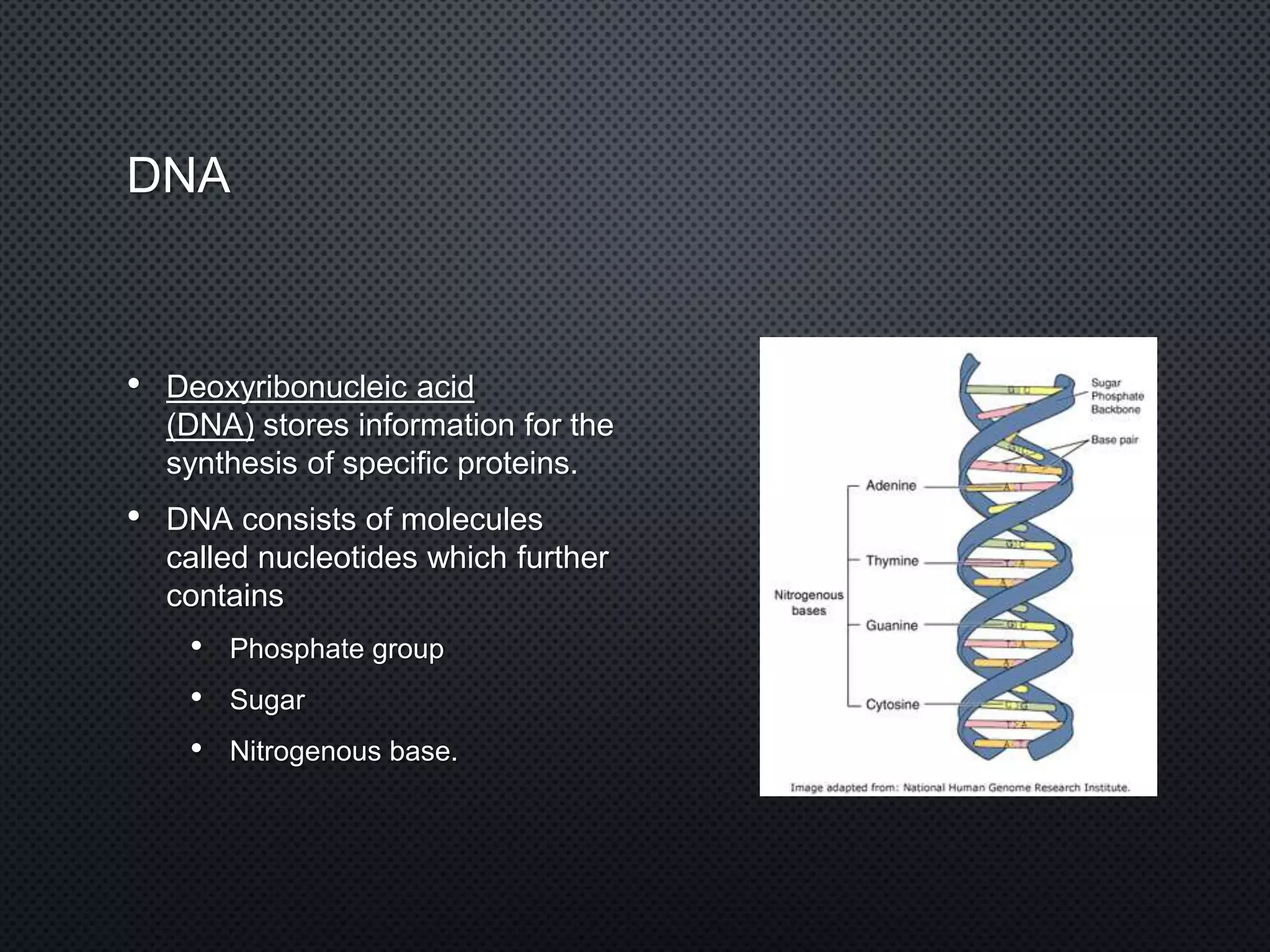
• Deoxyribonucleic acid
(DNA) stores information for the
synthesis of specific proteins.
• DNA consists of molecules
called nucleotides which further
contains
• Phosphate group
• Sugar
• Nitrogenous base.
PHOSPHATE GROUP
• Phosphorous atom bound to 4 oxygen atom.
• Acts as energy carrier like ATP (Adenosine Tri Phosphate) which
provide energy for moving our muscles.
• Along with sugar and bases, it makes up nucleic acid.
SUGAR
• Sugar is an important structural component of DNA.
• Consists of 5 carbon deoxyribose sugars called Pentose sugar and
phosphate groups.
• These sugars are linked between carbon 4 of their chain and CH2
group attached to phosphate ion.
NITROGENOUS BASES
• A nitrogenous base is an organic molecule that contains the element
nitrogen and acts as a base in chemical reactions.
• The nitrogen bases are also called nucleobases because they play a
major role as building blocks of the nucleic acids deoxyribonucleic
acid (DNA) and ribonucleic acid (RNA).
• There are two major classes of nitrogenous bases: purines and
pyrimidines.
• Although there are many nitrogenous bases, the five most important
to know are the bases found in DNA and RNA, which are also used
as energy carriers in biochemical reactions. These are adenine,
guanine, cytosine, thymine, and uracil.
NITROGENOUS BASES
• ADENINE-
• Adenine and guanine are purines.
• Adenine is often represented by the capital letter A.
• In DNA, its complementary base is thymine. The chemical formula of
adenine is C5H5N5.
• In RNA, adenine forms bonds with uracil.
• GUANINE-
• Guanine is a purine represented by the capital letter G.
• Its chemical formula is C5H5N5O.
• In both DNA and RNA, guanine bonds with cytosine. The nucleotide
formed by guanine is guanosine.
NITROGENOUS BASES
• THYMINE-
• Thymine is a pyrimidine found in DNA, where it binds to guanine.
• The symbol for thymine is a capital letter T.
• Its chemical formula is C5H6N2O2.
• CYTOSINE-
• Cytosine is represented by the capital letter C.
• In DNA and RNA, it binds with guanine.
• Three hydrogen bonds form between cytosine and guanine to form DNA.
• The chemical formula of cytosine is C4H4N2O2.
• The nucleotide formed by cytosine is cytidine.
NITROGENOUS BASES
• URACIL-
• Uracil is represented by the capital letter U.
• Its chemical formula is C4H4N2O2.
• In nucleic acids, it is found in RNA bound to adenine. Uracil forms the
nucleotide uridine.
• Pairings-
• In DNA the base pairing is:
• A - T
• G - C
• In RNA, uracil takes the place of thymine, so the base pairing is:
• A - U
• G - C
STRUCTURE
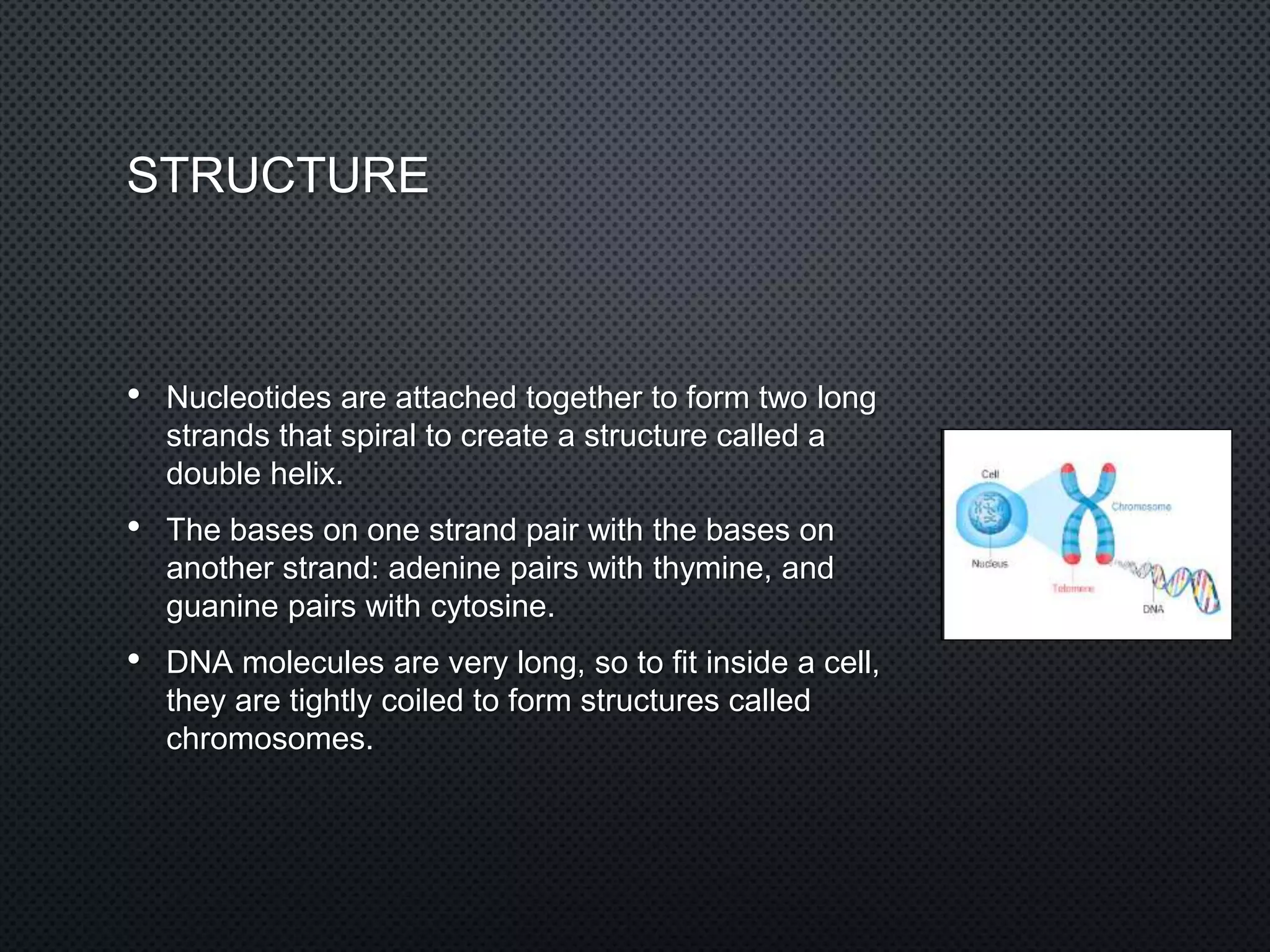
• Nucleotides are attached together to form two long
strands that spiral to create a structure called a
double helix.
• The bases on one strand pair with the bases on
another strand: adenine pairs with thymine, and
guanine pairs with cytosine.
• DNA molecules are very long, so to fit inside a cell,
they are tightly coiled to form structures called
chromosomes.
STRUCTURE
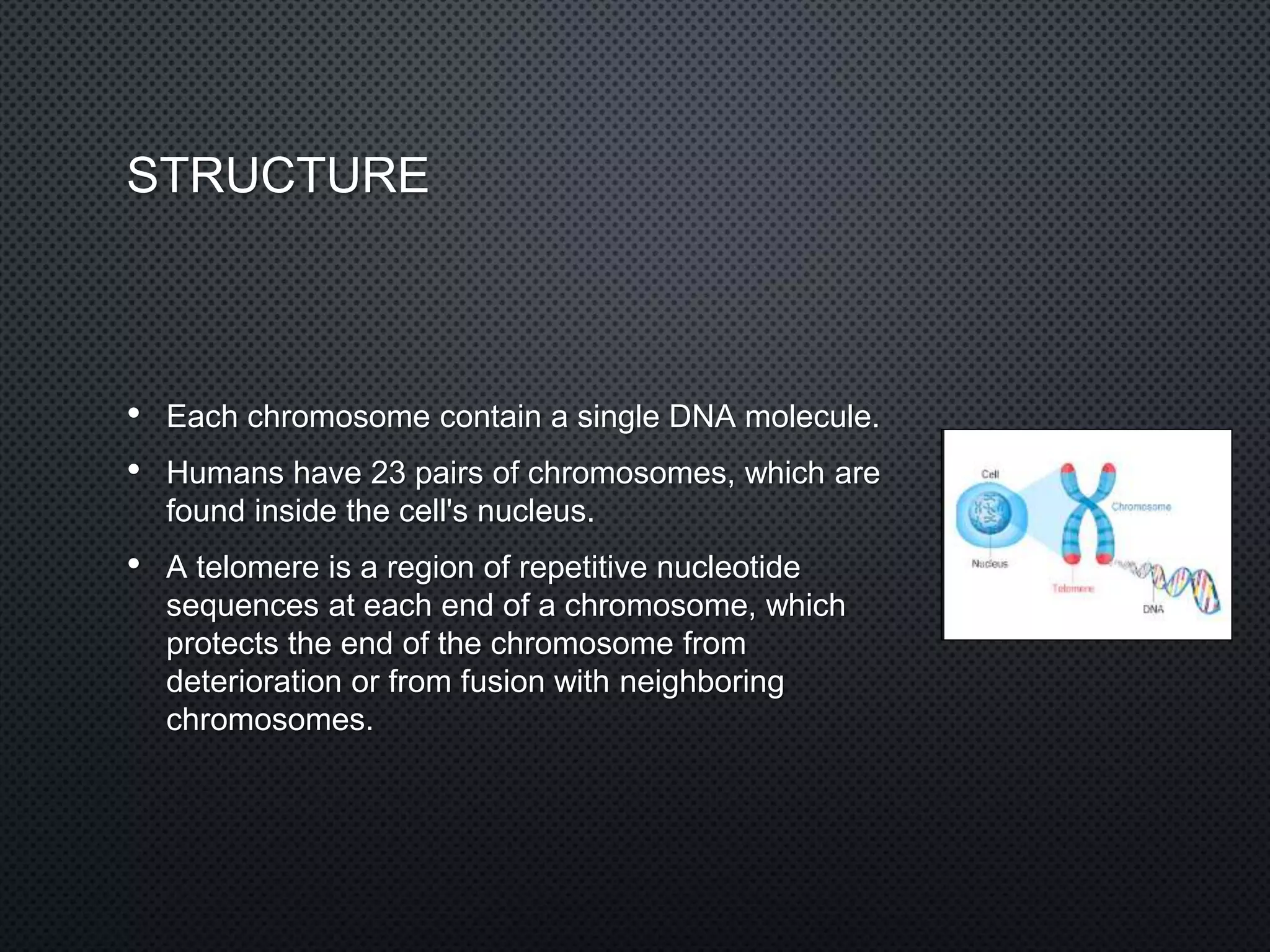
• Each chromosome contain a single DNA molecule.
• Humans have 23 pairs of chromosomes, which are
found inside the cell's nucleus.
• A telomere is a region of repetitive nucleotide
sequences at each end of a chromosome, which
protects the end of the chromosome from
deterioration or from fusion with neighboring
chromosomes.
HYDROGEN BOND
• A hydrogen bond is formed by a dipole-dipole force between an
electronegative atom (the hydrogen acceptor) and a hydrogen atom
that attaches covalently with another electronegative atom (the
hydrogen donor) of the same molecule or of a different molecule.
• Hydrogen bonds are fundamentally electrostatic interactions and are
much weaker than covalent bonds.
• DNA contains four bases: Guanine, Cytosine, Adenine, and Thymine.
The complementary base pairs of guanine with cytosine and adenine
with thymine connect to one another using hydrogen bonds. These
hydrogen bonds between complementary nucleotides are what keeps
the two strands of a DNA helix together.
WEAK FORCES
• Various Weak Forces come together to stabilize the DNA structure.
• Hydrogen bonds, linkage between bases, although weak energy-
wise, is able to stabilize the helix because of the large number present
in DNA molecule.
• Stacking interactions, or also known as Van der Waals
interactions between bases are weak, but the large amounts of these
interactions help to stabilize the overall structure of the helix.
• Charge-Charge Interactions- refers to the electrostatic (ion-ion)
repulsion of the negatively charged phosphate is potentially unstable.
SECONDARY FORM OF DNA
• Major and Minor Groove
• The major groove is wider than the minor groove in DNA and many sequence
specific proteins interact in the major groove.
• The N7 and C6 groups of purines and the C4 and C5 groups of pyrimidines
face into the major groove, thus they can make specific contacts with amino
acids in DNA-binding proteins.
• A Form
• It was discovered by Rosalind Franklin, who also named the B form.
• She showed that DNA is driven into the A form when under dehydrating
conditions.
• It is a right-handed double helix fairly similar to the more common B-DNA
form, but with a shorter, more compact helical structure whose base pairs are
not perpendicular to the helix-axis as in B-DNA
SECONDARY FORM OF DNA
• B Form
• Watson and Crick in 1953 proposed model for a double helical structure
for DNA.
• They proposed two strands of DNA -- each in a right hand helix -- wound
around the same axis.
• The two strands are held together by H bonding between the bases.
• Z Form
• This Z DNA is formed by stretches of alternating purines and pyrimidines,
e.g. GCGCGC, leading to the zig-zag pattern.
• A small amount of the DNA in a cell exists in the Z form.

Biochemistry of DNA Structure

  • 1.
    BIOCHEMISTRY OF DNA STRUCTURE RoopakBhama MCA/25003/18 BT417 - Bioinformatics
  • 2.
    DNA • Deoxyribonucleic acid (DNA)stores information for the synthesis of specific proteins. • DNA consists of molecules called nucleotides which further contains • Phosphate group • Sugar • Nitrogenous base.
  • 3.
    PHOSPHATE GROUP • Phosphorousatom bound to 4 oxygen atom. • Acts as energy carrier like ATP (Adenosine Tri Phosphate) which provide energy for moving our muscles. • Along with sugar and bases, it makes up nucleic acid.
  • 4.
    SUGAR • Sugar isan important structural component of DNA. • Consists of 5 carbon deoxyribose sugars called Pentose sugar and phosphate groups. • These sugars are linked between carbon 4 of their chain and CH2 group attached to phosphate ion.
  • 5.
    NITROGENOUS BASES • Anitrogenous base is an organic molecule that contains the element nitrogen and acts as a base in chemical reactions. • The nitrogen bases are also called nucleobases because they play a major role as building blocks of the nucleic acids deoxyribonucleic acid (DNA) and ribonucleic acid (RNA). • There are two major classes of nitrogenous bases: purines and pyrimidines. • Although there are many nitrogenous bases, the five most important to know are the bases found in DNA and RNA, which are also used as energy carriers in biochemical reactions. These are adenine, guanine, cytosine, thymine, and uracil.
  • 6.
    NITROGENOUS BASES • ADENINE- •Adenine and guanine are purines. • Adenine is often represented by the capital letter A. • In DNA, its complementary base is thymine. The chemical formula of adenine is C5H5N5. • In RNA, adenine forms bonds with uracil. • GUANINE- • Guanine is a purine represented by the capital letter G. • Its chemical formula is C5H5N5O. • In both DNA and RNA, guanine bonds with cytosine. The nucleotide formed by guanine is guanosine.
  • 7.
    NITROGENOUS BASES • THYMINE- •Thymine is a pyrimidine found in DNA, where it binds to guanine. • The symbol for thymine is a capital letter T. • Its chemical formula is C5H6N2O2. • CYTOSINE- • Cytosine is represented by the capital letter C. • In DNA and RNA, it binds with guanine. • Three hydrogen bonds form between cytosine and guanine to form DNA. • The chemical formula of cytosine is C4H4N2O2. • The nucleotide formed by cytosine is cytidine.
  • 8.
    NITROGENOUS BASES • URACIL- •Uracil is represented by the capital letter U. • Its chemical formula is C4H4N2O2. • In nucleic acids, it is found in RNA bound to adenine. Uracil forms the nucleotide uridine. • Pairings- • In DNA the base pairing is: • A - T • G - C • In RNA, uracil takes the place of thymine, so the base pairing is: • A - U • G - C
  • 9.
    STRUCTURE • Nucleotides areattached together to form two long strands that spiral to create a structure called a double helix. • The bases on one strand pair with the bases on another strand: adenine pairs with thymine, and guanine pairs with cytosine. • DNA molecules are very long, so to fit inside a cell, they are tightly coiled to form structures called chromosomes.
  • 10.
    STRUCTURE • Each chromosomecontain a single DNA molecule. • Humans have 23 pairs of chromosomes, which are found inside the cell's nucleus. • A telomere is a region of repetitive nucleotide sequences at each end of a chromosome, which protects the end of the chromosome from deterioration or from fusion with neighboring chromosomes.
  • 11.
    HYDROGEN BOND • Ahydrogen bond is formed by a dipole-dipole force between an electronegative atom (the hydrogen acceptor) and a hydrogen atom that attaches covalently with another electronegative atom (the hydrogen donor) of the same molecule or of a different molecule. • Hydrogen bonds are fundamentally electrostatic interactions and are much weaker than covalent bonds. • DNA contains four bases: Guanine, Cytosine, Adenine, and Thymine. The complementary base pairs of guanine with cytosine and adenine with thymine connect to one another using hydrogen bonds. These hydrogen bonds between complementary nucleotides are what keeps the two strands of a DNA helix together.
  • 12.
    WEAK FORCES • VariousWeak Forces come together to stabilize the DNA structure. • Hydrogen bonds, linkage between bases, although weak energy- wise, is able to stabilize the helix because of the large number present in DNA molecule. • Stacking interactions, or also known as Van der Waals interactions between bases are weak, but the large amounts of these interactions help to stabilize the overall structure of the helix. • Charge-Charge Interactions- refers to the electrostatic (ion-ion) repulsion of the negatively charged phosphate is potentially unstable.
  • 13.
    SECONDARY FORM OFDNA • Major and Minor Groove • The major groove is wider than the minor groove in DNA and many sequence specific proteins interact in the major groove. • The N7 and C6 groups of purines and the C4 and C5 groups of pyrimidines face into the major groove, thus they can make specific contacts with amino acids in DNA-binding proteins. • A Form • It was discovered by Rosalind Franklin, who also named the B form. • She showed that DNA is driven into the A form when under dehydrating conditions. • It is a right-handed double helix fairly similar to the more common B-DNA form, but with a shorter, more compact helical structure whose base pairs are not perpendicular to the helix-axis as in B-DNA
  • 14.
    SECONDARY FORM OFDNA • B Form • Watson and Crick in 1953 proposed model for a double helical structure for DNA. • They proposed two strands of DNA -- each in a right hand helix -- wound around the same axis. • The two strands are held together by H bonding between the bases. • Z Form • This Z DNA is formed by stretches of alternating purines and pyrimidines, e.g. GCGCGC, leading to the zig-zag pattern. • A small amount of the DNA in a cell exists in the Z form.