DNA STRUCTURE
AND FUNCTION
BY PROF. T. V. RATHOD
DEOXY RIBOSE NUCLEIC ACID (DNA)
• In 1869, Friedrich Meischer was the first person who separated cell
nuclei from the cytoplasm and extracted an acidic material, nuclein,
from the nuclei of pus cells.
• He found that the acidic material contained unusually large amounts of
phosphorous and no sulphur.
• Later on in 1889, Richard Altmann used the term nucleic acid in place
of nuclein.
• Nucleic acids were found to be associated with various proteins called
nucleoproteins.
• There are two types of nucleic acids viz.,
 Deoxy ribose Nucleic acid (DNA) and
 Ribose Nucleic acid (RNA).
• DNA is the genetic material in most of the organisms.
• RNA acts as genetic material only in some viruses.
• DNA is mainly found in the chromosomes in the nucleus, while RNA is
mostly found in the ribosomes in the cytoplasm.
• Levene showed that nucleic acid can be broken into smaller molecules
called nucleotides.
• Each nucleotide consists of a sugar, phosphate group and a nitrogenous
base.
• The combination of nitrogenous base and sugar without the phosphate
group is called nucleoside (riboside and deoxyriboside)
• where as the combination of nitrogenous base, sugar and the
phosphate group is called nucleotide (ribotide and deoxyribotide)
 nucleotide = nucleoside + phosphate
• The 5-carbon (pentose) sugar could be either ribose as in case of RNA
or deoxyribose in case of DNA.
• Associated with each sugar is a nitrogenous base with one or two
carbon–nitrogen rings.
• Bases containing one carbon–nitrogen ring are called pyrimidines.
• The common pyrimidines present in DNA are thymine(T) and cytosine
(C), while in case of RNA pyrimidine base thymine(T) is replaced by
uracil(U).
• Bases containing two carbon-nitrogen rings are called purines.
• The common purines present in nucleic acids are adenine (A) and
guanine(G).
Purine Bases
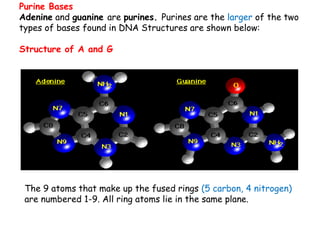
Adenine and guanine are purines. Purines are the larger of the two
types of bases found in DNA Structures are shown below:
Structure of A and G
The 9 atoms that make up the fused rings (5 carbon, 4 nitrogen)
are numbered 1-9. All ring atoms lie in the same plane.
Pyrimidine Bases
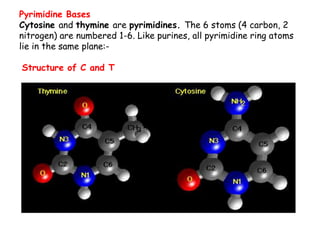
Cytosine and thymine are pyrimidines. The 6 stoms (4 carbon, 2
nitrogen) are numbered 1-6. Like purines, all pyrimidine ring atoms
lie in the same plane:-
Structure of C and T
Deoxyribose Sugar
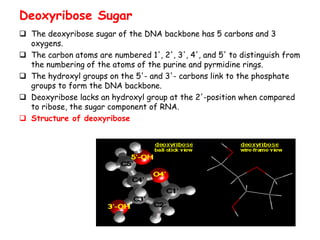
 The deoxyribose sugar of the DNA backbone has 5 carbons and 3
oxygens.
 The carbon atoms are numbered 1', 2', 3', 4', and 5' to distinguish from
the numbering of the atoms of the purine and pyrmidine rings.
 The hydroxyl groups on the 5'- and 3'- carbons link to the phosphate
groups to form the DNA backbone.
 Deoxyribose lacks an hydroxyl group at the 2'-position when compared
to ribose, the sugar component of RNA.
 Structure of deoxyribose
Differences between pyrimidines and purines
Pyrimidines
• These are single ring (six
member)compounds.
• They are of three types, viz.,
cytosine, thymine and uracil.
• They occupy less space in
DNA structure.
• Deoxyribose is linked at
position 3 of pyrimidine.
Purines
• These are double ring (nine
member)compounds.
• They are of two types, viz.,
adenine and guanine.
• They occupy more space in
DNA structure.
• Deoxyribose is linked at
position 9 of purine.
The DNA Double Helix
• Taking into account the facts known at that time Watson and Crick in
1953 proposed a “double helix” structure of DNA which quickly gained
wide acceptance.
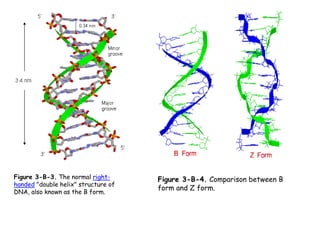
• The DNA molecule consists of two polynucleotide chains wound around
each other in a right-handed double helix.
• The two strands of a DNA molecule are oriented anti-parallel to each
other and run in opposite directions.
• The sugar-phosphate backbones of the two DNA strands wind around
the helix axis like the railing of a spiral staircase.
• The bases of the individual nucleotides are on the inside of the helix,
stacked on top of each other like the steps of a spiral staircase.
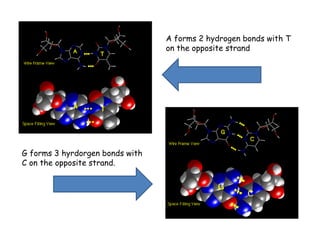
• Within the DNA double helix, A forms 2 hydrogen bonds with T on the
opposite strand, and G forms 3 hydrogen bonds with C on the opposite
strand.
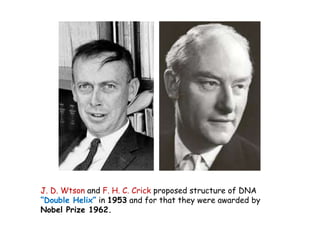
J. D. Wtson and F. H. C. Crick proposed structure of DNA
“Double Helix” in 1953 and for that they were awarded by
Nobel Prize 1962.
It contains two polynucleotide strands wound
around each other.
The backbone of each consists of
alternating deoxyribose and phosphate groups.
The phosphate group bonded to the 5' carbon
atom of one deoxyribose is covalently bonded to the
3' carbon of the next.
The two strands are "antiparallel“ ; that is, one
strand runs 5′ to 3′ while the other runs 3′ to 5′.
The DNA strands are assembled in the 5′ to 3′
direction [More] and, by convention, we "read" them
the same way.
The purine or pyrimidine attached to each
deoxyribose projects in toward the axis of the
helix.
Each base forms hydrogen bonds with the one
directly opposite it, forming base pairs (also called
nucleotide pairs).
3.4 Å separate the planes in which adjacent base
pairs are located.
The double helix makes a complete turn in just
over 10 nucleotide pairs, so each turn takes a little
more (35.7 Å to be exact) than the 34 Å.
G forms 3 hyrdorgen bonds with
C on the opposite strand.
A forms 2 hydrogen bonds with T
on the opposite strand
A B & Z forms of DNA
• In a DNA molecule, the two strands are not parallel, but intertwined
with each other. Each strand looks like a helix. The two strands form a
"double helix" structure, which was first discovered by James D.
Watson and Francis Crick in 1953.
• In this structure, also known as the B form.
• In a solution with higher salt concentrations or with alcohol added, the
DNA structure may change to an A form.
• Which is still right-handed, but every 2.3 nm makes a turn and there
are 11 base pairs per turn.
• Another DNA structure is called the Z form. Because its bases seem
to zigzag. Z DNA is left-handed. One turn spans 4.6 nm, comprising 12
base pairs. The DNA molecule with alternating G-C sequences in alcohol
or high salt solution tends to have such structure.
Figure 3-B-3. The normal right-
handed "double helix" structure of
DNA, also known as the B form.
Figure 3-B-4. Comparison between B
form and Z form.
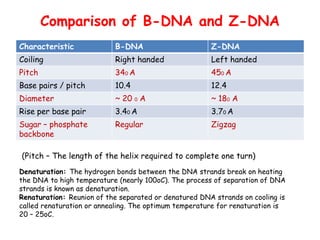
Comparison of B-DNA and Z-DNA
Characteristic B-DNA Z-DNA
Coiling Right handed Left handed
Pitch 340 A 450 A
Base pairs / pitch 10.4 12.4
Diameter ~ 20 0 A ~ 180 A
Rise per base pair 3.40 A 3.70 A
Sugar – phosphate
backbone
Regular Zigzag
(Pitch – The length of the helix required to complete one turn)
Denaturation: The hydrogen bonds between the DNA strands break on heating
the DNA to high temperature (nearly 100oC). The process of separation of DNA
strands is known as denaturation.
Renaturation: Reunion of the separated or denatured DNA strands on cooling is
called renaturation or annealing. The optimum temperature for renaturation is
20 – 25oC.
The DNA molecule satisfies the requirement of genetic material
in the following ways:-
1. It can replicate itself accurately during cell growth and division.
2. Its structure is sufficiently stable so that heritable charges i.e.,
mutations can occur only very rarely.
3. It has a potential to carry all kinds of necessary biological
information.
4. It transmits all the biological information to the daughter cells.
Thus the essential functions of DNA are the storage and
transmission of genetic information and the expression of this
information in the form of synthesis of cellular proteins.
THANK
YOU

DNA Structure & Function

  • 1.
  • 2.
    DEOXY RIBOSE NUCLEICACID (DNA) • In 1869, Friedrich Meischer was the first person who separated cell nuclei from the cytoplasm and extracted an acidic material, nuclein, from the nuclei of pus cells. • He found that the acidic material contained unusually large amounts of phosphorous and no sulphur. • Later on in 1889, Richard Altmann used the term nucleic acid in place of nuclein. • Nucleic acids were found to be associated with various proteins called nucleoproteins. • There are two types of nucleic acids viz.,  Deoxy ribose Nucleic acid (DNA) and  Ribose Nucleic acid (RNA). • DNA is the genetic material in most of the organisms. • RNA acts as genetic material only in some viruses. • DNA is mainly found in the chromosomes in the nucleus, while RNA is mostly found in the ribosomes in the cytoplasm.
  • 3.
    • Levene showedthat nucleic acid can be broken into smaller molecules called nucleotides. • Each nucleotide consists of a sugar, phosphate group and a nitrogenous base. • The combination of nitrogenous base and sugar without the phosphate group is called nucleoside (riboside and deoxyriboside) • where as the combination of nitrogenous base, sugar and the phosphate group is called nucleotide (ribotide and deoxyribotide)  nucleotide = nucleoside + phosphate
  • 4.
    • The 5-carbon(pentose) sugar could be either ribose as in case of RNA or deoxyribose in case of DNA. • Associated with each sugar is a nitrogenous base with one or two carbon–nitrogen rings. • Bases containing one carbon–nitrogen ring are called pyrimidines. • The common pyrimidines present in DNA are thymine(T) and cytosine (C), while in case of RNA pyrimidine base thymine(T) is replaced by uracil(U). • Bases containing two carbon-nitrogen rings are called purines. • The common purines present in nucleic acids are adenine (A) and guanine(G).
  • 5.
    Purine Bases Adenine andguanine are purines. Purines are the larger of the two types of bases found in DNA Structures are shown below: Structure of A and G The 9 atoms that make up the fused rings (5 carbon, 4 nitrogen) are numbered 1-9. All ring atoms lie in the same plane.
  • 6.
    Pyrimidine Bases Cytosine andthymine are pyrimidines. The 6 stoms (4 carbon, 2 nitrogen) are numbered 1-6. Like purines, all pyrimidine ring atoms lie in the same plane:- Structure of C and T
  • 7.
    Deoxyribose Sugar  Thedeoxyribose sugar of the DNA backbone has 5 carbons and 3 oxygens.  The carbon atoms are numbered 1', 2', 3', 4', and 5' to distinguish from the numbering of the atoms of the purine and pyrmidine rings.  The hydroxyl groups on the 5'- and 3'- carbons link to the phosphate groups to form the DNA backbone.  Deoxyribose lacks an hydroxyl group at the 2'-position when compared to ribose, the sugar component of RNA.  Structure of deoxyribose
  • 8.
    Differences between pyrimidinesand purines Pyrimidines • These are single ring (six member)compounds. • They are of three types, viz., cytosine, thymine and uracil. • They occupy less space in DNA structure. • Deoxyribose is linked at position 3 of pyrimidine. Purines • These are double ring (nine member)compounds. • They are of two types, viz., adenine and guanine. • They occupy more space in DNA structure. • Deoxyribose is linked at position 9 of purine.
  • 9.
    The DNA DoubleHelix • Taking into account the facts known at that time Watson and Crick in 1953 proposed a “double helix” structure of DNA which quickly gained wide acceptance. • The DNA molecule consists of two polynucleotide chains wound around each other in a right-handed double helix. • The two strands of a DNA molecule are oriented anti-parallel to each other and run in opposite directions. • The sugar-phosphate backbones of the two DNA strands wind around the helix axis like the railing of a spiral staircase. • The bases of the individual nucleotides are on the inside of the helix, stacked on top of each other like the steps of a spiral staircase. • Within the DNA double helix, A forms 2 hydrogen bonds with T on the opposite strand, and G forms 3 hydrogen bonds with C on the opposite strand.
  • 10.
    J. D. Wtsonand F. H. C. Crick proposed structure of DNA “Double Helix” in 1953 and for that they were awarded by Nobel Prize 1962.
  • 11.
    It contains twopolynucleotide strands wound around each other. The backbone of each consists of alternating deoxyribose and phosphate groups. The phosphate group bonded to the 5' carbon atom of one deoxyribose is covalently bonded to the 3' carbon of the next. The two strands are "antiparallel“ ; that is, one strand runs 5′ to 3′ while the other runs 3′ to 5′. The DNA strands are assembled in the 5′ to 3′ direction [More] and, by convention, we "read" them the same way. The purine or pyrimidine attached to each deoxyribose projects in toward the axis of the helix. Each base forms hydrogen bonds with the one directly opposite it, forming base pairs (also called nucleotide pairs). 3.4 Å separate the planes in which adjacent base pairs are located. The double helix makes a complete turn in just over 10 nucleotide pairs, so each turn takes a little more (35.7 Å to be exact) than the 34 Å.
  • 12.
    G forms 3hyrdorgen bonds with C on the opposite strand. A forms 2 hydrogen bonds with T on the opposite strand
  • 13.
    A B &Z forms of DNA • In a DNA molecule, the two strands are not parallel, but intertwined with each other. Each strand looks like a helix. The two strands form a "double helix" structure, which was first discovered by James D. Watson and Francis Crick in 1953. • In this structure, also known as the B form. • In a solution with higher salt concentrations or with alcohol added, the DNA structure may change to an A form. • Which is still right-handed, but every 2.3 nm makes a turn and there are 11 base pairs per turn. • Another DNA structure is called the Z form. Because its bases seem to zigzag. Z DNA is left-handed. One turn spans 4.6 nm, comprising 12 base pairs. The DNA molecule with alternating G-C sequences in alcohol or high salt solution tends to have such structure.
  • 14.
    Figure 3-B-3. Thenormal right- handed "double helix" structure of DNA, also known as the B form. Figure 3-B-4. Comparison between B form and Z form.
  • 15.
    Comparison of B-DNAand Z-DNA Characteristic B-DNA Z-DNA Coiling Right handed Left handed Pitch 340 A 450 A Base pairs / pitch 10.4 12.4 Diameter ~ 20 0 A ~ 180 A Rise per base pair 3.40 A 3.70 A Sugar – phosphate backbone Regular Zigzag (Pitch – The length of the helix required to complete one turn) Denaturation: The hydrogen bonds between the DNA strands break on heating the DNA to high temperature (nearly 100oC). The process of separation of DNA strands is known as denaturation. Renaturation: Reunion of the separated or denatured DNA strands on cooling is called renaturation or annealing. The optimum temperature for renaturation is 20 – 25oC.
  • 16.
    The DNA moleculesatisfies the requirement of genetic material in the following ways:- 1. It can replicate itself accurately during cell growth and division. 2. Its structure is sufficiently stable so that heritable charges i.e., mutations can occur only very rarely. 3. It has a potential to carry all kinds of necessary biological information. 4. It transmits all the biological information to the daughter cells. Thus the essential functions of DNA are the storage and transmission of genetic information and the expression of this information in the form of synthesis of cellular proteins.
  • 17.