DNA Structure,DNA Structure,
Functions andFunctions and
PropertiesProperties
Presented by:
Rajeshwar
DEPARTMENT OF PHARMACOLOGY
R.I.T Greater Noida ,INDIA
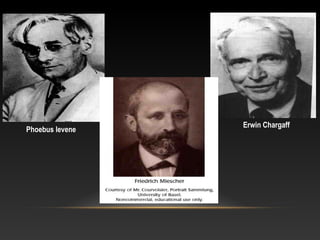
Erwin Chargaff
Phoebus levene
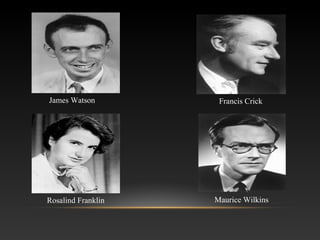
James Watson Francis Crick
Maurice WilkinsRosalind Franklin
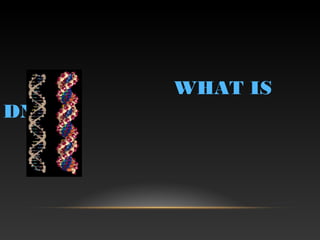
WHAT IS
DNA?
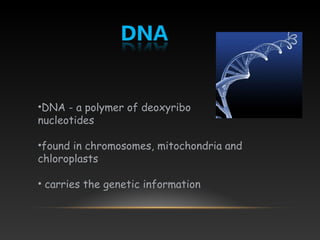
•DNA - a polymer of deoxyribo
nucleotides
•found in chromosomes, mitochondria and
chloroplasts
• carries the genetic information
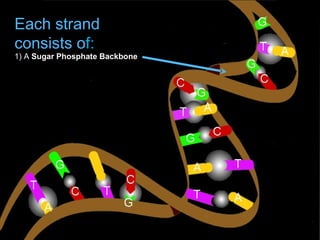
Each strand
consists of:
1) A Sugar Phosphate Backbone
Each strand
consists of:
1) A Sugar Phosphate Backbone
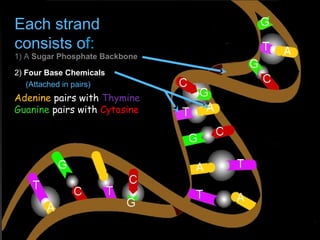
2) Four Base Chemicals
(Attached in pairs)
AdenineAdenine pairs with ThymineThymine
GuanineGuanine pairs with CytosineCytosine
STRUCTURESTRUCTURE
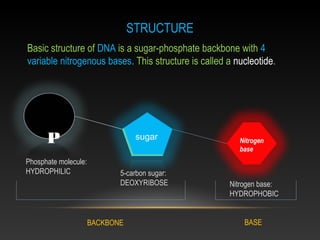
Basic structure of DNA is a sugar-phosphate backbone with 4
variable nitrogenous bases. This structure is called a nucleotide.
P sugar Nitrogen
base
Phosphate molecule:
HYDROPHILIC 5-carbon sugar:
DEOXYRIBOSE Nitrogen base:
HYDROPHOBIC
BACKBONE BASE
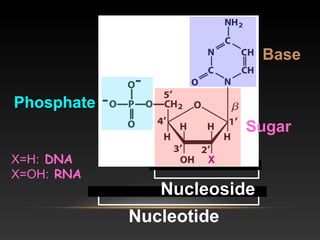
Nucleotide
Nucleoside
Base
Phosphate
Sugar
X=H: DNA
X=OH: RNA
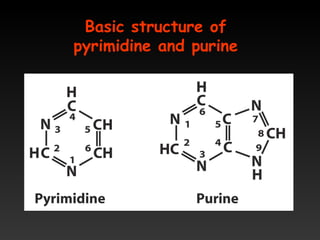
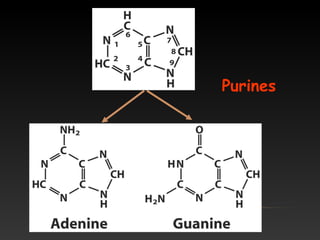
Basic structure of
pyrimidine and purine
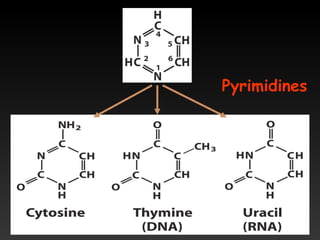
Pyrimidines
Purines
DNA structure
 Primary structure
 Secondary structure
 Tertiary structure
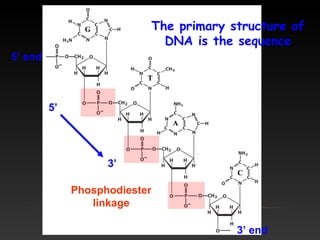
The primary structure of
DNA is the sequence
5’ end
3’ end
5’
3’
Phosphodiester
linkage
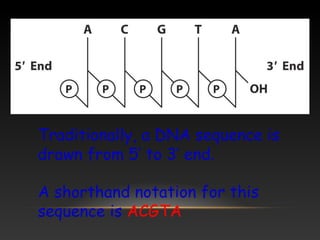
Traditionally, a DNA sequence is
drawn from 5’ to 3’ end.
A shorthand notation for this
sequence is ACGTA
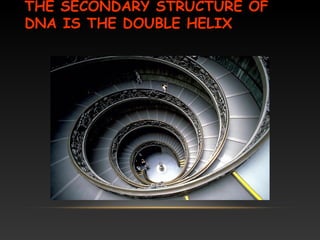
THE SECONDARY STRUCTURE OF
DNA IS THE DOUBLE HELIX
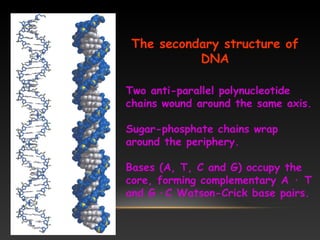
The secondary structure of
DNA
Two anti-parallel polynucleotide
chains wound around the same axis.
Sugar-phosphate chains wrap
around the periphery.
Bases (A, T, C and G) occupy the
core, forming complementary A · T
and G · C Watson-Crick base pairs.
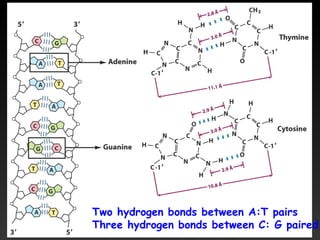
 hydrogen bonding;
 base stacking
The DNA double helix is held together
mainly by- Hydrogen bonds
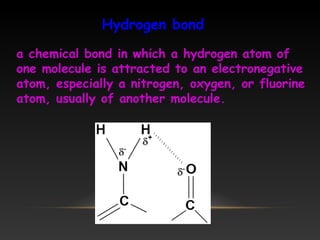
Hydrogen bond
a chemical bond in which a hydrogen atom of
one molecule is attracted to an electronegative
atom, especially a nitrogen, oxygen, or fluorine
atom, usually of another molecule.
Two hydrogen bonds between A:T pairs
Three hydrogen bonds between C: G paired
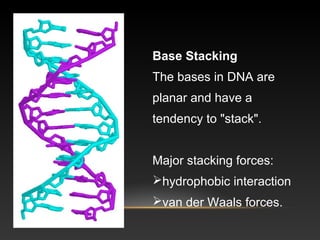
Base Stacking
The bases in DNA are
planar and have a
tendency to "stack".
Major stacking forces:
hydrophobic interaction
van der Waals forces.
In eukaryotic cells,
DNA is folded into chromatin
DNA Tertiary Structure
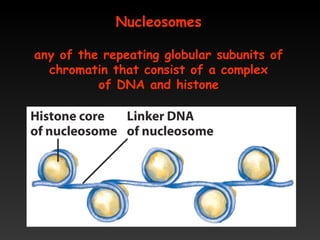
•DNA DOUBLE HELICAL STRUCTURE COILS ROUND
HISTONES.
•DNA BOUND TO HISTONES FORMS
NUCLEOSOMES (10nm FIBRES)
•NUCLEOSOMES CONTAIN 146 NUCLEOTIDES
Nucleosomes
any of the repeating globular subunits of
chromatin that consist of a complex
of DNA and histone
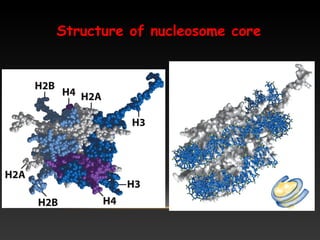
Structure of nucleosome core
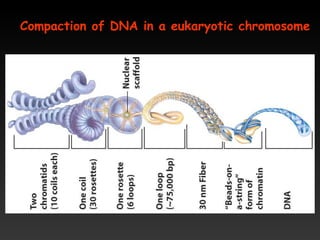
Compaction of DNA in a eukaryotic chromosome
Functions of DNA and
summary of structure
DNA consists of four bases—A, G, C, and T—that are held in
linear array by phosphodiester bonds through the 3' and 5'
positions of adjacent deoxyribose moieties.
DNA is organized into two strands by the pairing of bases A to T
and G to C on complementary strands. These strands form a
double helix around a central axis.
The 3 x 10⁹
base pairs of DNA in humans are organized into the
haploid complement of 23 chromosomes.
DNA provides a template for its own replication and thus
maintenance of the genotype and for the transcription of the
roughly 30,000 human genes into a variety of RNA molecules.
DNA

DNA

  • 1.
    DNA Structure,DNA Structure, FunctionsandFunctions and PropertiesProperties Presented by: Rajeshwar DEPARTMENT OF PHARMACOLOGY R.I.T Greater Noida ,INDIA
  • 3.
  • 4.
    James Watson FrancisCrick Maurice WilkinsRosalind Franklin
  • 5.
  • 6.
    •DNA - apolymer of deoxyribo nucleotides •found in chromosomes, mitochondria and chloroplasts • carries the genetic information
  • 7.
    Each strand consists of: 1)A Sugar Phosphate Backbone
  • 8.
    Each strand consists of: 1)A Sugar Phosphate Backbone 2) Four Base Chemicals (Attached in pairs) AdenineAdenine pairs with ThymineThymine GuanineGuanine pairs with CytosineCytosine
  • 9.
    STRUCTURESTRUCTURE Basic structure ofDNA is a sugar-phosphate backbone with 4 variable nitrogenous bases. This structure is called a nucleotide. P sugar Nitrogen base Phosphate molecule: HYDROPHILIC 5-carbon sugar: DEOXYRIBOSE Nitrogen base: HYDROPHOBIC BACKBONE BASE
  • 10.
  • 11.
  • 12.
  • 13.
  • 14.
    DNA structure  Primarystructure  Secondary structure  Tertiary structure
  • 15.
    The primary structureof DNA is the sequence 5’ end 3’ end 5’ 3’ Phosphodiester linkage
  • 16.
    Traditionally, a DNAsequence is drawn from 5’ to 3’ end. A shorthand notation for this sequence is ACGTA
  • 17.
    THE SECONDARY STRUCTUREOF DNA IS THE DOUBLE HELIX
  • 18.
    The secondary structureof DNA Two anti-parallel polynucleotide chains wound around the same axis. Sugar-phosphate chains wrap around the periphery. Bases (A, T, C and G) occupy the core, forming complementary A · T and G · C Watson-Crick base pairs.
  • 19.
     hydrogen bonding; base stacking The DNA double helix is held together mainly by- Hydrogen bonds
  • 20.
    Hydrogen bond a chemicalbond in which a hydrogen atom of one molecule is attracted to an electronegative atom, especially a nitrogen, oxygen, or fluorine atom, usually of another molecule.
  • 21.
    Two hydrogen bondsbetween A:T pairs Three hydrogen bonds between C: G paired
  • 22.
    Base Stacking The basesin DNA are planar and have a tendency to "stack". Major stacking forces: hydrophobic interaction van der Waals forces.
  • 23.
    In eukaryotic cells, DNAis folded into chromatin
  • 24.
    DNA Tertiary Structure •DNADOUBLE HELICAL STRUCTURE COILS ROUND HISTONES. •DNA BOUND TO HISTONES FORMS NUCLEOSOMES (10nm FIBRES) •NUCLEOSOMES CONTAIN 146 NUCLEOTIDES
  • 25.
    Nucleosomes any of therepeating globular subunits of chromatin that consist of a complex of DNA and histone
  • 26.
  • 27.
    Compaction of DNAin a eukaryotic chromosome
  • 28.
    Functions of DNAand summary of structure DNA consists of four bases—A, G, C, and T—that are held in linear array by phosphodiester bonds through the 3' and 5' positions of adjacent deoxyribose moieties. DNA is organized into two strands by the pairing of bases A to T and G to C on complementary strands. These strands form a double helix around a central axis. The 3 x 10⁹ base pairs of DNA in humans are organized into the haploid complement of 23 chromosomes. DNA provides a template for its own replication and thus maintenance of the genotype and for the transcription of the roughly 30,000 human genes into a variety of RNA molecules.

Editor's Notes