DNA STRUCTURE
      AND
   FUNCTION


DIAMSAY, ELISHA GRACE B.
MENDOZA, LINETTE M.
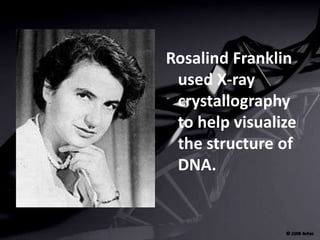
Rosalind Franklin
 used X-ray
 crystallography
 to help visualize
 the structure of
 DNA.
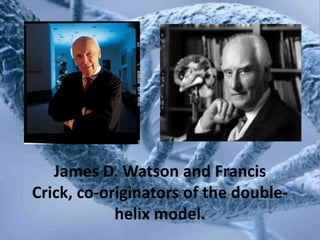
James D. Watson and Francis
Crick, co-originators of the double-
            helix model.
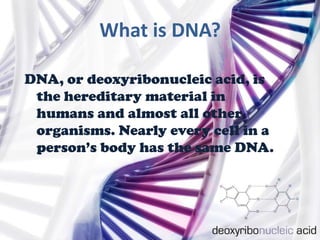
What is DNA?

DNA, or deoxyribonucleic acid, is
 the hereditary material in
 humans and almost all other
 organisms. Nearly every cell in a
 person’s body has the same DNA.
Where is it located?
Most DNA is located in the
cell nucleus (where it is
called nuclear DNA), but a
small amount of DNA can
also be found in the
mitochondria (where it is
called mitochondrial DNA or
mtDNA).
FUNCTION

DNA stores an organism's genetic
information and controls the
production of proteins and is thus
responsible for the biochemistry of
an organism.
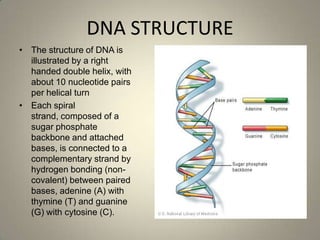
DNA STRUCTURE
• The structure of DNA is
  illustrated by a right
  handed double helix, with
  about 10 nucleotide pairs
  per helical turn
• Each spiral
  strand, composed of a
  sugar phosphate
  backbone and attached
  bases, is connected to a
  complementary strand by
  hydrogen bonding (non-
  covalent) between paired
  bases, adenine (A) with
  thymine (T) and guanine
  (G) with cytosine (C).
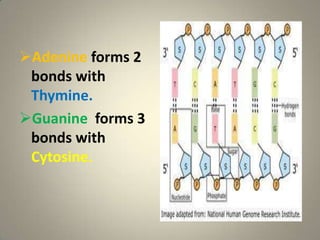
Adenine forms 2
 bonds with
 Thymine.
Guanine forms 3
 bonds with
 Cytosine.
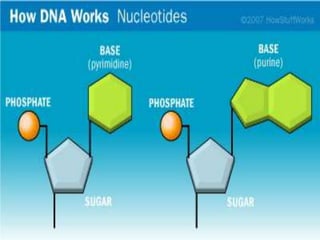
Sugar - Either ribose or deoxyribose (in RNA or DNA).

Nitrogenous base
  Purines consist of a six-membered and a five-
  membered nitrogen-containing ring, fused together
   – Adenine
   – Guanine
  Pyridmidines have only a six-membered nitrogen-
  containing ring.
   – Uracil (RNA)
   – Thymine
   – Cytosine
Phosphates - One to three, two of which are usually
  hydrolyzed to provide the energy to attach the
  nucleotide and form the phosphodiester bond.
Base Pairing of DNA
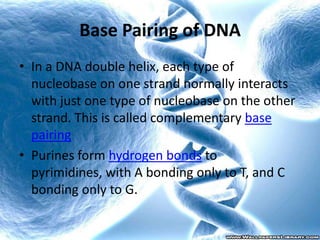
• In a DNA double helix, each type of
  nucleobase on one strand normally interacts
  with just one type of nucleobase on the other
  strand. This is called complementary base
  pairing
• Purines form hydrogen bonds to
  pyrimidines, with A bonding only to T, and C
  bonding only to G.

DNA Structure and Function (Diamsay, Mendoza))

  • 1.
    DNA STRUCTURE AND FUNCTION DIAMSAY, ELISHA GRACE B. MENDOZA, LINETTE M.
  • 2.
    Rosalind Franklin usedX-ray crystallography to help visualize the structure of DNA.
  • 3.
    James D. Watsonand Francis Crick, co-originators of the double- helix model.
  • 4.
    What is DNA? DNA,or deoxyribonucleic acid, is the hereditary material in humans and almost all other organisms. Nearly every cell in a person’s body has the same DNA.
  • 5.
    Where is itlocated? Most DNA is located in the cell nucleus (where it is called nuclear DNA), but a small amount of DNA can also be found in the mitochondria (where it is called mitochondrial DNA or mtDNA).
  • 6.
    FUNCTION DNA stores anorganism's genetic information and controls the production of proteins and is thus responsible for the biochemistry of an organism.
  • 7.
    DNA STRUCTURE • Thestructure of DNA is illustrated by a right handed double helix, with about 10 nucleotide pairs per helical turn • Each spiral strand, composed of a sugar phosphate backbone and attached bases, is connected to a complementary strand by hydrogen bonding (non- covalent) between paired bases, adenine (A) with thymine (T) and guanine (G) with cytosine (C).
  • 8.
    Adenine forms 2 bonds with Thymine. Guanine forms 3 bonds with Cytosine.
  • 10.
    Sugar - Eitherribose or deoxyribose (in RNA or DNA). Nitrogenous base Purines consist of a six-membered and a five- membered nitrogen-containing ring, fused together – Adenine – Guanine Pyridmidines have only a six-membered nitrogen- containing ring. – Uracil (RNA) – Thymine – Cytosine Phosphates - One to three, two of which are usually hydrolyzed to provide the energy to attach the nucleotide and form the phosphodiester bond.
  • 11.
    Base Pairing ofDNA • In a DNA double helix, each type of nucleobase on one strand normally interacts with just one type of nucleobase on the other strand. This is called complementary base pairing • Purines form hydrogen bonds to pyrimidines, with A bonding only to T, and C bonding only to G.