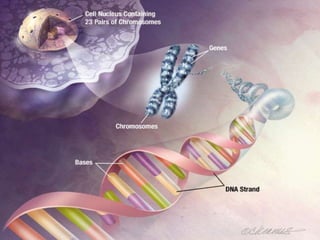
DNA structure
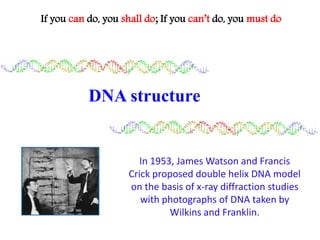
In 1953, James Watson and Francis
Crick proposed double helix DNA model
on the basis of x-ray diffraction studies
with photographs of DNA taken by
Wilkins and Franklin.
If you can do, you shall do; If you can’t do, you must do
• DNA is a macromolecular substance with double
stranded polynucleotide.
• DNA is a double stranded structure in which the two
strands are coiled around each other forming a double
helix.
• The DNA duplex is “coil of life”.
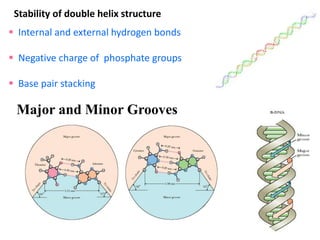
There are two grooves found in DNA molecule
namely
 Major groove and
 Minor groove.
The backbone of the helix is formed of sugar and
phosphate molecule. The nitrogenous bases are
attached to sugar molecules.
The two nucleotide strands are held together by
unstable hydrogen bonds
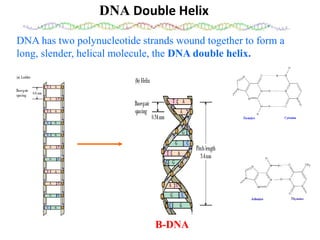
DNA Double Helix
DNA has two polynucleotide strands wound together to form a
long, slender, helical molecule, the DNA double helix.
B-DNA
• The two strand run antiparallely in opposite directions
ie. they run in opposite direction 5’ to 3’ end and 3’ to 5’
end.
• The two strands are interwined in clockwise direction.
• The width of DNA molecule is 20 Å. The strand
completes a turn every 34 Å along its length.
• There are ten nucleotides per turn. The internucleotide
distance is 3.4 Å.
• Watson and Crick model of DNA is called B-form DNA.
The chains in B-form DNA are in right handed
orientation.
Stability of double helix structure
 Internal and external hydrogen bonds
 Negative charge of phosphate groups
 Base pair stacking
Major and Minor Grooves
• Each nucleotide is made up of pentose sugar, a
phosphate group and a nitrogenous base.
Deoxyribose is the constituent sugar in DNA.
• The nitrogenous bases are of two kinds – purines and
pyrimidines.
• Adenine and guanine are the purines and thymine
and cytosine are pyrimidines.
• The nitrogenous bases found in DNA are adenine,
guanine, cytosine and thymine
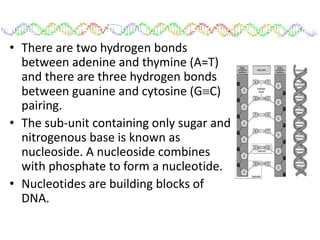
• There are two hydrogen bonds
between adenine and thymine (A=T)
and there are three hydrogen bonds
between guanine and cytosine (GC)
pairing.
• The sub-unit containing only sugar and
nitrogenous base is known as
nucleoside. A nucleoside combines
with phosphate to form a nucleotide.
• Nucleotides are building blocks of
DNA.
• Erwin Chargaff in 1949 showed that
• (i) The bases pair in specific manner. Adenine always
pairs with thymine and guanine pairs with cytosine.
• (ii) Total amount of purine nucleotides is always equal
to the total amount of pyrimidine nucleotides i.e.[A] +
[G] = [T] + [C].
• (iii) The proportion of adenine is equal to thymine and
so also of guanine is equal to cytosine. But the [A] + [T]
need not necessarily be equal to [G] + [C].
• These empirical rules regarding the composition of
bases in DNA is collectively known as Chargaff’s law or
Base pair rules.
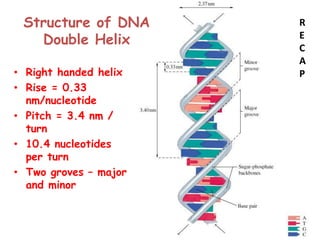
Structure of DNA
Double Helix
• Right handed helix
• Rise = 0.33
nm/nucleotide
• Pitch = 3.4 nm /
turn
• 10.4 nucleotides
per turn
• Two groves – major
and minor
R
E
C
A
P
Reference:
Books:
Fundamentals of Genetics – B.D.Singh
Websites:
• www.biology200.gsu.edu
• www.biofo.com
• www.wikipedia.com
BY
R.ABARNA
BTH-12-001
T
H
A
N
K
Y
O
U

DNA structure - double helix structure

  • 1.
    DNA structure In 1953,James Watson and Francis Crick proposed double helix DNA model on the basis of x-ray diffraction studies with photographs of DNA taken by Wilkins and Franklin. If you can do, you shall do; If you can’t do, you must do
  • 2.
    • DNA isa macromolecular substance with double stranded polynucleotide. • DNA is a double stranded structure in which the two strands are coiled around each other forming a double helix. • The DNA duplex is “coil of life”.
  • 3.
    There are twogrooves found in DNA molecule namely  Major groove and  Minor groove. The backbone of the helix is formed of sugar and phosphate molecule. The nitrogenous bases are attached to sugar molecules. The two nucleotide strands are held together by unstable hydrogen bonds
  • 4.
    DNA Double Helix DNAhas two polynucleotide strands wound together to form a long, slender, helical molecule, the DNA double helix. B-DNA
  • 6.
    • The twostrand run antiparallely in opposite directions ie. they run in opposite direction 5’ to 3’ end and 3’ to 5’ end. • The two strands are interwined in clockwise direction. • The width of DNA molecule is 20 Å. The strand completes a turn every 34 Å along its length. • There are ten nucleotides per turn. The internucleotide distance is 3.4 Å. • Watson and Crick model of DNA is called B-form DNA. The chains in B-form DNA are in right handed orientation.
  • 7.
    Stability of doublehelix structure  Internal and external hydrogen bonds  Negative charge of phosphate groups  Base pair stacking Major and Minor Grooves
  • 8.
    • Each nucleotideis made up of pentose sugar, a phosphate group and a nitrogenous base. Deoxyribose is the constituent sugar in DNA. • The nitrogenous bases are of two kinds – purines and pyrimidines. • Adenine and guanine are the purines and thymine and cytosine are pyrimidines. • The nitrogenous bases found in DNA are adenine, guanine, cytosine and thymine
  • 9.
    • There aretwo hydrogen bonds between adenine and thymine (A=T) and there are three hydrogen bonds between guanine and cytosine (GC) pairing. • The sub-unit containing only sugar and nitrogenous base is known as nucleoside. A nucleoside combines with phosphate to form a nucleotide. • Nucleotides are building blocks of DNA.
  • 10.
    • Erwin Chargaffin 1949 showed that • (i) The bases pair in specific manner. Adenine always pairs with thymine and guanine pairs with cytosine. • (ii) Total amount of purine nucleotides is always equal to the total amount of pyrimidine nucleotides i.e.[A] + [G] = [T] + [C]. • (iii) The proportion of adenine is equal to thymine and so also of guanine is equal to cytosine. But the [A] + [T] need not necessarily be equal to [G] + [C]. • These empirical rules regarding the composition of bases in DNA is collectively known as Chargaff’s law or Base pair rules.
  • 11.
    Structure of DNA DoubleHelix • Right handed helix • Rise = 0.33 nm/nucleotide • Pitch = 3.4 nm / turn • 10.4 nucleotides per turn • Two groves – major and minor R E C A P
  • 12.
    Reference: Books: Fundamentals of Genetics– B.D.Singh Websites: • www.biology200.gsu.edu • www.biofo.com • www.wikipedia.com
  • 13.