




Enzyme linked immuno sorbent
assay (ELISA)- a quick revision
Namrata CHHABRA
MHPE, FAIMER FELLOW, MD, MBBS
NAMRATA CHHABRA- Our Biochemistry 1
INTRODUCTION
• Enzyme Linked Immunosorbent Assay (ELISA) is a very sensitive
immunochemical technique which is used to assess the presence and
quantification of a specific protein (antigen or antibody) in the given
sample.
NAMRATA CHHABRA- Our Biochemistry 2
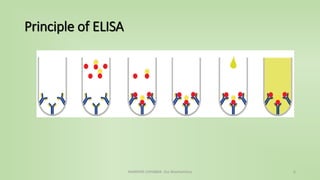
Principle of ELISA
• ELISA is based on the Immunochemical principles of Ag-Ab reaction.
• The specific interactions between specific antigens and antibodies are
used here to detect/ quantitate the specific components of a
biological fluid, using the enzyme labeled antibodies.
NAMRATA CHHABRA- Our Biochemistry 3
Principle of ELISA
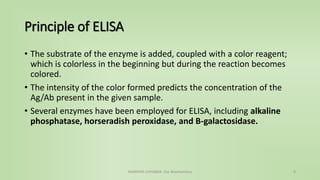
• The substrate of the enzyme is added, coupled with a color reagent;
which is colorless in the beginning but during the reaction becomes
colored.
• The intensity of the color formed predicts the concentration of the
Ag/Ab present in the given sample.
• Several enzymes have been employed for ELISA, including alkaline
phosphatase, horseradish peroxidase, and B-galactosidase.
NAMRATA CHHABRA- Our Biochemistry 4
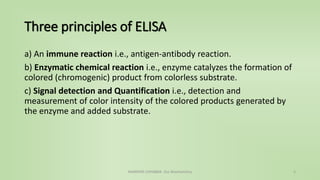
Three principles of ELISA
a) An immune reaction i.e., antigen-antibody reaction.
b) Enzymatic chemical reaction i.e., enzyme catalyzes the formation of
colored (chromogenic) product from colorless substrate.
c) Signal detection and Quantification i.e., detection and
measurement of color intensity of the colored products generated by
the enzyme and added substrate.
NAMRATA CHHABRA- Our Biochemistry 5
Principle of ELISA
NAMRATA CHHABRA- Our Biochemistry 6
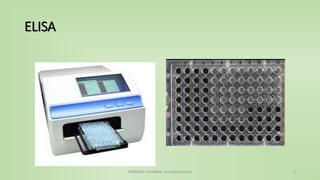
ELISA
NAMRATA CHHABRA- Our Biochemistry 7
Samples routinely used in ELISAs
• Serum,
• Plasma,
• Cell culture cell lysates,
• Saliva,
• Tissue lysates, and
• Urine.
NAMRATA CHHABRA- Our Biochemistry 8
Types of ELISA
There are 4 types of ELISA based on binding structure between the
Antibody and Antigen:
• Sandwich ELISA
• Direct ELISA
• Indirect ELISA
• Competitive ELISA
Each type of ELISA has its own advantages and disadvantages.
NAMRATA CHHABRA- Our Biochemistry 9
A) Sandwich ELISA (Antigen detection)
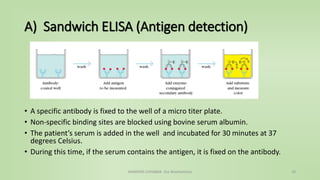
• A specific antibody is fixed to the well of a micro titer plate.
• Non-specific binding sites are blocked using bovine serum albumin.
• The patient’s serum is added in the well and incubated for 30 minutes at 37
degrees Celsius.
• During this time, if the serum contains the antigen, it is fixed on the antibody.
NAMRATA CHHABRA- Our Biochemistry 10
A) Sandwich ELISA (Antigen detection)
• Excess antigens and other unwanted proteins are washed out.
• Then antibodies tagged with horse radish peroxidase (HRP) enzyme
are added.
• If the antigen is already fixed, the Ab-HRP conjugate will be fixed in
the well.
• Then a coloring reagent, containing hydrogen peroxide (H2O2) and
diamino benzidine (DAB) are added.
NAMRATA CHHABRA- Our Biochemistry 11
A) Sandwich ELISA (Antigen detection)
• Development of brown color indicates that the antigen is originally
present in the patient’s serum.
• Color developed is proportional to the antigen in the serum.
• Therefore, intensity of the color is measured from which the
concentration of the antigen can be calculated.
• Other chromogens that can be used in ELISA are NBT (Nitro blue
tetrazolium-blue color) and NPP (Nitro phenyl phosphate-yellow
color).
NAMRATA CHHABRA- Our Biochemistry 12
Let’s revise
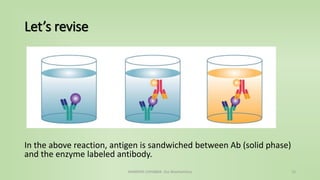
In the above reaction, antigen is sandwiched between Ab (solid phase)
and the enzyme labeled antibody.
NAMRATA CHHABRA- Our Biochemistry 13
Advantages of Sandwich ELISA
• High specificity because the antigen/analyte is specifically captured
and detected.
• Suitable for complex (or crude/impure) samples as the antigen does
not require purification prior to measurement.
• Flexible and sensitive,
NAMRATA CHHABRA- Our Biochemistry 14
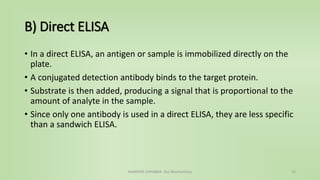
B) Direct ELISA
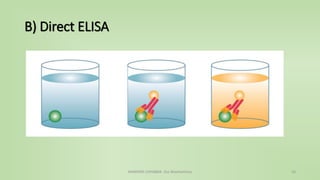
• In a direct ELISA, an antigen or sample is immobilized directly on the
plate.
• A conjugated detection antibody binds to the target protein.
• Substrate is then added, producing a signal that is proportional to the
amount of analyte in the sample.
• Since only one antibody is used in a direct ELISA, they are less specific
than a sandwich ELISA.
NAMRATA CHHABRA- Our Biochemistry 15
B) Direct ELISA
NAMRATA CHHABRA- Our Biochemistry 16
Advantages and Disadvantages of ELISA
Advantages:
Fast and simple protocol.
Disadvantages:
Less specific since only ONE antibody is used.
NAMRATA CHHABRA- Our Biochemistry 17
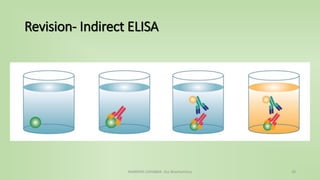
C) Indirect ELISA (Antibody detection)
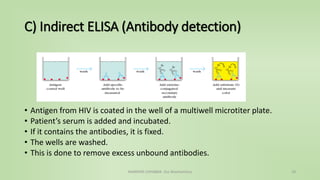
• Antigen from HIV is coated in the well of a multiwell microtiter plate.
• Patient’s serum is added and incubated.
• If it contains the antibodies, it is fixed.
• The wells are washed.
• This is done to remove excess unbound antibodies.
NAMRATA CHHABRA- Our Biochemistry 18
C) Indirect ELISA (Antibody detection)
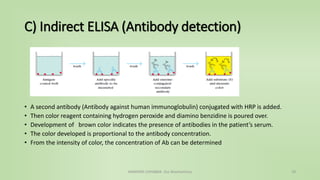
• A second antibody (Antibody against human immunoglobulin) conjugated with HRP is added.
• Then color reagent containing hydrogen peroxide and diamino benzidine is poured over.
• Development of brown color indicates the presence of antibodies in the patient’s serum.
• The color developed is proportional to the antibody concentration.
• From the intensity of color, the concentration of Ab can be determined
NAMRATA CHHABRA- Our Biochemistry 19
Revision- Indirect ELISA
NAMRATA CHHABRA- Our Biochemistry 20
Advantages Of Indirect ELISA
• Versatile because many primary antibodies can be made in one
species and the same labeled secondary antibody can be used for
detection.
• Maximum immunoreactivity of the primary antibody is retained
because it is not labeled.
• Sensitivity is increased because each primary antibody contains
several epitopes that can be bound by the labeled secondary antibody,
allowing for signal amplification.
NAMRATA CHHABRA- Our Biochemistry 21
Disadvantages
• Cross-reactivity might occur with the secondary antibody, resulting in
nonspecific signal.
• An extra incubation step is required in the procedure.
NAMRATA CHHABRA- Our Biochemistry 22
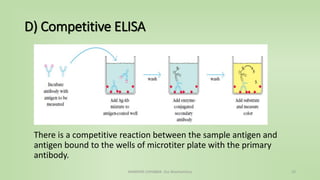
D) Competitive ELISA
There is a competitive reaction between the sample antigen and
antigen bound to the wells of microtiter plate with the primary
antibody.
NAMRATA CHHABRA- Our Biochemistry 23
D) Competitive ELISA
• First, the primary antibody is incubated with the sample.
• This results in the formation of Ag-Ab complexes which are then
added to the wells that have been coated with the same antigens.
• After an incubation, unbound antibodies are washed off.
• More the antigen in the sample, more primary antibody will bind to
the sample antigen.
NAMRATA CHHABRA- Our Biochemistry 24
D) Competitive ELISA
• Therefore, there will be smaller amount of primary antibody available
to bind to the antigen coated on well.
• Secondary antibody conjugated to an enzyme is added, followed by a
substrate to elicit a chromogenic signal.
• The intensity of color is inversely proportional to the amount of
antigen present in the sample.
NAMRATA CHHABRA- Our Biochemistry 25
D) Competitive ELISA
Advantages
Competitive ELISAs are commonly used for small molecules, when the
protein of interest is too small to efficiently sandwich with two antibodies. It
is highly sensitive even when the specific detecting antibody is present in
relatively small amounts.
Disadvantage
Less specific
NAMRATA CHHABRA- Our Biochemistry 26
Applications of ELISA
The ELISA techniques are widely used for-
1) Quantitative estimation of-
• Hormones
• Amino acids
• Growth factors
• Tumor markers and
• Other analytes which are present in very small concentration in
biological fluids
NAMRATA CHHABRA- Our Biochemistry 27
Applications of ELISA
2) Qualitative detection of-
• Bacterial or viral antigens
• Antibodies against microbes
• Any antigen, or antibody present in small concentration in the
biological fluid/tissues
NAMRATA CHHABRA- Our Biochemistry 28
Advantages of ELISA
• The test can be undertaken to detect antigens or antibodies present
in very small quantities in tissues or blood.
• It is highly economical and a sensitive method.
• An enzyme is used as a label, so it is non-isotopic immune assay.
• It is more sensitive than Radioimmuno Assay and there is no risk of
radiations hazards.
NAMRATA CHHABRA- Our Biochemistry 29
Thank you
NAMRATA CHHABRA- Our Biochemistry 30

ELISA- a quick revision

  • 1.
    Enzyme linked immunosorbent assay (ELISA)- a quick revision Namrata CHHABRA MHPE, FAIMER FELLOW, MD, MBBS NAMRATA CHHABRA- Our Biochemistry 1
  • 2.
    INTRODUCTION • Enzyme LinkedImmunosorbent Assay (ELISA) is a very sensitive immunochemical technique which is used to assess the presence and quantification of a specific protein (antigen or antibody) in the given sample. NAMRATA CHHABRA- Our Biochemistry 2
  • 3.
    Principle of ELISA •ELISA is based on the Immunochemical principles of Ag-Ab reaction. • The specific interactions between specific antigens and antibodies are used here to detect/ quantitate the specific components of a biological fluid, using the enzyme labeled antibodies. NAMRATA CHHABRA- Our Biochemistry 3
  • 4.
    Principle of ELISA •The substrate of the enzyme is added, coupled with a color reagent; which is colorless in the beginning but during the reaction becomes colored. • The intensity of the color formed predicts the concentration of the Ag/Ab present in the given sample. • Several enzymes have been employed for ELISA, including alkaline phosphatase, horseradish peroxidase, and B-galactosidase. NAMRATA CHHABRA- Our Biochemistry 4
  • 5.
    Three principles ofELISA a) An immune reaction i.e., antigen-antibody reaction. b) Enzymatic chemical reaction i.e., enzyme catalyzes the formation of colored (chromogenic) product from colorless substrate. c) Signal detection and Quantification i.e., detection and measurement of color intensity of the colored products generated by the enzyme and added substrate. NAMRATA CHHABRA- Our Biochemistry 5
  • 6.
    Principle of ELISA NAMRATACHHABRA- Our Biochemistry 6
  • 7.
  • 8.
    Samples routinely usedin ELISAs • Serum, • Plasma, • Cell culture cell lysates, • Saliva, • Tissue lysates, and • Urine. NAMRATA CHHABRA- Our Biochemistry 8
  • 9.
    Types of ELISA Thereare 4 types of ELISA based on binding structure between the Antibody and Antigen: • Sandwich ELISA • Direct ELISA • Indirect ELISA • Competitive ELISA Each type of ELISA has its own advantages and disadvantages. NAMRATA CHHABRA- Our Biochemistry 9
  • 10.
    A) Sandwich ELISA(Antigen detection) • A specific antibody is fixed to the well of a micro titer plate. • Non-specific binding sites are blocked using bovine serum albumin. • The patient’s serum is added in the well and incubated for 30 minutes at 37 degrees Celsius. • During this time, if the serum contains the antigen, it is fixed on the antibody. NAMRATA CHHABRA- Our Biochemistry 10
  • 11.
    A) Sandwich ELISA(Antigen detection) • Excess antigens and other unwanted proteins are washed out. • Then antibodies tagged with horse radish peroxidase (HRP) enzyme are added. • If the antigen is already fixed, the Ab-HRP conjugate will be fixed in the well. • Then a coloring reagent, containing hydrogen peroxide (H2O2) and diamino benzidine (DAB) are added. NAMRATA CHHABRA- Our Biochemistry 11
  • 12.
    A) Sandwich ELISA(Antigen detection) • Development of brown color indicates that the antigen is originally present in the patient’s serum. • Color developed is proportional to the antigen in the serum. • Therefore, intensity of the color is measured from which the concentration of the antigen can be calculated. • Other chromogens that can be used in ELISA are NBT (Nitro blue tetrazolium-blue color) and NPP (Nitro phenyl phosphate-yellow color). NAMRATA CHHABRA- Our Biochemistry 12
  • 13.
    Let’s revise In theabove reaction, antigen is sandwiched between Ab (solid phase) and the enzyme labeled antibody. NAMRATA CHHABRA- Our Biochemistry 13
  • 14.
    Advantages of SandwichELISA • High specificity because the antigen/analyte is specifically captured and detected. • Suitable for complex (or crude/impure) samples as the antigen does not require purification prior to measurement. • Flexible and sensitive, NAMRATA CHHABRA- Our Biochemistry 14
  • 15.
    B) Direct ELISA •In a direct ELISA, an antigen or sample is immobilized directly on the plate. • A conjugated detection antibody binds to the target protein. • Substrate is then added, producing a signal that is proportional to the amount of analyte in the sample. • Since only one antibody is used in a direct ELISA, they are less specific than a sandwich ELISA. NAMRATA CHHABRA- Our Biochemistry 15
  • 16.
    B) Direct ELISA NAMRATACHHABRA- Our Biochemistry 16
  • 17.
    Advantages and Disadvantagesof ELISA Advantages: Fast and simple protocol. Disadvantages: Less specific since only ONE antibody is used. NAMRATA CHHABRA- Our Biochemistry 17
  • 18.
    C) Indirect ELISA(Antibody detection) • Antigen from HIV is coated in the well of a multiwell microtiter plate. • Patient’s serum is added and incubated. • If it contains the antibodies, it is fixed. • The wells are washed. • This is done to remove excess unbound antibodies. NAMRATA CHHABRA- Our Biochemistry 18
  • 19.
    C) Indirect ELISA(Antibody detection) • A second antibody (Antibody against human immunoglobulin) conjugated with HRP is added. • Then color reagent containing hydrogen peroxide and diamino benzidine is poured over. • Development of brown color indicates the presence of antibodies in the patient’s serum. • The color developed is proportional to the antibody concentration. • From the intensity of color, the concentration of Ab can be determined NAMRATA CHHABRA- Our Biochemistry 19
  • 20.
    Revision- Indirect ELISA NAMRATACHHABRA- Our Biochemistry 20
  • 21.
    Advantages Of IndirectELISA • Versatile because many primary antibodies can be made in one species and the same labeled secondary antibody can be used for detection. • Maximum immunoreactivity of the primary antibody is retained because it is not labeled. • Sensitivity is increased because each primary antibody contains several epitopes that can be bound by the labeled secondary antibody, allowing for signal amplification. NAMRATA CHHABRA- Our Biochemistry 21
  • 22.
    Disadvantages • Cross-reactivity mightoccur with the secondary antibody, resulting in nonspecific signal. • An extra incubation step is required in the procedure. NAMRATA CHHABRA- Our Biochemistry 22
  • 23.
    D) Competitive ELISA Thereis a competitive reaction between the sample antigen and antigen bound to the wells of microtiter plate with the primary antibody. NAMRATA CHHABRA- Our Biochemistry 23
  • 24.
    D) Competitive ELISA •First, the primary antibody is incubated with the sample. • This results in the formation of Ag-Ab complexes which are then added to the wells that have been coated with the same antigens. • After an incubation, unbound antibodies are washed off. • More the antigen in the sample, more primary antibody will bind to the sample antigen. NAMRATA CHHABRA- Our Biochemistry 24
  • 25.
    D) Competitive ELISA •Therefore, there will be smaller amount of primary antibody available to bind to the antigen coated on well. • Secondary antibody conjugated to an enzyme is added, followed by a substrate to elicit a chromogenic signal. • The intensity of color is inversely proportional to the amount of antigen present in the sample. NAMRATA CHHABRA- Our Biochemistry 25
  • 26.
    D) Competitive ELISA Advantages CompetitiveELISAs are commonly used for small molecules, when the protein of interest is too small to efficiently sandwich with two antibodies. It is highly sensitive even when the specific detecting antibody is present in relatively small amounts. Disadvantage Less specific NAMRATA CHHABRA- Our Biochemistry 26
  • 27.
    Applications of ELISA TheELISA techniques are widely used for- 1) Quantitative estimation of- • Hormones • Amino acids • Growth factors • Tumor markers and • Other analytes which are present in very small concentration in biological fluids NAMRATA CHHABRA- Our Biochemistry 27
  • 28.
    Applications of ELISA 2)Qualitative detection of- • Bacterial or viral antigens • Antibodies against microbes • Any antigen, or antibody present in small concentration in the biological fluid/tissues NAMRATA CHHABRA- Our Biochemistry 28
  • 29.
    Advantages of ELISA •The test can be undertaken to detect antigens or antibodies present in very small quantities in tissues or blood. • It is highly economical and a sensitive method. • An enzyme is used as a label, so it is non-isotopic immune assay. • It is more sensitive than Radioimmuno Assay and there is no risk of radiations hazards. NAMRATA CHHABRA- Our Biochemistry 29
  • 30.
    Thank you NAMRATA CHHABRA-Our Biochemistry 30