DNA is the stuff our genes are made of…
 The organization of total sum of genetic information
  (or genome) of an organism is in the form of double-
  stranded DNA, except that viruses may have single-
  stranded DNA, single-stranded RNA or double-
  stranded RNA genomes.
 In many viruses and prokaryotes, the genome is a
  single linear or circular molecule.
 In eukaryotes, the nuclear genome consists of linear
  chromosomes (usually as a diploid set) and the
  mitochondrial and chloroplast (in plants) genomes
  are small circular DNA molecules.
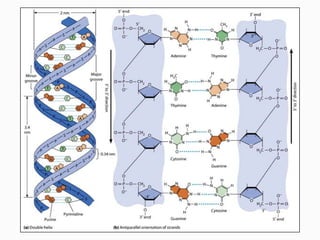
 In 1952, Watson and Crick proposed that DNA is a
  double helix which is known to have alternative
  forms.
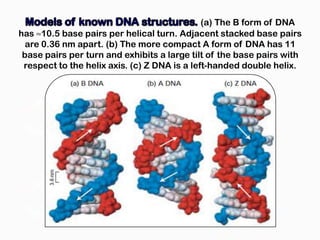
(a) The B form of DNA
has ≈10.5 base pairs per helical turn. Adjacent stacked base pairs
  are 0.36 nm apart. (b) The more compact A form of DNA has 11
 base pairs per turn and exhibits a large tilt of the base pairs with
 respect to the helix axis. (c) Z DNA is a left-handed double helix.
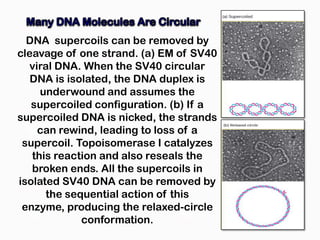
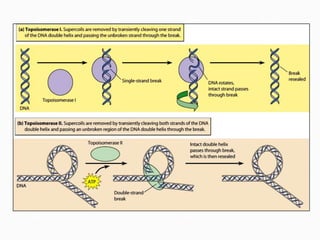
DNA supercoils can be removed by
cleavage of one strand. (a) EM of SV40
  viral DNA. When the SV40 circular
   DNA is isolated, the DNA duplex is
     underwound and assumes the
   supercoiled configuration. (b) If a
supercoiled DNA is nicked, the strands
    can rewind, leading to loss of a
 supercoil. Topoisomerase I catalyzes
   this reaction and also reseals the
   broken ends. All the supercoils in
isolated SV40 DNA can be removed by
      the sequential action of this
 enzyme, producing the relaxed-circle
             conformation.
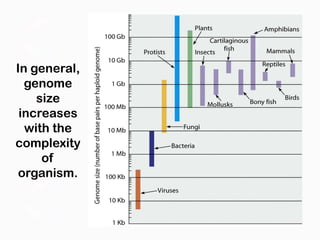
In general,
  genome
    size
 increases
  with the
complexity
     of
 organism.
1. Base stacking interactions - hydrophobic interactions resulting from
   the individual base pairs’ stacking on top of each other in the nonpolar
   interior of the double helix, electrostatic forces between nearest-
   neighbor base pairs, and from van der Waals forces between the
   bases.
2. Deoxyribose sugar- this is less reactive because of C-H bonds.
   Consequently, DNA has smaller grooves which hinder attachment of
   damaging enzymes that attack DNA.
3. Hydrogen bonds- the sum of all the H-bonds between the paired bases
   leads to a stabilizing "zipper effect.“
4. Protective "twisting" of the DNA helix and flexibility of the two strands
   - although the bases cannot rotate freely about the axis of their bonds
   with each other, they are able to rotate around their bonds with the
   sugars. This area of rotation is like a joint on a human arm. In
   DNA, there are several flexible bonds:
     a. bonds between oxygen and phosphorus in phosphate groups
     b. bonds linking the phosphate groups to the sugar rings
     c. bonds which link the sugar rings to the aromatic bases
5. Interaction with histones- chains of DNA become even more stable, as
   they entwine with histones. DNA ribbons coil around histones for
   protection, like a string on a spool.
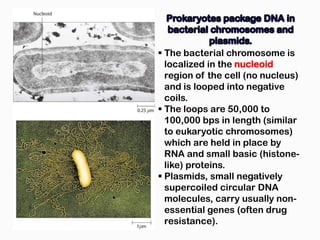
 The bacterial chromosome is
  localized in the nucleoid
  region of the cell (no nucleus)
  and is looped into negative
  coils.
 The loops are 50,000 to
  100,000 bps in length (similar
  to eukaryotic chromosomes)
  which are held in place by
  RNA and small basic (histone-
  like) proteins.
 Plasmids, small negatively
  supercoiled circular DNA
  molecules, carry usually non-
  essential genes (often drug
  resistance).
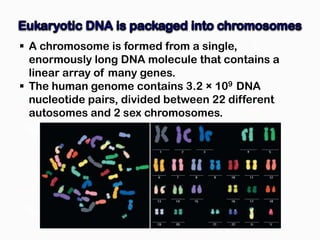
 A chromosome is formed from a single,
  enormously long DNA molecule that contains a
  linear array of many genes.
 The human genome contains 3.2 × 10⁹ DNA
  nucleotide pairs, divided between 22 different
  autosomes and 2 sex chromosomes.
Chromosomal banding patterns and multicolor FISH are
                used to analyze human anomalies
 Characteristic chromosomal translocations are associated with
certain genetic disorders and specific types of cancers. In nearly
  all patients with chronic myelogenous leukemia, the leukemic
     cells contain the Philadelphia chromosome, a shortened
chromosome 22 [der (22)], and an abnormally long chromosome
  9 [der (9)]. These result from a translocation between normal
                      chromosomes 9 and 22.
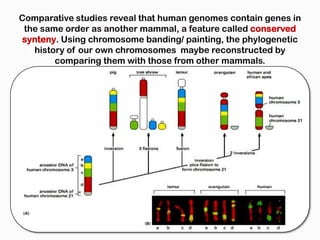
Comparative studies reveal that human genomes contain genes in
 the same order as another mammal, a feature called conserved
 synteny. Using chromosome banding/ painting, the phylogenetic
   history of our own chromosomes maybe reconstructed by
        comparing them with those from other mammals.
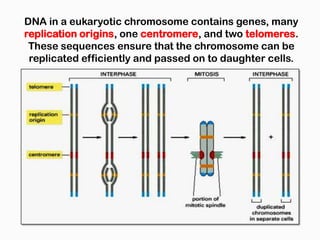
DNA in a eukaryotic chromosome contains genes, many
replication origins, one centromere, and two telomeres.
 These sequences ensure that the chromosome can be
 replicated efficiently and passed on to daughter cells.
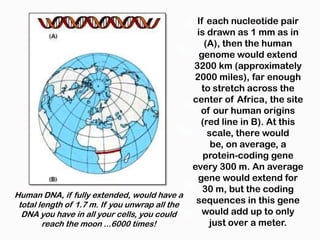
If each nucleotide pair
                                                 is drawn as 1 mm as in
                                                    (A), then the human
                                                  genome would extend
                                                3200 km (approximately
                                                2000 miles), far enough
                                                   to stretch across the
                                                center of Africa, the site
                                                  of our human origins
                                                  (red line in B). At this
                                                     scale, there would
                                                      be, on average, a
                                                   protein-coding gene
                                                every 300 m. An average
                                                 gene would extend for
                                                   30 m, but the coding
Human DNA, if fully extended, would have a
 total length of 1.7 m. If you unwrap all the    sequences in this gene
  DNA you have in all your cells, you could        would add up to only
        reach the moon ...6000 times!                just over a meter.
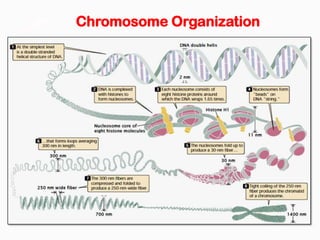
Chromosome Organization
 Interphase chromosomes contain both condensed
  and more extended forms of chromatin
    Constitutive heterochromatin - found in the
     centromere, nucleolar organizers (found in human
     chromosomes 13,14,15,21, and 22), repetitive or
     satellite DNA
    Facultative heterochromatin- one of the
     homologues become heterochromatic, e.g. X
     chromosome becomes Barr body
    Euchromatin – loosely packed, actively
     transcribed regions of the chromosome.
 Chromatin structure is dynamic: by temporarily
  altering its structure by using chromatin remodeling
  complexes and enzymes that modify histone tail, the
  cell can ensure that proteins involved in gene
  expression, replication, and repair have
  rapid, localized access to the necessary DNA
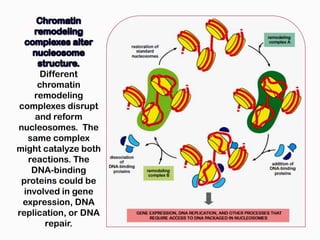
Different
      chromatin
     remodeling
complexes disrupt
     and reform
nucleosomes. The
   same complex
might catalyze both
   reactions. The
    DNA-binding
 proteins could be
  involved in gene
 expression, DNA
replication, or DNA
        repair.
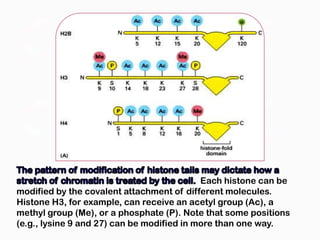
Each histone can be
modified by the covalent attachment of different molecules.
Histone H3, for example, can receive an acetyl group (Ac), a
methyl group (Me), or a phosphate (P). Note that some positions
(e.g., lysine 9 and 27) can be modified in more than one way.
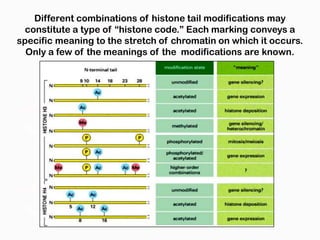
Different combinations of histone tail modifications may
  constitute a type of “histone code.” Each marking conveys a
specific meaning to the stretch of chromatin on which it occurs.
  Only a few of the meanings of the modifications are known.
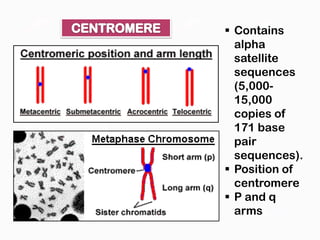
 Contains
  alpha
  satellite
  sequences
  (5,000-
  15,000
  copies of
  171 base
  pair
  sequences).
 Position of
  centromere
 P and q
  arms
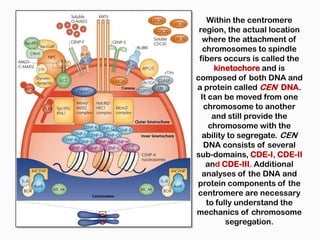
Within the centromere
 region, the actual location
  where the attachment of
   chromosomes to spindle
 fibers occurs is called the
      kinetochore and is
composed of both DNA and
a protein called CEN DNA.
  It can be moved from one
   chromosome to another
      and still provide the
     chromosome with the
  ability to segregate. CEN
   DNA consists of several
sub-domains, CDE-I, CDE-II
    and CDE-III. Additional
  analyses of the DNA and
protein components of the
centromere are necessary
    to fully understand the
mechanics of chromosome
          segregation.
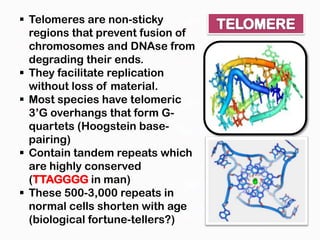
 Telomeres are non-sticky
  regions that prevent fusion of
  chromosomes and DNAse from
  degrading their ends.
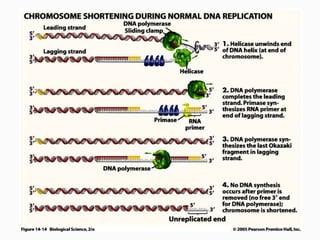
 They facilitate replication
  without loss of material.
 Most species have telomeric
  3’G overhangs that form G-
  quartets (Hoogstein base-
  pairing)
 Contain tandem repeats which
  are highly conserved
  (TTAGGGG in man)
 These 500-3,000 repeats in
  normal cells shorten with age
  (biological fortune-tellers?)
The stability of the T-
     loop is largely
   dependent on the
integrity of associated
   telomere-specific
  proteins called the
  shelterin complex.

   TRF (telomeric repeat-binding factor) 1 and TRF2 bind to the
    double-stranded segment of telomeric DNA. POT1 (protein
  protection of telomeres 1) binds directly to the single-stranded
    telomeric DNA and interacts directly with TPP1 (tripeptidyl
peptidase 1). Rap1 (repressor activator protein 1) binds TRF2, and
TIN2 (TRF1-interacting nuclear factor 2) is a central component of
        the complex interacting with TRF1, TRF2 and TPP1.
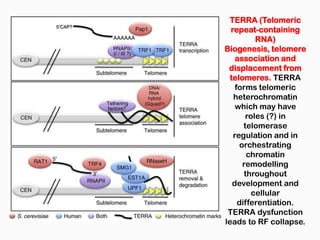
TERRA (Telomeric
  repeat-containing
           RNA)
Biogenesis, telomere
    association and
 displacement from
  telomeres. TERRA
    forms telomeric
   heterochromatin
    which may have
        roles (?) in
       telomerase
   regulation and in
      orchestrating
        chromatin
       remodelling
       throughout
   development and
          cellular
     differentiation.
 TERRA dysfunction
leads to RF collapse.
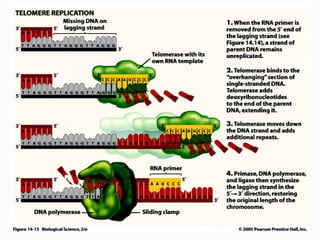
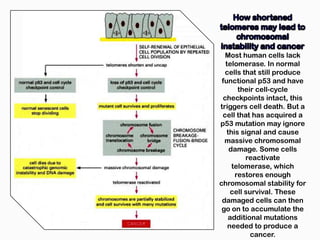
Most human cells lack
  telomerase. In normal
  cells that still produce
 functional p53 and have
       their cell-cycle
 checkpoints intact, this
triggers cell death. But a
 cell that has acquired a
p53 mutation may ignore
   this signal and cause
  massive chromosomal
    damage. Some cells
         reactivate
     telomerase, which
      restores enough
chromosomal stability for
    cell survival. These
 damaged cells can then
 go on to accumulate the
   additional mutations
   needed to produce a
           cancer.
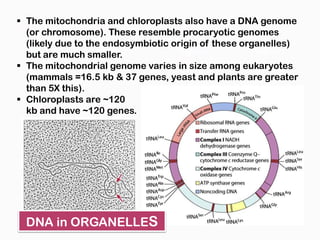
 The mitochondria and chloroplasts also have a DNA genome
  (or chromosome). These resemble procaryotic genomes
  (likely due to the endosymbiotic origin of these organelles)
  but are much smaller.
 The mitochondrial genome varies in size among eukaryotes
  (mammals =16.5 kb & 37 genes, yeast and plants are greater
  than 5X this).
 Chloroplasts are ~120
  kb and have ~120 genes.


  DNA in ORGANELLES
DNA Can Undergo Reversible Strand Separation
Denaturation or “melting,”(unwinding and separation
of DNA strands), can be induced by increasing the
temperature of a solution of DNA.
 Denaturation and renaturation of DNA are the basis
  of nucleic acid hybridization.
 Loss of the multiple weak interactions holding the
  strands together along the entire length of the DNA
  molecules lead to an abrupt change in the
  absorption of ultraviolet (UV) light.
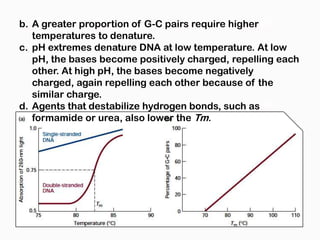
 The melting temperature (Tm ) at which DNA strands
  will separate depends on several factors:
   a. When the ion concentration is low, shielding of
       negatively charged phosphate groups in the two
       strands by positively charged ions is
       decreased, thus increasing the repulsive forces
       between the strands and reducing the Tm.
b. A greater proportion of G-C pairs require higher
   temperatures to denature.
c. pH extremes denature DNA at low temperature. At low
   pH, the bases become positively charged, repelling each
   other. At high pH, the bases become negatively
   charged, again repelling each other because of the
   similar charge.
d. Agents that destabilize hydrogen bonds, such as
   formamide or urea, also lower the Tm.
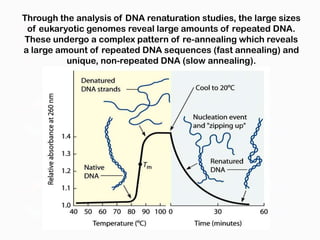
Through the analysis of DNA renaturation studies, the large sizes
 of eukaryotic genomes reveal large amounts of repeated DNA.
These undergo a complex pattern of re-annealing which reveals
a large amount of repeated DNA sequences (fast annealing) and
          unique, non-repeated DNA (slow annealing).
Dna and chromosomes

Dna and chromosomes

  • 2.
    DNA is thestuff our genes are made of…  The organization of total sum of genetic information (or genome) of an organism is in the form of double- stranded DNA, except that viruses may have single- stranded DNA, single-stranded RNA or double- stranded RNA genomes.  In many viruses and prokaryotes, the genome is a single linear or circular molecule.  In eukaryotes, the nuclear genome consists of linear chromosomes (usually as a diploid set) and the mitochondrial and chloroplast (in plants) genomes are small circular DNA molecules.  In 1952, Watson and Crick proposed that DNA is a double helix which is known to have alternative forms.
  • 4.
    (a) The Bform of DNA has ≈10.5 base pairs per helical turn. Adjacent stacked base pairs are 0.36 nm apart. (b) The more compact A form of DNA has 11 base pairs per turn and exhibits a large tilt of the base pairs with respect to the helix axis. (c) Z DNA is a left-handed double helix.
  • 5.
    DNA supercoils canbe removed by cleavage of one strand. (a) EM of SV40 viral DNA. When the SV40 circular DNA is isolated, the DNA duplex is underwound and assumes the supercoiled configuration. (b) If a supercoiled DNA is nicked, the strands can rewind, leading to loss of a supercoil. Topoisomerase I catalyzes this reaction and also reseals the broken ends. All the supercoils in isolated SV40 DNA can be removed by the sequential action of this enzyme, producing the relaxed-circle conformation.
  • 7.
    In general, genome size increases with the complexity of organism.
  • 8.
    1. Base stackinginteractions - hydrophobic interactions resulting from the individual base pairs’ stacking on top of each other in the nonpolar interior of the double helix, electrostatic forces between nearest- neighbor base pairs, and from van der Waals forces between the bases. 2. Deoxyribose sugar- this is less reactive because of C-H bonds. Consequently, DNA has smaller grooves which hinder attachment of damaging enzymes that attack DNA. 3. Hydrogen bonds- the sum of all the H-bonds between the paired bases leads to a stabilizing "zipper effect.“ 4. Protective "twisting" of the DNA helix and flexibility of the two strands - although the bases cannot rotate freely about the axis of their bonds with each other, they are able to rotate around their bonds with the sugars. This area of rotation is like a joint on a human arm. In DNA, there are several flexible bonds: a. bonds between oxygen and phosphorus in phosphate groups b. bonds linking the phosphate groups to the sugar rings c. bonds which link the sugar rings to the aromatic bases 5. Interaction with histones- chains of DNA become even more stable, as they entwine with histones. DNA ribbons coil around histones for protection, like a string on a spool.
  • 9.
     The bacterialchromosome is localized in the nucleoid region of the cell (no nucleus) and is looped into negative coils.  The loops are 50,000 to 100,000 bps in length (similar to eukaryotic chromosomes) which are held in place by RNA and small basic (histone- like) proteins.  Plasmids, small negatively supercoiled circular DNA molecules, carry usually non- essential genes (often drug resistance).
  • 10.
     A chromosomeis formed from a single, enormously long DNA molecule that contains a linear array of many genes.  The human genome contains 3.2 × 10⁹ DNA nucleotide pairs, divided between 22 different autosomes and 2 sex chromosomes.
  • 11.
    Chromosomal banding patternsand multicolor FISH are used to analyze human anomalies Characteristic chromosomal translocations are associated with certain genetic disorders and specific types of cancers. In nearly all patients with chronic myelogenous leukemia, the leukemic cells contain the Philadelphia chromosome, a shortened chromosome 22 [der (22)], and an abnormally long chromosome 9 [der (9)]. These result from a translocation between normal chromosomes 9 and 22.
  • 12.
    Comparative studies revealthat human genomes contain genes in the same order as another mammal, a feature called conserved synteny. Using chromosome banding/ painting, the phylogenetic history of our own chromosomes maybe reconstructed by comparing them with those from other mammals.
  • 13.
    DNA in aeukaryotic chromosome contains genes, many replication origins, one centromere, and two telomeres. These sequences ensure that the chromosome can be replicated efficiently and passed on to daughter cells.
  • 14.
    If each nucleotidepair is drawn as 1 mm as in (A), then the human genome would extend 3200 km (approximately 2000 miles), far enough to stretch across the center of Africa, the site of our human origins (red line in B). At this scale, there would be, on average, a protein-coding gene every 300 m. An average gene would extend for 30 m, but the coding Human DNA, if fully extended, would have a total length of 1.7 m. If you unwrap all the sequences in this gene DNA you have in all your cells, you could would add up to only reach the moon ...6000 times! just over a meter.
  • 15.
  • 17.
     Interphase chromosomescontain both condensed and more extended forms of chromatin  Constitutive heterochromatin - found in the centromere, nucleolar organizers (found in human chromosomes 13,14,15,21, and 22), repetitive or satellite DNA  Facultative heterochromatin- one of the homologues become heterochromatic, e.g. X chromosome becomes Barr body  Euchromatin – loosely packed, actively transcribed regions of the chromosome.  Chromatin structure is dynamic: by temporarily altering its structure by using chromatin remodeling complexes and enzymes that modify histone tail, the cell can ensure that proteins involved in gene expression, replication, and repair have rapid, localized access to the necessary DNA
  • 18.
    Different chromatin remodeling complexes disrupt and reform nucleosomes. The same complex might catalyze both reactions. The DNA-binding proteins could be involved in gene expression, DNA replication, or DNA repair.
  • 19.
    Each histone canbe modified by the covalent attachment of different molecules. Histone H3, for example, can receive an acetyl group (Ac), a methyl group (Me), or a phosphate (P). Note that some positions (e.g., lysine 9 and 27) can be modified in more than one way.
  • 20.
    Different combinations ofhistone tail modifications may constitute a type of “histone code.” Each marking conveys a specific meaning to the stretch of chromatin on which it occurs. Only a few of the meanings of the modifications are known.
  • 21.
     Contains alpha satellite sequences (5,000- 15,000 copies of 171 base pair sequences).  Position of centromere  P and q arms
  • 22.
    Within the centromere region, the actual location where the attachment of chromosomes to spindle fibers occurs is called the kinetochore and is composed of both DNA and a protein called CEN DNA. It can be moved from one chromosome to another and still provide the chromosome with the ability to segregate. CEN DNA consists of several sub-domains, CDE-I, CDE-II and CDE-III. Additional analyses of the DNA and protein components of the centromere are necessary to fully understand the mechanics of chromosome segregation.
  • 23.
     Telomeres arenon-sticky regions that prevent fusion of chromosomes and DNAse from degrading their ends.  They facilitate replication without loss of material.  Most species have telomeric 3’G overhangs that form G- quartets (Hoogstein base- pairing)  Contain tandem repeats which are highly conserved (TTAGGGG in man)  These 500-3,000 repeats in normal cells shorten with age (biological fortune-tellers?)
  • 26.
    The stability ofthe T- loop is largely dependent on the integrity of associated telomere-specific proteins called the shelterin complex. TRF (telomeric repeat-binding factor) 1 and TRF2 bind to the double-stranded segment of telomeric DNA. POT1 (protein protection of telomeres 1) binds directly to the single-stranded telomeric DNA and interacts directly with TPP1 (tripeptidyl peptidase 1). Rap1 (repressor activator protein 1) binds TRF2, and TIN2 (TRF1-interacting nuclear factor 2) is a central component of the complex interacting with TRF1, TRF2 and TPP1.
  • 27.
    TERRA (Telomeric repeat-containing RNA) Biogenesis, telomere association and displacement from telomeres. TERRA forms telomeric heterochromatin which may have roles (?) in telomerase regulation and in orchestrating chromatin remodelling throughout development and cellular differentiation. TERRA dysfunction leads to RF collapse.
  • 28.
    Most human cellslack telomerase. In normal cells that still produce functional p53 and have their cell-cycle checkpoints intact, this triggers cell death. But a cell that has acquired a p53 mutation may ignore this signal and cause massive chromosomal damage. Some cells reactivate telomerase, which restores enough chromosomal stability for cell survival. These damaged cells can then go on to accumulate the additional mutations needed to produce a cancer.
  • 29.
     The mitochondriaand chloroplasts also have a DNA genome (or chromosome). These resemble procaryotic genomes (likely due to the endosymbiotic origin of these organelles) but are much smaller.  The mitochondrial genome varies in size among eukaryotes (mammals =16.5 kb & 37 genes, yeast and plants are greater than 5X this).  Chloroplasts are ~120 kb and have ~120 genes. DNA in ORGANELLES
  • 30.
    DNA Can UndergoReversible Strand Separation Denaturation or “melting,”(unwinding and separation of DNA strands), can be induced by increasing the temperature of a solution of DNA.  Denaturation and renaturation of DNA are the basis of nucleic acid hybridization.  Loss of the multiple weak interactions holding the strands together along the entire length of the DNA molecules lead to an abrupt change in the absorption of ultraviolet (UV) light.  The melting temperature (Tm ) at which DNA strands will separate depends on several factors: a. When the ion concentration is low, shielding of negatively charged phosphate groups in the two strands by positively charged ions is decreased, thus increasing the repulsive forces between the strands and reducing the Tm.
  • 31.
    b. A greaterproportion of G-C pairs require higher temperatures to denature. c. pH extremes denature DNA at low temperature. At low pH, the bases become positively charged, repelling each other. At high pH, the bases become negatively charged, again repelling each other because of the similar charge. d. Agents that destabilize hydrogen bonds, such as formamide or urea, also lower the Tm.
  • 32.
    Through the analysisof DNA renaturation studies, the large sizes of eukaryotic genomes reveal large amounts of repeated DNA. These undergo a complex pattern of re-annealing which reveals a large amount of repeated DNA sequences (fast annealing) and unique, non-repeated DNA (slow annealing).

Editor's Notes

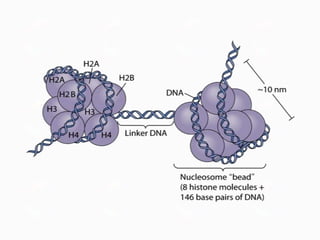
  • #16 A NUCLEOSOME(11 nm fiber) is composed of histoneoctamer (2 each of H2A, H2B, H3, H4) around which is wound 176 DNA base pairs; nucleosomes are linked to each other by H1Larger fibers made of nucleosome groups are called SOLENOIDS (30 nm fiber)