DNA structure determination
10/10/0533
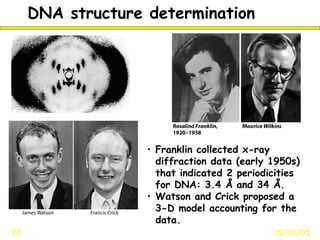
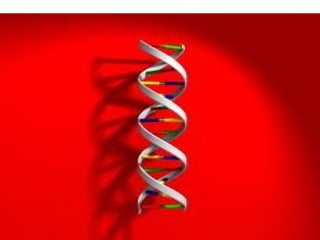
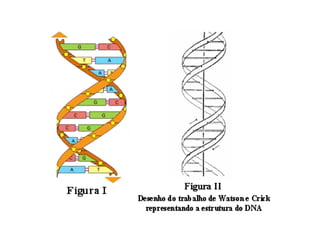
• Franklin collected x-ray
diffraction data (early 1950s)
that indicated 2 periodicities
for DNA: 3.4 Å and 34 Å.
• Watson and Crick proposed a
3-D model accounting for the
data.
CELL STRUCTURE AND
BIOMOLECULES
Molecular biology- Energy based flow of
information from DNA to RNA to
proteins and enzymes i.e. from Hypo
pituitary access to hormones to
homeostatic etc.
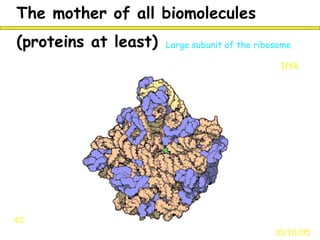
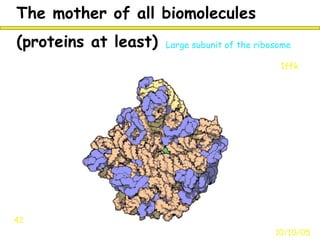
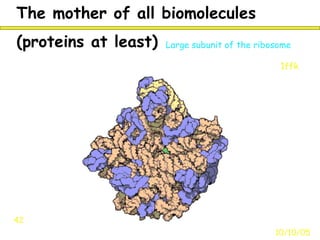
The mother of all biomolecules
10/10/05
42
1ffk
Large subunit of the ribosome(proteins at least)
Chromatin Structure
INACTIVE &ACTIVE CHROMATIN
• Active (transcriptionally active)differ
from from inactive region.
• DNA in active region contain large
regions(100,000bp)prone to digestion by
Dnase- I (single strand cut)
MAJOR AND MINOR
GROOVES
• MINOR
– EXPOSES EDGE FROM WHICH C1’ ATOMS
EXTEND
• MAJOR
– EXPOSES OPPOSITE EDGE OF BASE PAIR
• THE PATTERN OF H-BOND POSSIBILITIES IS
MORE SPECIFIC AND MORE
DISCRIMINATING IN THE MAJOR GROOVE
DNA structure
10/10/05
34
Fig. 8-15
•DNA consists of two
helical chains wound
around the same axis in
a right-handed fashion
aligned in an antiparallel
fashion.
• There are 10.5 base pairs,
or 36 Å, per turn of the
helix.
• Alternating deoxyribose and
phosphate groups on the
backbone form the outside
of the helix.
• The planar purine and
pyrimidine bases of both
strands are stacked inside
the helix.
Much of Genome is not
TRANSCRIBED
• The entire human haploid
genome contain sufficent DNA to
code for app. 1.5 million genes.
• Human genome encodes less
than 100,000 proteins ie 1% of
human genome.
• 24% of genome as Introns
More than half DNA of Eukaryotic is
non Repetitive Sequences.
• In humans 10,000 to 15000 . genes are
expressed.
• Different combination of genes are
expressed in each tissue,of course and
how this is accomplished in one of the
major unanswered question in biology.
30% of Human Genome has
Repetitive sequences
• A.Highly repetitive: 5-500 bp length
repeated many times.(these seq. are
transcriptionaly inactive)may play role in
structure of ch.
• B. Moderately repetitive: 106
copies
per haploid genome are not clustered but
are interspred with unique seq.
• C. Microsatelite repeat seqs.2-6bp
repeated up to 50 times(AC=TG)AC
repeat seqs. Are50000-100000 locations
in genome.
TELOMERE
• The ends of each chromosome
contains structures called TELOMERES
• Telomere consist of short repeat TG
sequences.(5’-TTAGGG-3’)can run for
kb.
• TELOMERASE ( RNA+RNA dependent
DNA polymerasesor{ Reverse
transcriptase} is responsible for
telomere synthesis) & maintains length
of telomere.
Cont………………………….
• Genome of Prokaryotes are
circular.human &Eukaryotes is linear as
result the lagging strand has incomplete
51 end. Each round of replication would
shorten the chromosome.Telo=End.
• How are repeated sequences generated
the enzyme TELOMERASE performs this
function.
• The protein component of
telomerases,hence it acts as reverse
transcriptase.that carries its own template.
• Telomerase levels are raised in cancer
cells.
DNA
• Two helical polynucleotide chains
are coiled around a common axis.
• The chains run in opposite
directions.(Template and Coding)
• Sugar-Phosphate backbones are
on the outer side and Purine
&Pyrimidene bases lie on the
inside of helix.
• The bases are prepandicular to the
helix axis. (10 bases per turn of
Helix)
• Diameter of helix is 20 Ao.
Cont………………………..
• In between large regions there
are shorter streches (100-
300)which are more sensative
to Dnase-I These sites provides
a sight for transcription.
(euchromatin)
• Transcriptionally inactive ch. Is
densly packed.
(Hetrochromatin)
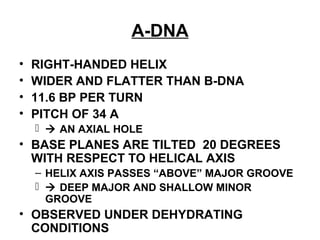
A-DNA
• RIGHT-HANDED HELIX
• WIDER AND FLATTER THAN B-DNA
• 11.6 BP PER TURN
• PITCH OF 34 A
  AN AXIAL HOLE
• BASE PLANES ARE TILTED 20 DEGREES
WITH RESPECT TO HELICAL AXIS
– HELIX AXIS PASSES “ABOVE” MAJOR GROOVE
  DEEP MAJOR AND SHALLOW MINOR
GROOVE
• OBSERVED UNDER DEHYDRATING
CONDITIONS
B-DNA
• B-DNA Right handed double helix.
• Supercoils store energy.
• Supercoiled DNA is prefered form.
• DNA of E.coli is1.4mm, 4.7million
bp.
• Eukaryotes contain more than ten
times of DNA as compaired to
prok.
Z-DNA
• A LEFT-HANDED HELIX
• SEEN IN CONDITIONS OF HIGH SALT
CONCENTRATIONS
– REDUCES REPULSIONS BETWEEN CLOSEST
PHOSPHATE GROUPS ON OPPOSITE
STRANDS (8 A VS 12 A IN B-DNA)
• IN COMPLEMENTARY POLYNUCLEOTIDES WITH
ALTERNATING PURINES AND PYRIMIDINES
– POLY d(GC) · POLY d(GC)
– POLY d(AC) ⋅ POLY d(GT)
• MIGHT ALSO BE SEEN IN DNA SEGMENTS WITH
ABOVE CHARACTERISTICS
B,A and Z DNA
10/10/0538
Fig. 8-19
• B form - The most common
conformation for DNA.
• A form - common for RNA
because of different sugar
pucker. Deeper minor groove,
shallow major groove
• A form is favored in conditions
of low water.
• Z form - narrow, deep minor
groove. Major groove hardly
existent. Can form for some
DNA sequences; requires
alternating syn and anti base
configurations.
36 base pairs
Backbone - blue;
Bases- gray
DNA strands
10/10/05
37
Fig. 8-16
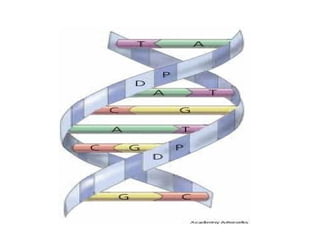
• The antiparallel strands of DNA
are not identical, but are
complementary.
• This means that they are
positioned to align complementary
base pairs: C with G, and A with
T.
• So you can predict the sequence
of one strand given the sequence
of its complement.
• Useful for information storage
and transfer!
• Note sequence conventionally is
given from the 5' to 3' end
Discovering the structure of DNA
• DNA = Deoxyribose nucleic acid
• Made out of sugars (deoxyribose), phosphates
and nitrogen bases
Difference between
DNA and RNA
• Sugar: DNA;deoxyribose.
• RNA; Ribose.
• DNA: A,T,G,C.: RNA;A,U,G,C.
• DNA Double,RNA single stranded.
• DNA A=T,G=C, RNA; U=A,,G=C not.
• RNA can be hydrolysed by
Alkali,DNA not.
HISTONES:
• H1
• H2A
• H2B
• H3
• H4
Acetylation linked with replication,H1
with condensation,DNA
repair,transcription
repression,methylation of histones
activation and repression of gene.
HISTONES
• Most abundant basic chr.protein.
• H1Loosly bound to chr,&not not
necessary,but adjecent nucleosome
is joined by H1, nucleosome
• Nucleosome contain four types of
histones.H2A,H2B,H3 and H4
• Function identical in all eukaryotes.
• Four core Histones are subject to 6
types of covalent modifications
HISTONES
• Acetylation,Methylation,Phosphory
lation,ADP-
ribosylation,monoubiquitylation
and Sumoylation.
• H3,H4 form tetramer
• h2A &H2B form Dimer.Under
physiologic conditions
olig.associate & form octamer.
• The amino tail(His) is available co-
valent modifications
• One octamer has 1.75 turns of DNA
(146bp)
The mother of all biomolecules
10/10/05
42
1ffk
Large subunit of the ribosome(proteins at least)
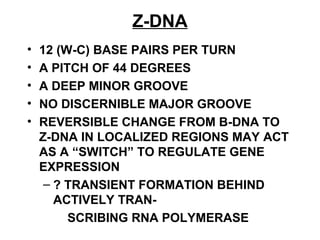
Z-DNA
• 12 (W-C) BASE PAIRS PER TURN
• A PITCH OF 44 DEGREES
• A DEEP MINOR GROOVE
• NO DISCERNIBLE MAJOR GROOVE
• REVERSIBLE CHANGE FROM B-DNA TO
Z-DNA IN LOCALIZED REGIONS MAY ACT
AS A “SWITCH” TO REGULATE GENE
EXPRESSION
– ? TRANSIENT FORMATION BEHIND
ACTIVELY TRAN-
SCRIBING RNA POLYMERASE
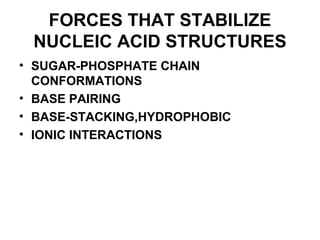
FORCES THAT STABILIZE
NUCLEIC ACID STRUCTURES
• SUGAR-PHOSPHATE CHAIN
CONFORMATIONS
• BASE PAIRING
• BASE-STACKING,HYDROPHOBIC
• IONIC INTERACTIONS
DNA TOPOLOGY
• THE TOPOLOGICAL PROPERTIES OF DNA HELP US
TO EXPLAIN
• DNA COMPACTING IN THE NUCLEUS
• UNWINDING OF DNA AT THE REPLICATION FORK
• FORMATION AND MAINTENANCE OF THE
TRANSCRIPTION BUBBLE
• MANAGING THE SUPERCOILING IN THE
ADVANCING TRANSCRIPTION BUBBLE
mRNA (messenger RNA)
• mRNA is synthasized from DNA by
enzyme RNA Polymerase.
• Introns and Exons.(Hetrogenous
hnRNA)
• Most hetrogenous,highly elongated
and short lived.
• Has 5’—3’ polarity complimentary to
coding strand.
• For protein synthesis.
• Stable in Euk. Unstable in Pro.
tRNA (Transfer RNA)
• Much smaller in size (75-90
ribonucleotide)Clover leaf shaped.
• 15% of total cellular RNA.
• 20 species of tRNA.
• It acts as adaptor molecule.
• 40 different tRNA.
• Five arms of tRNA: 1:D-Arm; 2:TUC-
Arm 3: CCA Arm(Acceptor) 4:
Anticodon Arm 5: Variable Arm or
Extra Arm (determine Sp.).
tRNA
• Amino Acid acceptor arm 7 base pair
stem
• 5’—3’ CCA.Links Amino Acid.AA are
linked co-valently to corresponding
tRNA by enz.AAtRNA Synthetase.
• Anticodon Arm Has 5-bp loop and
triplet nucleotide
sequence(anticodon) complimentary
to codon.
• DHU arm .3-4 base pairs.
• TUC arm stem has 5 bp.
RIBOSOMAL RNA
• Are present in Ribosomes in
association with many polypeptides.
• 80 % of total cellular RNA.
• Very complex in Euc. Two sub-units
(60S)and (40S)
• Protein Synthesis.
• Larger unit has 3 RNA ie 5S,5.8S,28S
with 50 polypeptides.
• Smaller subunit has 18S and 30
polypeptides.
MITOCHONDRIAL DNA
• 54 out of 67 genes are coded by
nuclear genes,rest are coded by
Mitochondria.(mt)
• It form 1% of total cellular DNA.
• It codes 13 proteins that play key role
in the respiratory chain.
Features of mtDNA
• Circular,double stranded
• Contains 16,569 bp
• Encodes 13 protein subunits.
• Encodes 22 mt. tRNA molecules.
• Encodes(16s) and a small (12s)mt rRNA
• Very few untranslated sequences.
• High mutation rate (5-10 times to nucl.)
• M for M (Maternaly inherited Mitochondria)
Discovering the structure of DNA
• DNA = Deoxyribose nucleic acid
• Made out of sugars (deoxyribose), phosphates
and nitrogen bases
The mother of all biomolecules
10/10/05
42
1ffk
Large subunit of the ribosome(proteins at least)
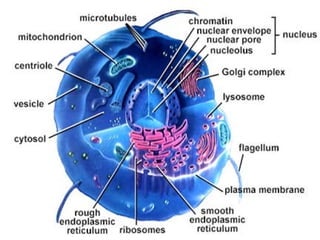
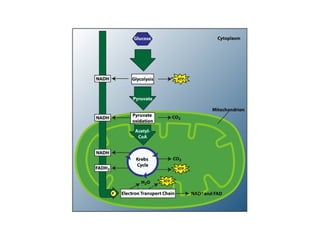
• Mitochondria
Function- ATP synthase, fatty acid oxidation, Krebs cycle, cytosolic
Ca2+
regulation.
Marker- Succinate dehydrogenase, glutamate dehydrogenase.
Redox potential of some redox system
Redox system Eo`(volt)
NADH/NAD+
-0.32
Succinate/Fumarate -0.32
FADH2/FAD 0.0
Coenzyme Q.H2/CoQ 0.10
Cytochrome b (Fe2+
/Fe 3+
) 0.12
Cytochrome c1 (Fe2+
/Fe 3+
) 0.22
Cytochrome a (Fe2+
/Fe 3+
) 0.29
Cytochrome a3 (Fe2+
/Fe 3+
) 0.39
HO2/1/2
O2 0.82
• Endoplasm reticulum (2 type RER & SER)
Function- Production of excretory proteins, glycosylation, drug
metabolism.
Marker- Glucose-6-phosphatase.
• Golgi complex
Function- Synthesis of lipoprotein, formation of lysosomes, secretion
of proteins.
Marker- Galactosyle transferase, Fucosyle transferase.
• Peroxisomes
Function- Fatty acid oxidation, detoxification of H2O2.
Marker- Catalase, uric acid oxidase.
• Lysosomes
Function- Intracellular digestion and detoxification.
Marker- Acid phosphatase.
Dna rna-13
Dna rna-13
Dna rna-13
Dna rna-13
Dna rna-13

Dna rna-13

  • 1.
    DNA structure determination 10/10/0533 •Franklin collected x-ray diffraction data (early 1950s) that indicated 2 periodicities for DNA: 3.4 Å and 34 Å. • Watson and Crick proposed a 3-D model accounting for the data.
  • 2.
    CELL STRUCTURE AND BIOMOLECULES Molecularbiology- Energy based flow of information from DNA to RNA to proteins and enzymes i.e. from Hypo pituitary access to hormones to homeostatic etc.
  • 3.
    The mother ofall biomolecules 10/10/05 42 1ffk Large subunit of the ribosome(proteins at least)
  • 7.
  • 8.
    INACTIVE &ACTIVE CHROMATIN •Active (transcriptionally active)differ from from inactive region. • DNA in active region contain large regions(100,000bp)prone to digestion by Dnase- I (single strand cut)
  • 9.
    MAJOR AND MINOR GROOVES •MINOR – EXPOSES EDGE FROM WHICH C1’ ATOMS EXTEND • MAJOR – EXPOSES OPPOSITE EDGE OF BASE PAIR • THE PATTERN OF H-BOND POSSIBILITIES IS MORE SPECIFIC AND MORE DISCRIMINATING IN THE MAJOR GROOVE
  • 11.
    DNA structure 10/10/05 34 Fig. 8-15 •DNAconsists of two helical chains wound around the same axis in a right-handed fashion aligned in an antiparallel fashion. • There are 10.5 base pairs, or 36 Å, per turn of the helix. • Alternating deoxyribose and phosphate groups on the backbone form the outside of the helix. • The planar purine and pyrimidine bases of both strands are stacked inside the helix.
  • 13.
    Much of Genomeis not TRANSCRIBED • The entire human haploid genome contain sufficent DNA to code for app. 1.5 million genes. • Human genome encodes less than 100,000 proteins ie 1% of human genome. • 24% of genome as Introns
  • 14.
    More than halfDNA of Eukaryotic is non Repetitive Sequences. • In humans 10,000 to 15000 . genes are expressed. • Different combination of genes are expressed in each tissue,of course and how this is accomplished in one of the major unanswered question in biology.
  • 15.
    30% of HumanGenome has Repetitive sequences • A.Highly repetitive: 5-500 bp length repeated many times.(these seq. are transcriptionaly inactive)may play role in structure of ch. • B. Moderately repetitive: 106 copies per haploid genome are not clustered but are interspred with unique seq. • C. Microsatelite repeat seqs.2-6bp repeated up to 50 times(AC=TG)AC repeat seqs. Are50000-100000 locations in genome.
  • 16.
    TELOMERE • The endsof each chromosome contains structures called TELOMERES • Telomere consist of short repeat TG sequences.(5’-TTAGGG-3’)can run for kb. • TELOMERASE ( RNA+RNA dependent DNA polymerasesor{ Reverse transcriptase} is responsible for telomere synthesis) & maintains length of telomere.
  • 17.
    Cont…………………………. • Genome ofProkaryotes are circular.human &Eukaryotes is linear as result the lagging strand has incomplete 51 end. Each round of replication would shorten the chromosome.Telo=End. • How are repeated sequences generated the enzyme TELOMERASE performs this function. • The protein component of telomerases,hence it acts as reverse transcriptase.that carries its own template. • Telomerase levels are raised in cancer cells.
  • 18.
    DNA • Two helicalpolynucleotide chains are coiled around a common axis. • The chains run in opposite directions.(Template and Coding) • Sugar-Phosphate backbones are on the outer side and Purine &Pyrimidene bases lie on the inside of helix. • The bases are prepandicular to the helix axis. (10 bases per turn of Helix) • Diameter of helix is 20 Ao.
  • 19.
    Cont……………………….. • In betweenlarge regions there are shorter streches (100- 300)which are more sensative to Dnase-I These sites provides a sight for transcription. (euchromatin) • Transcriptionally inactive ch. Is densly packed. (Hetrochromatin)
  • 20.
    A-DNA • RIGHT-HANDED HELIX •WIDER AND FLATTER THAN B-DNA • 11.6 BP PER TURN • PITCH OF 34 A   AN AXIAL HOLE • BASE PLANES ARE TILTED 20 DEGREES WITH RESPECT TO HELICAL AXIS – HELIX AXIS PASSES “ABOVE” MAJOR GROOVE   DEEP MAJOR AND SHALLOW MINOR GROOVE • OBSERVED UNDER DEHYDRATING CONDITIONS
  • 21.
    B-DNA • B-DNA Righthanded double helix. • Supercoils store energy. • Supercoiled DNA is prefered form. • DNA of E.coli is1.4mm, 4.7million bp. • Eukaryotes contain more than ten times of DNA as compaired to prok.
  • 22.
    Z-DNA • A LEFT-HANDEDHELIX • SEEN IN CONDITIONS OF HIGH SALT CONCENTRATIONS – REDUCES REPULSIONS BETWEEN CLOSEST PHOSPHATE GROUPS ON OPPOSITE STRANDS (8 A VS 12 A IN B-DNA) • IN COMPLEMENTARY POLYNUCLEOTIDES WITH ALTERNATING PURINES AND PYRIMIDINES – POLY d(GC) · POLY d(GC) – POLY d(AC) ⋅ POLY d(GT) • MIGHT ALSO BE SEEN IN DNA SEGMENTS WITH ABOVE CHARACTERISTICS
  • 23.
    B,A and ZDNA 10/10/0538 Fig. 8-19 • B form - The most common conformation for DNA. • A form - common for RNA because of different sugar pucker. Deeper minor groove, shallow major groove • A form is favored in conditions of low water. • Z form - narrow, deep minor groove. Major groove hardly existent. Can form for some DNA sequences; requires alternating syn and anti base configurations. 36 base pairs Backbone - blue; Bases- gray
  • 24.
    DNA strands 10/10/05 37 Fig. 8-16 •The antiparallel strands of DNA are not identical, but are complementary. • This means that they are positioned to align complementary base pairs: C with G, and A with T. • So you can predict the sequence of one strand given the sequence of its complement. • Useful for information storage and transfer! • Note sequence conventionally is given from the 5' to 3' end
  • 25.
    Discovering the structureof DNA • DNA = Deoxyribose nucleic acid • Made out of sugars (deoxyribose), phosphates and nitrogen bases
  • 26.
    Difference between DNA andRNA • Sugar: DNA;deoxyribose. • RNA; Ribose. • DNA: A,T,G,C.: RNA;A,U,G,C. • DNA Double,RNA single stranded. • DNA A=T,G=C, RNA; U=A,,G=C not. • RNA can be hydrolysed by Alkali,DNA not.
  • 27.
    HISTONES: • H1 • H2A •H2B • H3 • H4 Acetylation linked with replication,H1 with condensation,DNA repair,transcription repression,methylation of histones activation and repression of gene.
  • 30.
    HISTONES • Most abundantbasic chr.protein. • H1Loosly bound to chr,&not not necessary,but adjecent nucleosome is joined by H1, nucleosome • Nucleosome contain four types of histones.H2A,H2B,H3 and H4 • Function identical in all eukaryotes. • Four core Histones are subject to 6 types of covalent modifications
  • 31.
    HISTONES • Acetylation,Methylation,Phosphory lation,ADP- ribosylation,monoubiquitylation and Sumoylation. •H3,H4 form tetramer • h2A &H2B form Dimer.Under physiologic conditions olig.associate & form octamer. • The amino tail(His) is available co- valent modifications • One octamer has 1.75 turns of DNA (146bp)
  • 32.
    The mother ofall biomolecules 10/10/05 42 1ffk Large subunit of the ribosome(proteins at least)
  • 33.
    Z-DNA • 12 (W-C)BASE PAIRS PER TURN • A PITCH OF 44 DEGREES • A DEEP MINOR GROOVE • NO DISCERNIBLE MAJOR GROOVE • REVERSIBLE CHANGE FROM B-DNA TO Z-DNA IN LOCALIZED REGIONS MAY ACT AS A “SWITCH” TO REGULATE GENE EXPRESSION – ? TRANSIENT FORMATION BEHIND ACTIVELY TRAN- SCRIBING RNA POLYMERASE
  • 34.
    FORCES THAT STABILIZE NUCLEICACID STRUCTURES • SUGAR-PHOSPHATE CHAIN CONFORMATIONS • BASE PAIRING • BASE-STACKING,HYDROPHOBIC • IONIC INTERACTIONS
  • 35.
    DNA TOPOLOGY • THETOPOLOGICAL PROPERTIES OF DNA HELP US TO EXPLAIN • DNA COMPACTING IN THE NUCLEUS • UNWINDING OF DNA AT THE REPLICATION FORK • FORMATION AND MAINTENANCE OF THE TRANSCRIPTION BUBBLE • MANAGING THE SUPERCOILING IN THE ADVANCING TRANSCRIPTION BUBBLE
  • 39.
    mRNA (messenger RNA) •mRNA is synthasized from DNA by enzyme RNA Polymerase. • Introns and Exons.(Hetrogenous hnRNA) • Most hetrogenous,highly elongated and short lived. • Has 5’—3’ polarity complimentary to coding strand. • For protein synthesis. • Stable in Euk. Unstable in Pro.
  • 43.
    tRNA (Transfer RNA) •Much smaller in size (75-90 ribonucleotide)Clover leaf shaped. • 15% of total cellular RNA. • 20 species of tRNA. • It acts as adaptor molecule. • 40 different tRNA. • Five arms of tRNA: 1:D-Arm; 2:TUC- Arm 3: CCA Arm(Acceptor) 4: Anticodon Arm 5: Variable Arm or Extra Arm (determine Sp.).
  • 44.
    tRNA • Amino Acidacceptor arm 7 base pair stem • 5’—3’ CCA.Links Amino Acid.AA are linked co-valently to corresponding tRNA by enz.AAtRNA Synthetase. • Anticodon Arm Has 5-bp loop and triplet nucleotide sequence(anticodon) complimentary to codon. • DHU arm .3-4 base pairs. • TUC arm stem has 5 bp.
  • 45.
    RIBOSOMAL RNA • Arepresent in Ribosomes in association with many polypeptides. • 80 % of total cellular RNA. • Very complex in Euc. Two sub-units (60S)and (40S) • Protein Synthesis. • Larger unit has 3 RNA ie 5S,5.8S,28S with 50 polypeptides. • Smaller subunit has 18S and 30 polypeptides.
  • 50.
    MITOCHONDRIAL DNA • 54out of 67 genes are coded by nuclear genes,rest are coded by Mitochondria.(mt) • It form 1% of total cellular DNA. • It codes 13 proteins that play key role in the respiratory chain.
  • 51.
    Features of mtDNA •Circular,double stranded • Contains 16,569 bp • Encodes 13 protein subunits. • Encodes 22 mt. tRNA molecules. • Encodes(16s) and a small (12s)mt rRNA • Very few untranslated sequences. • High mutation rate (5-10 times to nucl.) • M for M (Maternaly inherited Mitochondria)
  • 52.
    Discovering the structureof DNA • DNA = Deoxyribose nucleic acid • Made out of sugars (deoxyribose), phosphates and nitrogen bases
  • 53.
    The mother ofall biomolecules 10/10/05 42 1ffk Large subunit of the ribosome(proteins at least)
  • 54.
    • Mitochondria Function- ATPsynthase, fatty acid oxidation, Krebs cycle, cytosolic Ca2+ regulation. Marker- Succinate dehydrogenase, glutamate dehydrogenase.
  • 58.
    Redox potential ofsome redox system Redox system Eo`(volt) NADH/NAD+ -0.32 Succinate/Fumarate -0.32 FADH2/FAD 0.0 Coenzyme Q.H2/CoQ 0.10 Cytochrome b (Fe2+ /Fe 3+ ) 0.12 Cytochrome c1 (Fe2+ /Fe 3+ ) 0.22 Cytochrome a (Fe2+ /Fe 3+ ) 0.29 Cytochrome a3 (Fe2+ /Fe 3+ ) 0.39 HO2/1/2 O2 0.82
  • 60.
    • Endoplasm reticulum(2 type RER & SER) Function- Production of excretory proteins, glycosylation, drug metabolism. Marker- Glucose-6-phosphatase. • Golgi complex Function- Synthesis of lipoprotein, formation of lysosomes, secretion of proteins. Marker- Galactosyle transferase, Fucosyle transferase. • Peroxisomes Function- Fatty acid oxidation, detoxification of H2O2. Marker- Catalase, uric acid oxidase.
  • 61.
    • Lysosomes Function- Intracellulardigestion and detoxification. Marker- Acid phosphatase.