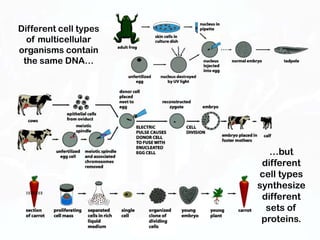
Different cell types
  of multicellular
organisms contain
 the same DNA…


                          …but
                        different
                       cell types
                       synthesize
                        different
                         sets of
                        proteins.
 A cell typically expresses only a fraction of its genes,
  and the different types of cells in multicellular
  organisms arise because different sets of genes are
  expressed.
 Types of gene expression:
   o Constitutive expression: some genes are essential
      and necessary for life, and therefore are continuously
      expressed; these genes are called housekeeping
      genes.
   o The expression levels of some genes fluctuate in
      response to the external signals. Some genes
      demonstrate higher expression level once being
      activated (induced). Some genes are repressed and
      their expression levels are lower (repressed).
 So how do cells know which kinds of proteins to
  synthesize? …gene expression can be regulated at many
  of the steps in the pathway from DNA to RNA to protein.
Prokaryotic
  Gene Regulation


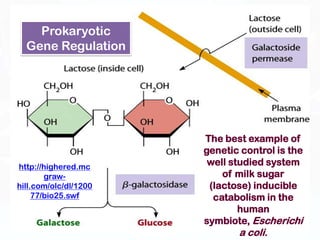
                       The best example of
                       genetic control is the
http://highered.mc
                        well studied system
        graw-              of milk sugar
hill.com/olc/dl/1200    (lactose) inducible
     77/bio25.swf        catabolism in the
                               human
                       symbiote, Escherichi
                               a coli.
Regulation of the lac operon (dual control:
                    repression and promotion)


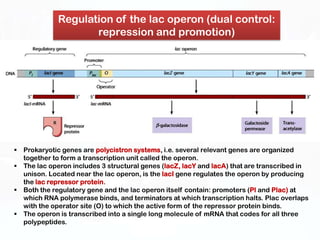
 Prokaryotic genes are polycistron systems, i.e. several relevant genes are organized
  together to form a transcription unit called the operon.
 The lac operon includes 3 structural genes (lacZ, lacY and lacA) that are transcribed in
  unison. Located near the lac operon, is the lacI gene regulates the operon by producing
  the lac repressor protein.
 Both the regulatory gene and the lac operon itself contain: promoters (Pl and Plac) at
  which RNA polymerase binds, and terminators at which transcription halts. Plac overlaps
  with the operator site (O) to which the active form of the repressor protein binds.
 The operon is transcribed into a single long molecule of mRNA that codes for all three
  polypeptides.
http://highered.mcgraw-
                             hill.com/olc/dl/120080/bio27.swf


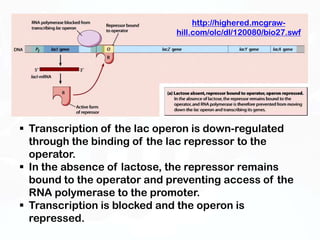
 Transcription of the lac operon is down-regulated
  through the binding of the lac repressor to the
  operator.
 In the absence of lactose, the repressor remains
  bound to the operator and preventing access of the
  RNA polymerase to the promoter.
 Transcription is blocked and the operon is
  repressed.
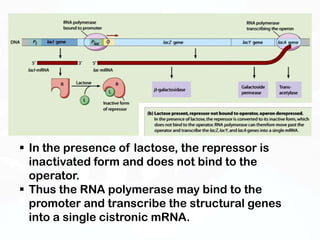
 In the presence of lactose, the repressor is
  inactivated form and does not bind to the
  operator.
 Thus the RNA polymerase may bind to the
  promoter and transcribe the structural genes
  into a single cistronic mRNA.
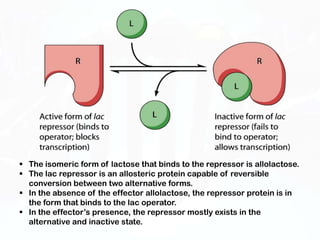
 The isomeric form of lactose that binds to the repressor is allolactose.
 The lac repressor is an allosteric protein capable of reversible
  conversion between two alternative forms.
 In the absence of the effector allolactose, the repressor protein is in
  the form that binds to the lac operator.
 In the effector’s presence, the repressor mostly exists in the
  alternative and inactive state.
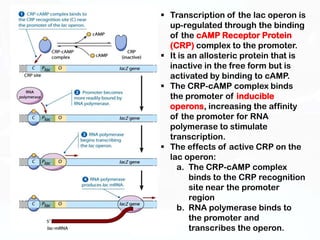
 Transcription of the lac operon is
  up-regulated through the binding
  of the cAMP Receptor Protein
  (CRP) complex to the promoter.
 It is an allosteric protein that is
  inactive in the free form but is
  activated by binding to cAMP.
 The CRP-cAMP complex binds
  the promoter of inducible
  operons, increasing the affinity
  of the promoter for RNA
  polymerase to stimulate
  transcription.
 The effects of active CRP on the
  lac operon:
    a. The CRP-cAMP complex
        binds to the CRP recognition
        site near the promoter
        region
    b. RNA polymerase binds to
        the promoter and
        transcribes the operon.
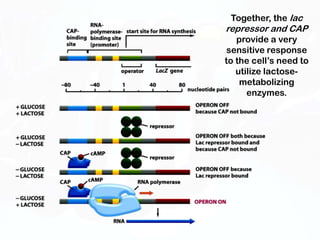
Together, the lac
repressor and CAP
   provide a very
 sensitive response
to the cell’s need to
   utilize lactose-
    metabolizing
      enzymes.
http://highered.mcgraw-
hill.com/olc/dl/120080/bio26.swf

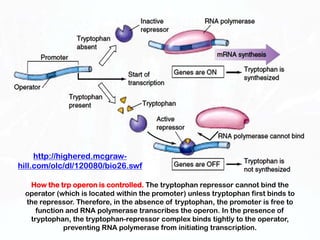
  How the trp operon is controlled. The tryptophan repressor cannot bind the
 operator (which is located within the promoter) unless tryptophan first binds to
 the repressor. Therefore, in the absence of tryptophan, the promoter is free to
    function and RNA polymerase transcribes the operon. In the presence of
  tryptophan, the tryptophan-repressor complex binds tightly to the operator,
            preventing RNA polymerase from initiating transcription.
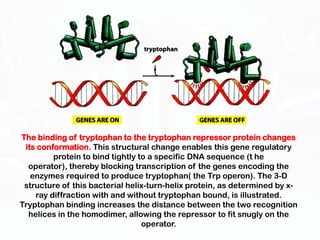
The binding of tryptophan to the tryptophan repressor protein changes
 its conformation. This structural change enables this gene regulatory
         protein to bind tightly to a specific DNA sequence (t he
  operator), thereby blocking transcription of the genes encoding the
   enzymes required to produce tryptophan( the Trp operon). The 3-D
 structure of this bacterial helix-turn-helix protein, as determined by x-
    ray diffraction with and without tryptophan bound, is illustrated.
Tryptophan binding increases the distance between the two recognition
  helices in the homodimer, allowing the repressor to fit snugly on the
                                  operator.
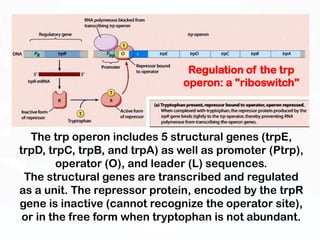
Regulation of the trp
                               operon: a "riboswitch"


   The trp operon includes 5 structural genes (trpE,
trpD, trpC, trpB, and trpA) as well as promoter (Ptrp),
        operator (O), and leader (L) sequences.
 The structural genes are transcribed and regulated
as a unit. The repressor protein, encoded by the trpR
gene is inactive (cannot recognize the operator site),
 or in the free form when tryptophan is not abundant.
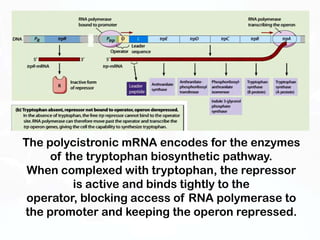
The polycistronic mRNA encodes for the enzymes
     of the tryptophan biosynthetic pathway.
 When complexed with tryptophan, the repressor
          is active and binds tightly to the
 operator, blocking access of RNA polymerase to
the promoter and keeping the operon repressed.
Absence of nuclear membrane separates transcription
                                    and translation and the ribosomes will bind the nascent
                                          message soon after it emerges from the RNA
                                      polymerase. The close linkage of the processes can
                                      lead to interdependent control mechanisms such as
                                     the attenuation controlled by the trp leader sequence.

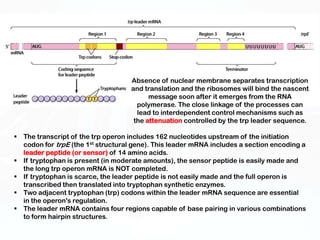
 The transcript of the trp operon includes 162 nucleotides upstream of the initiation
  codon for trpE (the 1st structural gene). This leader mRNA includes a section encoding a
  leader peptide (or sensor) of 14 amino acids.
 If tryptophan is present (in moderate amounts), the sensor peptide is easily made and
  the long trp operon mRNA is NOT completed.
 If tryptophan is scarce, the leader peptide is not easily made and the full operon is
  transcribed then translated into tryptophan synthetic enzymes.
 Two adjacent tryptophan (trp) codons within the leader mRNA sequence are essential
  in the operon's regulation.
 The leader mRNA contains four regions capable of base pairing in various combinations
  to form hairpin structures.
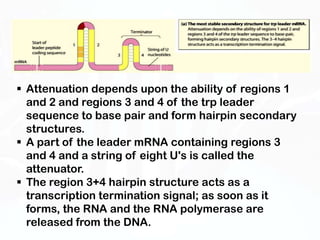
 Attenuation depends upon the ability of regions 1
  and 2 and regions 3 and 4 of the trp leader
  sequence to base pair and form hairpin secondary
  structures.
 A part of the leader mRNA containing regions 3
  and 4 and a string of eight U's is called the
  attenuator.
 The region 3+4 hairpin structure acts as a
  transcription termination signal; as soon as it
  forms, the RNA and the RNA polymerase are
  released from the DNA.
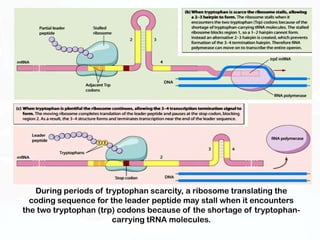
During periods of tryptophan scarcity, a ribosome translating the
  coding sequence for the leader peptide may stall when it encounters
the two tryptophan (trp) codons because of the shortage of tryptophan-
                       carrying tRNA molecules.
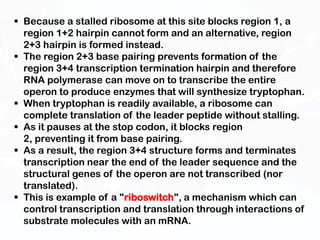
 Because a stalled ribosome at this site blocks region 1, a
  region 1+2 hairpin cannot form and an alternative, region
  2+3 hairpin is formed instead.
 The region 2+3 base pairing prevents formation of the
  region 3+4 transcription termination hairpin and therefore
  RNA polymerase can move on to transcribe the entire
  operon to produce enzymes that will synthesize tryptophan.
 When tryptophan is readily available, a ribosome can
  complete translation of the leader peptide without stalling.
 As it pauses at the stop codon, it blocks region
  2, preventing it from base pairing.
 As a result, the region 3+4 structure forms and terminates
  transcription near the end of the leader sequence and the
  structural genes of the operon are not transcribed (nor
  translated).
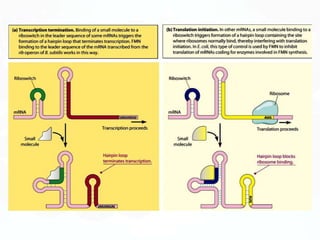
 This is example of a "riboswitch", a mechanism which can
  control transcription and translation through interactions of
  substrate molecules with an mRNA.
http://highered.mcgraw-
hill.com/sites/dl/free/0072437316/120060/ravenanimat
ion.html

http://highered.mcgraw-
hill.com/olc/dl/120080/bio27.swf

http://highered.mcgraw-
hill.com/olc/dl/120080/bio31.swf

http://highered.mcgraw-
hill.com/olc/dl/120080/bio28.swf

Gene regulation prokaryote spptx

  • 2.
    Different cell types of multicellular organisms contain the same DNA… …but different cell types synthesize different sets of proteins.
  • 3.
     A celltypically expresses only a fraction of its genes, and the different types of cells in multicellular organisms arise because different sets of genes are expressed.  Types of gene expression: o Constitutive expression: some genes are essential and necessary for life, and therefore are continuously expressed; these genes are called housekeeping genes. o The expression levels of some genes fluctuate in response to the external signals. Some genes demonstrate higher expression level once being activated (induced). Some genes are repressed and their expression levels are lower (repressed).  So how do cells know which kinds of proteins to synthesize? …gene expression can be regulated at many of the steps in the pathway from DNA to RNA to protein.
  • 4.
    Prokaryotic GeneRegulation The best example of genetic control is the http://highered.mc well studied system graw- of milk sugar hill.com/olc/dl/1200 (lactose) inducible 77/bio25.swf catabolism in the human symbiote, Escherichi a coli.
  • 5.
    Regulation of thelac operon (dual control: repression and promotion)  Prokaryotic genes are polycistron systems, i.e. several relevant genes are organized together to form a transcription unit called the operon.  The lac operon includes 3 structural genes (lacZ, lacY and lacA) that are transcribed in unison. Located near the lac operon, is the lacI gene regulates the operon by producing the lac repressor protein.  Both the regulatory gene and the lac operon itself contain: promoters (Pl and Plac) at which RNA polymerase binds, and terminators at which transcription halts. Plac overlaps with the operator site (O) to which the active form of the repressor protein binds.  The operon is transcribed into a single long molecule of mRNA that codes for all three polypeptides.
  • 6.
    http://highered.mcgraw- hill.com/olc/dl/120080/bio27.swf  Transcription of the lac operon is down-regulated through the binding of the lac repressor to the operator.  In the absence of lactose, the repressor remains bound to the operator and preventing access of the RNA polymerase to the promoter.  Transcription is blocked and the operon is repressed.
  • 7.
     In thepresence of lactose, the repressor is inactivated form and does not bind to the operator.  Thus the RNA polymerase may bind to the promoter and transcribe the structural genes into a single cistronic mRNA.
  • 8.
     The isomericform of lactose that binds to the repressor is allolactose.  The lac repressor is an allosteric protein capable of reversible conversion between two alternative forms.  In the absence of the effector allolactose, the repressor protein is in the form that binds to the lac operator.  In the effector’s presence, the repressor mostly exists in the alternative and inactive state.
  • 9.
     Transcription ofthe lac operon is up-regulated through the binding of the cAMP Receptor Protein (CRP) complex to the promoter.  It is an allosteric protein that is inactive in the free form but is activated by binding to cAMP.  The CRP-cAMP complex binds the promoter of inducible operons, increasing the affinity of the promoter for RNA polymerase to stimulate transcription.  The effects of active CRP on the lac operon: a. The CRP-cAMP complex binds to the CRP recognition site near the promoter region b. RNA polymerase binds to the promoter and transcribes the operon.
  • 10.
    Together, the lac repressorand CAP provide a very sensitive response to the cell’s need to utilize lactose- metabolizing enzymes.
  • 11.
    http://highered.mcgraw- hill.com/olc/dl/120080/bio26.swf Howthe trp operon is controlled. The tryptophan repressor cannot bind the operator (which is located within the promoter) unless tryptophan first binds to the repressor. Therefore, in the absence of tryptophan, the promoter is free to function and RNA polymerase transcribes the operon. In the presence of tryptophan, the tryptophan-repressor complex binds tightly to the operator, preventing RNA polymerase from initiating transcription.
  • 12.
    The binding oftryptophan to the tryptophan repressor protein changes its conformation. This structural change enables this gene regulatory protein to bind tightly to a specific DNA sequence (t he operator), thereby blocking transcription of the genes encoding the enzymes required to produce tryptophan( the Trp operon). The 3-D structure of this bacterial helix-turn-helix protein, as determined by x- ray diffraction with and without tryptophan bound, is illustrated. Tryptophan binding increases the distance between the two recognition helices in the homodimer, allowing the repressor to fit snugly on the operator.
  • 13.
    Regulation of thetrp operon: a "riboswitch" The trp operon includes 5 structural genes (trpE, trpD, trpC, trpB, and trpA) as well as promoter (Ptrp), operator (O), and leader (L) sequences. The structural genes are transcribed and regulated as a unit. The repressor protein, encoded by the trpR gene is inactive (cannot recognize the operator site), or in the free form when tryptophan is not abundant.
  • 14.
    The polycistronic mRNAencodes for the enzymes of the tryptophan biosynthetic pathway. When complexed with tryptophan, the repressor is active and binds tightly to the operator, blocking access of RNA polymerase to the promoter and keeping the operon repressed.
  • 15.
    Absence of nuclearmembrane separates transcription and translation and the ribosomes will bind the nascent message soon after it emerges from the RNA polymerase. The close linkage of the processes can lead to interdependent control mechanisms such as the attenuation controlled by the trp leader sequence.  The transcript of the trp operon includes 162 nucleotides upstream of the initiation codon for trpE (the 1st structural gene). This leader mRNA includes a section encoding a leader peptide (or sensor) of 14 amino acids.  If tryptophan is present (in moderate amounts), the sensor peptide is easily made and the long trp operon mRNA is NOT completed.  If tryptophan is scarce, the leader peptide is not easily made and the full operon is transcribed then translated into tryptophan synthetic enzymes.  Two adjacent tryptophan (trp) codons within the leader mRNA sequence are essential in the operon's regulation.  The leader mRNA contains four regions capable of base pairing in various combinations to form hairpin structures.
  • 16.
     Attenuation dependsupon the ability of regions 1 and 2 and regions 3 and 4 of the trp leader sequence to base pair and form hairpin secondary structures.  A part of the leader mRNA containing regions 3 and 4 and a string of eight U's is called the attenuator.  The region 3+4 hairpin structure acts as a transcription termination signal; as soon as it forms, the RNA and the RNA polymerase are released from the DNA.
  • 17.
    During periods oftryptophan scarcity, a ribosome translating the coding sequence for the leader peptide may stall when it encounters the two tryptophan (trp) codons because of the shortage of tryptophan- carrying tRNA molecules.
  • 18.
     Because astalled ribosome at this site blocks region 1, a region 1+2 hairpin cannot form and an alternative, region 2+3 hairpin is formed instead.  The region 2+3 base pairing prevents formation of the region 3+4 transcription termination hairpin and therefore RNA polymerase can move on to transcribe the entire operon to produce enzymes that will synthesize tryptophan.  When tryptophan is readily available, a ribosome can complete translation of the leader peptide without stalling.  As it pauses at the stop codon, it blocks region 2, preventing it from base pairing.  As a result, the region 3+4 structure forms and terminates transcription near the end of the leader sequence and the structural genes of the operon are not transcribed (nor translated).  This is example of a "riboswitch", a mechanism which can control transcription and translation through interactions of substrate molecules with an mRNA.
  • 21.