DNA Structure and
   Replication
        Submitted by:

   Esguerra, Joanna Marie
      Evaristo, Roselle
          AAPD2G
                            1
 In the early 1900s, scientists knew that
 chromosomes are made up of DNA
 (deoxyribonucleic acid) and proteins,
 contained genetic information.

 However, they did not know whether the DNA or
 the proteins was the actual genetic material.
                                                  2
 In the 1940s, various researchers
 showed that DNA was the genetic
 material

 In the 1950s, the structure of DNA was
 determined.

                                           3
Structure of DNA
The structure of DNA was determined by
James Watson and Francis Crick in
the early 1950s.

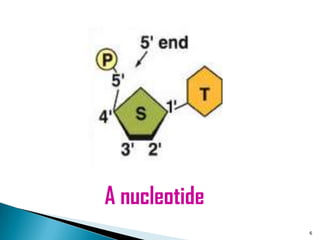
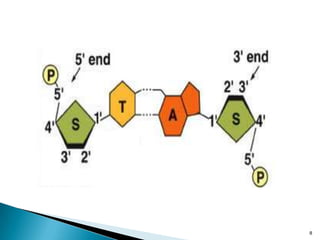
DNA is a polynucleotide; nucleotides are
composed of a phosphate, a sugar, and a
nitrogen-containing base.                  4
 The sugar in DNA is deoxyribose


 The four different bases in DNA are:
 adenine (A),      thymine (T), guanine
 (G), and cytosine (C).


                                          5
A nucleotide
               6
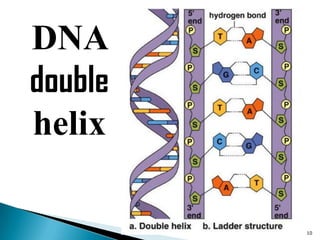
Watson and Crick showed that DNA is a double
helix in which
           A is paired with T
           G is paired with C

This is called complementary base pairing
because a purine is always paired with a
pyrimidine.
                                               7
8
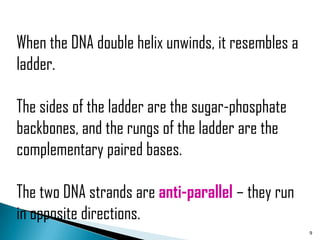
When the DNA double helix unwinds, it resembles a
ladder.

The sides of the ladder are the sugar-phosphate
backbones, and the rungs of the ladder are the
complementary paired bases.

The two DNA strands are anti-parallel – they run
in opposite directions.
                                                    9
DNA
double
helix

         10
Replication of DNA
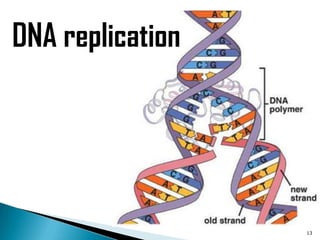
DNA replication occurs during chromosome
duplication.

An exact copy of the DNA is produced with the aid of
DNA polymerase.

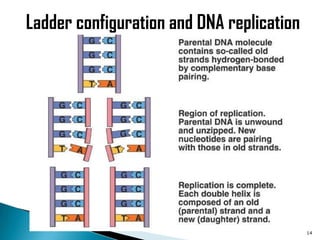
Hydrogen bonds between bases break and enzymes
“unzip” the molecule.
                                                       11
 Each old strand of nucleotides serves
 as a template for each new strand.

 New nucleotides move into
 complementary positions are joined by
 DNA polymerase.

                                          12
DNA replication


                  13
Ladder configuration and DNA replication


                                           14
Gene Expression
A gene is a segment of DNA that specifies the amino
acid sequence of a protein.

Gene expression occurs when gene activity leads to
a protein product in the cell.

A gene does not directly control protein synthesis;
instead, it passes its genetic information on to RNA,
which is more directly involved in protein synthesis.
                                                        15
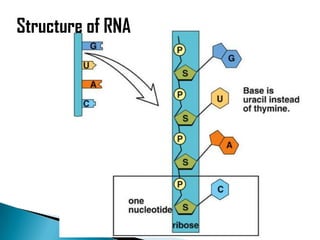
RNA (ribonucleic acid ) is a single-
stranded nucleic acid in which

   (adenine) A pairs with U (uracil )
  (guanine) G pairs with C. (cytosine)

                                         16
 messenger   RNA (mRNA) carries genetic
 information to the ribosomes,

 ribosomal   RNA (rRNA) is found in the ribosomes,

 transferRNA (tRNA) transfers amino acids to the
    ribosomes, where the protein product is
 synthesized.

                                                      17
Structure of RNA


                   18
Two processes are involved in the synthesis of
proteins in the cell:

     Transcription makes an RNA molecule
     complementary to a portion of DNA.

     Translation occurs when the sequence of
     bases of mRNA directs the sequence of
amino     acids in a polypeptide.
                                                 19
The Genetic Code
DNA specifies the synthesis of proteins
because it contains a triplet code: every
three bases stand for one amino acid.

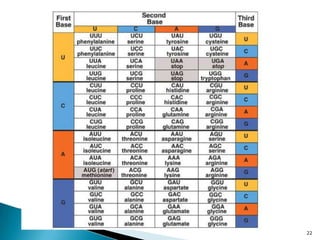
Each three-letter unit of an mRNA
molecule is called a codon.
                                            20
 Most amino acids have more than one
 codon; there are 20 amino acids with a
 possible 64 different triplets.

 The code is nearly universal among
 living organisms.

                                          21
22
Central Concept or " The Central Dogma"
The central concept of genetics involves the DNA-
to-protein sequence involving transcription and
translation.

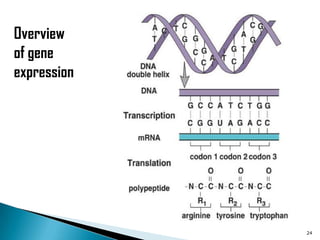
DNA has a sequence of bases that is transcribed into
a sequence of bases in mRNA.

Every three bases is a codon that stands for a
particular amino acid.
                                                       23
Overview
of gene
expression


             24
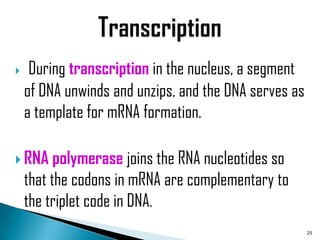
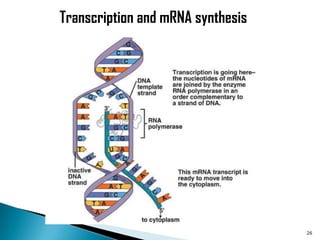
    During transcription in the nucleus, a segment
    of DNA unwinds and unzips, and the DNA serves as
    a template for mRNA formation.

 RNA     polymerase joins the RNA nucleotides so
    that the codons in mRNA are complementary to
    the triplet code in DNA.
                                                       25
Transcription and mRNA synthesis


                                   26
Translation
Translation is the second step by which gene
expression leads to protein synthesis.

During translation, the sequence of codons in mRNA
specifies the order of amino acids in a protein.

Translation requires several enzymes and two other
types of RNA: transfer RNA and ribosomal RNA.

                                                     27
Review of Gene Expression

DNA in the nucleus contains a triplet
code; each group of three bases stands
for one amino acid.

During transcription, an mRNA copy of
the DNA template is made.
                                         28
 The mRNA is processed before leaving the
 nucleus.

 The mRNA joins with a ribosome, where
 tRNA carries the amino acids into position
 during translation.

                                              29

DNA Structure and Replication.

  • 1.
    DNA Structure and Replication Submitted by: Esguerra, Joanna Marie Evaristo, Roselle AAPD2G 1
  • 2.
     In theearly 1900s, scientists knew that chromosomes are made up of DNA (deoxyribonucleic acid) and proteins, contained genetic information.  However, they did not know whether the DNA or the proteins was the actual genetic material. 2
  • 3.
     In the1940s, various researchers showed that DNA was the genetic material  In the 1950s, the structure of DNA was determined. 3
  • 4.
    Structure of DNA Thestructure of DNA was determined by James Watson and Francis Crick in the early 1950s. DNA is a polynucleotide; nucleotides are composed of a phosphate, a sugar, and a nitrogen-containing base. 4
  • 5.
     The sugarin DNA is deoxyribose  The four different bases in DNA are: adenine (A), thymine (T), guanine (G), and cytosine (C). 5
  • 6.
  • 7.
    Watson and Crickshowed that DNA is a double helix in which A is paired with T G is paired with C This is called complementary base pairing because a purine is always paired with a pyrimidine. 7
  • 8.
  • 9.
    When the DNAdouble helix unwinds, it resembles a ladder. The sides of the ladder are the sugar-phosphate backbones, and the rungs of the ladder are the complementary paired bases. The two DNA strands are anti-parallel – they run in opposite directions. 9
  • 10.
  • 11.
    Replication of DNA DNAreplication occurs during chromosome duplication. An exact copy of the DNA is produced with the aid of DNA polymerase. Hydrogen bonds between bases break and enzymes “unzip” the molecule. 11
  • 12.
     Each oldstrand of nucleotides serves as a template for each new strand.  New nucleotides move into complementary positions are joined by DNA polymerase. 12
  • 13.
  • 14.
    Ladder configuration andDNA replication 14
  • 15.
    Gene Expression A geneis a segment of DNA that specifies the amino acid sequence of a protein. Gene expression occurs when gene activity leads to a protein product in the cell. A gene does not directly control protein synthesis; instead, it passes its genetic information on to RNA, which is more directly involved in protein synthesis. 15
  • 16.
    RNA (ribonucleic acid) is a single- stranded nucleic acid in which (adenine) A pairs with U (uracil ) (guanine) G pairs with C. (cytosine) 16
  • 17.
     messenger RNA (mRNA) carries genetic information to the ribosomes,  ribosomal RNA (rRNA) is found in the ribosomes,  transferRNA (tRNA) transfers amino acids to the ribosomes, where the protein product is synthesized. 17
  • 18.
  • 19.
    Two processes areinvolved in the synthesis of proteins in the cell: Transcription makes an RNA molecule complementary to a portion of DNA. Translation occurs when the sequence of bases of mRNA directs the sequence of amino acids in a polypeptide. 19
  • 20.
    The Genetic Code DNAspecifies the synthesis of proteins because it contains a triplet code: every three bases stand for one amino acid. Each three-letter unit of an mRNA molecule is called a codon. 20
  • 21.
     Most aminoacids have more than one codon; there are 20 amino acids with a possible 64 different triplets.  The code is nearly universal among living organisms. 21
  • 22.
  • 23.
    Central Concept or" The Central Dogma" The central concept of genetics involves the DNA- to-protein sequence involving transcription and translation. DNA has a sequence of bases that is transcribed into a sequence of bases in mRNA. Every three bases is a codon that stands for a particular amino acid. 23
  • 24.
  • 25.
    During transcription in the nucleus, a segment of DNA unwinds and unzips, and the DNA serves as a template for mRNA formation.  RNA polymerase joins the RNA nucleotides so that the codons in mRNA are complementary to the triplet code in DNA. 25
  • 26.
  • 27.
    Translation Translation is thesecond step by which gene expression leads to protein synthesis. During translation, the sequence of codons in mRNA specifies the order of amino acids in a protein. Translation requires several enzymes and two other types of RNA: transfer RNA and ribosomal RNA. 27
  • 28.
    Review of GeneExpression DNA in the nucleus contains a triplet code; each group of three bases stands for one amino acid. During transcription, an mRNA copy of the DNA template is made. 28
  • 29.
     The mRNAis processed before leaving the nucleus.  The mRNA joins with a ribosome, where tRNA carries the amino acids into position during translation. 29