Genes And DNA
What is DNA?
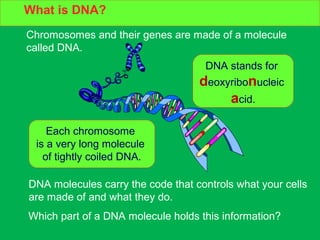
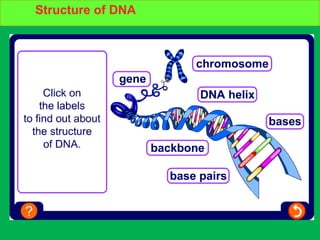
Chromosomes and their genes are made of a molecule
called DNA.
DNA molecules carry the code that controls what your cells
are made of and what they do.
DNA stands for
deoxyribonucleic
acid.
Each chromosome
is a very long molecule
of tightly coiled DNA.
Which part of a DNA molecule holds this information?
What is DNA?
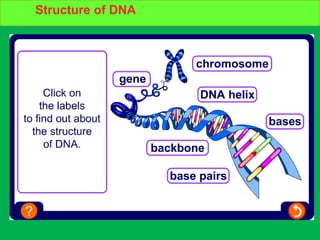
Structure of DNAStructure of DNA
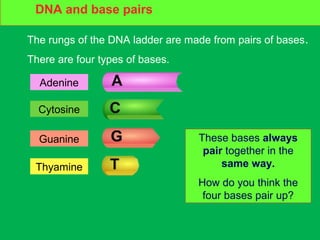
DNA and base pairs
The rungs of the DNA ladder are made from pairs of bases.
There are four types of bases.
These bases always
pair together in the
same way.
How do you think the
four bases pair up?
Adenine
Cytosine
Guanine
Thyamine
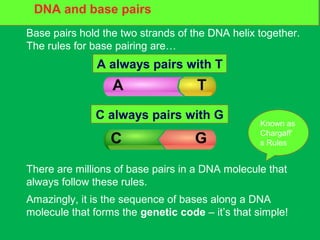
DNA and base pairs
DNA and base pairs
Base pairs hold the two strands of the DNA helix together.
The rules for base pairing are…
There are millions of base pairs in a DNA molecule that
always follow these rules.
A always pairs with T
C always pairs with G
Amazingly, it is the sequence of bases along a DNA
molecule that forms the genetic code – it’s that simple!
DNA and base pairs
Known as
Chargaff’
s Rules
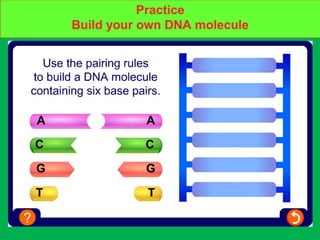
Build your own DNA moleculePractice
Build your own DNA molecule
DNA – true or false?Practice
DNA – true or false?
DNA and cell division
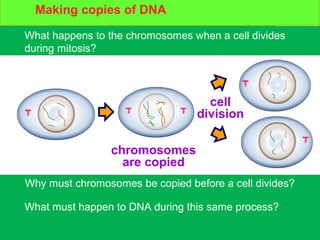
What happens to the chromosomes when a cell divides
during mitosis?
What must happen to DNA during this same process?
cell
division
chromosomes
are copied
Why must chromosomes be copied before a cell divides?
Making copies of DNA
DNA and cell division
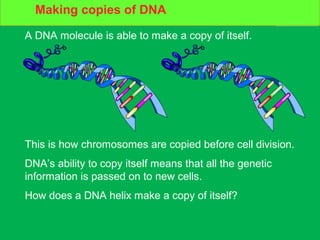
A DNA molecule is able to make a copy of itself.
This is how chromosomes are copied before cell division.
DNA’s ability to copy itself means that all the genetic
information is passed on to new cells.
How does a DNA helix make a copy of itself?
Making copies of DNA
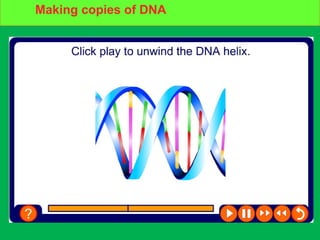
How does DNA copy itself?Making copies of DNA
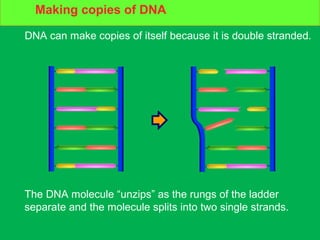
The DNA molecule “unzips” as the rungs of the ladder
separate and the molecule splits into two single strands.
How DNA copies itself
DNA can make copies of itself because it is double stranded.
Making copies of DNA
How DNA copies itself
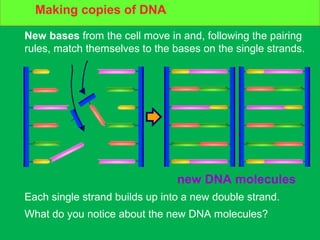
Each single strand builds up into a new double strand.
What do you notice about the new DNA molecules?
New bases from the cell move in and, following the pairing
rules, match themselves to the bases on the single strands.
new DNA molecules
Making copies of DNA
How DNA copies itself
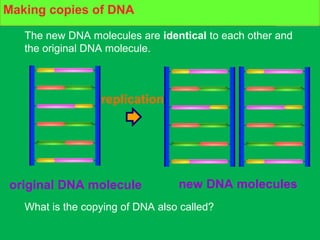
What is the copying of DNA also called?
The new DNA molecules are identical to each other and
the original DNA molecule.
new DNA moleculesoriginal DNA molecule
replication
Making copies of DNA
© Boardworks Ltd 2004
Practice
Build your own DNA molecule
Practice!
DNA multiple choicePractice!
What are proteins made of?How DNA works
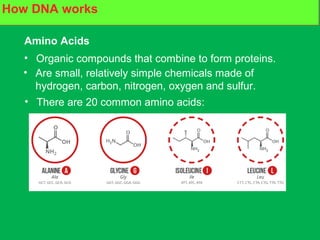
Amino Acids
• Organic compounds that combine to form proteins.
• Are small, relatively simple chemicals made of
hydrogen, carbon, nitrogen, oxygen and sulfur.
• There are 20 common amino acids:
What are proteins made of?How DNA works
Amino Acids and Proteins
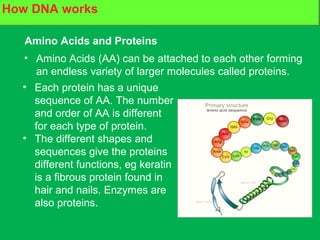
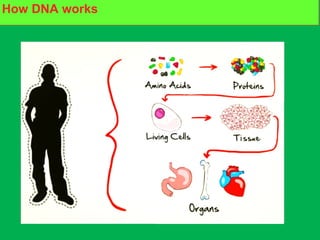
• Amino Acids (AA) can be attached to each other forming
an endless variety of larger molecules called proteins.
• Each protein has a unique
sequence of AA. The number
and order of AA is different
for each type of protein.
• The different shapes and
sequences give the proteins
different functions, eg keratin
is a fibrous protein found in
hair and nails. Enzymes are
also proteins.
What are proteins made of?How DNA works
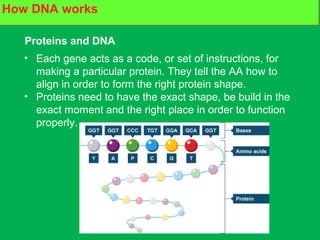
Proteins and DNA
• Each gene acts as a code, or set of instructions, for
making a particular protein. They tell the AA how to
align in order to form the right protein shape.
• Proteins need to have the exact shape, be build in the
exact moment and the right place in order to function
properly.
What are proteins made of?How DNA works
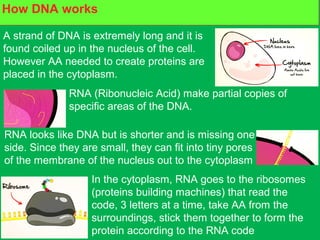
A strand of DNA is extremely long and it is
found coiled up in the nucleus of the cell.
However AA needed to create proteins are
placed in the cytoplasm.
RNA (Ribonucleic Acid) make partial copies of
specific areas of the DNA.
RNA looks like DNA but is shorter and is missing one
side. Since they are small, they can fit into tiny pores
of the membrane of the nucleus out to the cytoplasm
In the cytoplasm, RNA goes to the ribosomes
(proteins building machines) that read the
code, 3 letters at a time, take AA from the
surroundings, stick them together to form the
protein according to the RNA code
How do genes make proteins?
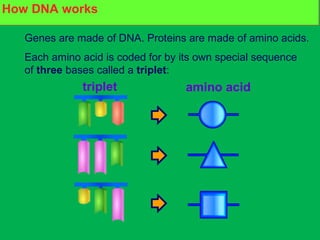
Genes are made of DNA. Proteins are made of amino acids.
Each amino acid is coded for by its own special sequence
of three bases called a triplet:
triplet amino acid
How DNA works
How do genes make proteins?
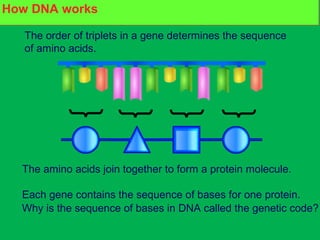
The amino acids join together to form a protein molecule.
Each gene contains the sequence of bases for one protein.
The order of triplets in a gene determines the sequence
of amino acids.
Why is the sequence of bases in DNA called the genetic code?
How DNA works
How do genes make proteins?
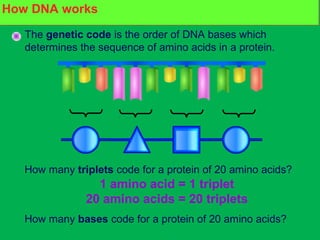
The genetic code is the order of DNA bases which
determines the sequence of amino acids in a protein.
How many triplets code for a protein of 20 amino acids?
1 amino acid = 1 triplet
20 amino acids = 20 triplets
How many bases code for a protein of 20 amino acids?
How DNA works
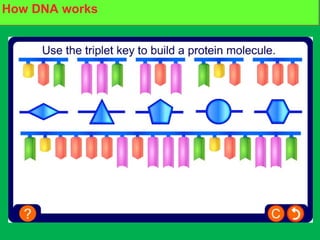
Build your own protein moleculeHow DNA works
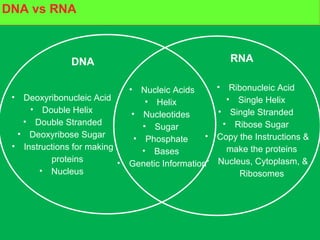
Build your own protein moleculeDNA vs RNA
• Deoxyribonucleic Acid
• Double Helix
• Double Stranded
• Deoxyribose Sugar
• Instructions for making
proteins
• Nucleus
• Ribonucleic Acid
• Single Helix
• Single Stranded
• Ribose Sugar
• Copy the Instructions &
make the proteins
• Nucleus, Cytoplasm, &
Ribosomes
• Nucleic Acids
• Helix
• Nucleotides
• Sugar
• Phosphate
• Bases
• Genetic Information
DNA RNA
DNA mutations and proteinsMutations
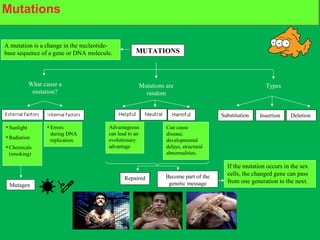
A mutation is a change in the nucleotide-
base sequence of a gene or DNA molecule.
What cause a
mutation?
MUTATIONS
Mutations are
random
Types
• Sunlight
• Radiation
• Chemicals
(smoking)
Mutagen
• Errors
during DNA
replication.
Can cause
disease,
developmental
delays, structural
abnormalities.
Advantageous
can lead to an
evolutionary
advantage
Substitution Insertion Deletion
Repaired Become part of the
genetic message
If the mutation occurs in the sex
cells, the changed gene can pass
from one generation to the next.
DNA mutations and proteinsMutations
SUBSTITUTION INSERTION DELETION 
DNA mutations and proteinsMutations
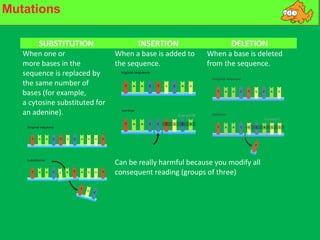
SUBSTITUTION INSERTION DELETION 
When one or
more bases in the
sequence is replaced by
the same number of
bases (for example,
a cytosine substituted for
an adenine).
When a base is added to
the sequence.
When a base is deleted
from the sequence.
Can be really harmful because you modify all
consequent reading (groups of three)
Genetic code quizPractice!

Genes and DNA

  • 1.
  • 2.
    What is DNA? Chromosomesand their genes are made of a molecule called DNA. DNA molecules carry the code that controls what your cells are made of and what they do. DNA stands for deoxyribonucleic acid. Each chromosome is a very long molecule of tightly coiled DNA. Which part of a DNA molecule holds this information? What is DNA?
  • 3.
  • 4.
  • 5.
    DNA and basepairs The rungs of the DNA ladder are made from pairs of bases. There are four types of bases. These bases always pair together in the same way. How do you think the four bases pair up? Adenine Cytosine Guanine Thyamine DNA and base pairs
  • 6.
    DNA and basepairs Base pairs hold the two strands of the DNA helix together. The rules for base pairing are… There are millions of base pairs in a DNA molecule that always follow these rules. A always pairs with T C always pairs with G Amazingly, it is the sequence of bases along a DNA molecule that forms the genetic code – it’s that simple! DNA and base pairs Known as Chargaff’ s Rules
  • 7.
    Build your ownDNA moleculePractice Build your own DNA molecule
  • 8.
    DNA – trueor false?Practice DNA – true or false?
  • 9.
    DNA and celldivision What happens to the chromosomes when a cell divides during mitosis? What must happen to DNA during this same process? cell division chromosomes are copied Why must chromosomes be copied before a cell divides? Making copies of DNA
  • 10.
    DNA and celldivision A DNA molecule is able to make a copy of itself. This is how chromosomes are copied before cell division. DNA’s ability to copy itself means that all the genetic information is passed on to new cells. How does a DNA helix make a copy of itself? Making copies of DNA
  • 11.
    How does DNAcopy itself?Making copies of DNA
  • 12.
    The DNA molecule“unzips” as the rungs of the ladder separate and the molecule splits into two single strands. How DNA copies itself DNA can make copies of itself because it is double stranded. Making copies of DNA
  • 13.
    How DNA copiesitself Each single strand builds up into a new double strand. What do you notice about the new DNA molecules? New bases from the cell move in and, following the pairing rules, match themselves to the bases on the single strands. new DNA molecules Making copies of DNA
  • 14.
    How DNA copiesitself What is the copying of DNA also called? The new DNA molecules are identical to each other and the original DNA molecule. new DNA moleculesoriginal DNA molecule replication Making copies of DNA
  • 15.
    © Boardworks Ltd2004 Practice Build your own DNA molecule Practice!
  • 16.
  • 17.
    What are proteinsmade of?How DNA works Amino Acids • Organic compounds that combine to form proteins. • Are small, relatively simple chemicals made of hydrogen, carbon, nitrogen, oxygen and sulfur. • There are 20 common amino acids:
  • 18.
    What are proteinsmade of?How DNA works Amino Acids and Proteins • Amino Acids (AA) can be attached to each other forming an endless variety of larger molecules called proteins. • Each protein has a unique sequence of AA. The number and order of AA is different for each type of protein. • The different shapes and sequences give the proteins different functions, eg keratin is a fibrous protein found in hair and nails. Enzymes are also proteins.
  • 19.
    What are proteinsmade of?How DNA works
  • 20.
    What are proteinsmade of?How DNA works Proteins and DNA • Each gene acts as a code, or set of instructions, for making a particular protein. They tell the AA how to align in order to form the right protein shape. • Proteins need to have the exact shape, be build in the exact moment and the right place in order to function properly.
  • 21.
    What are proteinsmade of?How DNA works A strand of DNA is extremely long and it is found coiled up in the nucleus of the cell. However AA needed to create proteins are placed in the cytoplasm. RNA (Ribonucleic Acid) make partial copies of specific areas of the DNA. RNA looks like DNA but is shorter and is missing one side. Since they are small, they can fit into tiny pores of the membrane of the nucleus out to the cytoplasm In the cytoplasm, RNA goes to the ribosomes (proteins building machines) that read the code, 3 letters at a time, take AA from the surroundings, stick them together to form the protein according to the RNA code
  • 22.
    How do genesmake proteins? Genes are made of DNA. Proteins are made of amino acids. Each amino acid is coded for by its own special sequence of three bases called a triplet: triplet amino acid How DNA works
  • 23.
    How do genesmake proteins? The amino acids join together to form a protein molecule. Each gene contains the sequence of bases for one protein. The order of triplets in a gene determines the sequence of amino acids. Why is the sequence of bases in DNA called the genetic code? How DNA works
  • 24.
    How do genesmake proteins? The genetic code is the order of DNA bases which determines the sequence of amino acids in a protein. How many triplets code for a protein of 20 amino acids? 1 amino acid = 1 triplet 20 amino acids = 20 triplets How many bases code for a protein of 20 amino acids? How DNA works
  • 25.
    Build your ownprotein moleculeHow DNA works
  • 26.
    Build your ownprotein moleculeDNA vs RNA • Deoxyribonucleic Acid • Double Helix • Double Stranded • Deoxyribose Sugar • Instructions for making proteins • Nucleus • Ribonucleic Acid • Single Helix • Single Stranded • Ribose Sugar • Copy the Instructions & make the proteins • Nucleus, Cytoplasm, & Ribosomes • Nucleic Acids • Helix • Nucleotides • Sugar • Phosphate • Bases • Genetic Information DNA RNA
  • 27.
    DNA mutations andproteinsMutations A mutation is a change in the nucleotide- base sequence of a gene or DNA molecule. What cause a mutation? MUTATIONS Mutations are random Types • Sunlight • Radiation • Chemicals (smoking) Mutagen • Errors during DNA replication. Can cause disease, developmental delays, structural abnormalities. Advantageous can lead to an evolutionary advantage Substitution Insertion Deletion Repaired Become part of the genetic message If the mutation occurs in the sex cells, the changed gene can pass from one generation to the next.
  • 28.
    DNA mutations andproteinsMutations SUBSTITUTION INSERTION DELETION 
  • 29.
    DNA mutations andproteinsMutations SUBSTITUTION INSERTION DELETION  When one or more bases in the sequence is replaced by the same number of bases (for example, a cytosine substituted for an adenine). When a base is added to the sequence. When a base is deleted from the sequence. Can be really harmful because you modify all consequent reading (groups of three)
  • 30.