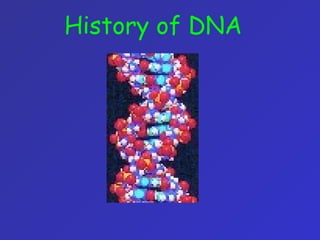
History of DNA
How do genes work?
How do genes determine the characteristics of an organism?
Are genes single molecules?
Are genes made up of many molecules?
In the 1900’s biologists were trying
to find these answers.
In order to understand genetics,
biologists had to figure out the
chemical structure of a gene.
(what are the parts & pieces?)
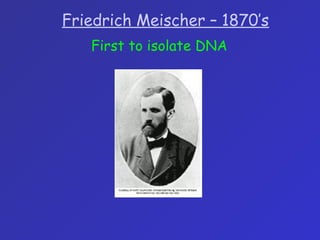
Friedrich Meischer – 1870’s
First to isolate DNA
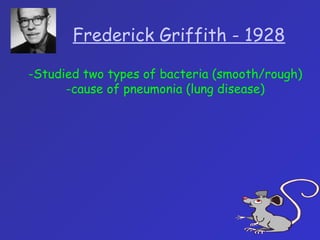
Frederick Griffith - 1928
-Studied two types of bacteria (smooth/rough)
-cause of pneumonia (lung disease)
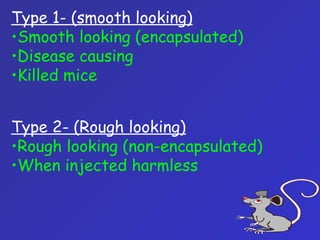
Type 2- (Rough looking)
‱Rough looking (non-encapsulated)
‱When injected harmless
Type 1- (smooth looking)
‱Smooth looking (encapsulated)
‱Disease causing
‱Killed mice
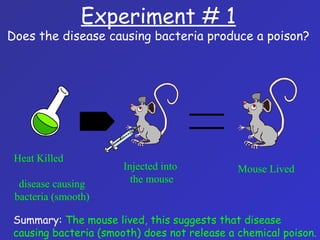
Experiment # 1
Does the disease causing bacteria produce a poison?
Heat Killed
disease causing
bacteria (smooth)
Mouse LivedInjected into
the mouse
Summary: The mouse lived, this suggests that disease
causing bacteria (smooth) does not release a chemical poison.
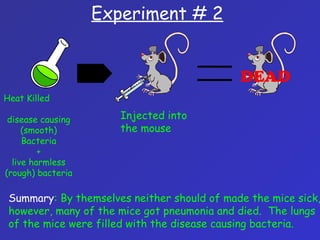
Heat Killed
disease causing
(smooth)
Bacteria
+
live harmless
(rough) bacteria
Injected into
the mouse
Experiment # 2
Summary: By themselves neither should of made the mice sick,
however, many of the mice got pneumonia and died. The lungs
of the mice were filled with the disease causing bacteria.
DEAD
These experiments showed that one strain of bacteria
could be transformed into another type of bacteria.
Griffith’s Conclusion
Griffith hypothesized that when the live, harmless
bacteria and heat killed bacteria were mixed, some
factor was transferred from the heat killed cells
into the live harmless cells. This factor may contain
“information” that could transform the harmless
bacteria.
This was the first evidence that DNA stores and
transmits genetic information.
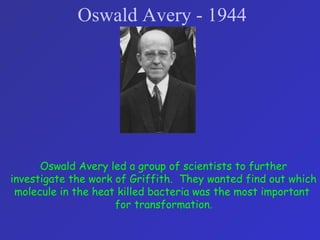
Oswald Avery - 1944
Oswald Avery led a group of scientists to further
investigate the work of Griffith. They wanted find out which
molecule in the heat killed bacteria was the most important
for transformation.
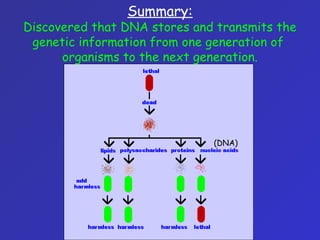
Summary:
Discovered that DNA stores and transmits the
genetic information from one generation of
organisms to the next generation.
(DNA)
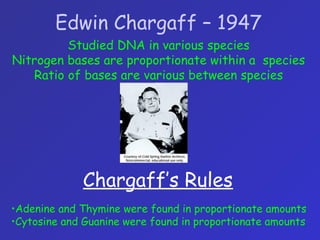
Edwin Chargaff – 1947
Studied DNA in various species
Nitrogen bases are proportionate within a species
Ratio of bases are various between species
‱Adenine and Thymine were found in proportionate amounts
‱Cytosine and Guanine were found in proportionate amounts
Chargaff’s Rules
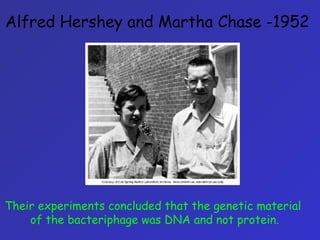
Alfred Hershey and Martha Chase -1952
Their experiments concluded that the genetic material
of the bacteriphage was DNA and not protein.
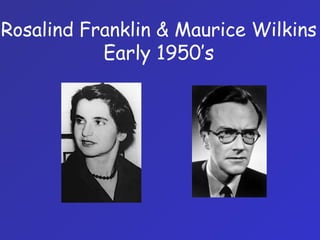
Rosalind Franklin & Maurice Wilkins
Early 1950’s
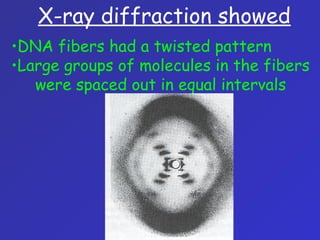
X-ray diffraction showed
‱DNA fibers had a twisted pattern
‱Large groups of molecules in the fibers
were spaced out in equal intervals
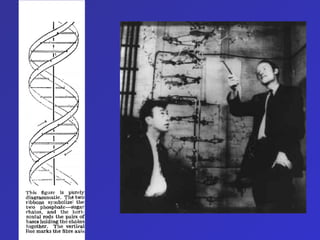
James Watson & Francis Crick - 1953
‱Watson Crick Model
‱“Double Helix”
‱Determined the shape and structure
‱Adenine bonds with Thymine
‱Cytosine bonds with Guanine
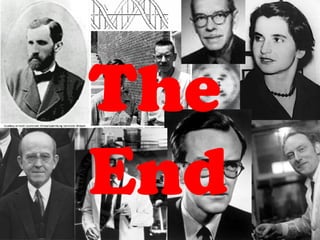
The
End

Discovery dna

  • 1.
  • 2.
    How do geneswork? How do genes determine the characteristics of an organism? Are genes single molecules? Are genes made up of many molecules?
  • 3.
    In the 1900’sbiologists were trying to find these answers. In order to understand genetics, biologists had to figure out the chemical structure of a gene. (what are the parts & pieces?)
  • 4.
    Friedrich Meischer –1870’s First to isolate DNA
  • 5.
    Frederick Griffith -1928 -Studied two types of bacteria (smooth/rough) -cause of pneumonia (lung disease)
  • 6.
    Type 2- (Roughlooking) ‱Rough looking (non-encapsulated) ‱When injected harmless Type 1- (smooth looking) ‱Smooth looking (encapsulated) ‱Disease causing ‱Killed mice
  • 7.
    Experiment # 1 Doesthe disease causing bacteria produce a poison? Heat Killed disease causing bacteria (smooth) Mouse LivedInjected into the mouse Summary: The mouse lived, this suggests that disease causing bacteria (smooth) does not release a chemical poison.
  • 8.
    Heat Killed disease causing (smooth) Bacteria + liveharmless (rough) bacteria Injected into the mouse Experiment # 2 Summary: By themselves neither should of made the mice sick, however, many of the mice got pneumonia and died. The lungs of the mice were filled with the disease causing bacteria. DEAD
  • 9.
    These experiments showedthat one strain of bacteria could be transformed into another type of bacteria. Griffith’s Conclusion Griffith hypothesized that when the live, harmless bacteria and heat killed bacteria were mixed, some factor was transferred from the heat killed cells into the live harmless cells. This factor may contain “information” that could transform the harmless bacteria. This was the first evidence that DNA stores and transmits genetic information.
  • 10.
    Oswald Avery -1944 Oswald Avery led a group of scientists to further investigate the work of Griffith. They wanted find out which molecule in the heat killed bacteria was the most important for transformation.
  • 11.
    Summary: Discovered that DNAstores and transmits the genetic information from one generation of organisms to the next generation. (DNA)
  • 12.
    Edwin Chargaff –1947 Studied DNA in various species Nitrogen bases are proportionate within a species Ratio of bases are various between species ‱Adenine and Thymine were found in proportionate amounts ‱Cytosine and Guanine were found in proportionate amounts Chargaff’s Rules
  • 13.
    Alfred Hershey andMartha Chase -1952 Their experiments concluded that the genetic material of the bacteriphage was DNA and not protein.
  • 14.
    Rosalind Franklin &Maurice Wilkins Early 1950’s
  • 15.
    X-ray diffraction showed ‱DNAfibers had a twisted pattern ‱Large groups of molecules in the fibers were spaced out in equal intervals
  • 16.
    James Watson &Francis Crick - 1953 ‱Watson Crick Model ‱“Double Helix” ‱Determined the shape and structure ‱Adenine bonds with Thymine ‱Cytosine bonds with Guanine
  • 18.